Cary Grant Won't Eat You

Classic movies for phobics

  • About
  • eBooks
  • Previous Blogathons
Classic movies for phobics

religion and film

Great Spectacle, Romance Misstep: The Miracle Woman
11/11/2026 by leah@carygrantwonteatyou.com 13 Comments
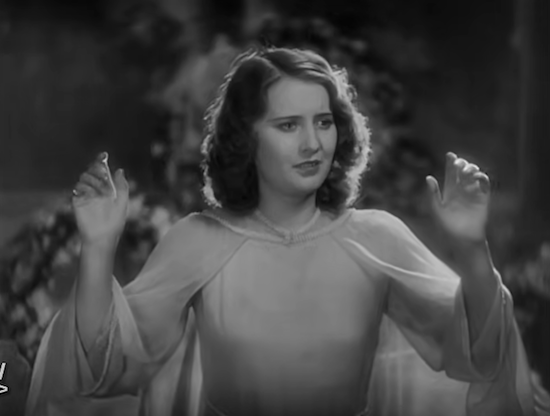
Barbara Stanwyck, The Miracle Woman

The second of Frank Capra and Barbara Stanywck’s five films, The Miracle Woman (1931) captures only a whiff of his future magic and her acting mastery. But it’s enough to make this a compelling watch. It’s fun to compare it to his later work, such as the far more sophisticated Meet John Doe, which would pair the two a decade later.

It’s a strange film. Stanwyck plays a version of Aimee Semple McPherson, the pioneering Pentecostal evangelist who “staged revivals that drew larger crowds than P. T. Barnum, Harry Houdini, or Teddy Roosevelt” according to The American Experience. Like McPherson, the character becomes a star, with a savvy for entertainment and media, from music to radio. While McPherson was controversial, Stanwyck is a flat out con artist (we think). Only through a love affair with an honest man does she regret her choice and repent.

The film has an amusing backstory. Robert Riskin, co-playwright of Bless You, Sister, on which it was based, warned the studio not to make a film of his story. It would flop, like the play he’d created with John Meehan, he told them, and he had no intention of adapting it. Jo Swerling did instead. This unusually honest prophecy proved true, as Joseph McBride points out in Frank Capra: The Catastrophe of Success. (Note: Riskin and Capra would work productively on many films together, including with Stanwyck.)

Capra’s skill with capturing personal breakdowns (It’s a Wonderful Life, Mr. Smith Goes to Washington) is evident in the first and best scene in the film. Florence Fallon (Stanwyck) shares her father’s last sermon with his congregation. She explains he’s too unwell to deliver it: he’s been crushed by their decision to fire him for a newer, shinier model.

When she ends his sermon midway through, she explains he died while writing it. She then tears the congregation apart for their cruelty in firing him, hypocrisy and un-Christian behavior. As it’s a pre-code, she doesn’t mince words.
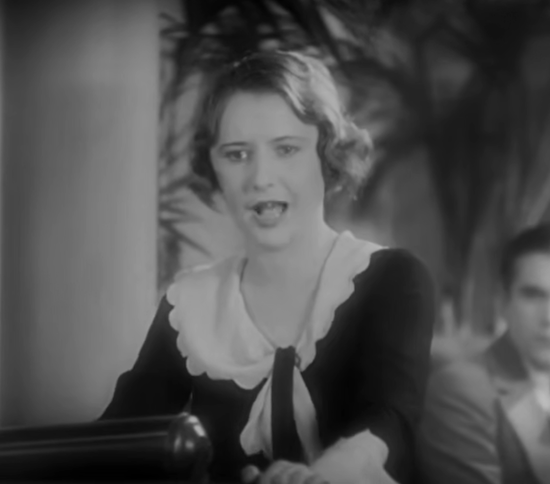
Church scene, Barbara Stanwyck, The Miracle Woman


The audience flees en masse, probably to avoid being named personally when she gets into their affairs and drinking. It’s a sight to behold. Stanwyck delivers it. It’s a gem of a scene. We can see why Bob Hornsby (Sam Hardy), a conman passing through town, thinks she’d be an ideal fake faith healer. She can preach. He can promote her. Both will get rich and play jerks like those in her congregation for suckers.

Now a good mega-church scene needs some glam. Capra didn’t have a big budget for the film. One way he accomplished style without large funds is in the costuming. For big revival scenes, Stanwyck wears simple white. Her outfit comes across as historically accurate, given some of McPherson’s real-life styles. Her choir wears a simple uniform. They have several rousing scenes to get us in the spirit of the event and to capture its scale.
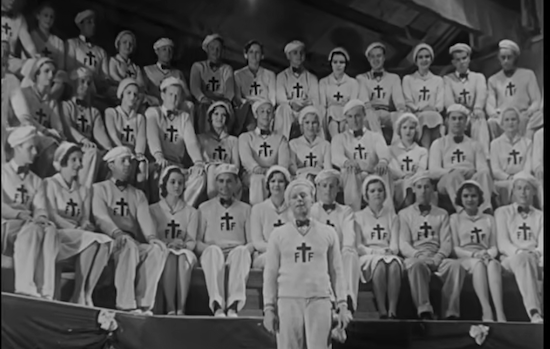
Choir, The Miracle Woman


According to TCM, Capra used real lions in a scene where Fallon, now Sister Fallon, preaches about Daniel in the lion’s den. Netting only separated her from the animals. Stanwyck apparently was terrified. She comes across as fearless. In Frank Capra, Sam Wasson explains how Capra earned so much trust. According to Wasson, during Ladies of Leisure, their first film, he would ask her questions about her character rather than telling her what to do. He allowed her to de-glam a bit personally, be more herself. And, of course, he fell in love with her. By their second film, the two were working together beautifully.
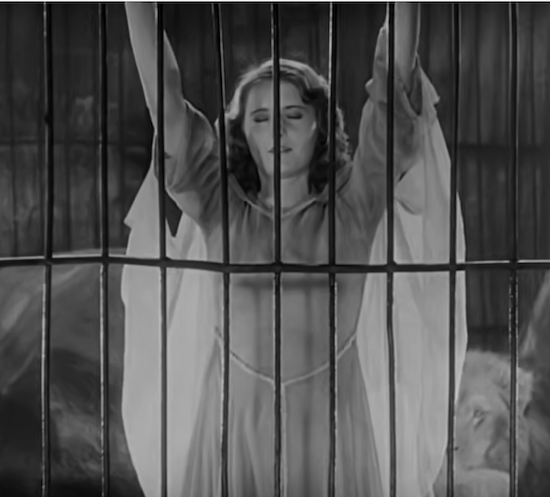
Daniel and the lion scene, The Miracle Woman, Barbara Stanwyck.


Later in the movie, Capra uses actual fire in a dramatic scene. Of course, Capra was no Busby Berkeley. His skill was in characterization, not in fancy scenes. But these shots still manage to be very convincing, in part because in some respects they were very real. And Stanwyck; with that low voice, compelling delivery of strong emotions and simple magnetism; can sell a message.

Admittedly, the faith healing scenes are a bit of a let-down after the first few minutes. I do love the humorous moments we catch the people hired to be pretend-healed nodding off on the job. But I could use a little of (the boxing film) The Set-Up’s style of audience reaction shots. More close-ups of individuals moved by her words would help us buy her influence and betrayal of this congregation. There isn’t enough movement of the camera overall.

Besides the costuming, you can see other ways Capra kept scenes simple, likely to save money. There’s a close focus on the primary actors in several scenes, with little background (note the simple beach scene, for example). Hornsby’s party is just in his rooms, making the settings inexpensive. Likewise, Fallon’s love interest, John Carson (David Manners), and she are always hanging out at his home.

Where Capra does go big (the lions, the fire, all the white), it works. The film can be mesmerizing. I also love where he, with the humor we’d see used to greater effect later in his career, mocks the whole faith healer bit. The second-best moment in The Miracle Woman is when Hornsby yells as his shills for being awful at their jobs.

Oddly for a director so skilled with actors and character development, it’s with the romance that this film falls apart. Carson, a blind man, is moved by Fallon’s sermon on the radio. He decides not to commit suicide, as he was intending. Instead, he goes to see her preach and falls in love. As he first arrives, he is laughing at the pageantry of it all. But that is his single moment of cynicism. After that, this man is so corny. In later films, like Meet John Doe, Capra has the wisdom to either make the hero more sophisticated than he initially seems (Mr. Smith Goes to Washington, Mr. Deeds Goes to Town) or make the doltish character a sidekick. Alas, in The Miracle Woman, our hero has survived a war yet somehow remains as innocent as an eight-year-old. Case in point:
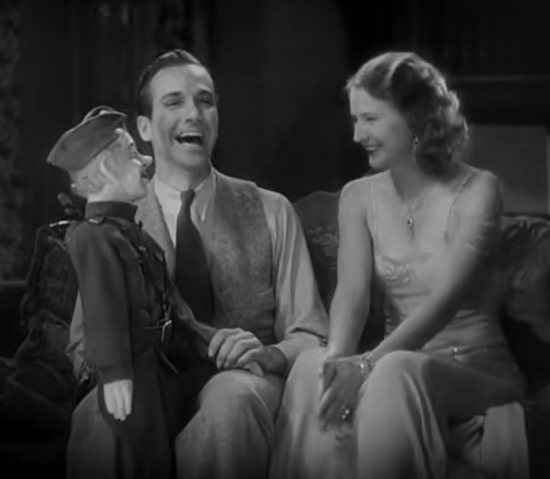
This wasn’t sexy in the 1930s either.

Yes, he tries to charm Fallon with ventriloquy in an excruciating scene. Stanwyck, bless her heart, sells this hobby as delightful. TCM gives her credit for performing in front of scary lions. I give this Brooklyn girl credit for managing not to roll her eyes. In real life, 99% of us would have faked an emergency phone call or hightailed it out of there. I’m sorry, but in my decades on this earth, I’ve never met a woman who could fall for a man using a Chucky to communicate.

Given that Fallon’s father was a preacher, she may have liked simple, homespun joys. Still, someone as cynical as Fallon can’t possibly think this is seductive. True, Hornsby’s always deeply intoxicated friends don’t seem like much fun either (not to a sober person certainly).

Fallon’s inconsistent characterization is part of the problem with this romance. To what extent is she in on the con? Does she know what kind of fraud Hornsby’s committing with the money collections? Capra admits he never really decided. In Ella Smith’s tribute biography, Starring Miss Barbara Stanwyck, he is quoted confessing he blew it by blaming so much of her behavior on Hornsby. Capra’s film still lost a lot of potential money thanks to being banned in Britain for irreverence, according to Smith, so why not go for it? Maybe he worried about Riskin’s prediction. Unfortunately, having a character whose guilt and knowledge about what’s going on are both fuzzy makes her ending “redemption” mysterious rather than noble. Likewise, we have to believe her awfully innocent to enjoy such childish amusements with her boyfriend, yet her interactions with the conman suggest she is wised up and in on everything. Only when his sexual harassment escalates and she learns about the murder does she seem shocked.

Despite these issues, it is fun to see Capra playing with tropes he would repeat in his greatest works: There is a true evil character. There is a redeemable person acting in an immoral way. There is a battle between sincerity, goodness, and/or integrity and duplicity, greed, and/or power-hunger. One character (at least) works to replace deeply held cynicism with hope — one of Capra’s major themes. And of course, there’s some late-stage heroism, Capra style.

Stanwyck’s character is twice as sophisticated in Meet John Doe, yet she makes the same mistakes as the woman she played a decade earlier in The Miracle Woman: going along with a con man’s game. Yet again, we have a suicidal love interest, but this time, his depression lasts more than two minutes, and Gary Cooper sells the man’s sadness and more complex characterization.

In other words, Capra’s added much more realism to his characterizations over time. That’s why we feel more invested than we ever can feel for the hero or heroine in The Miracle Woman.

I would have enjoyed a more credible Fallon, like Sugarpuss O’Shea in Ball of Fire (1941), embarrassed for loving a cheesy guy. Or Saunders (Jean Arthur), the smart woman who has to overcome her sarcastic tendencies to fall for someone as straightforward as the hero of Mr. Smith Goes to Washington. I also wish Capra had given Carson more dimension by following through on his initial joking, having him laugh a bit at Fallon for her circus-like performance. Or make her feel guilty for taking the money of the gullible.

But all critiques aside, it’s still fun to see Stanwyck in this bold early part.

I look at this film as Capra’s rough draft, a chance to play with these themes, figure out how to get them the right the next time. And realize that though he can pull off some big crowd scenes, as he does here and in Mr. Smith Goes to Washington, his real skill would always be with small, intimate moments.

He just needed to leave out the puppet.

This is part of the The CMBA Fall Blogathon: Cinema Couture | The Art of Illusion. Check out the other entries!

Share
Posted in: 1930s films, 1940s films, Drama (film), Feminism Tagged: Aimee Semple McPherson, Barbara Stanwyck, Frank Capra, It's a Wonderful Life, Meet John Doe, Mr. Deeds Goes to Washington, Mr. Smith Goes to Washington, religion and film, The Miracle Woman

1946’s The Razor’s Edge: The Good, the Bad, and the Ugly

04/13/2016 by leah@carygrantwonteatyou.com 13 Comments

RazorsEdge
This is my contribution to the Classic Movie Blog Association‘s Words! Words! Words! blogathon. Some of the entries have been collected into an eBook, which is free on Smashwords or .99 on Amazon, with all proceeds going to the National Film Preservation Fund. I hope you’ll get the book or go here to read the words of my talented peers.

When I learned that CMBA’s spring blogathon would be devoted to writing and film, I decided to tackle one of my oldest literary phobias (of twenty years duration): watching The Razor’s Edge, an adaptation of one of my favorite novels. W. Somerset Maugham’s cynicism and lack of judgment about human behavior have always won me, and his Larry is a fascinating hero: elusive and religious, known for his evasions, gentle but of strong will, a scholar without pretension.

I’ve always loved how the story is told. The narrator, an unveiled W. Somerset Maugham, simply ties together a series of Larry encounters (both his own and others’), trying to explain why someone he barely knew had such an impact. Many believe Larry was someone the author actually knew, and have speculated on his identity.

Larry is an unusual character.

Larry-RazorsEdge
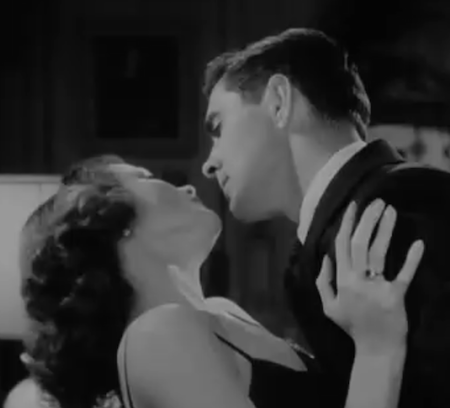
He is disillusioned after his time in WWI, looking for something to believe in, and wanders around Paris, through Europe, and eventually to India to find it, a quest he calls “loafing,” which actually means intense intellectual pursuits. He decides to let go of his love, Isabel, when she won’t join in his journey, and she never gets over him. While he finds what he needs (faith), Isabel pines for him even after her marriage to a millionaire (Gray Maturin). I shuddered at what Hollywood would do with such a religious quest–probably turn it into a romance.

PowerandTierneyromance-RazorsEdge
Alternatively, the movie could focus on Isabel’s uncle, Elliott, and his high society ambitions–a better option, given how delightful that character is, but still not the story I knew.

I wanted to give the screenwriter some slack, since creating a good movie from such a story was a pretty tough aim. Lamar Trotti managed better than I would have thought, and has moments of real mastery. But alas, much of the film tips toward tedium. I’ll start with what works, and lead into the atrocious.

The Good.

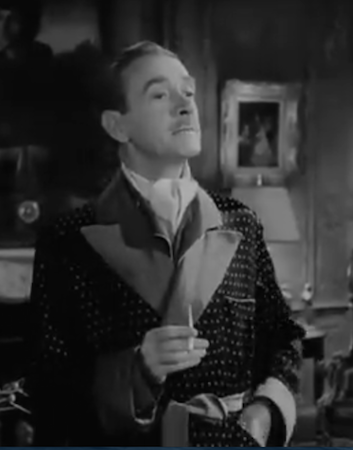
Elliott (Clifton Webb).

CliftonWebb-RazorsEdge
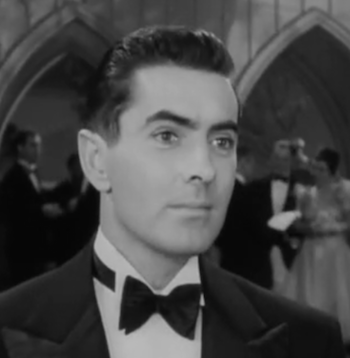
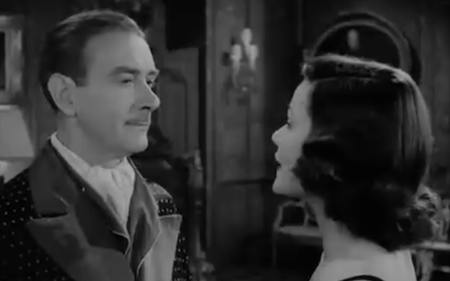
A lot of the credit for the characterization of literature’s most endearing snob goes to the actor. (After all, he excelled at this role in Laura and Titanic.) But much goes to Trotti too: he retains great lines from the novel, which capture the snobbery and yet the sweetness of the man. I like how occasionally Trotti uses him as a stand-in for the narrator, as when Isabel (Gene Tierney) thinks of luring Larry (Tyrone Power) to bed to trap him with a pregnancy, and her uncle rips on her for it.

WebbandTierney-RazorsEdge
This moment was much livelier than the narrator’s conversation with her in the novel. Maugham and Elliott share a sardonic humor and lack of pretense about human behavior; it’s not at all surprising that they’re friends (in Elliott’s case, of course, he is quite blind about his own). This switch works much better than (oh horror!) when the writer exchanges the narrator and Larry later (see “The Ugly.”)

Isabel’s Selfishness. I was afraid the writer would take the cruelty out of Isabel, soften her up to earn sympathy. High marks to Lamar Trotti for letting her be who she is; her self-centered behavior is one of the highlights of the novel and the film.

GeneTierney-RazorsEdge
She comes across as real, like Maugham’s other fascinating heroines: charming and fun, but judgmental, conniving, and occasionally ruthless. As the narrator says of her, “You only lack one thing to make you completely enchanting…tenderness.”

Montages of Larry’s Actions. What a stroke of brilliance to pair Elliott’s guesses about Larry’s likely debauchery and high-class life in Paris with scenes of his real actions (hanging out on a steamer with a bunch of guys rather than the glamorous voyage Elliott would have booked, reading books rather than finding a mistress).

Powermontage-RazorsEdge
The juxtaposition made me laugh aloud. Beautifully done.

The Narrator. While his absence in much of the first half makes little sense, when he appears, Maugham is quite similar to his character in the book, though (thanks to the casting of Herbert Marshall) less animated.

MarshallandTierney-RazorsEdge

The Bad

The Strange Opening about Larry. The writer falters with his introduction. Instead of trusting his scenes to show Larry’s originality and holiness, he preaches it to us by lifting a whole passage from the book. Since we don’t see the many encounters between Larry and the narrator or the narrator and Isabel that appear in the novel, this knowledge of and admiration for Larry are puzzling, as is Maugham’s later intimacy with the Maturin family.

Sophie (Anne Baxter).

Baxter-RazorsEdge
True, the girl had her romantic side, but what happened to the dry cynic we saw in those early scenes in the book? The cool-headed observer of her peers? She was passionate about her husband, yes, but theirs was a kind of exclusive love; they weren’t exactly the social butterflies we get in the film. Nor was she ever a fan of Isabel’s. She was an outsider from the start, which made her tragedy all the more acute. Baxter does a good job (though her Oscar was a stretch), but she’s given a far less interesting character to work with than in the novel; the character’s lack of boldness in the film also took away the dark humor of her reactions to Isabel’s superficiality.

The Absence of Suzanne Rouvier. What this film really needs is some comic relief, and the sensual artist offered a trove of it in the novel. A one-time lover of Larry, she is an unapologetic, sensual woman who made a career of being an artist’s model/mistress. Her frankness about her life is hilarious, and her insights about Larry’s kindness (he only took her in because she was sick and destitute) fascinating. True, the majority of her words and actions wouldn’t make it through the censors. But surely a toned-down version could have been attempted?

The Ugly

When Larry Talks about His Faith. Those ponderous religious speeches!

TyronePower-faithRazorsEdge
So much more could have been accomplished with wit, with expressions, and with Larry’s dodges when asked direct questions (which we see frequently in the book). In fact, his mystery was one of Larry’s biggest appeals, and is utterly absent from this characterization. He also took himself far less seriously than we see here, and only rarely talked about his beliefs.

Instead, the camera freezes on Power’s intense expressions; we hear his words about doubts and faith. The melodramatic music and shots of clouds don’t help, but I doubt those are the fault of the screenwriter. I know some will blame the boredom of these speeches on Power, but honestly, he does seem like the joyful Larry when in motion. Just when he’s still do I roll my eyes and try to avoid drifting off to sleep.

Larry’s Sanctimony. What happened to his “aloof” quality, which is mentioned in the movie? His lack of judgment? His desire not to have a hold on others–or to let them have a hold on him? Now he’s lecturing Isabel about Sophie? What? By taking the narrator’s scenes and putting Larry in his place, the writer has turned Larry into a stuffy character I’ve no interest in knowing. And this is one of my favorite characters in literature.

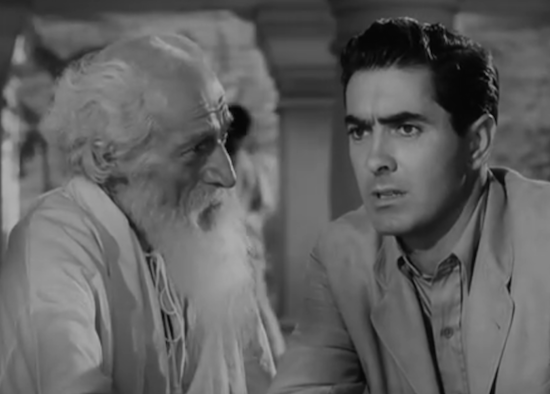
The Holy Man. Until this man said, “We Indians,” I wasn’t sure if this was the Benedictine monk from earlier in the book, or the Hindu who helps Larry find his faith. After all, the latter was described in the book as someone who “didn’t talk very much” and mainly meditated.

PowerandYogi-RazorsEdge
This strange bearded guy is the chattiest of yogis ever seen on film and perhaps the most European looking. He also is guilty of some serious close talking. Come on. I know this wasn’t exactly a racially/ethnically enlightened time in American film, but surely some understanding of the faith being displayed was required? In a film about faith?

I can’t decide if I’m happy I saw the film or not. It certainly didn’t ruin the book for me, and I enjoyed the scenes with Isabel when Larry wasn’t present, and Elliott with everyone. I’m curious what others think who haven’t read the novel. Did you just fast forward through Larry’s religious scenes to get to the juicy ones, as I wished I had?  Now that I’ve gotten over my phobia, maybe I can give Bill Murray’s version a chance; he’s a softer presence than Power, and supposedly really fought for the role. Maybe it’s a bit closer to the novel, and at the very least, it’s more time with Murray….

Share
Posted in: 1940s films, Blogathons, Drama (film), Romance (films) Tagged: Clifton Webb, Gene Tierney, religion and film, screenwriter, The Razor's Edge, Tyrone Power, W. Somerset Maugham

Recent Posts

  • Great Spectacle, Romance Misstep: The Miracle Woman
  • Bite-Sized Film Reviews
  • How You Know Your Friends Know You
  • National Classic Movie Day!
  • Colbert’s Midnight (1939), Rom-Com Magic

Subscribe to Blog via Email

Enter your email address to subscribe to this blog and receive notifications of new posts by email.

Categories

  • 1920s films
  • 1930s films
  • 1940s films
  • 1950s films
  • 1960s films
  • 1970s films
  • 1980s films
  • 1990-current films
  • 2020s films
  • Action & Sports Films
  • Anti-Romance films
  • Blogathons
  • Childfree
  • Comedies (film)
  • Drama (film)
  • Feminism
  • Femme fatales
  • Film Noir/Crime/Thriller & Mystery
  • Gloriously Silly Scenes
  • Horror
  • Humor
  • Mae West Moments
  • Musicals and dancing films
  • Oscars
  • Random
  • Romance (films)
  • Romantic Comedies (film)
  • The Moment I Fell for
  • Turn My Sister into Classic Movie Fan
  • TV & Pop Culture
  • Uncategorized
Share
Classic Movie Blog Hub Member

Recent Comments

  • Dominique Revue on Great Spectacle, Romance Misstep: The Miracle Woman
  • leah@carygrantwonteatyou.com on Great Spectacle, Romance Misstep: The Miracle Woman
  • Dominique Revue on Great Spectacle, Romance Misstep: The Miracle Woman
  • leah@carygrantwonteatyou.com on Great Spectacle, Romance Misstep: The Miracle Woman
  • Waleed on Great Spectacle, Romance Misstep: The Miracle Woman

Archives

  • November 2026
  • June 2026
  • May 2026
  • March 2026
  • November 2025
  • September 2025
  • May 2025
  • March 2025
  • January 2025
  • November 2024
  • August 2024
  • July 2024
  • May 2024
  • March 2024
  • February 2024
  • December 2023
  • November 2023
  • October 2023
  • September 2023
  • August 2023
  • July 2023
  • May 2023
  • April 2023
  • March 2023
  • January 2023
  • December 2022
  • November 2022
  • September 2022
  • July 2022
  • May 2022
  • April 2022
  • March 2022
  • February 2022
  • October 2021
  • September 2021
  • April 2021
  • March 2021
  • February 2021
  • December 2020
  • October 2020
  • September 2020
  • July 2020
  • May 2020
  • April 2020
  • March 2020
  • February 2020
  • December 2019
  • October 2019
  • September 2019
  • June 2019
  • May 2019
  • April 2019
  • February 2019
  • January 2019
  • November 2018
  • September 2018
  • July 2018
  • June 2018
  • May 2018
  • April 2018
  • March 2018
  • February 2018
  • January 2018
  • November 2017
  • September 2017
  • August 2017
  • July 2017
  • June 2017
  • May 2017
  • April 2017
  • March 2017
  • February 2017
  • January 2017
  • December 2016
  • November 2016
  • October 2016
  • August 2016
  • July 2016
  • June 2016
  • May 2016
  • April 2016
  • March 2016
  • February 2016
  • January 2016
  • December 2015
  • November 2015
  • October 2015
  • September 2015
  • August 2015
  • July 2015
  • June 2015
  • May 2015
  • April 2015
  • March 2015
  • February 2015
  • January 2015
  • December 2014
  • November 2014
  • October 2014
  • September 2014
  • August 2014
  • July 2014
  • June 2014
  • May 2014
  • April 2014
  • March 2014
  • February 2014
  • January 2014

Meta

  • Log in
  • Entries feed
  • Comments feed
  • WordPress.org

Copyright © 2026 Cary Grant Won't Eat You.

Church WordPress Theme by themehall.com