Cary Grant Won't Eat You

Classic movies for phobics

  • About
  • eBooks
  • Previous Blogathons
Classic movies for phobics

Sympathetic Liars: The Book of Mormon & Beat the Devil

06/26/2016 by leah@carygrantwonteatyou.com 2 Comments

BeattheDevil-JenniferJones
Kooky. Bizarre. Silly. Odd. Original. It’s difficult to sum up the strange charm of Beat the Devil (1953), that Truman Capote-penned film* that fits no genre and makes no sense. You have the feeling as you watch that Capote must have been tripping, but his quirky personality, not to mention the strange antics that took place on the set–arm wrestling competitions between him and Humphrey Bogart, celebrity drop-ins who dictated costuming, etc.–may do something to explain its odd mishmash of mystery, comedy, and social commentary. I’ve never been a fan of Jennifer Jones, but she won me here as Mrs. Gwendolen Chelm, a seemingly ordinary wife who has the imagination of Capote, and no compunction about confusing her fantasies with reality. She is truly the director of the show. Just ask this question: “What would a film be like if a compulsive, whimsical fantasist got to rule the plot?” Your answer is Beat the Devil.

The film’s heroine reminds me of Arnold from the hilarious musical The Book of Mormon, and his twisting of the Mormon faith to convert Ugandans. (Minor spoiler: If you haven’t seen it, Elder Arnold Cunningham adds Boba Fett and some unfortunate AIDS-curing frogs to his faith’s origin story.) While an everyday liar provides little narrative interest, Chelm’s degree of imagination, as with Wes Anderson’s many heroes, seems to color the world with such an enormous brush that it’s hard not to become enthralled by her, as Bogart’s character is throughout Beat the Devil.

I dare not attempt to explain the plot to you, what little there is of one. It’s better if you simply start watching and see where it takes you. That’s clearly what Capote intended, and as any casual reader of his life knows, hanging out with Capote on a boring, rainy Sunday was probably thrilling. Watch the film. It’s as close to experiencing the mind of that fascinating socializer and entertainer, that creator of world-famous parties and disastrous scandals, as any of us are now likely to get.

*According to Gerald Clarke, Truman’s biographer, John Huston’s screenplay contribution was probably negligible.

Share
Posted in: 1950s films, Comedies (film), Film Noir/Crime/Thriller & Mystery, Humor, TV & Pop Culture Tagged: Arnold Cunningham, Beat the Devil, compulsive liars on film, Film, Jennifer Jones, review, The Book of Mormon, Truman Capote

The Dark Humor of High Noon (1952)

06/12/2016 by leah@carygrantwonteatyou.com 6 Comments

HighNoon
**Contains spoilers**

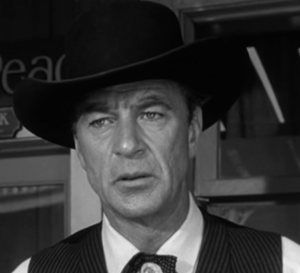
When I watched High Noon many years ago, I was struck by its pacing, its intensity, its seriousness. This time, I kept laughing. There’s something comic about watching Marshal Will Kane (Gary Cooper) aimlessly tread around the town, waiting for someone, anyone to assist him. I found myself curious (having forgotten most of the details) not whether he’d find aid, but just what methods of bailing on responsibility his fellow townspeople would employ.

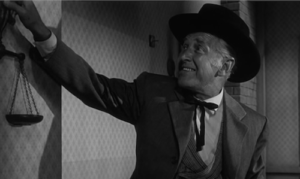
The judge (Otto Kruger) is, of course, is my favorite. Having passed sentence on Frank Miller (Ian MacDonald), a killer who has now been freed and is headed to town for revenge, the judge opts for exiting pronto. He tells Kane, the marshal who caught Miller, to do the same. His advice is a cynical history lesson about how little one can rely on civilian ethics when danger is afoot–an account of Athenians who welcomed a tyrant they’d once banished, and watched as he executed their government; an incident much like one that recently occurred in a nearby town. The judge shares these accounts as he casually packs away his flag and scales of justice.

ScalesofJusticeOttoKruger
His assessment about the value of the people he’s leaving to the mercy of an outlaw is almost as breathtakingly cold as the clock speech in The Third Man: “This is just a dirty little village in the middle of nowhere. Nothing that happens here is really important. Now get out.” The former marshal (Lon Chaney, Jr.), Kane’s mentor, is likewise a ray of light: “People got to talk themselves into law and order..down deep, they don’t care. They just don’t care.” Poor Kane is asking for just a bit of support before he takes on a posse, and these are his cheerleaders.

Of course, it’s hard not to love Kane, even as you wonder whether there’s a better way to overcome Miller than the one he’s devised (i.e., shoot it out).

Cooper-HighNoon
“I’ve got lots to do,” Kane keeps saying as the minutes creep by. But really, he doesn’t. He has to warn Helen Ramirez (former lover to both him and Miller), ask for volunteer deputies, and write a brief will. But this is a small town, easily navigated, and these tasks are quickly accomplished. What he really has to do is busy himself to avoid dwelling on the cowardice of his companions and his own slim chances for survival if he stays in town until noon, when Miller is arriving.

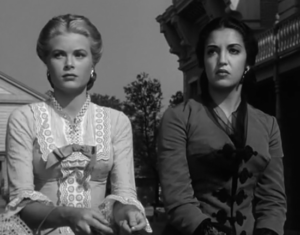
While Ramirez (Katy Jurado) is the most interesting character, it’s clearly Kane’s new bride, Amy (Grace Kelly), who brings on the dark humor.

JuradoandKelly
First, there’s the fact that she’s just had the biggest bummer of a wedding day ever. Then there’s the small detail that she’s a Quaker who has married a marshal. I don’t think I have to tell you that she may not be the wisest of women. Sure, he’s retiring; the new marshal is arriving the next day, and the newlyweds are planning to leave town and to run a store elsewhere before they hear about Miller. But surely five minutes of Kane’s obdurate behavior during courtship would have enlightened Amy that this whole conversion business–of both faith and career–wasn’t going to work so well. (Admittedly, given the pickings we see of the townspeople during the film, she may still have made the best choice of a mate she could.) And of course, it’s quite amusing that a woman who has to overcome her beliefs–not dodge them–is the only helper Kane receives. No wonder Kane throws his star on the ground after besting Miller.

That the film would include such darkness isn’t surprising from a screenwriter (Carl Foreman) who had been blacklisted before High Noon even came out. What he was witnessing of former friends and those he must have once respected couldn’t have led to idealism. Apparently, John Wayne scorned the film as anti-American, and Rio Bravo is a reinterpretation, with more admirable townspeople. While I agree with the movie’s distance from Wayne’s optimism, I think Foreman’s (and the original story’s) cynicism goes much deeper than any individual country, any specific belief system. It’s a simple, sadly humorous morality tale about human nature: while there may be rare moments of heroism (like Kane’s), typically, when the going gets tough, the “tough” scatter.

Share
Posted in: 1950s films, Action & Sports Films, Drama (film), Humor Tagged: best Westerns, dark humor, Gary Cooper, Grace Kelly, High Noon, movie, review

The Klutziest Bonnie & Clyde Ever: Gun Crazy (1950)

06/06/2016 by leah@carygrantwonteatyou.com Leave a Comment

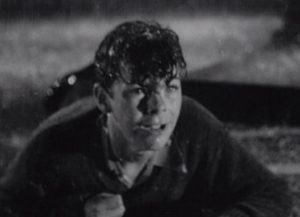
GunCrazy
**Only very minor, preliminary spoilers here**

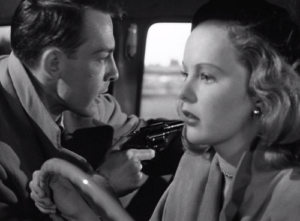
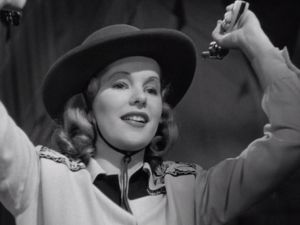
Gun Crazy begins with a boy getting caught for stealing a gun because he trips. The kid, Barton Tare, has a mysterious attraction to guns he can neither explain nor control. Others try to defend him, given that he has no desire to harm and isn’t a good thief. But he’s sent to reform school anyway, and after that and a bout in the army, the young man returns home and falls for a carnival sharpshooter, Annie Laurie Starr (Peggy Cummins). The two are both skilled in their expertise with weaponry and in their seduction of one another (clearly what brings them together), but their limbs just go haywire in all other contexts. When they turn to crime to satisfy Laurie’s lust for excitement and cash, the two can’t stop themselves from tripping, falling, and dropping the payroll.

The chief delight of this famous noir is Laurie’s ruthlessness; she’s one of the most fascinating femme fatales; the whole movie, you’re just waiting to see if her attraction to her now-husband, Bart (John Dall), will trump her self-interest.

LaurieGunCrazy
Bart’s a little screwy (as when he brings a gun to school as a kid and refuses to give it to teacher or superintendent). But there’s an aw-shucks, Jimmy-Stewartist innocence to his love for his wife, making her single-mindedness and easy manipulation of him both sinister and completely believable. When the going gets tough, you know Bart will save Laurie. What you don’t know is whether Laurie will lose a nail to save him.

Their gun skills, of course, make them a dangerous pair when they start to rob. But in peak moments, the pair keep FALLING, making you wonder how many capers they could have actually pulled off. Call me cynical, but I think some grace might help in a getaway. This lack of finesse might dissatisfy viewers looking for slick criminals in action, but being anything but nimble myself, I found their lack of coordination endearing–an unexpected trait that made me worry for their chances, and realize that I’ve seen this trait in cinematic bank robbers too seldom. Far too many action stars have amazing reflexes without Jason Bourne’s training; more of us stumble in real life, as the Darwin Awards and local news so often prove. I know I’m not alone in loving the pratfallers, even in a noir. (Usually, only minor characters make such silly mistakes.)

Of course, there’s a lot more to recommend the movie: its stylishness, the costumes of Cummins (clearly an inspiration for Faye Dunaway’s in Bonnie and Clyde), the many artfully composed shots. But its lack of predictability (thanks to screenwriters, blacklisted Dalton Trumbo and MacKinlay Kantor) is what kept me watching and wondering. I expected some hairy getaways, but not the twists I got. I expected a dastardly female, but couldn’t predict her moves. And I certainly didn’t expect–but loved–all the great moments like this, Bart’s first tripping incident, which led to all the rest:

Bartsfirstfall-GunCrazy

Share
Posted in: 1950s films, Anti-Romance films, Drama (film), Femme fatales, Film Noir/Crime/Thriller & Mystery, Romance (films) Tagged: best femme fatales, Claire Underwood, Dalton Trumbo blacklisted, film noir, films glorifying crime, Gun Crazy, John Dall, Peggy Cummins

Mae West’s Theme Show: Miss Fisher’s Murder Mysteries

05/30/2016 by leah@carygrantwonteatyou.com 2 Comments

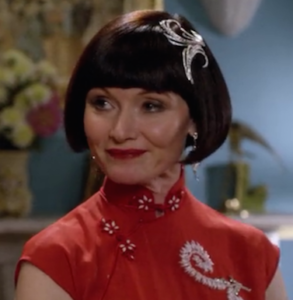
EssieDavisasFisher
Sexually adventurous, unapologetic, averse to marriage, in control, attractive to all men–and in her 40s. Phryne Fisher (Essie Davis) is the kind of character feminists have despaired of seeing onscreen, and yet there she is, captivating her Australian viewers, and now American ones, who have binge watched her on Netflix as quickly as I have. She’s a 1920s heiress who solves crimes, and the rather dainty title of the show–Miss Fisher’s Murder Mysteries–doesn’t capture the boldness of its heroine at all.

Of course, being an appreciator of all things Mae West would love, I claim this would be her current TV show of choice, just as Elle King’s “Ex’s & Oh’s” would be her theme song. Essie Davis has just the right attitude for her role, and while she isn’t Mae West (who is?), the two would clearly get along. Not that the characters the two actresses play are doubles. The slow strut of West’s characters contrasts with Fisher’s quick energy, and while West’s characters clearly take pride in their sexual conquests, Fisher simply relishes them, as if so many lovers are simply a matter of course.

EssieDavisasPhryne Fisher
This is what you do when you’ve survived WWI, Fisher suggests: you have FUN. And yet, like West’s heroines, she never belittles her more demure fellow females; her closest companion (and employee), Dot (Ashleigh Cummings), is a devout, chaste Catholic (in more modern terms, Charlotte York to Fisher’s Samantha Jones).

The show is also praised for its female writers, its attention to historical detail, and, of course, its fashion. I can’t begin to describe those glorious costumes, but others have here and here. Like West’s characters, Fisher likes silk and feathers and furs and jewels, and wears them with panache.

MissFisherfashion2 MissFisherFashion
There are many other reasons to watch the show. The mysteries are fun, but in the end, I don’t care about them any more than I do in The Thin Man or Psych. Just gimme some more of Fisher’s chemistry with the detective (Nathan Page), more of her lascivious looks, more of her joyful dancing, more of her comments on singlehood, more of her liberality toward those mistreated by her time period, and in many cases, still by ours (gay friends, communists, anarchists, pacifists, prostitutes, working women, etc.) Give me more of the clothes. And most of all, give me more of that lust for life that has made me fall for Mae West. Please, please, you wonderful writers and you very busy star, give us a Season 4.

This post is part of my monthly West moment series.

Share
Posted in: 1930s films, 1940s films, Comedies (film), Feminism, Mae West Moments, TV & Pop Culture Tagged: Essie Davis, feminists, Miss Fisher's Murder Mysteries, older women as sex objects, Phryne Fisher, Samantha Jones, TV

Happy Films: You Were Never Lovelier (1942)

05/22/2016 by leah@carygrantwonteatyou.com 12 Comments

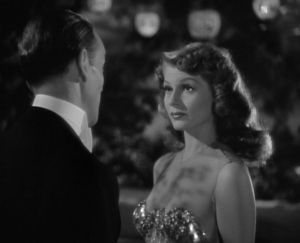
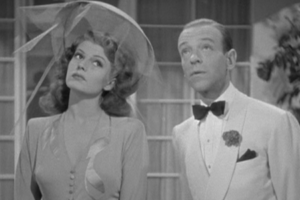
YouWereNeverLovelier
When asked to pick a film that I’d equate with ice cream for a sweet-inspired blogathon, I recalled the Rita Hayworth-Fred Astaire confection, You Were Never Lovelier. The plot is so silly: a sexist father, Eduardo Acuña (Adolphe Menjou), creates an imaginary secret admirer for his daughter, Maria (Rita Hayworth). He thinks he can handpick her suitor and pretend the boy is writing the love notes he himself is penning. But Maria mistakes a dancer, Robert (Fred Astaire), for her admirer, and much confusion ensues. It’s hard to explain why a story like this could win over its audience, especially since Maria is ridiculously susceptible, Robert directionless, and the film’s portrayal of Argentinians fantastical. And yet….What’s the primary feeling while watching? Utter delight. Try to watch it without grinning, rewinding, and pressing play again.

Why, you might ask?

Well, here’s our hero, Robert (Fred Astaire), dancing on a desk to protest Acuña’s refusal to consider him for his nightclub:

https://carygrantwonteatyou.com/wp-content/uploads/2016/05/AstaireYouWereNeverLovelier-sc.mp4

There’s the very funny meet cute between Robert and Maria, an encounter that doesn’t go well thanks to some snarky remarks by the former, who doesn’t know who she is.

MeetCute-YouWereNeverLovelier
And there’s the heavenly dancing. Within one scene Rita Hayworth and Fred Astaire make you forget the implausibility of the story because these are two of the most expressive dancers ever. From their first dance in, you’re entranced by their characters’ romance. How could you not be convinced, after watching them together?

https://carygrantwonteatyou.com/wp-content/uploads/2016/05/RitaandFred.mp4

The sweet, Oscar-nominated score is lovely, and the songs are catchy. “I’m Old-Fashioned” always makes me smile. Listen to Ella Fitzgerald’s version, or even better, watch a much longer clip than I’ve posted here at TCM, with Hayworth lip syncing it (sung by Nan Wynn) to Astaire’s Robert.

And that’s just one scene. I envy all of you who haven’t seen this film. You’re in for a treat.

This post is part of the Classic Movie Ice Cream Social, hosted by Fritzi of Movies Silently: a celebration of those movies and recipes that make us smile.

Share
Posted in: 1940s films, Blogathons, Comedies (film), Musicals and dancing films, Romantic Comedies (film) Tagged: best dancing movies, classic film, feel-good film, Fred Astaire, musicals, Rita Hayworth, You Were Never Lovelier

Gary Cole’s Brilliant Lumbergh

05/15/2016 by leah@carygrantwonteatyou.com 12 Comments

It says something about me–the fact that I have a red Swingline stapler. I was a proselytizer where Office Space (1999) was concerned: My rec of the film was one of the ways I earned credibility with roommates and dates (the stapler itself was a parting gift from a convert). I even held viewing parties of the movie in grad school to remind peers that life could be worse: we could be in cubicles writing TPS reports.

So when asked to pick a favorite bad guy for this year’s villainathon, Gary Cole’s Bill Lumbergh seemed an obvious choice. The only surprise is that I needed someone (in this case, my sister, whose coworker gave her suspenders covered in flair) to remind me.

GaryCole-BillLumbergh
What I find so compelling about Cole’s performance is that he uses his attractiveness to add to the sleazy quality of his character. That sexy bedroom voice; that graceful, lounging pose are hilarious when employed to deliver directives rather than pick-up lines. Note how his arm rests on Peter’s cubicle, his slow, almost sensual movements with the coffee. Cole knows he’s sexy, and just how to use that sensuality to make us laugh.

Of course, Cole has always been a comedic gem, as Veep fans can attest. I fell for him in The Brady Bunch Movie (1995) and A Very Brady Sequel (1996), but others have been following him much longer. Despite the longevity and versatility of his career, he has little name recognition. Yet I would guess most comedy fans out there know the name Bill Lumbergh. Of what could have been a throwaway villainous role, Cole created THE example of corporate villainy–obsessed with minutiae, valuing bottom line above all, utterly impervious to human responses to his actions. When watching him, you have the feeling that the feds could be busting down the office doors in a raid, and Lumbergh would still calmly walk over to his employees’ desks, and ask about memos.

Consider his approach to Peter (Ron Livingston) at the start of the film. Lumbergh (Cole) greets him by asking what’s happening, with so little affect that Cole illustrates in two words how little management cares. His slow drawl of “yeah” is one of the most memorable lines in a quotable movie, largely because it means nothing at all. It’s simply a transition into the corporate speak he’s about to utter. (It is also such a favorite word of his that he even says it before “hi” on answering machine messages.) What I find hysterical about Lumbergh is the distance between the exaggerated words he uses (“special,” “terrific,” “great”) and Cole’s flat delivery. Even in Peter’s nightmares about Lumbergh sleeping with his girlfriend, his arch enemy is still uttering his favorite banalities in a near-monotone (“mmmkay?” is another favorite).

Lumbergh’s facial expressions are as funny as his words. Observe his gaze at the birthday cake prepared for him, as if he can’t wait for this attempt at office civility to end. His thanks, especially how “special” this celebration for him is, demonstrates the degree of his insincerity.

Cole relishes exaggerating just how awful this man is. (I think he particularly enjoyed that line about pesticide to Milton.) But why I find Lumbergh such a compelling villain is just how real he is, how perfectly he embodies the ugly side of American capitalism. Other villains are more theatrical, exciting, but they don’t scare me; they are so clearly fictional. But as we viewers watch Lumbergh, we think, I know this guy. He’s someone we’ve met. He’s someone we’ve worked with (but hopefully not under). He represents, as Peter claims, “all that is soulless and wrong.” And he’s not going away anytime soon.

This post is part of the Great Villain blogathon sponsored by Speakeasy, Shadows and Satin, and Silver Screenings. Go see some brilliant entries here.

Share
Posted in: 1990-current films, Blogathons, Comedies (film), TV & Pop Culture Tagged: Bill Lumbergh, Gary Cole, Office Space

New TV Show on Bette Davis and Joan Crawford!!

05/06/2016 by leah@carygrantwonteatyou.com 2 Comments

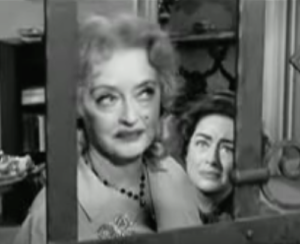
BetteandJoanWhateverHappenedtoBabyJane
FX is bringing classic movie buffs’ favorite sparring partners, Bette and Joan, to the screen. And the leads for the pair? Susan Sarandon and Jessica Lange. How lucky are we? The show, aptly titled Feud, will also feature some amazing costars. The only downside? We have to wait until 2017.

Join me as I watch What Ever Happened to Baby Jane? on repeat to rev up excitement for its debut!

Share
Posted in: Drama (film), Feminism, Humor, TV & Pop Culture Tagged: Bette Davis, Jessica Lange, Joan Crawford, rivalry, Whatever Happened to Baby Jane?

Top 4 Lazy Evening Films on Netflix

05/01/2016 by leah@carygrantwonteatyou.com 2 Comments

So you feel like doing nothing tonight, just want a film to make you smile? Here are four movies now on Netflix that I dare you to watch without grinning.

4. Bowfinger (1999)
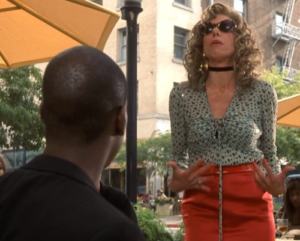
Steve Martin, a conniving producer/con man down on his luck, forces paranoid action megastar Kit Ramsey (Eddie Murphy) into his film by stalking him and shooting his scenes without his knowledge. You in yet? Written by Steve Martin. Now?:)

Favorite moment: Carol (the amazing Christine Baranksi), who doesn’t know Kit is being manipulated, begins her scene with him by ambushing him at a restaurant, ranting about soybeans and aliens.

BaranskiMurphy-Bowfinger
Bowfinger is not a comedy classic, but it’s a pointed satire on Hollywood—so silly and so fun.

3. Charade (1963)

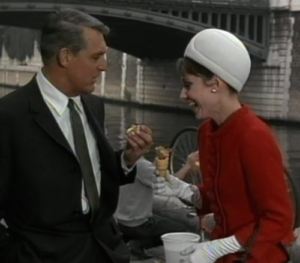
HepburnGrant-Charade
Cary Grant, Audrey Hepburn, and Walter Matthau (1963) star in this lighthearted romance/thriller. Basically, you feel no worry for Regina (Hepburn), despite the danger she’s in, and will give only cursory attention to the mystery itself, despite its fascinating twists and turns. Instead, you’ll just enjoy the cleverness of the script and watching Hepburn and Grant having a blast together.

2. Money Pit (1986)

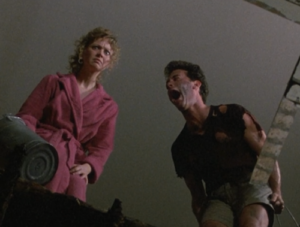
MoneyPit-HanksLong
This updated version of Mr. Blandings Builds His Dream House (1948) is hilarious whether or not you’ve ever been foolish enough to build a house. With Tom Hanks at his broadest, comedic best, and Shelley Long before her ego got too big for her. I know everyone else will claim the original better (Loy, the paint scene!), but Philip Bosco and Maureen Stapleton are so funny in it, and Hanks in hysterics makes me giggle every single time.

1. Begin Again (2013)

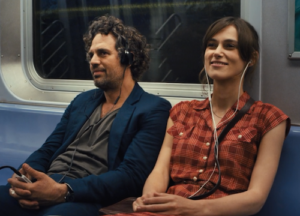
BeginAgain-RuffaloKnightley
Not as brilliant as Once, but writer/director John Carney manages again to craft a story that’s moving and sweet and joyful without ever veering into sentimentality–or even romance. A celebration of music and collaboration as cures for what ails us, with charming performances by Keira Knightley and Mark Ruffalo. Quick warning: If you don’t want the fragile, soulful tunes in your head for the rest of the week, don’t watch.

Share
Posted in: 1960s films, 1990-current films, Comedies (film), Romantic Comedies (film), TV & Pop Culture Tagged: Begin Again, Bowfinger, Charade, Money Pit

Remaking Hitchcock

04/23/2016 by leah@carygrantwonteatyou.com 4 Comments

This week I’ve been lucky enough to convince author Michael Gutierrez into guest posting. Check out his wonderful book, The Trench Angel (which deserves cinematic treatment of its own).

Back in the early 90s, during a time when there were a spate of remakes of classic films, my grandfather posited: “Why don’t they just redo shitty movies?”

He was right, in a sense. Remaking the greats because you think they’ll appeal to a modern audience is usually a lost cause. His Girl Friday will always be better than Switching Channels, even if you add modern stars like Burt Reynolds (the 80s loved a good mustache). But “shitty movies” are often shitty for several fundamental, inalterable reasons, be it bad acting, poor production values, or, most likely, a terrible story idea. These are films that can’t be saved. Take Showgirls: you can blame star Elizabeth Berkley’s humorless performance or director Paul Verhoeven’s lack of visual dexterity, but the film would probably still blow even if you gave the camera to Scorsese and put Meryl Streep in pasties.

Yet, there’s a middle ground: remake mediocre films, movies that just missed being great for one or two specific, easily discernible reasons. It’s been done before, most recently with Ocean’s Eleven. The original Rat pack vehicle was poorly paced and weighed down by a lazy script, bad jokes, and half-in-the-bag performances. Enter George Clooney and Steven Soderbergh and you’ve got a remake that trumps the original.

Case in point is Alfred Hitchcock, a man who made plenty of just-misses. For every Rear Window or North by Northwest, you’ve got a handful of Suspicions. Hitchcock, himself, had no issue with remakes, re-doing The Man Who Knew Too Much twenty years after his original version. While many of his lesser films should be left alone (I’m looking at you Stage Fright), a few of his other movies were nearly great, but suffered under the weight of one or two specific flaws.

Here are three that Hollywood should re-do and I’ll even give them a hand by telling them how to do it.

Foreign Correspondent (1940)
The Story: American reporter Huntley Haverstock (Joel McCrea) is sent to Europe to dig up a story on the continent’s impeding war. While there, he finds himself caught up in a sinister international conspiracy, falls in love with the chief villain’s daughter (Laraine Day), while palling around in the Netherlands with fellow reporter Scott ffolliett (George Sanders).

The Good: There’s a great cat and mouse chase through a field of Dutch windmills and some fantastic Sanders scenes where he binge-eats the scenery.

The Problem: The romance between McCrea and Day has all the sexual charisma of an arranged marriage. In addition, Sanders steals the film. Even Hitchcock seems to realize he cast the wrong star, and pretty much turns over the last third of the film to the charming Englishman. Finally, the end transforms into a piece of pro-war propaganda, trying to convince America to join the fight against the Nazis. It made sense at the time, but now it dates the film.

The Solution: Cast Ryan Gosling and Marion Cotillard. Besides being capable performers, they’re both so pretty to look at. Plus, you could actually shoot the film in Amsterdam. Why aren’t there more films in Amsterdam?

The Lady Vanishes (1938)
The Story: Young European Iris Henderson (Margaret Lockwood) is travelling home via railway to get married. On the trip she befriends Miss Froy (Dame May Whitty), who suddenly disappears in transit, though the train has made no stops. Henderson and fellow passenger Gilbert Redman (Michael Redgrave) investigate, only to find themselves caught up in a sinister international conspiracy.

The Good: It’s a great set-up with some tense scenes, red herrings, and a bouncy tone. Plus, you’re on a train and trains are awesome.

The Problem: Lockwood doesn’t come across as someone willing to challenge a waiter, let alone a cabal of killers. It should have been Myrna Loy or Katharine Hepburn. Redgrave’s fine, but Cary Grant would have been better. There are also some really hokey special effects where the train looks like a child’s model set and Hitchcock spends too much time setting up the story and gives away the villain too quickly.

The Solution: I know they re-did this film with Jodie Foster as Flightplan, and I’ve heard it isn’t bad, but I can’t watch movies set on airplanes without a heavy, accompanying dose of Xanax, so let’s keep it on the train because trains are, as you know, awesome and put in Reese Witherspoon and Ethan Hawke. Give the characters some age and gravitas. Or if they won’t do it, Cotillard and Gosling will do.

The 39 Steps (1935)
The Story: Robert Hannay (Robert Donat) finds himself caught up in a sinister international conspiracy. There’s a lot of running through fake Scottish moors, an evil dude with half a finger missing, and Madeleine Carroll going full Stockholm Syndrome on Donat after he kidnaps her.

The Good: It sounds bad, but it isn’t. Seriously. It’s just not great. Even if the moor scenes were filmed on a sound stage, the running is fun and the scene at the end in the Palladium when Mr. Memory reveals the secrets of the 39 Steps organization is brilliant.

The Problem: How many memorable movies have you seen with Donat or Carroll? There’s a reason. Hitchcock once famously referred to actors as “cattle” and he must have gotten these two off the slaughterhouse floor. At times, you’re rooting for 39 Steps to kill Donat, while Carroll’s quick turn from kidnap victim to doting lover is super uncomfortable.

The Solution: Keep the missing finger, film on real Scottish moors, and bring in Charlize Theron and Tom Hardy. A Mad Max reunion. Unlike Donat, Hardy looks like he could actually land a punch and Theron seems like she’d take a little more convincing to fall in love with her kidnapper than a charming smile. Or, hell, just cast Gosling and Cotillard. That should work.

by Michael Gutierrez

Share
Posted in: 1930s films, 1940s films, 1990-current films, Femme fatales, Film Noir/Crime/Thriller & Mystery, Random Tagged: Alfred Hitchcock, remakes

Surreal Reproduction: When Bette Met Mae (2014)

04/17/2016 by leah@carygrantwonteatyou.com Leave a Comment

WhenBetteMetMaeOn November 13, 1973 Wes Wheadon was the bartender for a party that joined  superstars Mae West (Victoria Mills) and Bette Davis (Karen Teliha) for the first time. He captured their encounter on audio tape, and then reenacted the event with lip-syncing actors, producing it more than 40 years later.

On the one hand, the film is fascinating–capturing the mutual admiration between these two strong female icons, particularly Davis’s for her hilarious predecessor. On the other, the poor quality of the audio gives me a skeezy feeling, like this recorder was hidden in a drawer and the actresses unaware, or the whole thing was faked or improperly edited for effect (not hard with such easily imitated voices). I know that the time period and recorder quality are likely responsible for the seeming sketchiness, but since both women are long dead and the event likely forgotten, it’s hard not to question even as you’re enjoying the interplay between these heroines of the screen.

I was fascinated by Davis’s descriptions of her battles for control and for actors’ rights, as with her recounting of Ronald Reagan’s tenure as SAG president. She suggests he sold out his fellow actors for the sake of his own future political gain.

Such blunt talk from Davis (who is drinking vodka and OJ throughout) is typical of the film. Her lines throughout are funny, and often outrageous:

“My enthusiasm is exhausting.”

“I tried to turn for years (into a lesbian). I thought it’d be so simple.”

(on the idea of marrying another man) “You kidding? End up supporting them?”

And some of West’s lines are equally fabulous, as in response to Davis’s question of whether she’d marry now (at 80):

“Well, I’d wanna see him first.”

But what I like best are West’s descriptions of the making of I’m No Angel, and her reflection that she’d always wanted to be a lion tamer (because of course she did). And her thoughts about her writing, as when she admits it could take her a day to come up with a great line. The studios besides Paramount, she claims, “were kicking against me too” during the Production Code years. She explains one of her methods to preserve her material. Originally, she says, the films would be shot and screened, and then the censors would shout out what they wanted eliminated. Instead, she had censors read and cut lines from her screenplays before they were filmed. She would add material before sharing the script that she knew they’d eliminate (“I start putting in stuff that I myself wouldn’t do”), hopefully preserving more of her actual lines in the process.

And, of course, one of the pleasures of the movie is when both women express their reactions to the male impersonators who’ve loved them so much over the years….

I can’t exactly recommend the film, as Wheadon’s narration is cheesy, and much of the interview is hard to hear, making its accuracy difficult to trust. But it IS a fun, remarkable conversation (true as experienced/not), and if you have Amazon Prime, it’s free.

This post is part of my monthly series on West.

Share
Posted in: 1990-current films, Feminism, Humor, Mae West Moments, Random Tagged: Bette Davis, Mae West, review, When Bette Met Mae (2014)
« Previous 1 2 3 4 5 … 10 11 12 13 14 15 16 17 18 … 24 25 26 27 28 Next »

Recent Posts

  • National Classic Movie Day!
  • Colbert’s Midnight (1939), Rom-Com Magic
  • Say Anything Is The Sure Thing’s Lame Younger Brother
  • Wallace Got an Oscar
  • Oscar Noms 2025: Gems & Duds

Subscribe to Blog via Email

Enter your email address to subscribe to this blog and receive notifications of new posts by email.

Categories

  • 1920s films
  • 1930s films
  • 1940s films
  • 1950s films
  • 1960s films
  • 1970s films
  • 1980s films
  • 1990-current films
  • 2020s films
  • Action & Sports Films
  • Anti-Romance films
  • Blogathons
  • Childfree
  • Comedies (film)
  • Drama (film)
  • Feminism
  • Femme fatales
  • Film Noir/Crime/Thriller & Mystery
  • Gloriously Silly Scenes
  • Horror
  • Humor
  • Mae West Moments
  • Musicals and dancing films
  • Oscars
  • Random
  • Romance (films)
  • Romantic Comedies (film)
  • The Moment I Fell for
  • Turn My Sister into Classic Movie Fan
  • TV & Pop Culture
  • Uncategorized
Share
Classic Movie Blog Hub Member

Recent Comments

  • leah@carygrantwonteatyou.com on National Classic Movie Day!
  • Classic Film And TV Corner on National Classic Movie Day!
  • leah@carygrantwonteatyou.com on Colbert’s Midnight (1939), Rom-Com Magic
  • Toni Ruberto on Colbert’s Midnight (1939), Rom-Com Magic
  • leah@carygrantwonteatyou.com on Colbert’s Midnight (1939), Rom-Com Magic

Archives

  • May 2026
  • March 2026
  • November 2025
  • September 2025
  • May 2025
  • March 2025
  • January 2025
  • November 2024
  • August 2024
  • July 2024
  • May 2024
  • March 2024
  • February 2024
  • December 2023
  • November 2023
  • October 2023
  • September 2023
  • August 2023
  • July 2023
  • May 2023
  • April 2023
  • March 2023
  • January 2023
  • December 2022
  • November 2022
  • September 2022
  • July 2022
  • May 2022
  • April 2022
  • March 2022
  • February 2022
  • October 2021
  • September 2021
  • April 2021
  • March 2021
  • February 2021
  • December 2020
  • October 2020
  • September 2020
  • July 2020
  • May 2020
  • April 2020
  • March 2020
  • February 2020
  • December 2019
  • October 2019
  • September 2019
  • June 2019
  • May 2019
  • April 2019
  • February 2019
  • January 2019
  • November 2018
  • September 2018
  • July 2018
  • June 2018
  • May 2018
  • April 2018
  • March 2018
  • February 2018
  • January 2018
  • November 2017
  • September 2017
  • August 2017
  • July 2017
  • June 2017
  • May 2017
  • April 2017
  • March 2017
  • February 2017
  • January 2017
  • December 2016
  • November 2016
  • October 2016
  • August 2016
  • July 2016
  • June 2016
  • May 2016
  • April 2016
  • March 2016
  • February 2016
  • January 2016
  • December 2015
  • November 2015
  • October 2015
  • September 2015
  • August 2015
  • July 2015
  • June 2015
  • May 2015
  • April 2015
  • March 2015
  • February 2015
  • January 2015
  • December 2014
  • November 2014
  • October 2014
  • September 2014
  • August 2014
  • July 2014
  • June 2014
  • May 2014
  • April 2014
  • March 2014
  • February 2014
  • January 2014

Meta

  • Log in
  • Entries feed
  • Comments feed
  • WordPress.org

Copyright © 2026 Cary Grant Won't Eat You.

Church WordPress Theme by themehall.com