Cary Grant Won't Eat You

Classic movies for phobics

  • About
  • eBooks
  • Previous Blogathons
Classic movies for phobics

The Depression Satire, Gold Diggers of 1933

01/11/2015 by leah@carygrantwonteatyou.com 6 Comments

GoldDiggersof1933
What does the term gold digger really mean, in the context of the Depression? Today we think of Kanye’s gold digger; buying gold and liposuction, maybe holding a lap dog and wearing furs; not a showgirl escaping destitution. For a musical, Gold Diggers of 1933 is surprisingly earnest, managing to both entertain and make us empathize with the plight of its subjects—and by extension, its audience. As a producer in the movie assures his performers, “I’ll make ’em laugh at you starving to death….”

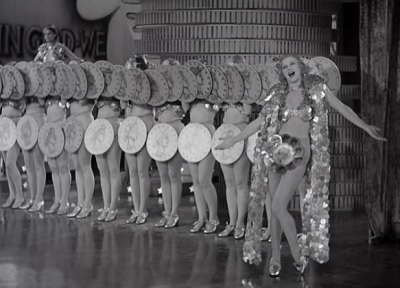
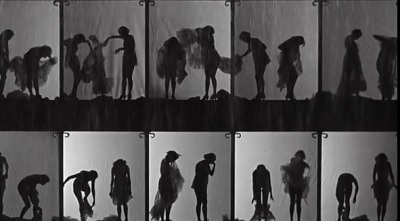
The film begins with showgirls performing in gold-coin bedecked, barely-there costumes. They’re singing the famous, “We’re in the Money,” led by Fay (Ginger Rogers).

WereintheMoney
We suspect there’s irony at play; after all, Fay sings a verse of it in Pig Latin.

Rogers's language play

Rogers’s language play

And of course, we’re right to be skeptical about those claims: before the song ends, the creditors bust in, close the show, and guarantee not a soul singing will be anything but broke.

Clearly, this isn’t the slight film the title, or its greatly inferior sequel, might lead a modern viewer to expect. I was just reading about Girls, wondering if I could handle another season of Lena Dunham’s show about over-privileged, under-motivated friends in the city. I kept thinking of that show when the camera panned from the closed show to a small posting illustrating these singers’ (dissimilar) lack of options:

TheaterSign-GoldDiggers
The camera then turned to a letter beneath the flat door of three of the performers, a rent demand from their landlady.

All three are sharing a bed. They wake up late, with nowhere to go. “Come on, let’s get up and look for work. I hate starving in bed,” gripes Polly (Ruby Keeler).

“Name me a better place to starve,” replies Trixie (Aline MacMahon). The famished roommates steal milk from the neighbors. Trixie reassures the others it’s okay because the milk company “stole it from a cow.”

I know that there’s a place for anyone’s woes; that life (and the films and shows depicting it) is not a comparison game. But the scene reminded me of why Girls so often, despite its cleverness, has left me flat. I’m just not very engaged by women without ambition or integrity. But women who can manage wit when they’re living on bread and snatched milk? Yes, please. Give me more.

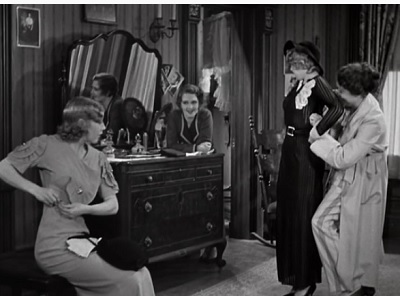
When Fay arrives to announce a new show, the women band together to give one of them—Carol (Joan Blondell)—a complete outfit to impress the producer. They’ve hocked too many stockings and dresses to do anything else.

DressingCarol-GoldDiggers
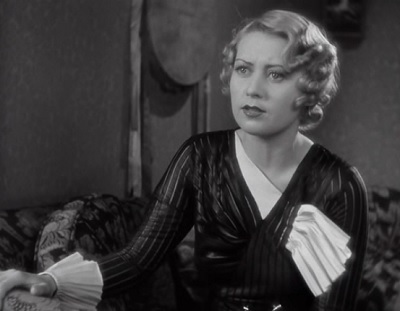
A tearful Carol calls to tell them it’s true that there’s work and that the producer, Barney (Ned Sparks), is on his way; however, he soon confesses he has no funds to start the musical. As eloquent as Carol’s response is to his trickery, her expression is even more so:

JoanBlondell-GoldDiggers
Luckily, the women’s singer-and-composer neighbor, Brad (Dick Powell) is available. He impresses Barney with his music, especially the tune which best fits the producer’s Depression theme. More importantly, Brad offers the money to put on the show.

(Just an early spoiler) Brad is secretly a member of a wealthy family, and his proud brother, Lawrence, is not pleased to see his sibling in a musical, and even less pleased the boy is in love with Polly (Keeler). Lawrence’s (Warren William’s) banker, Faneuil H. Peabody (Guy Kibbee), convinces his client all showgirls are gold diggers, and Lawrence therefore rushes to quash the romance.

The two men go to the girls’ apartment to pay off Polly, but mistake Carol for her. Enraged by their condescension, Trixie and Carol decide to pretend Carol is Polly and take the two haughty men for all they’re worth to teach them better manners (and teach us that the title of this film is as ironic as its opening song).

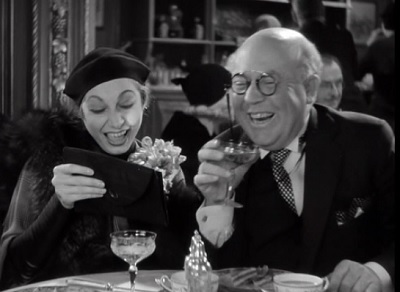
MacMahon as Trixie can occasionally grate, but Guy Kibbee is wonderful as the elderly, lascivious lawyer, the man whom Trixie feels is “the kind of man I’ve been looking for. Lots of money and no resistance.”

BankerandTrixie-Aline MacMahon
Trixie plans to marry the banker in spite of her lack of attraction for him (“You’re as light as a heifer,” she says when she dances with him). She just needs to fend off Kay (Rogers), who wants a meal ticket too.

Carol has no such plans. She’s just angry. The film wants us to understand that Kay and Trixie are just desperate—but understandable—exceptions to the rule. Most of the showgirls, far from being the “parasites” Lawrence assumes, are as ethical and proud as Carol and Polly are. Slowly, though, Carol, in spite of herself, begins to fall for the handsome snob.

The women’s antics are entertaining, especially when they fool the men into buying them pricey hats. But the men’s conviction they’re hanging out with these lovelies just to do Brad good is even funnier. Since this is a pre-Code film, there’s no dearth of skimpy clothing and sexual references. Lawrence soon passes out drunk after confessing love for Carol, and she and Trixie move him to their bed, knowing he’ll assume he’s had sex with faux-Polly and will be too compromised to object to Brad marrying the real one.

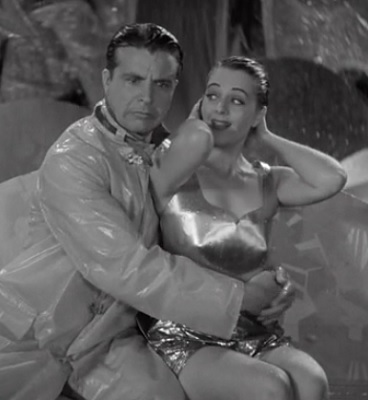
Sexual innuendo is evident throughout the musical numbers in the show, especially since this is a Busby Berkeley film. One of my favorite acts is about couples “Pettin’ in the Park.” When it rains, the women retreat to change, returning to their men in metal dresses.

Berkeleynumber-parkdressing
The men are frustrated and outraged they can’t access their partners’ bodies.

PowellandKeeler-PettinginthePark
Luckily for them, a peeping toddler (yes, you read that right) gives the star (Powell) a tool to break through his love’s (Keeler’s) metal, which he’ll presumably pass to the others.

But Berkeley doesn’t keep with this light tone for all of his numbers. The film ends with the Depression tune that Barney promised, with Carol singing, “Remember My Forgotten Man.”

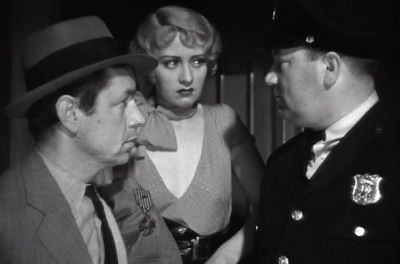
Alone on a street in seductive attire, she first talks, then sings, “Remember my forgotten man?/You put a rifle in his hand./You sent him far away./ You shouted, ‘Hip hooray,’ but look at him today.”

Showing the cop the homeless man a veteran

Carol defending a forgotten man

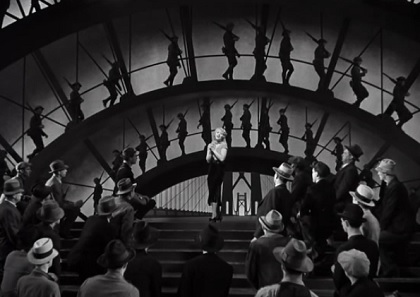
The song moves from one woman, to another, then builds into an anthem of men and women attacking the government for not doing more to help the veterans and farmers who’ve worked hard for their country, only to end homeless in breadlines, unable to support the women who love them.

ForgottenMan-GoldDiggers1933
Their women are left not only witnessing their men’s suffering, but with children to support as well as themselves–alone. Carol’s provocative attire and presence on the street are no accident, of course. There is one type of work she can get without her man.

The song is heartbreaking. How rare to find a movie, a musical, that captures the national plight like this, especially after such light fare. But of course, the song is also a reminder that there was nothing truly light about the whole film. Is Trixie a greedy gold digger for wanting a rich husband rather than starving as she waits for a show not to be canceled? The oldest and least attractive of the bunch, she knows she must beat Fay to the lawyer’s libido, or she’s probably headed for the streets. The relatively happy unions of these women don’t blind the audience to the fact that there are a lot of girls in that show, a lot of women without secretly-rich neighbor-lovers, without pliable elderly bankers, but with landlady’s notes waiting for them under the door.

Share
Posted in: 1930s films, Comedies (film), Romantic Comedies (film), TV & Pop Culture, Uncategorized Tagged: Busby Berkeley musical, Depression, Dick Powell, Ginger Rogers, Girls, Gold Diggers of 1933, Joan Blondell, Lena Dunham

A Showcase for Garfield, Neal, and Hernandez: The Breaking Point (1950)

01/07/2015 by leah@carygrantwonteatyou.com Leave a Comment

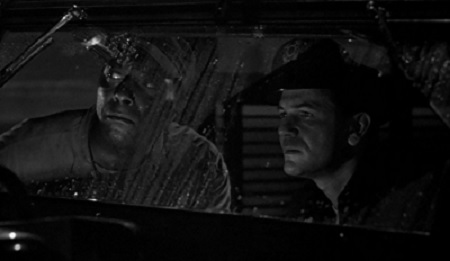
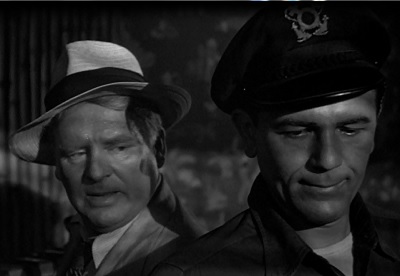
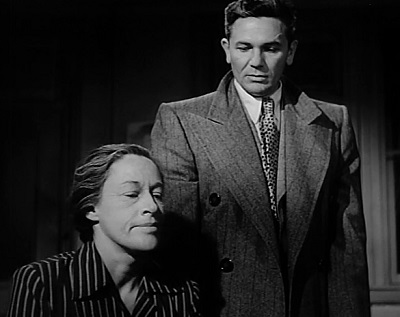
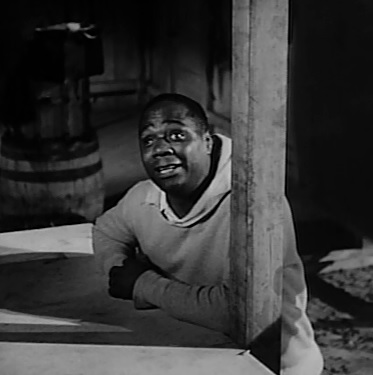
Juano HernandezJohnGarfield
The Breaking Point
is tense from its first scene, with fishing boat captain Harry (John Garfield) arriving on dock to find that his credit is no longer good enough for the gas he needs for his next trip. Money troubles mean he can’t feed his wife and kids, can’t pay his partner, Wesley (Juano Hernandez), can’t keep his boat, and likely can’t avoid a humble future of working for his father-in-law.

Unfortunately, that’s the peak of Harry’s fortune. After a couple sails to Mexico with him, the man skips out on his romantic partner and the fare. The woman he’s left behind, Leona (Patricia Neal), asks Harry for a ride home, causing the captain to snap, “Who’s going back? I need 100 bucks to clear the port and I got 80 cents toward it. If I can’t scrabble up some dough, we all better learn Spanish.”

Harry agrees to smuggle Chinese men into America with the help of fixer Duncan, a slimy attorney (Wallace Ford) whose mantra is “Relax, let it happen.” Harry tries to steer Leona and Wesley ashore and away from his criminal acts, but the former is too flippant and the latter too loyal to listen. As might be expected, Harry’s moral compass and prospects unhinge from then on out.

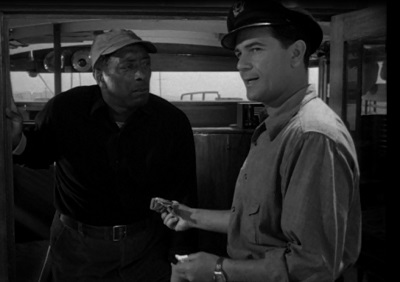
According to the Self-Styled Siren, Hernandez’s role was greater than it would have been thanks to Garfield’s intercession. Once you watch the film, you know how right Garfield was.

TheBreakingPoint-HernandezGarfield
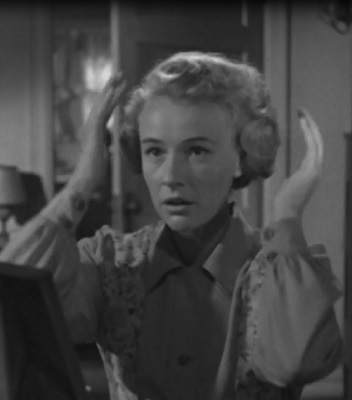
The heart of the film is in the relationship between these two men struggling to make it. Honestly, I cared little for Harry’s every-wife, the long-suffering Lucy (Phyllis Thaxter). She’s sympathetic in theory, yes, but she’s so devoid of individuality I felt no connection to her, except in a brief moment she dyes her hair to look as sexy as Leona, paining her guilty husband and embarrassing her kids.

Thaxter-TheBreakingPoint
One of the issues with the film is the disconnect between the director’s choices and the caliber of the acting. Much time is spent showing that Harry is hovering closer and closer to the title’s breaking point. But with a man as expressive as Garfield, why spend so long establishing it? Why not instead put more energy into the exciting smuggling scene, into his intriguing relationship with temptress Leona (Patricia Neal), and into developing the chemistry between these partners? It’s amazing that even with so few scenes, the pathos of Wesley’s situation comes through so much more clearly and vividly than that of Harry’s whole family, who get so much more screen time. I suspect that’s because Hernandez’s acting is just that good, and because the family really only serve to explain Harry’s stress and motivation.

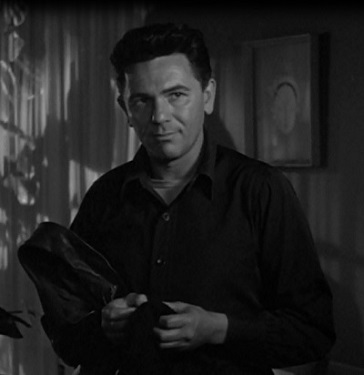
Of course, the film thankfully gives a lot of screen time to Garfield, who plays the stubborn, ex-war hero to perfection, and makes us root for him even as we see him putting his pride over ethics and loyalty to others.

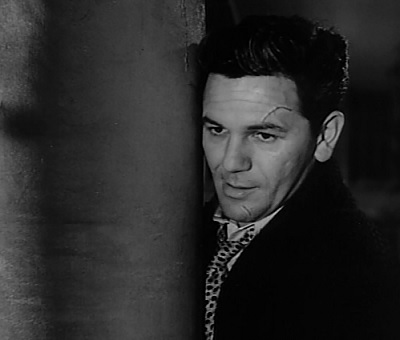
JohnGarfield
As always, Garfield’s understated style is fascinating to watch, as in a moody scene between him and the lawyer who has helped him ruin his life. Duncan has realized he’s too embroiled in the crimes of the gangsters Harry’s about to provide transport for to play the distant—but safe—role he’s accustomed to in his sketchy dealings.

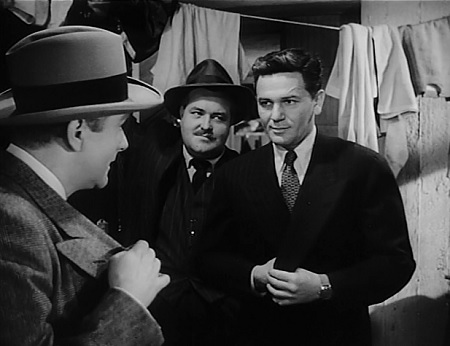
WallaceFordandGarfield
“We’re in it. Let’s hope we get out of it,” Harry replies to Duncan’s worries, and then, recalling the number of times the glib lawyer has told him to take it easy, he snarls, “Roll with it. Relax, let it happen.”

Although lured by Leona’s attractions, Harry doesn’t hesitate to turn his temper on her either, especially when she mocks his earlier admission, when he fell into the usual routine of “I-love-my-wife-but….”

“You women,” he returns. “You remember everything a guy says and then you hit him with it.”

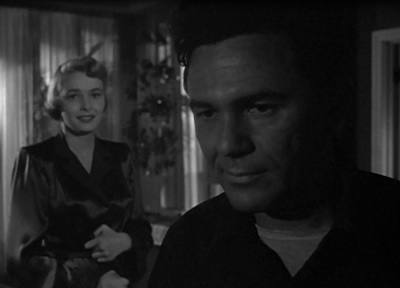
PatriciaNealJohnGarfield
Leona’s (Patricia Neal’s) party-girl attitude and unfailing good mood make her fun to watch in spite of her clichéd role as a siren. Neal’s superior performance and cool presence make the audience feel torn: we want Harry to stay with his beloved wife, but we find Leona as alluring as Harry does. She is so real and alive, and so attracted to the guts, recklessness, and sex appeal that are becoming Harry’s most noticeable traits. In a surprisingly modern take on love, she explains how she looks at her casual romances: “You don’t let it mean anything, it won’t mean anything.” But we don’t ever see the degree of temptation we could have between the two, even if he never did succumb.

This film ultimately seems like it’s about a man’s battle with his own courage, to the exclusion of others’ worries, as Harry admits shortly before the climactic sail, “All I got left to peddle is guts. I’m not sure I got any. I have to find out.”

The Breaking Point, with a shift of emphasis, could have explored the full tragedy of these three flawed characters. But in spite of these defects, it’s impossible not to be caught up in our anxiety for them all, and the film has one of those ending shots so full of understated tragedy I couldn’t get it out of my head. The film’s not easy to get access to (I had to use interlibrary loan), but it’s worth the effort.

*I will post again this weekend due to my holiday-driven lapse last week.*

Share
Posted in: 1950s films, Action & Sports Films, Drama (film), Film Noir/Crime/Thriller & Mystery Tagged: John Garfield, Juano Hernandez, noir, Patricia Neal, The Breaking Point, To Have and Have Not adaptations

Turning My Sister into a Classic Movie Fan, Bout 1: Rachel 1, Me 0

12/28/2014 by leah@carygrantwonteatyou.com 8 Comments

GarfieldBodyandSoul
Christmas night I made my sister watch Body and Soul (1947), her first viewing in fulfillment of our bet (if she watches 10 classic films, I will watch Breaking Bad). During the movie, she alternately complained about the music, stared blankly, and dozed off. Afterward, she said, “Well the acting wasn’t good,” and when I asked that she at least subtract my beloved John Garfield from that assessment, said, “He was fine. But it’s not like he’s Robert De Niro. You don’t actually think he’s that good, do you?”

Deflated. It’s a good word, isn’t it? Maybe I should have considered Rachel’s crankiness first: it was late, and she had just lost at Scene It; my sister does not take movie trivia loss well.

You might ask why I care that my sister won’t give classic movies a chance. I have, after all, plenty of others to convince. But Rachel and I otherwise share a movie brain, at least with dramas. I text Rachel right after I leave a theater with my commentary, and will go see almost every film she recommends, which is why she occasionally messes with me, sending me to a movie she knows is lousy so that she can call and say, “Yeah, awful, right? Thought you’d agree.”

I hadn’t viewed Body and Soul first (a risky move), but it came highly recommended, it was a sports movie, it was Garfield, and it was good—not as neatly edited or as intriguing as The Set-Up, but with similar themes and a dark mood she couldn’t dismiss as cheesy. I had hoped it would chisel a bit into her seemingly implacable beliefs about classic film: acting is better now, production quality is better now, any sequel would therefore be better than the originals, so why bother?

The film had no effect on her whatsoever, though she was intrigued by Garfield’s blacklisting. But in the interest of others who haven’t seen it, I’ll share a few things about the film, which my sister should have appreciated:

Good Supporting Characters
The story revolves around Charley’s (John Garfield’s) treatment of friends and family, and how that echoes his own deeper entanglement into the shady underworld of boxing.

CharlieandCrooks-BodyandSoul
He gets into the sport at the urging of his quick-talking friend, Shorty (Joseph Pevney). Disappointed he won’t pursue an education instead, his mother reassures herself he’s at least honest and has good taste in women, preferring a sweet artist, Peg (Lilli Palmer), to a bombshell (Hazel Brooks). Of course, he quickly succumbs to the temptations that have already sunk his one-time-rival, now trainer, Ben (Canada Lee).

I agree with Rachel that most of the women didn’t add much to the film; neither Palmer’s nor Brooks’s acting was notable, but neither subtracted from the film, and Peg’s independent spirit made her character a surprising one. How many boxers do we see—in any generation—courting an aspiring painter? She’s far more interesting than this supporting player in another boxing film Rachel likes better:

TaliaShire-Rocky
And while the other two actresses were solid, but not deserving of any accolades, no one can beat Anne Revere (another blacklist victim) when expressing disappointment in a son.

BlacklistedActors-GarfieldandRevere
Even Rachel praised Shorty (Pevney), the friend who helps broker the deal to get Charley into the business, and then comes to regret it due to Charley’s dealings with the immoral Roberts (Lloyd Gough). Shorty’s lively presence added much-needed humor to the proceedings, and his later absence from the film definitely hurt it.

An Intriguing Sparring Partner
But far more interesting than any of these other relationships is Charley’s with his rival, the champ, Ben (Canada Lee), who has a medical issue Charley isn’t told about before their first bout. Ben later befriends the newcomer, and starts to train Charley instead of fighting himself.

Ben comforting Charlie before a fight

Ben comforting Charlie before a fight

This made me wonder, as I’m not in on the usual trends of the boxing world. Is this, we-fight-to-the-death, now we train together a thing?

StalloneWeathersRocky
Interestingly, Charley seems to be unfazed by Roberts’ treatment of others, but his boss’s continued harshness toward Ben (racism? or just his usual cold-bloodedness?) begins to finally erode his nonchalance about his own complicity in the corruption, especially after Roberts asks him to be in on a fix.

BodyandSoul-GarfieldandCanadaLee
Lee’s part in the film should have been greater, as the movie’s start makes it clear just how important he is to Charley. But even what we get is interesting, and Lee captures both the pathetic nature of an older fighter, and his impressive inner strength; Ben is the representative of the soul that Charley has been abandoning in the pursuit of the perfect body, and foreshadows Charley’s likely future.

The Fights
There should have been more to the fights, which is my usual complaint. (Don’t even get me started on the lack of boxing scenes in the dreadful Million Dollar Baby). But I like how Body and Soul, which can go overboard with sentimental music, suddenly becomes silent in the last bout, enabling viewers to more fully take in the brutality.

BodyandSoulBoxing
As I watched, I kept hearing Rocky’s soundtrack, and realized the music in that later film had in many ways numbed me to the violence, counteracted it in some way by suggesting a possible victory. But here, I could feel the impact on the skin, the muscles, the bones.

In Conclusion….
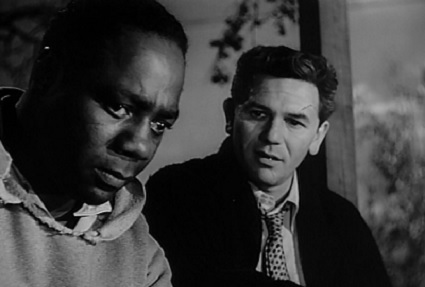
I can hear my sister asking me—which she actually didn’t—do you actually think this is better than Rocky? I didn’t. But I don’t think that’s the point. The film had something else to say, and I liked how it said it, and found Garfield as riveting as I usually do.
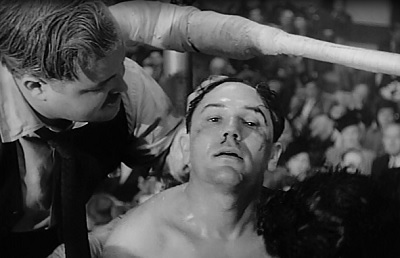
“I can’t decide,” Rachel said at one point, “if he’s good looking.”

“He’s attractive,” I answered, “not really handsome.” Her comment made me smile because you can’t stop asking yourself that when you watch him; you can’t keep your eyes off the guy. So something, at least, sank in.

As for our bet, I fear that at best my sister will regard any of the 10 movies she likes as exceptions to her classic-movies-suck rule, rather than as proof she’s wrong about them. But it’ll make her see some just the same, which is good in itself.

There was one moment of consolation, as I watched my sister’s disappointing response to Body and Soul. I’d shared a Miranda Lambert song with my mom earlier that week, and to my horror, heard her playing Rachel the video, urging her to like it too. My sister is a Beatles fanatic and has performed rock music since the age of five or so. She has ALWAYS despised country. My sister’s outraged response to my mom was as comic as I would have anticipated, and far more animated than her objections to my film choice. I could hear her spitting “twang” and “seriously?” and “that loser Blake Shelton” from the other side of the house.

So at least I’m not trying to convince her into country.

Bout 1: Rachel 1, Me 0, Country Music -1

Share
Posted in: 1940s films, Action & Sports Films, Drama (film), Turn My Sister into Classic Movie Fan Tagged: Anne Revere, blacklisting, Body and Soul, Boxing movies, John Garfield

The Moment I Fell for Eve Arden

12/18/2014 by leah@carygrantwonteatyou.com 4 Comments

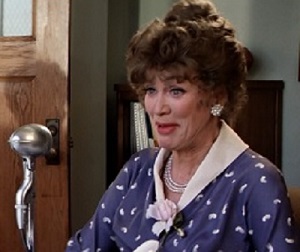
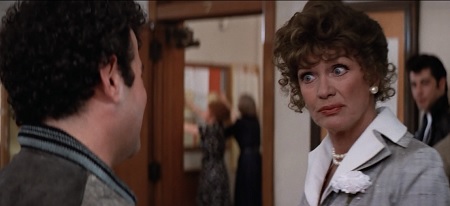
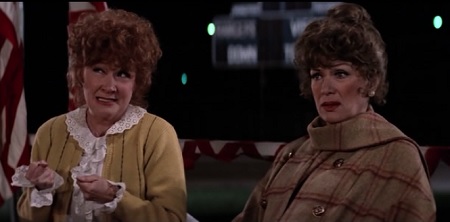
McGee Announcements Grease
In the early eighties, all the girls I knew pined for large hoop earrings, curly hair, and tight pants just like the changed Sandy in Grease. We piped “You’re the One that I Want,” with its requisite “oooh, oooh, ooohs,” imagining we could lure Danny into the sky with us.

Grease
Grease had a staying power thanks to the number of times it was replayed on TV. Although my attention was drawn to all of the figures who rocked leather, one of the administrators made an impression too. Something about those ringing tones of Principal McGee’s (Eve Arden’s) reached me. Her combination of idealism, exasperation, and cynicism echoed adults I knew as she alternately disciplined and inspired Rydell High’s seniors. In a throwaway part, this actress had developed a fully realized character, one for whom I could imagine a history of victories and frustrations with students. She made an impact even on the beauty-enthralled kid that I was.

I didn’t make the connection years later when I listened to Eve Arden’s verbal wizardry in Mildred Pierce (1945). But I looked her up on IMDB, hoping to find her elsewhere, and knew then why Principal McGee had affected me. This was Eve Arden, people, the master of the one liner, the woman who could annihilate a victim with one breath of her scathing tongue. Of course she could match wits with teenagers. Of course they couldn’t fool her and thus convert her into another of the anonymous adults in teen flicks. She was humoring them. She was holding back. She was—dare I say it—so much cooler than they were.

Take the scene when Sonny (Michael Tucci) decides he’s going to stand up to her when he inevitably lands back in her office. “This year she’s gonna wish she’s never seen me,” he tells his buddy. “I just ain’t gonna take any of her crap, that’s all, I don’t take no crap from nobody.”

“Sonny?” she interrupts.

“Hello, ma’am,” he says, all bluster gone.

“Aren’t you supposed to be in homeroom right now?”

“I was just going for a walk.”

“You were just dawdling, weren’t you?”

“Yes, ma’am.”

EveArden-PrincipalMcGee
Even funnier are her remarks and reactions to her incompetent and slightly insane assistant, Blanche (Dody Goodman). Her resignation when Blanche overreacts to the coach’s pre-game enthusiasm is just one example of her understated genius.

BlancheandMcGee
Like any good comedian, Arden knows just how to give words emphasis, just how to raise that eyebrow, just how to make what could have been a passing moment snap. Oh, how I love the woman.

I think I fell for her from the start of Mildred Pierce, but I didn’t realize I had until near the end of the film.

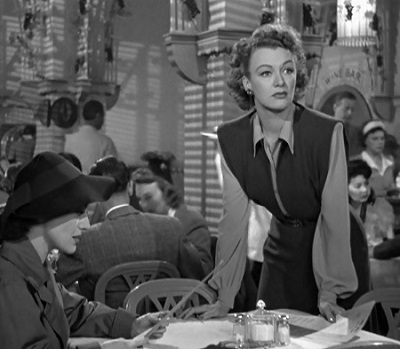
IdaMeetsMildred
She plays Ida, the business manager for the restaurant owner (Joan Crawford) who repeatedly sacrifices all of her money, time, and hope for her spawn-of-Satan daughter, Veda (Ann Blyth).

Ida’s humor is evident from the start, as when she agrees to give Mildred a job as a waitress just after she separates from her husband. “Kind of a nervous gal, aren’t you?” Ida observes. “Well, you wanna watch that, it’s tough on dishes.”

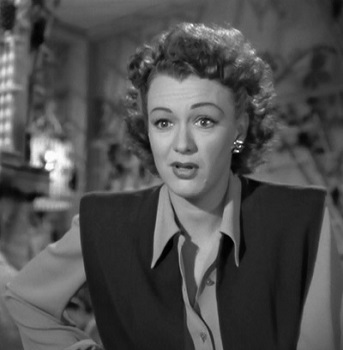
Ida is the ultimate sarcastic sidekick; her dry delivery is a great foil to Crawford’s sentimental, feminine performance. “When men get around me, they get allergic to wedding rings,” Ida explains when asked about her single status. “You know, big sister type. Good old Ida, you can talk it over with her man to man.”

EveArdenMildredPierce
“I hate all women,” Mildred’s business partner, Wally (Jack Carson), says to Ida after Mildred rejects his romantic overtures. “Thank goodness you’re not one of them.”

Ida smirks. “Laughing boy seems slightly burned at the edges,” she observes to Mildred. “What’s eating him?” In fact, every scene between Carson and Arden makes me wish for more, as when Ida gives Wally orchids to put away, saying, “Here, muscle.”

Ida’s critiques of Mildred’s boyfriend, Monty, are always amusing too, even though the man (and actor) is no match for her. When the aristocratic Monty says, “Oh, I wish I could get that interested in work,” Ida drawls, “You were probably frightened by a callus at an early age.” Later, after he’s been milking Mildred and expresses surprise that she might have business problems, Ida retorts, “Don’t look now, but you’ve got canary feathers all over your face.”

MontyIdaVeda
But she reserves her greatest slam for Mildred’s parasitic daughter. “Why don’t you forget about her?” she asks Mildred after watching the abusive pattern between the two for years.

IdaMildred-EveArden
Mildred babbles about what a daughter means to a mother, leading Ida to this classic response: “Personally, Veda’s convinced me that alligators have the right idea. They eat their young.”

I’m not sure why it took me that long, but that’s when I knew for sure I’d found an actress I’d never tire of watching—and more importantly, hearing. I think we can all be thankful Arden was never a huge star, as it meant she would wring everything she could from each line, each expression, and never stop making us laugh.

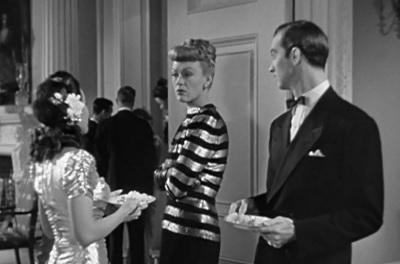
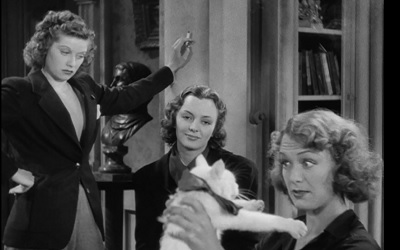
Arden and Ball wow in Stage Door

Lucille Ball and Arden hilarious in Stage Door

Share
Posted in: 1940s films, 1970s films, Comedies (film), Drama (film), Feminism, The Moment I Fell for Tagged: comedic sidekicks, Eve Arden, Grease, Ida, Mildred Pierce, Principal McGee

A Film Celebrating Bad Cooks: Christmas in Connecticut

12/13/2014 by leah@carygrantwonteatyou.com 2 Comments

Stanwyckcooking
I come from a long line of bad cooks. My mother was way ahead of her peers with the natural foods craze, but, like a new vegan, she never learned to substitute anything for the bacon grease she’d been raised with; everything she made was bland. When we visited my maternal grandmother’s, all of our cousins would drop by with food. I remember the day I discovered why, when I witnessed Grandmother putting mayonnaise in macaroni and cheese. My fraternal grandmother supposedly was a good baker before her illness set in, but the only real meal I remember from the Williams family recipes was courtesy of an in-law.

For some women, this deficiency would be a source of shame, but it wasn’t for my grandmother, who bragged about her recipes as she put ketchup in her ratatouille, knowing no one was bold enough to contradict her. As for my mom, she took Greek salad to every holiday potluck, shrugged at all the better fare, and returned to her studies afterward. Who cared about culinary proficiency, when she could be mastering Aristotle? I’ve followed my family’s example, neither worrying about my lack of ability, nor feeling an impulse to remedy it.

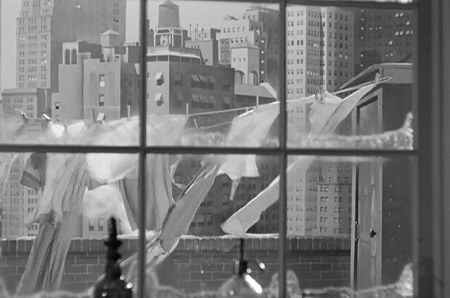
With these tendencies and antecedents, it’s perhaps unsurprising that one of the few domestic comedies I find relatable is Christmas in Connecticut (1945), starring Barbara Stanwyck as Elizabeth Lane, a food writer who can’t cook. The publisher of her magazine (Sydney Greenstreet) wants to please a hero who craves good eating and satisfy his own stomach in the bargain. He invites the sailor—and himself—to Christmas dinner at the columnist’s country home, forcing her to quickly accede to a friend’s proposal and thus be able to pretend owning the home—and baby—she’s been writing about for years instead of the actual tiny New York apartment she lives in as she spins stories about rocking chairs and fireplaces and pet cows.

A view Lane pretends to be “the broad front lawns of our farm, like a lovely picture postcard of wintry New England”

A view Lane pretends to be “the…front lawns of our farm”

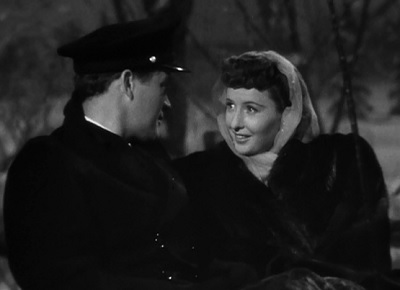
The premise is absurd, of course, but with Stanywck as the faux-Martha Stewart, Greenstreet as the busybody, and S.Z. Sakall as Felix (the enterprising buddy whose recipes she’s been using for her articles), this film is a lot of fun. When Lane falls for the sailor (Dennis Morgan), she plots to avoid the promised marriage to her stuffy friend, John Sloan (Reginald Gardiner). She boldly flirts with the handsome hero, Jefferson Jones (Morgan), freed by his engagement and her own supposed marriage.

LaneFlirtingxmasConnect
Even more entertaining than their flirtation is the treatment of Lane’s poor cooking as she pretends to be Mrs. Sloan. When he hears Felix will be handling dinner, the publisher complains, “…I won’t feel quite the same as if you’d cooked it, Mrs. Sloan.”

“Believe me,” quips Felix, “you will feel much better.”

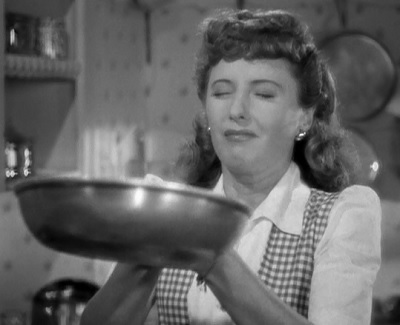
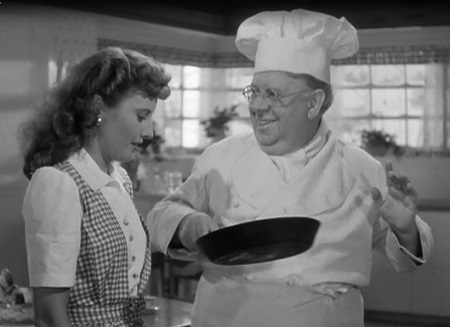
In a famous scene, Felix teaches Lane to flip a flapjack, which she’s described in great detail in her writing. Repeatedly, she screws up, hitting the ceiling with the batter.

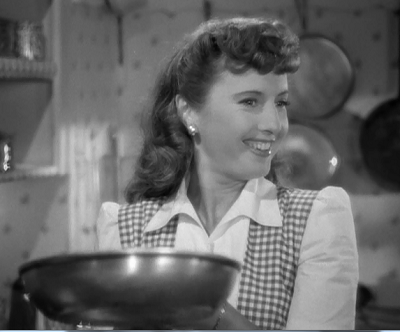
Lane, viewing the pan like it’s a tarantula

Lane, viewing the pan like it’s a tarantula

While she dodges having to display her bad aim at first, she’s finally put on the spot, and her shocked face when she succeeds—by a sheer fluke—is priceless.

ElizabethLaneSuccess
**spoilers below, for anyone who still thinks it’s possible to spoil a predictable romantic comedy***

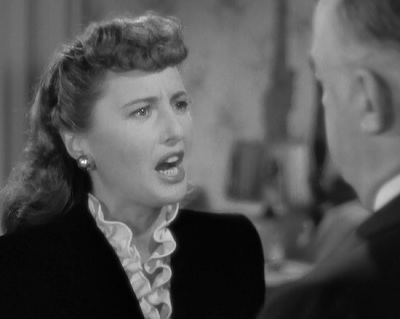
She may be a poor pancake maker, but Lane’s courage and quick wit are worth witnessing when she finally confronts her bullying publisher, who tries to convince her and her faux-husband Sloan that they should reproduce again for the good of the magazine’s circulation. Once he discovers the deception, the publisher urges her to marry the “bore” (Sloan) and proceed quickly to child bearing. Even though she’ll likely lose her job and a promised raise, Lane still decides to have her say: “Listen to me. I’m tired of being pushed around, tired of being told what to do, tired of writing your galldarned articles, tired of dancing to everybody else’s tune, tired of being told whom to marry. In short, I’m tired.”

StanwyckandGreenstreet
Of course, this exchange sets Lane up for becoming the housewife she’s been pretending to be, but in feminist fashion, it’s a choice, not a default—and quitting is in her case an act of liberation. I like to think of her using that big imagination to write the next great American novel while Jones, who already likes washing babies, tends to the children. (She knows what she’s doing, falling for this sensitive type.)

Surprisingly, the film is no more judgmental about her culinary failures than I would be. “Well, young man, I spose you know what you’re doing,” the publisher says to Jones once it’s clear the two are altar bound. “But I warn you, she can’t cook.”

Jones asks her if it’s true. “No, I can’t cook,” Lane admits, without a trace of embarrassment.

“She can’t cook,” Felix repeats. Then he adds for all of us who’ve fallen for her during the film, “But what a wife!”

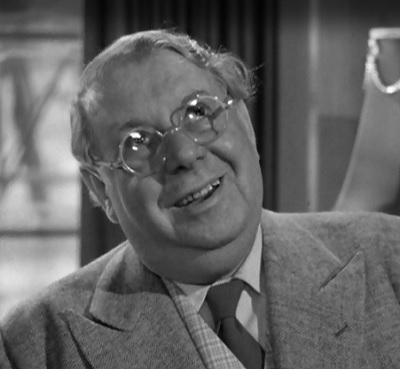
Sakall

Share
Posted in: 1940s films, Feminism, Humor, Romantic Comedies (film), Uncategorized Tagged: bad cooking movies, Barbara Stanwyck, Christmas in Connecticut, Christmas movies, S.Z. Sakall, Sydney Greenstreet

Please Keep the Hair: Keri Russell, Rita Hayworth, and Veronica Lake

12/07/2014 by leah@carygrantwonteatyou.com 4 Comments

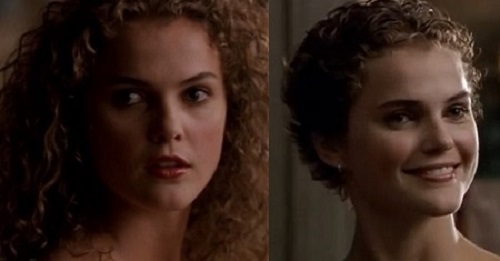
All the wig-switching in the KGB thriller The Americans has me thinking about hair. Of course, my musings must be rooted in the show’s star, Keri Russell, she of the infamous haircut that made Felicity stars everywhere wish her beautician Sweeney Todd.

FelicityShortandLongHair
But Russell was not the only star blamed for tanking a production with her shorn tresses. I’m thinking, of course, of The Love Goddess herself, Rita Hayworth, who made not one, but two hairy decisions in that barber chair. After all, her fans had fallen for her after this famous hair-flip in Gilda (1946), later celebrated in The Shawshank Redemption (1994):

RitaHayworthHairFlip
Audiences liked their WWII pinup just the way she was. But given that Hayworth’s former experiments at a stylist’s hands—a hairline move and a red dye job—had led to her fame to begin with, it’s not surprising she was willing to make a change to help her soon-to-be-ex Orson Welles with his noir, The Lady from Shanghai (1947). She changed the hue of her beloved hair, as seen in its usual glory in Cover Girl (1944):

RitaHayworthCoverGirl
And she also, like Russell after her, chopped it off. The bizarre results: a platinum dye job was blamed for low ticket sales. (Brunettes everywhere, take note: it did happen once.)

RitaHayworthBlonde
It’s true that Hayworth looks better as a redhead, but the film still features one of her sexiest performances. Admittedly, this woman could probably have pulled off a mullet.

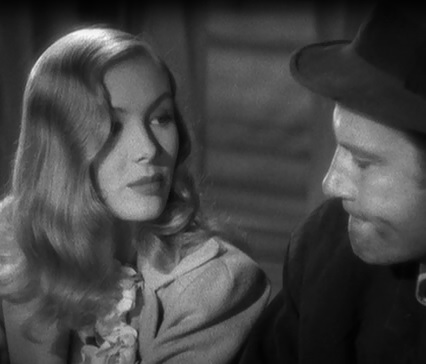
Of course, of all the hair-disaster stories, my favorite is Veronica Lake’s. She was known for that peek-a-boo, hair-in-front-of-eye sexy look models have been attempting since.

VeronicaLakeSullivan'sTravels
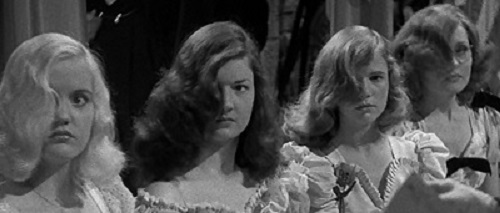
This hairstyle was so popular that it even reached spoof status. One of my favorite moments in The Major and the Minor (1942) is when a cadet mocks the girls at a nearby school: “May as well warn you, there’s an epidemic at Mrs. Shackleford’s school…[T]hey all think they’re Veronica Lake.” The film’s heroine (Ginger Rogers) tries to repress her smile when she sees what he means:

VeronicaLakeLookalikes
In a bizarre twist of fate, Lake undid the do in the interest of national public safety during WWII—all of those fool imitators getting their hair stuck in factories’ machinery. (Check out this staged photo warning her wannabes.). And—not surprisingly—Lake lost her star status soon after the change (though there were other, perhaps more likely reasons for her decline, as there were for the poor box office receipts of Hayworth’s film and lower ratings of Russell’s show).

I know more rational folks would claim that these outcries over hair are outrageous and silly, but having suffered the pains of fine, limp hair all my life, I do get a bit annoyed when a woman with a thick, luscious mane doesn’t appreciate what she has. Sure, if it’s too much for your delicate face, à la Audrey Hepburn, hack away. But if not, don’t pain all of us with wilted mops by throwing your riches away. Have a little pity. At least let us envy from afar.

Share
Posted in: 1940s films, Comedies (film), Drama (film), Film Noir/Crime/Thriller & Mystery, Humor, TV & Pop Culture Tagged: bad haircuts, Felicity, Keri Russell, Rita Hayworth, The Americans, The Lady from Shanghai, Veronica Lake hairdo

Is Something Rotten in Mayberry?: Andy Griffith, Bill Cosby, and Our Instinct to Idolize

11/29/2014 by leah@carygrantwonteatyou.com 4 Comments

I’d heard that Andy Griffith’s performance in A Face in the Crowd (1957) was something to see. But years of believing him the representative of small-town wholesomeness made his first appearance in the film as the target of the law rather than the enforcer of it instantly off-putting. My first instinct was denial. “It must be a mistake,” I thought to myself when he began the movie in jail. “Andy’s innocent.”

RhodesDiscoveryFace-Griffith
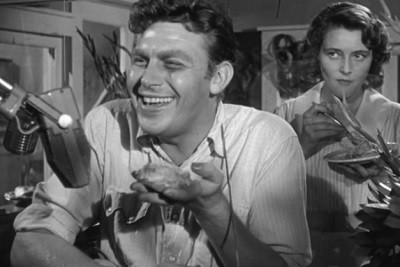
But innocent is one thing this character is not. At the start of the film, Larry ‘Lonesome’ Rhodes (Griffith) seems merely a ham, the kind of man who is a perfect subject for Marcia Jeffries’s (Patricia Neal’s) Arkansas radio program featuring interesting personalities. Most of all, this guy loves to laugh—and what a strong, compelling honk it is.

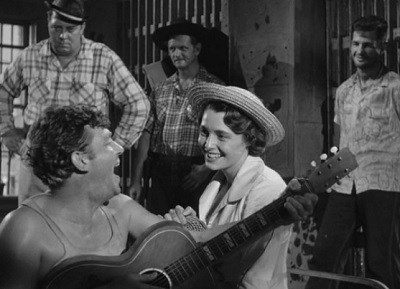
LonesomeRhodes-GriffithNeal
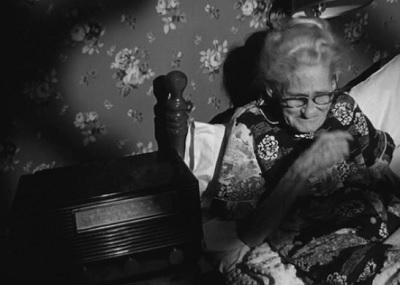
He sings, he jokes, he spins folksy tales about his relatives, like some undiscovered Will Rogers. And he gets people. He has little old ladies giggling over his good ol’ boy hijinks. He describes the pains of housekeeping, and we witness wives stopping to listen to him, hearing perhaps in his telling the first acknowledgement of their woes.

Listeners-Rhodes
But even from the start, we don’t picture Larry as ‘Lonesome,’ a representative of the little guy his radio listeners imagine. We watch the casual cruelty of Larry’s womanizing ways, his drinking, his avarice and disgust toward the fools he’s impressing. Most of all, we’re disturbed by his treatment of the smart, ambitious woman who discovered him, Marcia (Neal), who is so caught up in his charms and success that she puts up with—well, pretty much everything he does, including dropping her for teen baton twirler Betty Lou (Lee Remick).

Lonesome and Betty Lou

Lonesome and Betty Lou

Marcia escaping after discovering Larry's betrayal

Marcia escaping after witnessing Larry’s betrayal

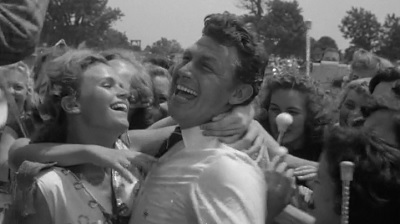
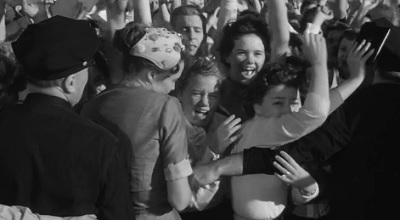
Lonesome soon acquires a big—and enormously loyal—following, especially among women, and as he moves from local to national broadcasts, and from radio to TV, he uses that popularity to wield influence.

At first, he does so in funny ways, making jokes on his sponsors and others who annoy him, as when he convinces listeners to send mutts to a mayoral candidate’s house to test out his ability to lead.

SheriffDogs-FaceintheCrowd
But as Lonesome’s numbers grow, and he begins to be courted by politicians eager to tap into his appeal, his ambition and power become menacing rather than funny.

GriffithasRhodes-ExplainingPower
Perhaps because I grew up watching others amused by Rush Limbaugh’s disturbing takes on feminism (feminazis), my trust in Griffith as Larry ‘Lonesome’ Rhodes soon eroded. I kept waiting for his behavior to worsen, but even so, the shock of his betrayals, his arrogance, and his corruption was difficult to experience. While he had other evil roles, Griffith was just so convincing as the loveable sheriff of Mayberry that I didn’t want to picture him in any other way.

I kept thinking of this performance of Griffith’s over the past couple weeks as the reports of Bill Cosby’s alleged crimes kept multiplying. Local radio personalities repeatedly played Cosby’s pudding commercials, creating eerie disjunctions between his fatherly role and the rape accusations. I realized then how wholeheartedly I’d believed Cosby was the character I’d admired in his famous show: a good man, a loving father, a feminist.

I don’t know if the allegations are true. I know it’s important not to jump to conclusions, even when the case against someone looks grim, perhaps especially then. I’ve read too many stories about innocent people destroyed by public opinion even when they were ultimately exonerated, have witnessed the ugly remains of false accusations firsthand. But whether or not these particular allegations are true, this story, and movies like A Face in the Crowd, are reminders to me of how often charm is mistaken for goodness, how closely and carefully we need to examine the figures we choose to revere.

Share
Posted in: 1950s films, Drama (film), TV & Pop Culture Tagged: A Face in the Crowd, allegations, Andy Griffith, Bill Cosby, Mayberry, role models

Actors Too Pretty for Their Parts

11/21/2014 by leah@carygrantwonteatyou.com 4 Comments

I would like to say that an actor’s performance always trumps any preconceptions of mine about a character from a book I’ve read, that I can set aside my firm conviction that a character was blonde or tall or curvy. But the truth is, sometimes my assumptions ruin a performance for me, no matter how adept and nuanced the acting, no matter how much that performer captured, even enhanced the essence of a character. And for some reason, I am most frustrated when an average-looking book character suddenly becomes a knockout in the movie.

Sometimes, I know this reaction is foolish. But in other cases, the character’s looks were essential to the character/story. Hollywood often mistakes delicacy for sex appeal, or assumes we’re all afraid to see someone onscreen who isn’t dazzling. Here’s my list of the most annoying casting choices in terms of beauty, from least to most irritating:

Fourth Runner Up: Alan Ladd as Shane (1953)

LaddCowboy-Shane
Shane is meant to be dark and mysterious. Alan Ladd could be a disturbing, haunted character, and he nails the cowboy’s reticence, humility, reserve. But I couldn’t see in him the forbidding man who managed to overcome my eighth-grade reluctance to read a western. When the teacher showed the film in class, I remember my fury: Come on. We’re not casting for New Kids on the Block here! (i.e., One Direction for you youngsters). Admittedly, the hairstyle and clothing designers didn’t help:

LaddasShane
In the battle between him and the bad guy, played by Jack Palance, I am so distracted by that pretty face that I’m sure the gunman would be too.

This casting decision also tainted the almost-romance between him and Marian (Jean Arthur). In the book, she is so drawn by his strength of character that she can’t help developing feelings for him. But in this film, it was hard not to believe Marian just found him hotter than her husband, Joe (Van Heflin).

HeflinandLadd-Shane

Third Runner Up: Lawrence Olivier as Darcy in Pride and Prejudice (1940)

OlivierasDarcy
Lawrence Olivier is a good Maxim de Winter in Rebecca. The character is described as aristocratic and cold, like a painting of a fourteenth-century nobleman: “His face was arresting, sensitive, medieval in some strange explicable way….Could one but rob him of his English tweeds, and put him in black, with lace at his throat and wrists, he would stare down at us in our new world from a long distant past…” Olivier fits this description perfectly; in fact, he always seems most at home in period dramas.

OlivierRebecca
But when it comes to bringing to life the imposing Fitzwilliam Darcy, this short Englishman looks too much like a toy soldier to me. I don’t see him as gathering all eyes due to his “fine, tall person, handsome features, noble mien.” There needs to be some rugged in Darcy’s handsome, and delicate Olivier doesn’t cut it. I see this actor as the snob cutting down a girl for wearing thrift store clothes, not a man whose very presence could intimidate a woman as sassy as Elizabeth Bennett.

 Second and First Runners Up: Joan Fontaine as Mrs. de Winter in Rebecca (1940) and Jane Eyre (1943)
Given, the narrator in Rebecca is a very humble sort, unlikely to recognize her own charms. And Fontaine’s looks are less sexy than those of the striking Anjelica Huston type I always imagined Rebecca to be. But she certainly doesn’t appear to be the mousy, flat-haired woman she’s described as in the book:

FontaineinRebecca
A girl this lovely surely would have gotten more attention from Mrs. Van Hopper’s friends. For the story to work, she needs to have been belittled and underestimated throughout her life, and I’m just not buying it. Does Fontaine capture the hesitancy and insecurity of the wife? Absolutely. Did the filmmakers try to tone down her considerable looks through makeup and hair style? Yes. Did I ever forget those looks enough to believe her as Mrs. de Winter? Not at all.

While the choice of Fontaine for Rebecca was a poor one, the decision to make her Jane Eyre was far worse. There’s no way a woman this ravishing would ever utter these famous lines to her love (bolding mine): “Do you think, because I am poor, obscure, plain and little, I am soulless and heartless? You think wrong! – I have as much soul as you, – and full as much heart! And if God had gifted me with some beauty and much wealth, I should have made it as hard for you to leave me, as it is now for me to leave you!”

Yeah, this woman looks plain:

FontaineJaneEyre
All of us less-than-beautiful little readers out there were thrilled to discover in Jane a heroine who wasn’t gorgeous but was strong-willed, proud, passionate. Too bad Hollywood doesn’t get that ordinary girls like their heroines to look like they do…..

Winner: Lana Turner as Marianne in Green Dolphin Street
Of all the silly selections I’ve listed, the most ludicrous by far is this one, especially since the film’s preview made a bold claim that it had not altered the source material:

TitleSlideGreenDolphin
Let’s see if you agree with MGM’s statement. In the novel, two sisters, Marianne and Marguerite, fall for the same guy, William (Richard Hart). He adores Marguerite, the sweet, gentle beauty (Donna Reed).

DonnaReedandRichardHart
After moving to New Zealand, he sends for the sister he wants for his bride, but instead of writing the name of his girlfriend, Marguerite, in his proposal letter, he writes Marianne instead because he’s drunk and kind of an idiot. To his shock and dismay, he’s stuck with marrying his love’s prickly, smart, unattractive sibling, portrayed by this actress:

LanaTurnerinPostman2
’Cause when I’m trying to come up with the gal all the boys choose girls-next-door over, Lana Turner is first on my list. Of course, the movie changed the plot a bit to make this casting choice look a bit less ridiculous. But since the reader likes Marianne in part because she’s so much more than she seems to outsiders, this va-va-voom choice doesn’t exactly convey novelist Elizabeth Goudge’s meaning.

And there you have it. My choices for actors and actresses far too pretty for their roles. What are yours?

Share
Posted in: 1940s films, 1950s films, Drama (film), Humor Tagged: Alan Ladd, Green Dolphin Street, Jane Eyre, Joan Fontaine, Lana Turner, Lawrence Olivier, Rebecca, Shane

Disney’s Tangled: Better as a Silent Film?

11/11/2014 by leah@carygrantwonteatyou.com 8 Comments

MotherKnowsBest-Tangled
This post is part of the The Fairy Tale Blogathon hosted by Movies Silently. Check out the other entries!

I was hesitant to give Tangled a chance. I’ve always been bored by Rapunzel, who had little to recommend her but strong hair. Sure, she had beauty—yawn—and a pretty voice (What heroine doesn’t?) But she always seemed so idiotic to me. She had two tasks in her life—let down her hair, and conceal the prince’s visits, and she botched one of them, setting her love up for the witch’s wrath. And however her looks might have grown in all that tower time, isolation surely didn’t do much for the fair one’s people skills.

Disney’s 2010 version was much more entertaining than I thought it would be. Rapunzel is savvier and spunkier than in the original tale. And Tangled has some amusing theories on what she did all day, and how her upbringing by a witch might have affected her. Some wonderful side characters add to the energy, and the witch is a hoot. But there are some disappointments too.

First, the improvements on the fairy tale:

A Heroine Who Isn’t a Snooze
I’ve always pictured Rapunzel as a less interesting version of Lady Bertram, napping until the prince arrived and slowly making her way to the window, yawning as she helped him climb. Disney’s version (voiced by Mandy Moore) is full of projects: reading, painting murals, baking, doing papier-mâché and otherwise trying to fill the hours. She is obsessed with the lights unleashed on her birthday, actually lanterns from the queen and king to call her (their daughter) back from the witch, who stole Rapunzel to retain the Fountain-of-Youth properties of her magical long hair.

The unbelievable strength of Rapunzel’s hair in the fairy tale always puzzled me, so I was relieved to find the hair was magical, and Disney made it much more fun by turning it into an all-in-one lever-rope-weapon.

Rapunzel-Tangled
Rapunzel is also pretty handy with a frying pan, which she wields to defend herself against the thief (a prince replacement) who escapes into her tower. She bribes him to help her to the lighting ceremony, after which she plans to return meekly to her mother (aka, the witch). (I was concerned about the amount of head-pan contact though, convinced she’d kill/maim him sooner or later; the pan surely must have been made of weaker stuff than my iron skillet.)

An Equal Partnership
In most ways, the thief (Flynn Rider, voiced by Zachary Levi) is an everyday Disney hero, handsome and arrogant, proud of his “smolder” look. His backstory—an orphan craving riches—explains both his law-breaking ways and duplicitous behavior toward his partners. While he will obviously be reformed by the love of such a sweet, naïve girl, à la Lady and the Tramp, she will pick up his daring and inventiveness, needed qualities for a girl who is dangerously set in her ways thanks to eighteen years in a tower. Of course, she does have one advantage over him, with that magic, glowing hair.

FlynnandRapunzel-hair
I can’t say I was terribly interested, moved by, or invested in their union, but thought his altruism near the end was a nice touch. But no worries—I didn’t have to care much about them. Not with the mama witch to keep me interested.

A Worthy Villain
Now, I’m not going to claim this witch is as fearsome or powerful as Cruella de Vil. But it’s fascinating to watch Mother Gothel, perfectly voiced by Donna Murphy, manipulate her supposed daughter Rapunzel. This mother has Bette Davis flair as she pronounces the evils outside that Rapunzel must avoid. My favorite of the dangers she lists: men with pointy teeth.

MenwithPointyTeeth-MotherGothel
“Skip the drama,” she advises in song. “Stay with Mama.” Murphy’s performance is simultaneously disturbing and hilarious.

Mother Gothel transitions from worldly dangers to a litany of Rapunzel’s weaknesses: her clumsiness, her naïveté, etc., which will supposedly make her easily fall prey to others.

Of course, Mother Gothel pretends love, not fear of loss, is what prompts her tower hiding of Rapunzel.

LoveYou-MotherGothelandRapunzel
(And, of course, she does love her obsessively—at least, that magical hair.)

In terms of models, Mother Gothel is a twin of the monstrous parents in Like Water for Chocolate and Now, Voyager, mothers who think a daughter should exist solely to serve, and enjoy doing so.

NowVoyager-GladysCooper
Mother Gothel likes to point out her maternal virtues, such as providing such great paints and soup!

I’d always considered the father of the original tale weak for giving his child to the witch’s care (to avoid paying for stealing food for his pregnant wife with his life). But I’d never reflected on just how cruel it was to leave his child in such hands. The ill effects are briefly seen when Rapunzel escapes, as she veers between bursts of joy and energy…

Joyous-Tangled

…and periods of debilitating guilt:

Miserable-Tangled
While this back-and-forth moodiness is funny to watch due to Disney’s deft portrayal, I kept thinking of Davis’s twitchy, insecurity-infused performance in Now, Voyager, and just how much therapy it would cost Rapunzel before she attained the exuberance and lightheartedness she displayed in the very next scene. Truly, a witch who just threatens physical harm would be sweet by comparison.

Amazing Allies
I used to like the sidekicks in Disney flicks, but after one too many Sebastian types (of The Little Mermaid fame), I was relieved to find the most prominent sidekicks largely silent, including an Owl-like chameleon, Pascal, whose expressions and gestures provide sage advice (in tribute to his name, of course).

PascalTangled
And there’s the glorious Maximus, a horse with amazing hunting skills and loyalty, who provides 90 percent of the comic relief of the film. As part of the royal guard, he tracks Flynn with Inspector Javert-like persistence after Flynn steals a crown from the palace.

Maximus-Tangled

Maximus falls for Rapunzel and reluctantly aids her beau, a reluctance that’s a joy to witness.

In fact, I was so enthralled by these animated allies that I found myself wishing the whole movie were silent, not just because these allies were the primary reward of watching the movie, but for the following additional reasons:

Utterly Forgettable Songs
Murphy (Mother Gothel) gets one good tune, and she’s a talented enough actress and singer to almost make the other songs worth hearing—almost. But with bland song after bland song, and the highly generic focus on dreams (seriously?), I was ready to return to the silent antics of Maximus. (If you can’t beat Kermit piping the lovely “Rainbow Connection” or the 1001 less compelling dreaming songs since, lay off of ’em.)

Scenery More Interesting than the Plot
A girl spends a lifetime in a tower, much of it reading, and the height of her ambition on escaping is to……see some lights. Umm, what? Couldn’t Disney have made her an artist—a writer or a painter (the murals!)? Or maybe an intellectual even? Surely Mother Gothel would have loved to provide the kinds of books that would turn Rapunzel into a scholar, as those might make her content to live a life of the mind, happy with her retreat. Turn the tower ivory, Mother Gothel! Come on! I’m not exactly talking about creativity here; I’m pronouncing the biggest cliché about towers ever. I know I’m supposed to believe Rapunzel has some spiritual connection with the lights, somehow understanding they’re for her, but if that’s the case, why didn’t Mother Gothel change the date of her birthday? The woman seems far too intelligent to have made such a dumb mistake.

The first big moment after Rapunzel’s re-entry to the world involves turning a bunch of thugs to her side because she asks if they have dreams, and they proceed to share them.

DreamingThugs-Tangled
If I’d been in the theater, I’d have been tempted to throw popcorn at the screen. Even if this is a strange alternate universe where dreams aren’t discussed ad nauseam, neither this character, nor her own ambition, is at all inspiring. To see lights is not exactly the kind of dream to get criminals past their reluctance to open up. If the movie had played off her dream as comically stupid, what someone dozing in a tower would come up with, I’d have been all for it. But sigh. They played it as motivating.

In contrast to such clichéd scenes, all the details of the landscape sucked me in, especially the flood. In trying to get boys to watch the film, Disney really succeeded with the action shots.

Flood-TangledActionShot-Tangled
How interesting it would have been, in contrast to that silly song about grass when the heroine hits the ground and the unnecessary (if occasionally amusing) scene with the tough types, to just witness Rapunzel quietly taking in the wonders around her, jumping at everyday noises, stumbling a bit at the unaccustomed exercise. What humor and pathos would have been possible! Disney gets this for a second, as Rapunzel is paralyzed after her tower retreat, unable to make the 12-inch drop to the ground.

FootfromGround2-Tangled
That moment was worth the next hour.

In fact, the only truly moving scene in the film is the silent clip of the king and queen, hesitant to practice this lantern ritual yet again, to allow themselves to still hope.

KingandQueen-Tangled
I wish that Disney hadn’t been so cowed by Pixar successes into such a conventional retreat from what’s compelling about this movie. They give Rapunzel a Barbie-sized waist. They back off from the interesting mother-daughter dynamic.

MotherGothelandRapunzel-insecurity
They don’t realize Maximus is the star. They have this supposedly feminist heroine spend her time on indisputably female-associated crafts instead of developing some kind of true ambition. And at the end of the movie she’s—surprise! A bride.

Disney had the potential for some Fantasia creativity, with silence used to beautiful effect, and the glimpses of the story’s potential still make this a fun movie. But how great it could have been.

Don’t forget to check out the other entries in the blogathon!

Share
Posted in: 1920s films, 1990-current films, Blogathons, Comedies (film), Drama (film) Tagged: animated movies, Disney, Now Voyager, overbearing mothers, Rapunzel, Tangled

Confession: Four Great Movies I’ve Never Seen, with Excuses

11/07/2014 by leah@carygrantwonteatyou.com 8 Comments

I am unashamed of my pathetic store of musical knowledge. I actually listen to—and like–the radio. And not the satellite kind. Frankly, if I can’t sing or dance to a song, I’m not interested. Riffs, jamming, orchestras, Bonnaroo—not for me. A Pat Benatar singalong? Sign me up.

It’s also rare for me to confess any embarrassment about novels I haven’t read, probably because I’m enough of a bookworm that gaps in my education are just opportunities for more fun, not sources of embarrassment.

But movies? I feel squeamish when I’ve missed the greats, and tend to dodge discovery. I’m not sure why.

Today, therefore, I’m going to be brave and confess to four very big omissions from my film education. I may turn red as I write, but you won’t have to see it. Here we go….

Lawrence of Arabia (1962)

LawrenceofArabia-
My excuse is the obvious one—too long. Over 3 ½ hours? Who has the time?

Umm, I do. I managed to watch a season of The Wire in a weekend, all episodes of the new Arrested Development in a day. The BBC Pride and Prejudice miniseries I practically have memorized, and it’s almost 100 minutes longer than this apparent masterpiece. I even own the film in VHS format (still in cellophane). That’s how long I’ve been peddling this rationalization to myself.

The Godfather: Part II (1974)

TheGodfatherPartII
I saw The Godfather at a movie party many years ago. It was in my early days at a new job, and I remember being embarrassed that I was the only one there watching it for the first time. I left before the second movie, shy about my older peers’ superior knowledge and my general lack of proficiency at small talk of any kind. (It really sucks sometimes to be twenty-three.) I kept feeling afterward like I’d somehow missed the window for seeing this movie, much as I still do about reading Jack Kerouac’s On the Road (who wants to read about youthful angst and self-importance past their early twenties?)

The Treasure of the Sierra Madre (1948)

Treasure-Bogart
I love Humphrey Bogart. I’m intrigued by gold mining, have read numerous novels about the Gold Rush. Films and novels about breakdowns due to avarice fascinate me. I have put this film into my VCR multiple times, and then not played it. Why? I guess it’s mood. I never seem to think to myself, “Yes, today, let’s watch a movie about people turning into monsters for money.”

Duck Soup (1933)

DuckSoup
I taught a humor class last semester. I have read Irving Brecher’s account of writing for the Marx brothers in And Here’s the Kicker. I’ve seen—and liked—clips of these siblings in action. I have spotted this movie on Netflix streaming. Yet I have never hit play. My only explanation is that I’m saving it; it’s a big source of relief I’m anxious about spending prematurely. I am reserving the film for a particularly grim day, the day I screw up at work, wreck my car, and make my husband, friends, and family cry. Then, then I’ll need some Marx brothers. Why just waste the film on a day it’s raining?

Perhaps now that I’ve made my confession, I’ll finally view three of these films, but I think I will save the Marx brothers. A present like that shouldn’t be squandered, right?

Share
Posted in: Comedies (film), Drama (film), Random Tagged: Confession, Movies I've missed
« Previous 1 2 3 4 5 … 18 19 20 21 22 23 24 25 26 27 Next »

Recent Posts

  • 100 Years Later, Still Scary: Dr. Caligari
  • Escaping Out of the Past (1947)
  • A Weeper for Those Who Love Jerks
  • Thank You, Academy, for Not Infuriating Me
  • Challengers (2024) Is a Bad Movie

Subscribe to Blog via Email

Enter your email address to subscribe to this blog and receive notifications of new posts by email.

Categories

  • 1920s films
  • 1930s films
  • 1940s films
  • 1950s films
  • 1960s films
  • 1970s films
  • 1980s films
  • 1990-current films
  • 2020s films
  • Action & Sports Films
  • Anti-Romance films
  • Blogathons
  • Childfree
  • Comedies (film)
  • Drama (film)
  • Feminism
  • Femme fatales
  • Film Noir/Crime/Thriller & Mystery
  • Gloriously Silly Scenes
  • Horror
  • Humor
  • Mae West Moments
  • Musicals and dancing films
  • Oscars
  • Random
  • Romance (films)
  • Romantic Comedies (film)
  • The Moment I Fell for
  • Turn My Sister into Classic Movie Fan
  • TV & Pop Culture
  • Uncategorized
Share
Classic Movie Blog Hub Member

Recent Comments

  • leah@carygrantwonteatyou.com on Meg Ryan’s Fate Foretold in Joe Versus the Volcano
  • Ryan on Meg Ryan’s Fate Foretold in Joe Versus the Volcano
  • leah@carygrantwonteatyou.com on 100 Years Later, Still Scary: Dr. Caligari
  • The Classic Movie Muse on 100 Years Later, Still Scary: Dr. Caligari
  • leah@carygrantwonteatyou.com on 100 Years Later, Still Scary: Dr. Caligari

Archives

  • November 2025
  • September 2025
  • May 2025
  • March 2025
  • January 2025
  • November 2024
  • August 2024
  • July 2024
  • May 2024
  • March 2024
  • February 2024
  • December 2023
  • November 2023
  • October 2023
  • September 2023
  • August 2023
  • July 2023
  • May 2023
  • April 2023
  • March 2023
  • January 2023
  • December 2022
  • November 2022
  • September 2022
  • July 2022
  • May 2022
  • April 2022
  • March 2022
  • February 2022
  • October 2021
  • September 2021
  • April 2021
  • March 2021
  • February 2021
  • December 2020
  • October 2020
  • September 2020
  • July 2020
  • May 2020
  • April 2020
  • March 2020
  • February 2020
  • December 2019
  • October 2019
  • September 2019
  • June 2019
  • May 2019
  • April 2019
  • February 2019
  • January 2019
  • November 2018
  • September 2018
  • July 2018
  • June 2018
  • May 2018
  • April 2018
  • March 2018
  • February 2018
  • January 2018
  • November 2017
  • September 2017
  • August 2017
  • July 2017
  • June 2017
  • May 2017
  • April 2017
  • March 2017
  • February 2017
  • January 2017
  • December 2016
  • November 2016
  • October 2016
  • August 2016
  • July 2016
  • June 2016
  • May 2016
  • April 2016
  • March 2016
  • February 2016
  • January 2016
  • December 2015
  • November 2015
  • October 2015
  • September 2015
  • August 2015
  • July 2015
  • June 2015
  • May 2015
  • April 2015
  • March 2015
  • February 2015
  • January 2015
  • December 2014
  • November 2014
  • October 2014
  • September 2014
  • August 2014
  • July 2014
  • June 2014
  • May 2014
  • April 2014
  • March 2014
  • February 2014
  • January 2014

Meta

  • Log in
  • Entries feed
  • Comments feed
  • WordPress.org

Copyright © 2025 Cary Grant Won't Eat You.

Church WordPress Theme by themehall.com