Cary Grant Won't Eat You

Classic movies for phobics

  • About
  • eBooks
  • Previous Blogathons
Classic movies for phobics

1930s films

5 Classic Film Costume Ideas–& What They’ll Be Mistaken for

10/27/2015 by leah@carygrantwonteatyou.com 2 Comments

Inspired a fashion blogger’s posts on Halloween options, I started thinking about potential costumes from classic film. I have recs for those of you stuck for ideas. Sure, your peers who don’t know the classics will mistake the character you’re playing, but if the costume is sharp, fun, or clever, who cares? Here are five suggestions:

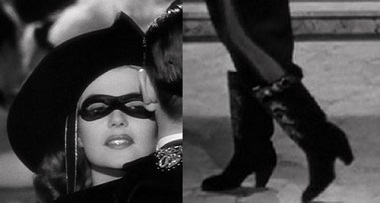
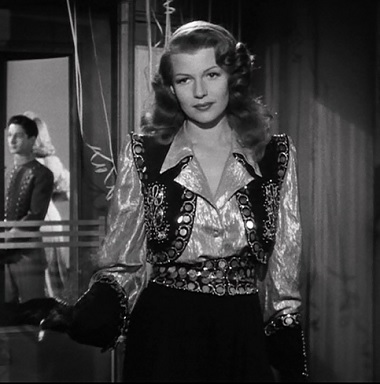
Gilda‘s Carnivàle Outfit

RitaCarnivaleoutfit-Gilda
The heroine’s (Rita Hayworth’s) stylish get-up has two major advantages:

  1. It’s fabulous.
  2. It has wonderful accessories:

GildaCarnivaleaccessories
You’ll Likely Be Mistaken for:
Zorro’s love interest

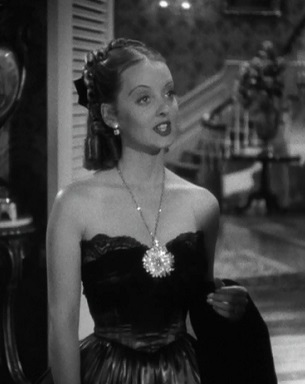
Jezebel‘s Red Dress

Jezebel-BetteDavis
Who hasn’t wanted to wear the dress that stops everyone short? And what gown in film had more impact than the one that branded Julie (Bette Davis) a fallen woman in front of her whole society? Plus, the dress is gorgeous.

You’ll Likely Be Mistaken for: A devil without her pitchfork, a bad angel sans wings, or just a gal who wants an excuse to wear an Oscars dress

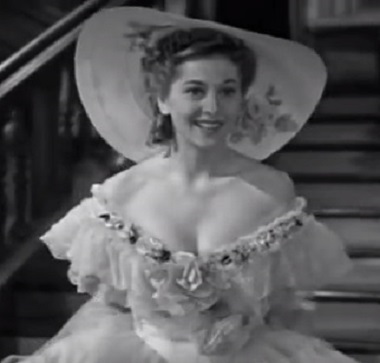
The Disastrous Dress from Rebecca

RebeccaJoanFontaine
The gown is a bit frilly, but putting on Rebecca’s character for the creepiest night of the year? Yeah, you could get into that. Of course, you could play it meek too, acting as the narrator, since both pick the same dress for the masquerade. Up to you. Some crinoline, a hat, some flowery details–you’ll have it.

You’ll Likely Be Mistaken for: Scarlett O’Hara (It’s a poofy dress. Who else could you be?)

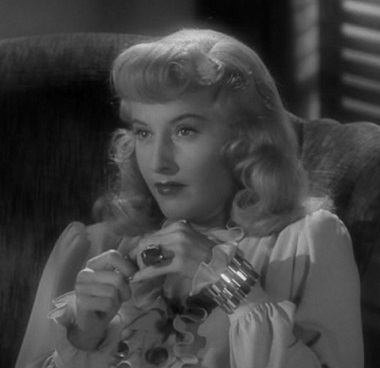
Phyllis Dietrichson from Double Indemnity

PhyllisDoubleIndemnity-Stanywck1
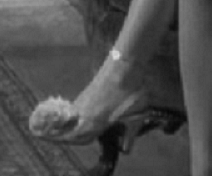
This is the budget option. As any smart Halloween shopper will tell you, you should skip the all-in-one packages in the costume store, and take a tour down the accessory aisle. Anyone can discover a sweater set or fussy dress at home or in the vintage shop. And it isn’t hard to find a wretchedly, embarrassingly bad blonde wig for less than twenty bucks, or some gloriously tacky jewelry. You might even have some from last year’s festivities. Just don’t forget those crazy feminine shoes–and, of course, the anklet:

PhyllisankletDoubleIndemnity
The best part? If you wear a wig–any wig–on Halloween, you really can’t go wrong.

You’ll Likely Be Mistaken for: George Washington or his wife Martha in modern gear (as was Barbara Stanwyck).

Shanghai Lily

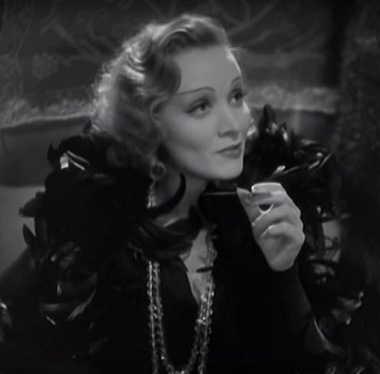
ShanghaiExpress
If you don’t gush over the fashions in Shanghai Express, head straight to the optometrist. Prostitutes in ’30s Shanghai had quite the budget, if Lily (Marlene Dietrich) is any indication. She’s costumed to the hilt in boas, feathered caps, furs, long gloves, and silk. For any woman who wants glamour in her life, Lily’s style is salivation material.

You’ll Likely Be Mistaken for: A generic femme fatale (close!)

There you have it. Five options for those seeking Halloween inspiration. What are favorites of yours?

Share
Posted in: 1930s films, 1940s films, Comedies (film), Drama (film), Humor, Random Tagged: classic film, costume ideas, Halloween

Mae West’s Dating Advice: the 3 Fs

10/11/2015 by leah@carygrantwonteatyou.com 2 Comments

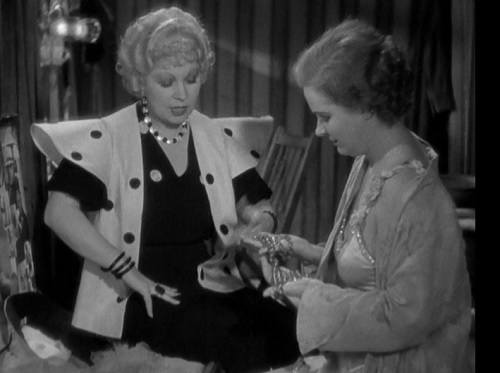
MaeWestgivesadvice
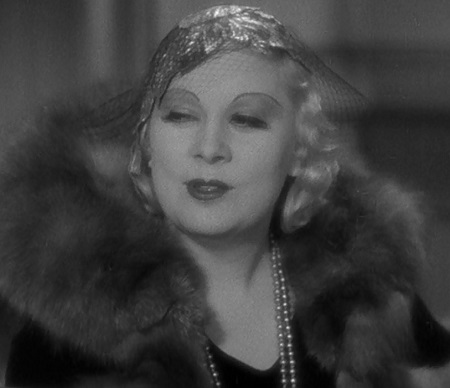
When advising friends about men, Mae West’s characters, of course, never hold back. As Tira in I’m No Angel, West keeps her suggestions pithy: “Never let one man worry your mind. Find him, fool him, and forget him.”

For more monthly Mae West favorites, click here.

Share
Posted in: 1930s films, Mae West Moments, Romantic Comedies (film) Tagged: dating advice, Mae West

The Moment I Fell for Claudette Colbert

09/13/2015 by leah@carygrantwonteatyou.com 12 Comments

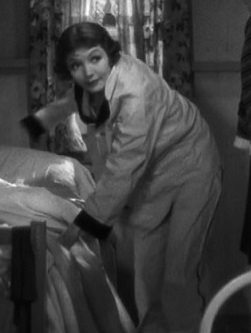
ClaudetteColbert-Ithappenedonenightlying
Today I’m reflecting on that tiny woman with the deep, sexy voice who managed to develop fully realized characters even in the smallest of roles. And in her greatest ones, set the bar so high for future comediennes that few have managed to approach, much less equal, her performances since.

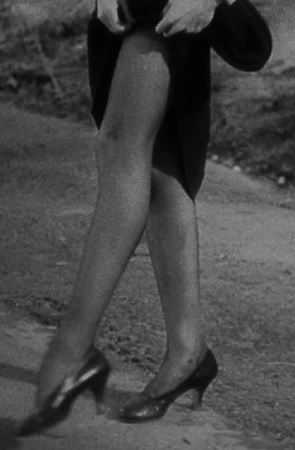
Like many of us out there, I knew Claudette Colbert’s legs first, as she starred in one of the most iconic scenes in American film, proving “once and for all” that when it comes to hitchhiking, “the limb is mightier than the thumb.”

ClaudetteColbertlegs
It took several years after seeing the image of her legs that I actually got around to It Happened One Night, which I’ve watched at least 30 times since. In her Academy-winning role as Ellen Andrews, she first perfects a chilly posture and refined voice as the stuck-up heiress. But slowly, Colbert reveals Ellen’s vulnerabilities and inexperience through expressions, gestures, stance, and tone. When Ellen and soon-to-be love interest Peter Warne (Clark Gable) stop at a motel en route to New York, she is ill at ease with the arrangement he makes to keep the room platonic–strapping a blanket between their beds. While she’s technically married, she has never been with a man. When she oversleeps the next morning, Peter threatens to come get her, and her clumsy, embarrassed fumbling to ensure he doesn’t makes me laugh every time I see it.

ClaudetteColbert-ItHappenedOneNight
That winning performance made me a fan. Without it, I never would have sought out The Palm Beach Story, Midnight, and so many other wonderful movies since. Although I appreciate Colbert’s dramatic abilities, her skill with romantic comedy is what wows me. Here are just a few of the megastars she managed to upstage, in spite of the camera’s deep love for them (and theirs for it): Miriam Hopkins in The Smiling Lieutenant (1931), Clark Gable in It Happened One Night (1934), John Barrymore in Midnight (1939) and John Wayne in Without Reservations (1946).

So on her birthday, I’d like to say thank you to the actress who has lightened my mood again, and again and again: the mesmerizing Claudette Colbert.

Share
Posted in: 1930s films, 1940s films, Feminism, Romantic Comedies (film), The Moment I Fell for Tagged: Claudette Colbert, Frank Capra, It Happened One Night

Mae West Schools the Teacher

09/06/2015 by leah@carygrantwonteatyou.com 4 Comments

WestandtheTeacherNightafterNight
A prim school teacher & Mae West. Almost a century later, this coupling seems inspired. But in 1932, nobody knew that. West was a vaudevillian, not a movie star. Her role as Maudie, an ex of the lead, Joe Anton (George Raft), was a minor part in her first film, Night after Night. She didn’t even enter the picture until a half hour in.

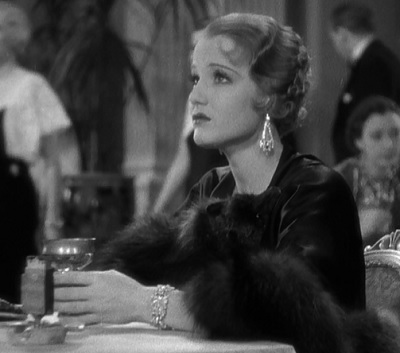
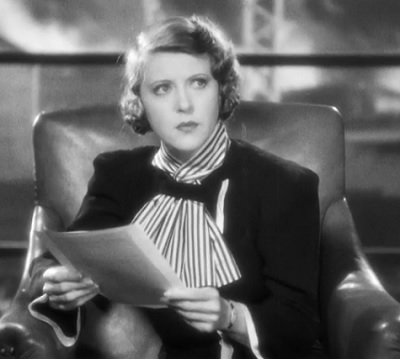
The script of the movie is bland, the story plodding. Joe, the owner of a mansion-turned-speakeasy, is fascinated by Jerry Healy (Constance Cummings), the mysterious beauty who shows up at his place every night unattended. He discovers that her family owned his mansion before the market crash.

ConstanceCummings-NightafterNight
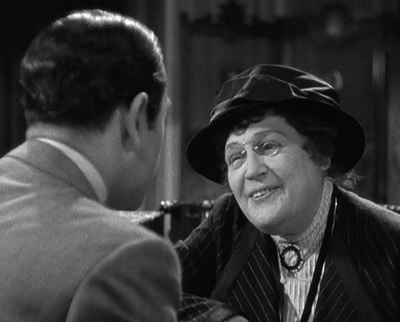
Joe has been dissatisfied lately, aspiring to a classier existence. He’s even hired a tutor, Miss Mabel Jellyman (Alison Skipworth), to improve his elocution, grammar and knowledge of current events–the type of lady who gets prissy when he uses words such as “got.”

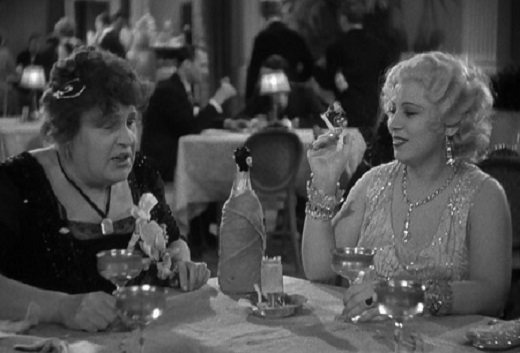
Speakeasy owner & tutor
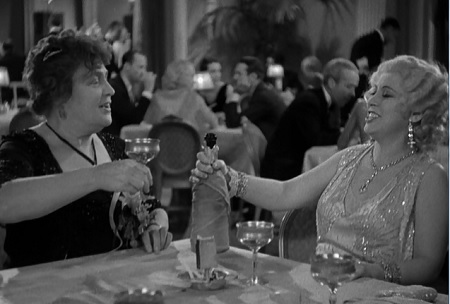
He thinks Jerry will lead him to a better life, but he needs the tutor’s help to win her. He invites Jerry for dinner at the speakeasy, and begs Jellyman to come along. The tutor is thrilled at the chance to hang out in a speakeasy and have some fun, but what a drag to be on such a date! Joe’s attempts at sophistication are painful, the conversation stilted. Everyone at the table is bored and uncomfortable.

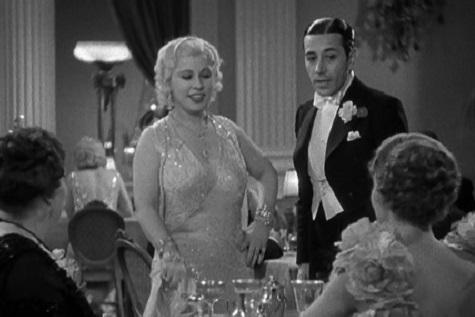
Then Maudie (West) enters the room.

MaudiesarrivalNightafterNight-WestRaft
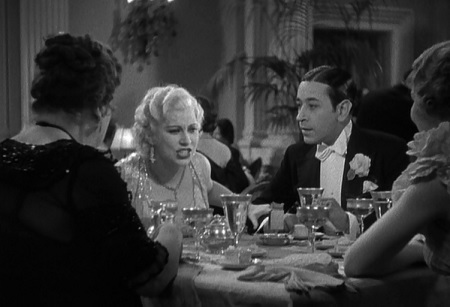
Within five minutes, she has decimated Joe’s fragile rep, having laughed about his love for the ladies, drunkenness, and a jail visit in quick succession.

WestasMaudieNightafterNight
“Oh Joe,” she concludes, “it’s just life to see you,” echoing our impressions of her arrival. She has completely redeemed his date (and the existence of the film). Finally, Jerry is enjoying herself.

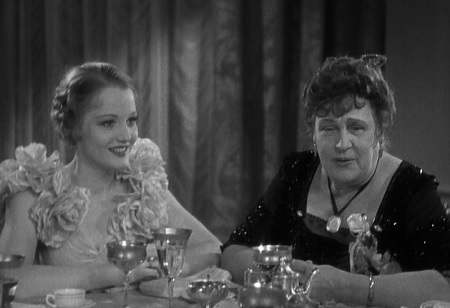
JerryandJellyman-NightafterNight
But clueless Joe urges Jerry to leave with him to tour the house. Jellyman, soon drunk thanks to Maudie’s generosity with the bottle, protests when Joe offers a cab before leaving them. “I don’t want to go home,” she complains. She turns to Maudie, “He said I didn’t have to.”

“Yeah, we’re gonna make a night of it,” Maudie agrees. “You go ahead,” she tells Joe, “we gotta talk it over.”

“Maudie and I have a great deal in common,” Jellyman explains to Joe.

“You said it, baby,” agrees the partying blonde, without a trace of irony.

Once they’re alone, Jellyman asks anxiously, “Maudie, do you believe in love at first sight?”

“I don’t know, but it saves an awful lot of time,” she quips.

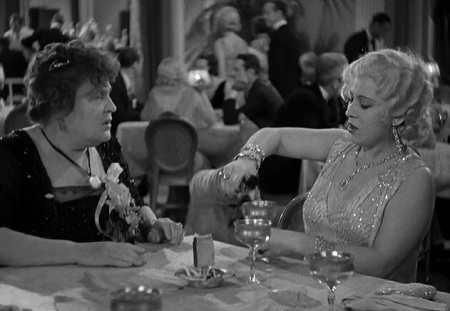
Jellyman protests when Maudie refills her class, to which our heroine responds, “Now listen, Mabel, if you’re gonna be Broadway, you gotta learn to take it, and you may as well break in the act right now.”

MaudieandJellyman-MaeWest
“I say, this night will read great in your diary,” she adds.

“You said it, baby,” Jellyman agrees, her education from Maudie having advanced dramatically in minutes.

WestenjoyingteacherNightafterNight
“Maudie, do you really think I could get rid of my inhibitions?” Jellyman asks.

“Why sure,” Maudie tells her, “I’ve got an old trunk you can put them in.”

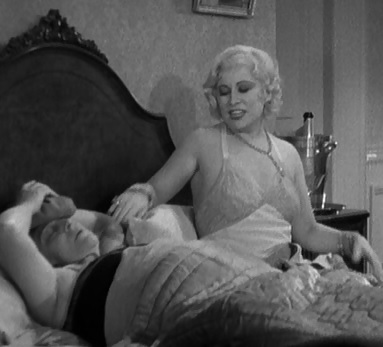
The next time we see the two of them, they’re in bed together at Joe’s after a bender. It does the heart good to witness them:

WestandSkipman
West only agreed to play the part of Maudie if she could write her own scenes. Thank goodness she did. Supposedly, Raft later claimed West “stole everything but the cameras.” What he didn’t say is that none of us would have wanted to see the film at all, had she not.

For more of my monthly West posts, click here.

Share
Posted in: 1930s films, Comedies (film), Feminism, Mae West Moments, Romantic Comedies (film) Tagged: Mae West, Night after Night

Female’s Heroine: 1933’s Amy (of Trainwreck), Samantha Jones, or Don Draper?

08/27/2015 by leah@carygrantwonteatyou.com 4 Comments

RuthChattertonFemalefilm
Given its plot synopsis, I expected Female to be shocking: a promiscuous executive casually sleeps with men until she finds the right guy. But I didn’t expect to gasp at its daring. A few of the heroine’s typical comments:

Falling in love: “To me, a woman in love is a pathetic spectacle. She’s either so miserable that she wants to die, or she’s so happy you want to die.”

Marriage: “No thanks, not me. You know a long time ago I decided to travel the same open road that men travel, so I treat men exactly the way they’ve always treated women.”

Husbands: “Of course, I know for some women, men are a household necessity. Myself, I’d rather have a canary.”

Then there’s a typical night. She…

1. Spots a handsome employee, feigns interest in his ideas, and asks him to come over to her house that night to discuss them.

2. Discourages business talk with flirtation, as when she says, “Are you naturally enthusiastic?” to a new hire, throwing a pillow onto a plush rug with a suggestive look.

RuthChattertonflirting2
3. Orders vodka from her butler, who informs the rest of the staff of the Catherine the Great custom: serving it to soldiers “to fortify their courage.”

4. Exercises with vigor the next morning, clearly energized by the tryst, and comes up with new ideas for the business.

5. Rejects the romantic overtures of her one-night stand, annoyed by his flowers, then offers him a bonus as a kiss-off. She doesn’t want to deal with the moodiness of emotional men at work. (Women, how many times have films suggested this about us?)

At first, I thought the movie would be like Trainwreck, as Alison (Ruth Chatterton) certainly displays the same level of disinterest in building a romance with her one-night stands and blows off a guy after he calls her “ethereal” and otherwise indicates their lack of sexual heat:

Annoyed by his flowery (nonsexual) language
Amy and Alison have an impressive list of conquests, and not only express disinterest in matrimony and kids for themselves, but for others, as when Alison can’t be bothered to remember her friend’s husband’s name, or how many kids she has–much like Amy’s (Amy Schumer’s) scene at her sister’s shower. Both heroines are funny and mostly likable, as when Alison worries about her chauffeur, who has taken a punch in her honor: “Now listen, Puggy, things people say about me don’t bother me,” she says with a lovely smile. “Thanks just the same.”

But in terms of power–and what they do with it–there’s no comparison. After one-night stands fueled by liquor, Amy, hungover, struggles to get through the day.

AmySchumerTrainwreck
Alison, in contrast, looks alert, pretty, and pleased with herself, and does a brilliant job at work afterward. The word “trainwreck” is about as far from Alison Drake as a term can be.

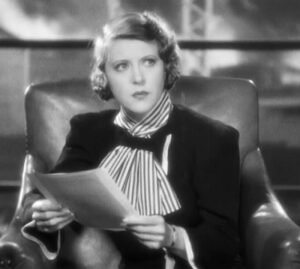
Like her more direct heir, Samantha Jones, Alison practically bristles with authority and confidence, but unlike Samantha, she has a whole auto factory full of employees.
RuthChatterton-businessFemale
One criticism of Sex & the City was that it never took the work as seriously as the characters’ personal lives, which made it less feminist than it could have been. Here, the heroine has no chance for tight friendships, but finds her work thrilling: “Oh, but I love it: the battling, the excitement; I don’t think I could do without it now.” I soon found myself as interested in the business–such as her decision to go with automatic transmission–as in the flings, not something I expected to experience with a romantic comedy.

Like Samantha, Alison wants to sleeps with her hot employees–only in Alison’s case, she does. (Samantha waits to fires hers first).

SamanthaJonesandrudeassistant
In fact, Alison has sex with so many of them that there are a flood of bonuses on the company payroll, like some kind of stud fee. Her leer at a new designer is as hilarious to witness as Samantha’s undressing looks. And as with Samantha, her vulnerabilities are evident–in her case, a fear that men are angling for her money rather than her personality or body (either would be fine).

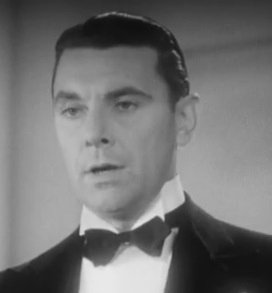
While it’s easy to admire Alison’s moxie, she’s guilty of sexual harassment throughout the story, as when her secretary shows her too much affection after their affair, and she transfers him to Montreal. Promptly afterward, this lovesick conquest watches the latest one-night stand leave her office and calls, “I’ll see you in Montreal.” When Alison falls for Jim (George Brent), mainly because he’s hard to get, his anger at her regular nightly ploy earns our admiration; he won’t sleep with her to keep his job, he retorts.
GeorgeBrentFemale
While she initially decides to fire Jim’s secretary, assuming the two are involved, and then plans to overload her with work, she quickly reconsiders, deciding not to be petty. While she’s still in murky moral territory due to her liaisons with subordinates, she doesn’t reach full anti-villain status, since she won’t fire someone for turning her down or stealing her guy. Still, it’s hard to forget that shady transfer…and how much she reminds us of Don Draper with his secretaries on Mad Men.

I stopped the film multiple times as the end neared, fearful about whatever sexist cliché it was headed for. This character was simply too complex, and Chatterton too wonderful in the role, for me to watch some reductive conclusion.

RuthChattertoninFemale
I was right to be scared (though I feared it would be worse). Oddly, Jim, till then annoying in spite of his rebellion, demonstrated unexpected feminist leanings near the close. Too bad the screenwriters and director chickened out and tacked on totally unbelievable concluding lines.

Despite its shock value and fascinating lead, the film hasn’t reached the popularity or accessibility today it deserves. I could only locate it in DVD form on Netflix, and went for the free month trial of streaming with Warner Archive instead. Go to the effort; it’s worth it.
Share
Posted in: 1930s films, 1990-current films, Anti-Romance films, Comedies (film), Feminism, Romantic Comedies (film), TV & Pop Culture Tagged: ahead of its time, Amy Schumer, Female (1933), Mad Men sexism, promiscuous women, Ruth Chatterton, Samantha Jones, Trainwreck

Pretending to Be Contagious: 2 Comic Scenes

08/02/2015 by leah@carygrantwonteatyou.com Leave a Comment

In one of my favorite scenes from The Thin Man series, Nick Charles pretends his wife is contagious for laughs. It made me think of outbreaks, and how they’ve been used to panic audiences—or amuse them. Somehow funny scenes so often result from mocking our greatest fears. So on the lovely actress’s birthday, here’s that scene—and another like it from many decades later—when the characters mess with the crowds around them for very different reasons.

Eliminating Suitors: Nora in Another Thin Man (1939)
Nora’s (Myrna Loy’s) considerable sex appeal is a joke in many of The Thin Man movies. Ex-cons can’t believe someone so desirable could be Nick’s wife instead of his mistress. Men follow her and hit on her constantly. Just look at her.

MyrnaLoy-AnotherThinMan
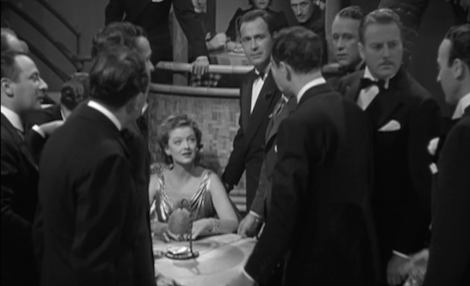
Who wouldn’t? When Nick (William Powell) seeks his wife in Another Thin Man, he finds a crowd of men vying for her attention.

NoraCharlesCrowd
To clear them away quickly, he begins, “Now Mommy, you know better than to come to a place like this your first day out of bed. What if the health officers find out? They’ll put you right back in quarantine.”

At first, her expression suggests she may be annoyed by his ploy. But her response tells us otherwise: “I won’t stay in quarantine. I don’t care who catches it.”

The two are instantly alone. Whether this routine is a regular gag with them (it seems so practiced) or just a function of their quick-wittedness, the couple delivers it—as they do everything—beautifully.

Cracking Themselves Up: Sam & Carl in Ghost (1990)
We witness a smirk from Sam (Patrick Swayze) as soon as he and his friend Carl (Tony Goldwyn) enter the elevator of their business in Ghost. We know therefore whatever follows is a gag of some kind. Clearly, there’s some level of improvisation to their conversation, with each trying to outwit each other, and out-gross-out their unlucky audience.

Swayze-GhostElevatorScene
Carl starts coughing.

Sam: “How you feeling? What did the doctor say?”

Carl: “He ummm said that it was contagious. That it was really—”

Sam: “No.”

Yeah. “Yeah. He said that I shouldn’t even be coming in today.”

Sam: “What about the rash?”

Carl: “The rash?”

Sam: “Mmhm.”

Carl: “The rash is ummm also incredibly contagious. He said that…will…spreading.”

Of course, it gets even grosser from there…and the two act like 10-year-old boys instead of grown men in enjoying their little joke.

I  think I enjoy silly scenes like these because I know I would be far more likely to be the one decamping than the one making the joke. I would be the butt of the ploy, and can’t help but smile at how easily these characters would play me.

Share
Posted in: 1930s films, 1990-current films, Romantic Comedies (film) Tagged: contagious, Ghost, movies outbreaks, Myrna Loy, Nick and Nora Charles, Patrick Swayze, The Thin Man

Mae West Quote of the Month: No Evidence

07/23/2015 by leah@carygrantwonteatyou.com 2 Comments

MaeWestSheDoneHimWrong
Lady Lou (Mae West) is the heroine of She Done Him Wrong (1933), the hilarious Oscar-nominated, pre-Code movie based on West’s play, Diamond Lil. The film opens in a Bowery bar in the Gay Nineties. Many of the customers are discussing Lou’s attractions, thanks to a new nude portrait of her on the wall.

Lou rides up in a carriage, with women staring at her disapprovingly, and men staring at her very approvingly.

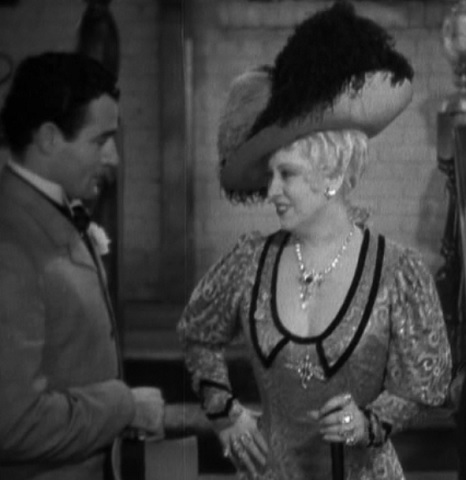
She enters the bar with the customary West strut, and is quickly introduced to Serge (Gilbert Roland) by her boyfriend, Gus. She reflects on Serge’s good manners in kissing her hand and smiles at him alluringly, as West is wont to do.

“I’m delighted,” Serge (Gilbert Roland) says. “I have heard so much about you.”

“Yeah,” Lou quips, “but you can’t prove it.”

If that line can’t get you through the day smiling, no worries. Just watch five minutes more of the film.

Share
Posted in: 1930s films, Comedies (film), Feminism, Mae West Moments, Romantic Comedies (film) Tagged: Diamond Lil, Lady Lou, Mae West, Pre-Code

Satirizing Consumerism: Easy Living

07/19/2015 by leah@carygrantwonteatyou.com 4 Comments

I’ve never liked shows like Lifestyles of the Rich and Famous. I’m uninterested in what Paris Hilton spent on a dog palace, am only slightly amused by what Sony Bono paid to fly his hat. I’ve never understood the point. Am I to envy? To condemn? I’m as prone to consumerism as the next American, but it’s easy to watch The Queen of Versailles and think, I would never expect a rental car company to supply a driver. What entitlement! Now where is that amazing silver necklace on Etsy…

I know my part in America’s deploring—and dangerous—overconsumption is something I should ponder, but these stories so rarely implicate average Americans, or say anything interesting about the culture most of us rarely question.

That’s why I like Easy Living (1937), an airy comedy about a girl just scraping by who—due to a series of misadventures—is mistaken for a banker’s mistress, and flooded with offers of well, everything, in return for just a tip or two about whether steel is up or down this week. What this fictional movie supplies that other shows and documentaries lack is a perspective on capitalism run stupid I rarely see, but have experienced: befuddlement.

JeanArthurhitbycoat
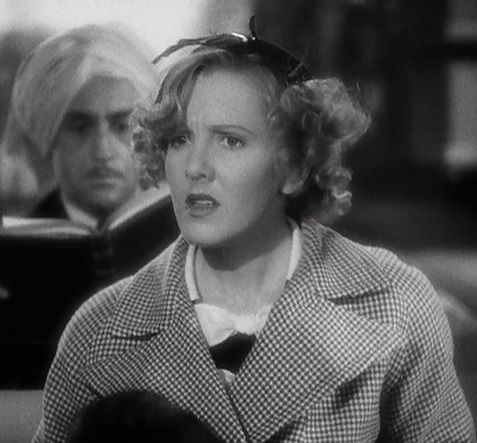
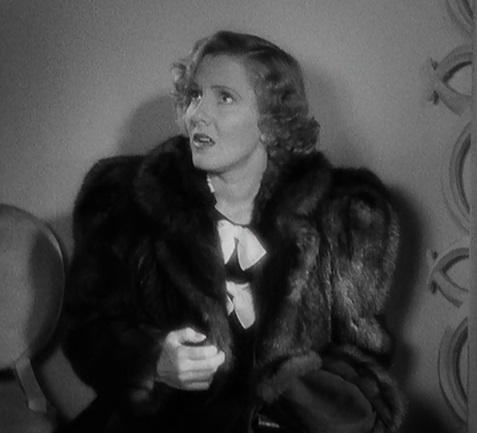
Our heroine, Mary Smith (Jean Arthur), enters the film on a streetcar. A sable coat suddenly lands on her head. Does she try to discover its origins? Does she ponder the nature of serendipity, or “kismet,” as her religious fellow passenger does? No. It ruined her hat, she can’t afford to replace it, and now she has to be late for work to help the idiot who threw it.
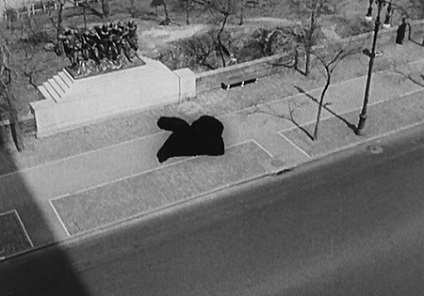
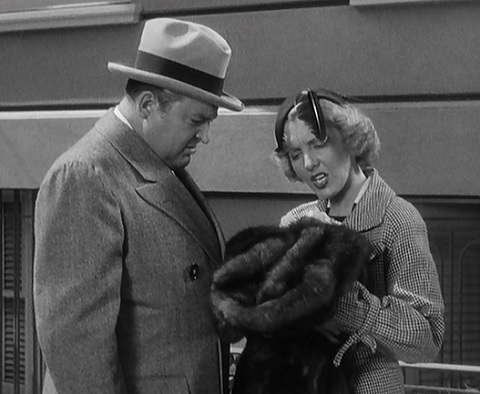
She approaches the banker (Edward Arnold) responsible for the coat’s airborne condition.

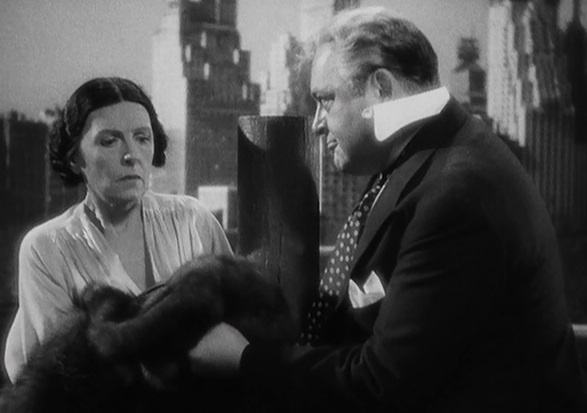
ArthurandArnold-EasyLiving
Moved by her innocence, he gives it to her, and a new hat besides. She takes the gifts as payback and benevolence, rather than as signs of sexual interest. Unfortunately, her stuffy employer doesn’t share this interpretation. He fires her for immorality.

Soon afterward, she befriends John Ball, Jr., the banker’s son (Ray Milland), after he steals a meal for her. Accompanied by her new knight-in-disguise, she starts getting offers from those who, like her employer, consider her a strumpet, but are glad she is. A hotel proprietor (Luis Alberni) offers her a room, hoping to extend his loan with her benefactor. She takes it, with no idea why it’s been offered. Her increasing confusion as questions and freebies fly her way is hilarious to witness.

The film is a pleasure for many reasons, Jean Arthur first among them. As a satire of consumerism, it’s incisive and often dark despite its frothiness, as these three scenes reveal:

1: The Coat
The banker, J.B. Ball (Arnold), begins the day disgruntled. He grumbles over his hearty breakfast, fights with his son (Ray Milland) over an expensive foreign car, then discovers this bill from his wife (Mary Nash):

bill-Sable
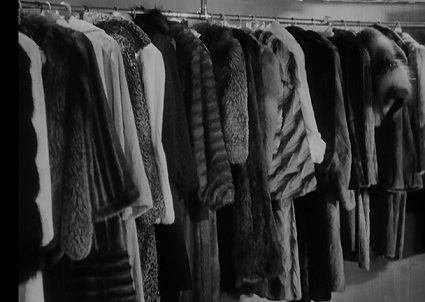
He storms into her room, demanding why she needs such a luxury, especially with a closet like this:
furcoats
She defends herself, claiming her other furs are out of fashion, that she doesn’t have so many, and then she runs away with the sable, impeding his race after her. The fight ends with some rooftop wrestling.

coatfightNashArnold
And one big toss:

flyingcoat
The rich banker, complaining of his family’s extravagance, tosses out a fortune like a tissue. (I wish I could claim the rest of us never show such hypocrisy, even if less flamboyantly/expensively expressed…)

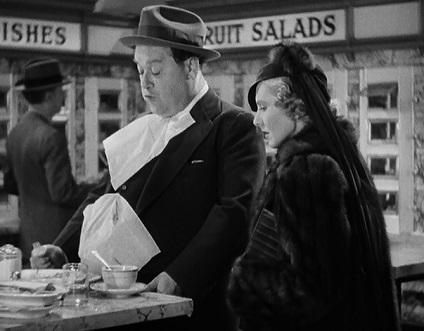
2: The Automat
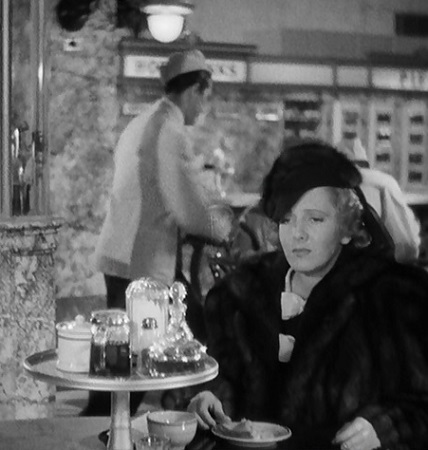
Mary doesn’t have enough money for a decent dinner, but enough appetite to envy those who do:

ArthurasMarySmith-hungry
She’s at an automat, a kind of vending machine restaurant with windows of entries. When the banker’s son (Milland), who is working there, suggests in a misplaced effort at flirtation that she have the meat pie, she retorts, “If you can suggest where to get the nine nickels, I might take your suggestion; otherwise, don’t go around putting ideas in people’s mouths.”

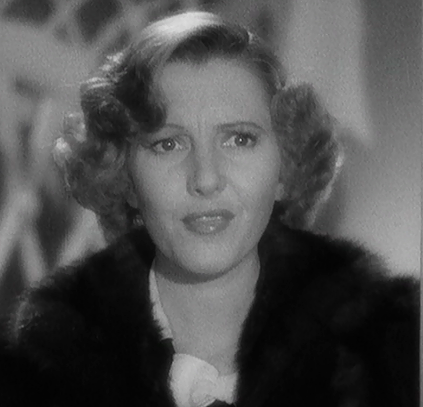
When he offers to spring a door so that she can steal one, she at first resists. But as she attempts to eat her humble meal, she reconsiders.

miserable
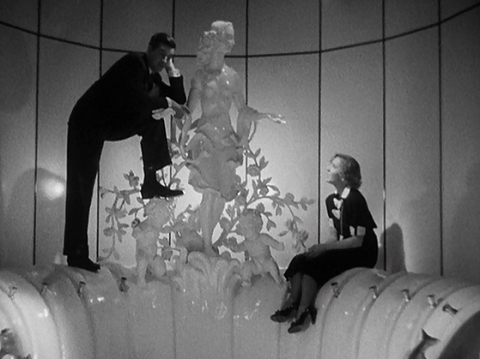
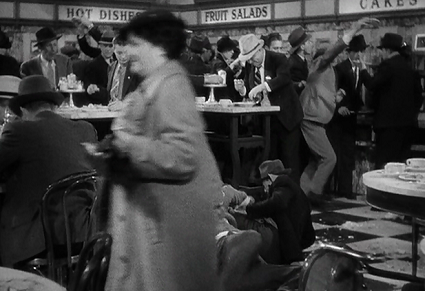
Of course, she breaks down, and of course, a security guard catches Junior, who promptly starts a fight that leads to a free-for-all at the automat the two barely escape.

automatgonewild-EasyLiving
This simple portrayal of the hunger an underfed woman feels as everyone around her overconsumes was a bit too on point to be funny. It did give me a fun flashback of when a vending machine in college went haywire, and I made out. But it also reminded me of when I returned from a visit to Ghana, and was overcome by the excessive options in my grocery store.

The Room
Lifestyles of the Rich and Famous couldn’t possibly capture the luxuriousness of a hotel run by Mr. Louis Louis (Alberni). When he displays a suite for Mary, he can’t even remember its layout, though he does remember to attack the competition’s inferior claims. What other Imperial Suite could boast 5 reception areas, and this monstrosity for a bathtub?

bathtubdisplayEasyLiving
Mary is not impressed by such affectations. She is–quite frankly–confused why anyone would want such nonsense.

JeanArthurconfused
Once alone, she’s even a bit frightened.

scaredJeanArthur
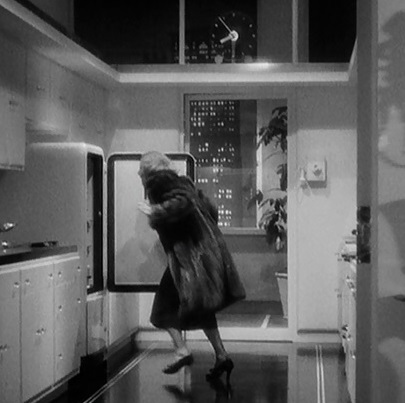
She doesn’t know what to do with any of it, until she remembers one feature in this new suite of hers, and finally feels what Mr. Louis Louis wanted her to feel. She tears across the room, running past all the silk and marble and chandeliers to one thing that she considers worthy of attention: the fridge.

fridge
Only to find it empty.

As a satire of luxury, it’s hard to imagine any scene harsher than this one. Trust writer Vera Caspary (of Laura fame), who penned the story, and screenwriting genius Preston Sturges to lacerate us with their black humor. Even though the critique is cloaked in pratfalls and silliness, it’s still there for us to see. Maybe all these years later, the lesson will actually penetrate our own product-loving minds….at least until the holidays.

Share
Posted in: 1930s films, Romantic Comedies (film) Tagged: capitalism, consumerism, Easy Living, Jean Arthur, Lifestyles of the Rich and Famous, Preston Sturges, satire, The Queen of Versailles, Vera Caspary

Mae West as a Deadpan Plaintiff in I’m No Angel

06/26/2015 by leah@carygrantwonteatyou.com 11 Comments

I'mNoAngel-CourtroomScene
This post is part of the The “…And Scene!” Blogathon. Check out the other entries here.

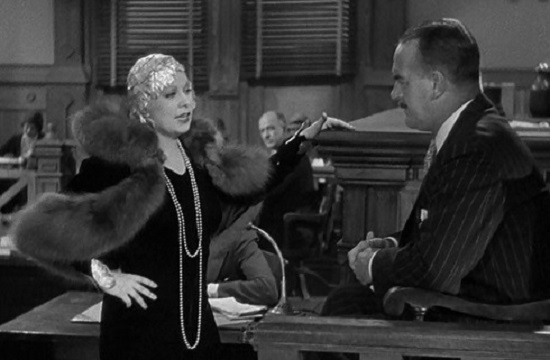
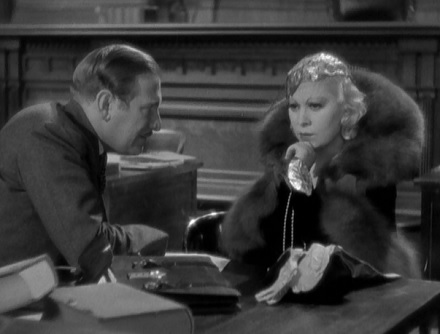
There are very few scenes in film as funny as when Mae West is talking about the number of men in her life, or, as she famously put it after the courtroom scene in I’m No Angel, the much more important amount of “life in your men.”

I’m a sucker for courtroom scenes in general, but most are thrilling, dramatic. I admit that a few are funny–From the Hip, Seems Like Old Times–but there’s nothing like Mae West on a roll, and every second of the courtroom scene of this glorious pre-Code wonder is the actress (and writer) at her best.

Tira, a circus performer, is suing her wealthy fiancé (Cary Grant) for breach of promise. He broke off their wedding because he saw another man in her place while she was out, not knowing it was a set-up by her boss, who didn’t want to lose her successful act to matrimony.

Unsurprisingly, the defense attorney immediately tries to besmirch Tira’s reputation, suggesting she gets around, that she has a “colorful past.”

In another movie, we might expect shame, embarrassment, hostility at such an attack. But this isn’t just any movie.

“Well, I gotta admit, I’ve been the love interest in more than one guy’s life,” Tira agrees. “I don’t see what my past has got to do with my present.”

“We shall show that to the satisfaction of the court, I believe,” the attorney primly responds. “Nevertheless, the fact remains that you’ve been on friendly terms with several men.”

“Alright, I’m the sweetheart of Sigma Psi. So what?”

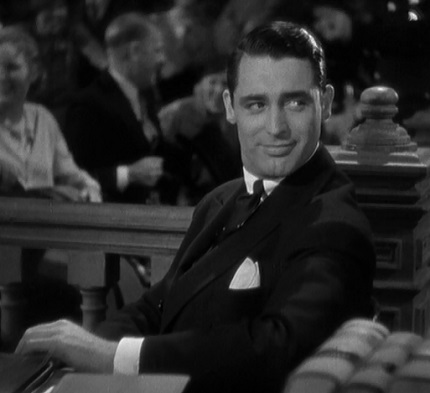
The audience in the courtroom aren’t the only ones laughing at her quip. Even the defendant can’t resist.

CaryGrantI'mNoAngel
When she’s scolded by the judge for not answering the question, she coos at him in response. (He will later take her on a date.)

MaeWest-judge
The attorney presses on, undeterred, referencing a bunch of (obviously married) men by name, asking if she knows them.

“I do recall their faces,” she answers, “but them ain’t the names they gave me.”

Appalled, her own lawyer asks for a recess and chides her for admitting to such an active dating life.

Tira is unrepentant: “Why shouldn’t I know guys? I’ve been around. I travel from coast to coast. A dame like me can’t make trips like that without meeting some of the male population.”

He explains that she can’t win the case. She considers her options.

MaeWest-court-strategy
And then asks if she can question witnesses herself.

It’s at this point that West really hits her stride–literally. Because she gets to walk up and down past the jury box, practicing her famous strut repeatedly, flirting with everyone in the courtroom.

She treats her accusers with disdain, slamming their efforts to make her look bad, and saying, “OK, I’m through with you,” after she completes her questioning. Between witnesses, she asks the jury, “How ‘m I doin, hmmmmnnnn?”

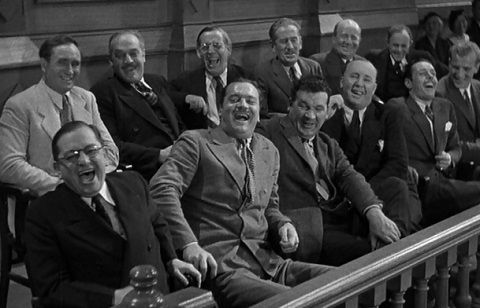
For once, jury duty has proven to be a blessing. Just look at their reactions to her performance:

I'mNoAngel-jury
As Tira concludes, her lover (Cary Grant) can’t handle it anymore and admits defeat. He’s fallen more in love with her than ever, as we have. Who cares if she’s the sweetheart of Sigma Psi? She’s Mae West, idiot. Catch her while you can. Case closed.

Share
Posted in: 1930s films, Blogathons, Mae West Moments, Romantic Comedies (film), Uncategorized Tagged: best courtroom scenes, Cary Grant, I'm No Angel, Mae West, Pre-Code

Love It, Love It Not?: Waffling over Lubitsch’s Design for Living

06/13/2015 by leah@carygrantwonteatyou.com 2 Comments

DesignforLiving
I hoped to love Design for Living. After all, the director was Ernst Lubitsch, who had helmed such witty, cynical comedies about relationships, movies that usually feel as insightful and controversial now as they probably did back in the 20s and 30s. And many reviewers I respect had praised its humor and star.

But….

I found myself teetering back and forth throughout the film—This is wonderful! This is bad!—so, like a gal tearing apart a flower over a crush, I’m going to explain its effects the best way I can:

Love It #1: Subject Matter & Morality

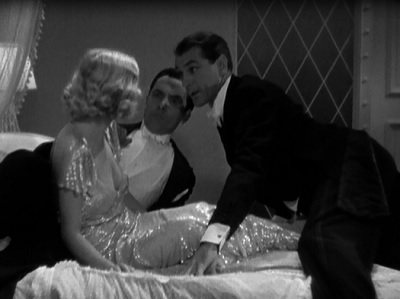
Gildasthreesome-DesignforLiving
Design for Living features a threesome—surely interesting coverage for a film of our time, much less in 1933. (An underrated film I watched in college, Threesome, got a lot of heat back in 1994 for its coverage, even though it was far less flip about the results of the tripling than Lubitsch’s.) I find stories about unusual relationships intriguing, and this is certainly one of them.

Knowing two roommates want her, Gilda tries to remain platonic with them. She attempts to preserve their friendship and guide their artistic successes (one is a playwright, the other a painter). Her catch phrase is “No sex.” Of course, she gives in to her own desire and theirs, repeatedly.

What’s interesting about the film is the utter lack of judgment about the heroine having sex with both men (in turn, rather than together), or later, wanting to leave her husband to resume the romance. Lubitsch’s touch is so incredibly light that we never blame Gilda (Miriam Hopkins) or her lovers, even though it would be easy to think of her actions, and theirs, as betrayal. Instead, we root for Gilda to stay with both men, as their happiness and hers seems most assured when their playful, sexually charged unit is intact.

Love It # 2: Its Opening
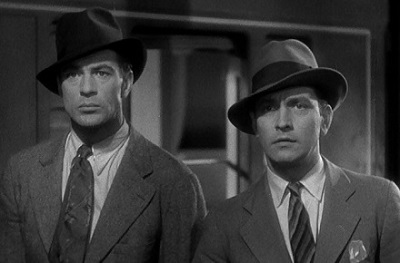
The plot begins with Gilda drawing a rather merciless caricature of two strangers in her train car, Tom (Fredric March) and George (Gary Cooper). Her humor and confidence are breathtaking. Her casual decision to put her legs up on their seat, her amused reaction to their annoyance at her picture, and their own exuberant attraction to her are a pleasure to watch. Although the development is almost too quick, their move from prickly insecurity to joy in each other’s company is funny, and such a convincing depiction of youthful spirits that it made me laugh.

Love It #3: Its Heroine
The film stars Miriam Hopkins, whom I’ve always thought I should like more than I do, which was confirmed by persuasive defenses of her work in a recent blogathon.

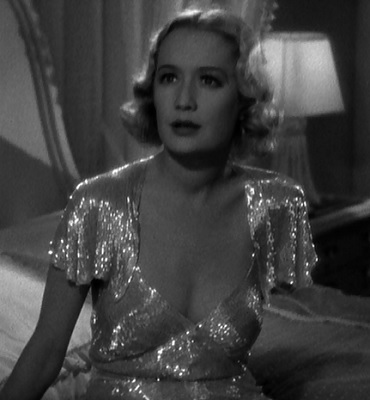
MiriamHopkinsDesignforLiving-2
Although she can be dramatic in the film, my usual objection to her, that theatricality suits Gilda’s personality. After all, Gilda imagines herself the driving force behind multiple men’s artistic successes—not to mention their sexual satisfaction. I love that Gilda has utter confidence in her own role as a lover and commercial artist, but quickly sets about fixing the two men’s wobbly self-esteem. Her defense of a woman’s need to try out men like hats is hilarious, and amazingly ahead of its time. Her assurance and energy made me a fan of hers throughout, and always curious what she’d do next.

But….here’s the thing: Despite my enjoyment of these aspects of the film, I didn’t laugh that much, and had to wonder why, which brings me to…

Love It Not #1: Gary Cooper
Oh Gary. He just wasn’t formed for comedy. While his gawky, unnatural goofiness in Ball of Fire seemed to capture his academic persona, the same portrayal here rings very false. He is not convincing as a painter, as a lover, or as a spirited friend. I just wanted to hide my eyes or send him to acting class every time he was on the screen.

Love It Not #2: Edward Everett Horton as Deus Ex Machina
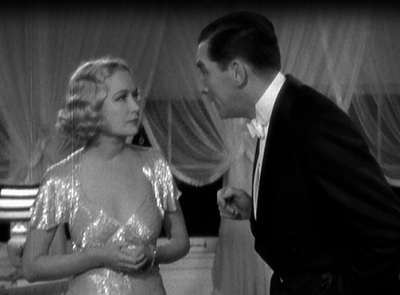
Whereas Cooper pains me in comedy, Horton delights me. But here, his role as Gilda’s boss and competing love interest was laughable—at best. The chemistry between Hopkins and Horton was so nonexistent that I felt like one of them was green screened in every time they were together.

HortonandHopkins

Threatened by...Horton?

Threatened by…Horton?

In addition, the mood between the three lovers is so light and Gilda’s own personality so ebullient that her desperate decision to throw herself at her boss to avoid Tom and George felt like the plot twist of a first-time playwright (which Noël Coward, the story’s creator, was not; apparently, the film barely resembled the play).

Speaking of poor playwrights….

Love It Not #3: These Three—Artists?
I can’t say I’m expecting realism in my comedies, but Hopkins’ drawing in the first few minutes of the story was so patently fake that it took my attention away from the film. (Why not an actress? Gilda definitely has that temperament.)

MiriamHopkins-DesignforLiving
But she’s Degas compared to Cooper, who may be the most unlikely painter ever to grace the screen, and Fredric March is not much more convincing as an author.

I get that a threesome seems Bohemian, and failed artistic aspirations are glamorous in the way poverty only can be in Hollywood portrayals, but come on. Making them artists felt like a cheap way for the writers and director to avoid the audience’s questioning of the characters’ behavior. (Those artists with their loose morals!) And the script is so thin that some truly adept performances were required. Unfortunately, not one of these casting choices fit the material fully. March reminded me so much of Gene Kelly that I could have believed in a little tap dancing. But he looked about as uncomfortable with that typewriter as Cooper did just being there.

In Conclusion….
So some loves, some nots. In the end, I’m glad I saw the film. The unabashed approval of this very untraditional relationship is breathtaking. There are some marvelous lines (my favorite, the “gentlemen’s agreement” to not hook up). The conclusion is a blast to watch. And Hopkins is riveting throughout. Just don’t expect that usual Lubitsch magic, and you’ll enjoy it.
Share
Posted in: 1930s films, Feminism, Romantic Comedies (film) Tagged: Design for Living, Ernst Lubitsch, Fredric March, Gary Cooper, Miriam Hopkins, Pre-Code, review, threesome
« Previous 1 2 3 4 5 6 7 8 9 Next »

Recent Posts

  • Great Spectacle, Romance Misstep: The Miracle Woman
  • Bite-Sized Film Reviews
  • How You Know Your Friends Know You
  • National Classic Movie Day!
  • Colbert’s Midnight (1939), Rom-Com Magic

Subscribe to Blog via Email

Enter your email address to subscribe to this blog and receive notifications of new posts by email.
Categories

  • 1920s films
  • 1930s films
  • 1940s films
  • 1950s films
  • 1960s films
  • 1970s films
  • 1980s films
  • 1990-current films
  • 2020s films
  • Action & Sports Films
  • Anti-Romance films
  • Blogathons
  • Childfree
  • Comedies (film)
  • Drama (film)
  • Feminism
  • Femme fatales
  • Film Noir/Crime/Thriller & Mystery
  • Gloriously Silly Scenes
  • Horror
  • Humor
  • Mae West Moments
  • Musicals and dancing films
  • Oscars
  • Random
  • Romance (films)
  • Romantic Comedies (film)
  • The Moment I Fell for
  • Turn My Sister into Classic Movie Fan
  • TV & Pop Culture
  • Uncategorized
Share
Classic Movie Blog Hub Member

Recent Comments

  • Dominique Revue on Great Spectacle, Romance Misstep: The Miracle Woman
  • leah@carygrantwonteatyou.com on Great Spectacle, Romance Misstep: The Miracle Woman
  • Dominique Revue on Great Spectacle, Romance Misstep: The Miracle Woman
  • leah@carygrantwonteatyou.com on Great Spectacle, Romance Misstep: The Miracle Woman
  • Waleed on Great Spectacle, Romance Misstep: The Miracle Woman

Archives

  • November 2026
  • June 2026
  • May 2026
  • March 2026
  • November 2025
  • September 2025
  • May 2025
  • March 2025
  • January 2025
  • November 2024
  • August 2024
  • July 2024
  • May 2024
  • March 2024
  • February 2024
  • December 2023
  • November 2023
  • October 2023
  • September 2023
  • August 2023
  • July 2023
  • May 2023
  • April 2023
  • March 2023
  • January 2023
  • December 2022
  • November 2022
  • September 2022
  • July 2022
  • May 2022
  • April 2022
  • March 2022
  • February 2022
  • October 2021
  • September 2021
  • April 2021
  • March 2021
  • February 2021
  • December 2020
  • October 2020
  • September 2020
  • July 2020
  • May 2020
  • April 2020
  • March 2020
  • February 2020
  • December 2019
  • October 2019
  • September 2019
  • June 2019
  • May 2019
  • April 2019
  • February 2019
  • January 2019
  • November 2018
  • September 2018
  • July 2018
  • June 2018
  • May 2018
  • April 2018
  • March 2018
  • February 2018
  • January 2018
  • November 2017
  • September 2017
  • August 2017
  • July 2017
  • June 2017
  • May 2017
  • April 2017
  • March 2017
  • February 2017
  • January 2017
  • December 2016
  • November 2016
  • October 2016
  • August 2016
  • July 2016
  • June 2016
  • May 2016
  • April 2016
  • March 2016
  • February 2016
  • January 2016
  • December 2015
  • November 2015
  • October 2015
  • September 2015
  • August 2015
  • July 2015
  • June 2015
  • May 2015
  • April 2015
  • March 2015
  • February 2015
  • January 2015
  • December 2014
  • November 2014
  • October 2014
  • September 2014
  • August 2014
  • July 2014
  • June 2014
  • May 2014
  • April 2014
  • March 2014
  • February 2014
  • January 2014

Meta

  • Log in
  • Entries feed
  • Comments feed
  • WordPress.org

Copyright © 2026 Cary Grant Won't Eat You.

Church WordPress Theme by themehall.com