Oscar Rant, Part 3: Flower Moon’s Many Missteps
Spoilers–but not as many as Scorsese’s
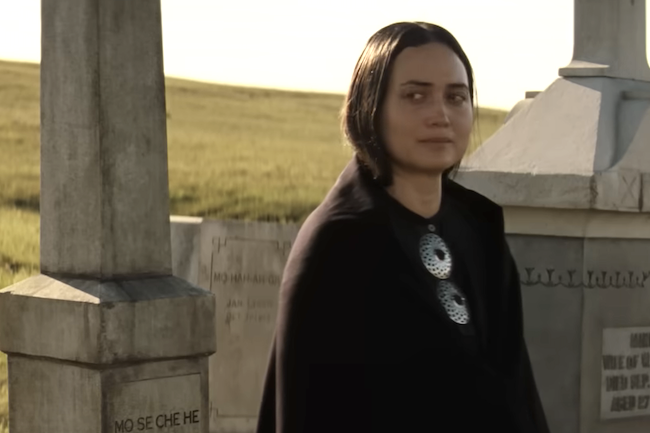
I knew I would struggle to warm to Martin Scorsese’s interpretation of a well-loved book. Killers of the Flower Moon is a heartbreaking, fascinating page turner. And it is a history book. I stayed up till 4 am to finish it. What I didn’t expect to do in watching Scorsese’s film of the same name was flinch. In trying to stay authentic and true to the Osage people, Scorsese walked into one of the oldest stereotypes. And the Academy is about to give his starring actress an Oscar for it.
The dignified, long-suffering man or woman of color is one of those stereotypes Hollywood has struggled to shake. There’s also a smug, self-satisfied attempt to award such films and performances with honors (Green Book, Driving Miss Daisy, The Help). When it comes to a group of people our country systematically oppressed, robbed, and killed–like the Osage and so many other American Indian tribes–granting the characters dignity can feel like a kind of reparation, minor as it may be. But it’s also dehumanizing to reduce a person to such a narrow set of traits.
I understand that Scorsese’s task was not easy. The American historical record is simply more complete when it comes to white men than for anyone else. Author/historian David Grann likely made FBI agent Thomas Bruce White Sr. his central character in part because he had so much information on him. Grann even includes a fascinating later history of his mercy toward prisoners who injured him in a prison break, which helps us understand the kind of man who would risk his life for others. And White was, indeed, a hero, and a fascinating one at that.
I get Scorsese’s attempt to avoid the white savior story he risked writing if White were his lead. But he had a dilemma: What do we know about Mollie Burkhart (Lily Gladstone)? We know she was rich. We know she lost many relatives to murder. That she believed in her husband, Ernest Burkhart (Leonard DiCaprio), far longer than she should have. We know that she was very sick. That’s not enough detail, if she’s your central figure. It was up to Scorsese to breathe life and complexity into her characterization, to make her wholly human in the way our 1920s racist, sexist historical record would not grant her–or lean on the descendants or family members who could tell him more.
Alas, Scorsese’s never been very good at female characters. This is no exception. Besides brief glimpses of a more complex woman during the courtship, he has her either sitting or in a sickbed looking resigned, sad, and stoic for 90% of the film. We don’t even feel the menace or experience her fear as she’s poisoned, as we would for a Alfred Hitchcock heroine, because we have little sense of her inner life.
We don’t get to see a sense of humor or any unique, humanizing quirks–we only know that she suffered. And with Eric Roth as his cowriter, whose credits include Forrest Gump (another film with underdeveloped female characters), what hope did he have of getting it right? Why, oh why, can’t this brilliant man recognize his limitations? There’s nothing wrong with specializing in dark white men as a genre. But this was not the subject matter for that focus. Why not let someone else write the screenplay? An Osage female writer would have been amazing; at the least, Scorsese could have chosen a woman.
Mollie’s is not the only half-baked characterization of the Osage in the film. The subtitles only occasionally translate the Osage language, which is used extensively. Instead, the subtitles spell out something like “speaking in Osage,” which was 1. evident 2. useless 3. distancing. Why not help us know the characters better by having them speak in English if you’re not going to bother to translate? (I kept hoping this was an issue with my streaming service, but I doubt it.) The occasional group scenes with Osage leaders stating the obvious didn’t help.
There was a fascinating real-life federal agent, John Wren (Tatanka Means), the only Native American who’d worked for the bureau by then. He assisted with the investigation and appears briefly in the film, and I kept thinking that Scorsese should have focused the narrative on him. What a fascinating angle that would have been! He was still an outsider to the Osage, but had more of an insider’s angle than the rest of the agents.
Instead, Scorsese doubles down on Leonardo DiCaprio’s Ernest, even minimizing the degree of his crimes by not covering his whole plan (or at least, tacit acceptance of the plan) to include his son and wife in the blow-up-the-house plot. Did he love Mollie? He seemed to in the book–and in how he handled the trial. But many dangerously abusive men have loved the women they attempt to murder. I’m not really interested in getting inside of their heads. Are you?
Also, where’s the excitement? We believe Ernest is pretty innocent for a long while in the book. We don’t know his uncle is a monster. The reveal is breathtaking in the book. Leaving out the suspense is a baffling choice.
It’s a shame to see all the wasted potential here: Robert De Niro is good in it and DiCaprio great (even if they are miscast; De Niro is no cowboy and both are at least two decades too old for their parts). Gladstone is very good with what she had to work with, and captures what we know of Mollie well. I enjoyed her subtlety.
There are so many beautifully shot scenes. That moment right before the bomb was especially powerful, as was the federal agents’ gathering scene. Scorsese shares the history and legal status of the Osage’s rights (or rather, lack of rights) without bogging down the narrative–not an easy thing to do. I thought the best part of the film was the start of the investigation by the private eyes: Whenever Scorsese feels comfortable, he does such great work. I loved how the movie helped me keep the characters straight, something I struggled with in an overpopulated book.
A lesser-known director might not have gotten this important story made into a film; I wanted so much to like it. Scorsese’s earnest attempt in that ending to finally give Mollie her due made me sad; I don’t think he succeeded. But maybe he’ll draw people back to the book, which does. I guess I’ll have to take some satisfaction in that.
