Cary Grant Won't Eat You

Classic movies for phobics

  • About
  • eBooks
  • Previous Blogathons
Classic movies for phobics

film noir

Escaping Out of the Past (1947)
09/01/2025 by leah@carygrantwonteatyou.com 6 Comments
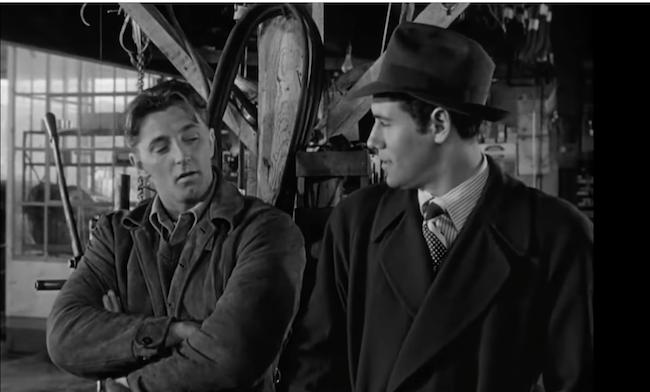
Jeff (Robert Mitchum) talking to a henchman in Out of the Past.


Spoilers coming.

Oh Jeff, I get why you fell for Kathie (Jane Greer). That sexy voice, her air of mystery, those all-white get-ups, vacation drinks, and her nonchalant response to your chase. You really had no hope, did you? Especially once she started toweling you off from the rain.

Yeah, you were a goner, my friend. That was a given.

But I give you credit. You saw her shoot your former partner and realized too much siren for me. You viewed her clearly after that. When your new, sweeter lady love defended her by saying, “She can’t be all bad. No one is,” you (justifiably) answered, “She comes the closest.”

You are right that you were a chump, falling for a homicidal moll’s lies, but honey, in the world of noir suckers, you are Albert Einstein. You learned. You improved your life and your dating judgment (a lot of us don’t make it that far).

Problem is, my friend, you need to work on your shadiness. The detective career is not one in which fisticuffs save you from a bent former partner. You don’t have to kill, but you must learn some trickery and bluffing. To be honest, I’m not sure how you’ve remained above ground this long. I might not approve of Kathie’s answer, but I understand why she thought your self-defense inadequate.

You said it yourself when Ann’s wannabe boyfriend threatened, “I was going to kill you.” You quipped, “Who isn’t?” In those two words, you captured the gumshoe life, in which craftiness and sketchiness are survival requisites.

Luckily, you do have a key asset, Jeff. You are a planner. I need you to remember that neither Whit, nor Kathie, nor any of the henchmen involved have this basic quality. They live on spur-of-the-moment, unerringly bad decision making.

Let’s take your nemesis, Whit. He hired you, a ridiculously attractive man with sleepy eyes and a sultry voice, to retrieve his already traitorous girlfriend. (As my sister says, “That’s like sending Cindy Crawford to get your boyfriend.”)

You soon discovered she was a viper, didn’t you? Whit did too. She’d already nearly killed him. So what did he do when he discovered all the additional murderous shenanigans she’d been up to? He forced this woman into a corner, thinking what? She’d say, “Okay, honey. Off to jail I go”?

I know he looked like he was intelligent, Jeff. But he really wasn’t. And his surviving buddies are even dumber. They just outnumbered you with this tax killing plot. They didn’t — in any way — outsmart you.

Why then, Jeff, after some unlucky moves and bad timing, have you let the fatalism get to you? When Kathie said, “Let’s get out of here” after killing Whit, what did you mean by asking, “There’s someplace left to go?”

Of course there is, Jeff! You surely can double-cross a sociopath with no impulse control. This is no Phyllis Dietrichson, my friend. She’s not going to out-connive you. And do you honestly have a problem setting her up for the three killings she is either solely or jointly responsible for? Is calling the police so that you and she will die in a shootout a more ethical plan? Do you think any of the henchmen left care enough about Whit’s honor or have brains enough between them to hunt you down?

I know you think you can’t escape your past — that once you get into bed (in your case, literally) with evil, you don’t have a shot unless you go full-scale monstrous yourself and outsmart them all, Red Harvest (or its imitator, Miller’s Crossing)-style. And you’re too good of a person to go that route.

But do you need to? Most of your enemies are dead. Your fate is not as determined as you think. Your odds are far better than Kathie’s were in her gambling efforts in Acapulco. Her fingerprints are all over that home, and angel face or not, she is a gun-loving gangster’s moll (in a terribly sexist age), which doesn’t make for the best defense.

I know this is the noir way, Jeff: You must play the man defeated. You must see killing her (even indirectly) as the only escape from her wiles and the only protection for the woman and friend you love. I get it, Jeff. It makes for a good movie.

But you said it yourself, Jeff: “There’s a way to lose more slowly.”

And in this case, you actually had a chance to win.

Share
Posted in: 1940s films, Drama (film), Femme fatales, Film Noir/Crime/Thriller & Mystery Tagged: best femme fatales, film noir, Jane Greer, Kathie Moffat, Out of the Past, Robert Mitchum

Laura (1944): Haunted by Dopes

11/11/2024 by leah@carygrantwonteatyou.com 18 Comments

**Spoilers coming**

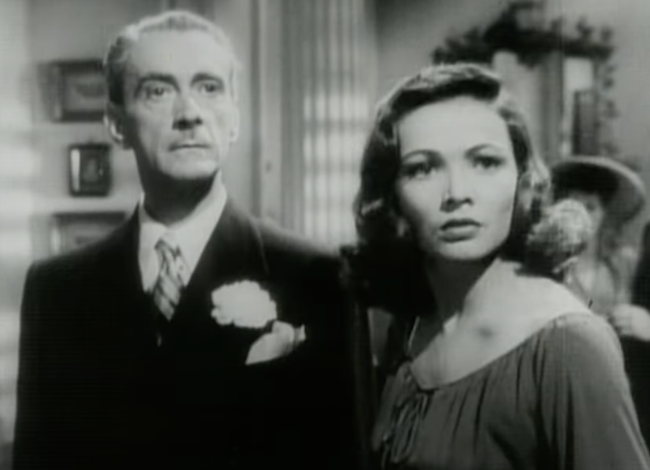
Clifton Webb and Gene Tierney in Laura (1944).


Laura is a curious film. I always think of it as the male gaze on steroids, as we know so little of the heroine apart from the versions we get from the men who surround her: the portrait artist, the boyfriend, the best friend and the cop. All are obsessed with her, and all want their version of the murdered heroine to supersede the others.’

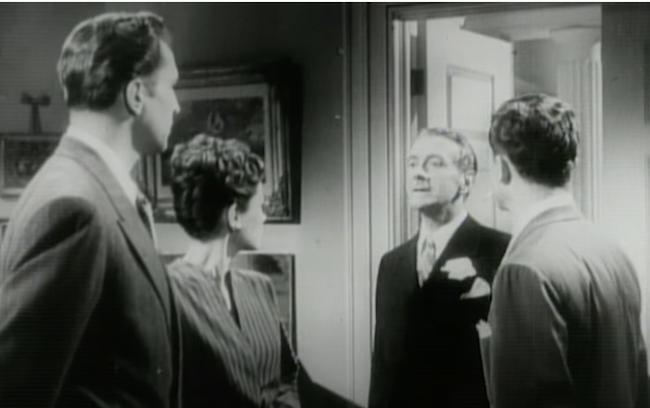
Laura's (Gene Tierney's) admirers, played by Vincent Price, Clifton Webb and Dana Andrews.


That’s why I chose the film for A Haunting Blogathon: In the Afterlife, hosted by the Classic Movie Blog Association. Crime writer James Ellroy once said something about Laura being the ultimate film for cops, and I think he’s right: the victim you only learn of from diaries, from photos, from others’ words. You never quite know who she was.

Surely, it would be easy for those driven to solve a homicide (especially one that remains out of reach) to become possessive about what they know and haunted by what they don’t. (Ellroy, whose mother was murdered, explores his own haunting in My Dark Places, a fascinating read, as is the book that inspired him: Joseph Wambaugh’s true-crime masterpiece, The Onion Field.)

It’s not hard to imagine becoming enamored with and fascinated by a victim who looks like Gene Tierney. In this particular story, however, the hauntings turn from reasonable to pathological.

What I love about the film is that the versions of Laura these men (and one woman) tell don’t quite add up. Her housekeeper, Bessie (Dorothy Adams), describes Laura as the sweetest lady on earth, and certainly Gene Tierney’s perfect face and that sentimental theme song seem to confirm those impressions.

But would such an angel be best friends with Waldo Lydecker, enjoying his poisonous remarks about her admirer and fellow party guests, as we see her do (in his version of her story, of course)?

Is she really a woman who, as fiancé Shelby Carpenter (Vincent Price) claims, will indulge any visitor, day or night? He has treated his bride-to-be like a doormat. Since he wants to continue to do so, this tenderhearted version of Laura is convenient for him. But Laura does, in fact, dump him, and despite occasional remarks seems little affected by the poor woman (cheater or not) who got killed in her doorway. Not exactly the heart-on-her-sleeve, always-forgiving softie he takes her for.

Of course, Lydecker isn’t wrong in accusing Det. Lt. Mark McPherson (Dana Andrews), Laura’s most recent admirer, of being a creep. McPherson wants to buy a portrait of her when she’s dead and becomes instantly possessive of her after she returns to life.

Who instantly hits on a stranger (worse than that, assumes she’s already his) while she’s still in shock?

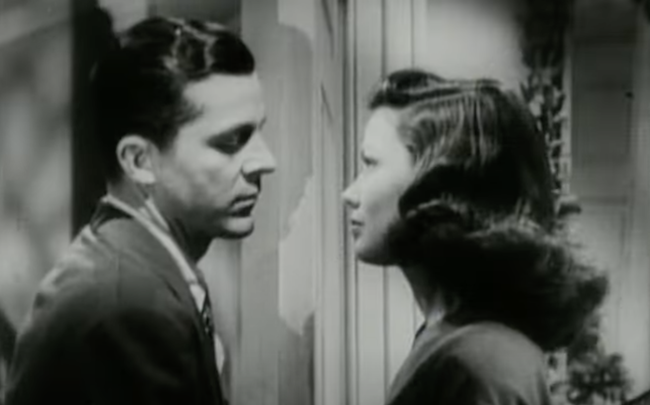
Dana Andrews and Gene Tierney in Laura

Even if she is vulnerable enough to think she’s in love too, it would be wise and kind to wait–I dunno–48 hours? He also chooses for the moment of his wooing a party during which the following things are happening to his new love:

  • Her fiancé has basically just said to her, “Yeah, I know you killed my lover, and that’s cool,” after inviting said lover into Laura’s home and into her clothes during the latter’s wedding week.
  • Someone has just been murdered in Laura’s home, and this cop/admirer has invited people over to it for a gathering before she’d had time to sage it, obsessively clean it, or call a real estate agent to put it on the market.
  • Her aunt, Ann Treadwell (Judith Anderson), has confessed–casually, I might add–that she’s toyed with murdering Laura herself.
  • And oh yeah, our heroine is still in grave danger from the best friend who tried to off her.

Our infatuated cop follows up this uproariously fun party by pretending he’s arresting her, ruining her reputation in front of her friends, because he can’t control his feelings without taking her into the police station. Ummm, what?

McPherson is right that Laura has surrounded herself by “dopes”–if by dopes he means a heartless group of friends and lovers, with some sociopathy in the mix. He’s just wrong not to include himself in the description. Andrews is quite handsome and feigns calm (with his trusty toy), so it’s easy to think of this detective as the hero in the beginning, but that impression soon wanes.

Right after returning home and shocking Bessie, Laura says gently, “I’m not a ghost, really,” and then jokes, “Have you ever heard a ghost ask for eggs?” But her claims ring hollow. Though she’s physically in the room, I would argue Laura still is a ghost through no fault of her own. Real/imagined impressions of her haunt her admirers and herself.

Actual men are also looming in her life, refusing to let her be who she wants to be, love whom she wants to love, or take five minutes to recover from life-altering trauma. And then there’s the method her best friend chose to kill her with: buckshot (interesting that Waldo doesn’t even reconsider that method during his second attempt). It’s not bad enough he wants to kill her. He wants to obliterate her.

If I were Laura’s true friend (or her therapist), I’d say, “Hey, honey. It time to hightail it out of town. A transfer overseas would be ideal. Also, you may want to keep that phone number unlisted.”

For more on the haunters and haunted, visit my peers’ excellent posts by going here: A Haunting Blogathon: In the Afterlife.

Share
Posted in: 1940s films, Anti-Romance films, Blogathons, Drama (film), Femme fatales, Film Noir/Crime/Thriller & Mystery, Romance (films) Tagged: Clifton Webb, femme fatales, film noir, Gene Tierney, hauntings, Laura, obsession, Vincent Price

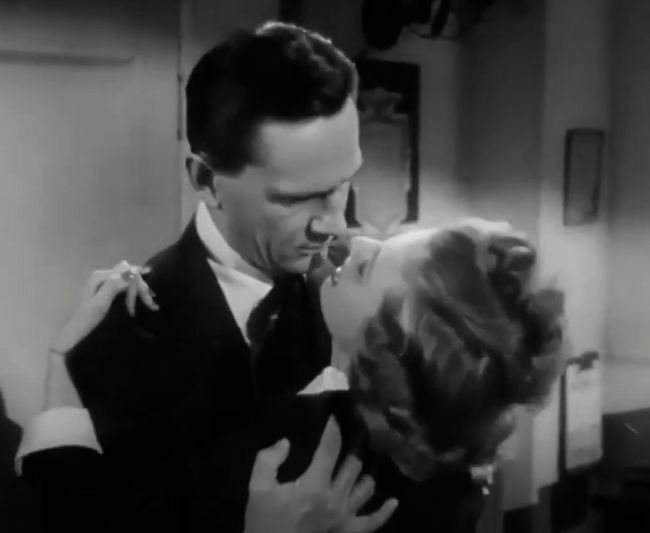
The File on Thelma Jordan

10/06/2023 by leah@carygrantwonteatyou.com 2 Comments


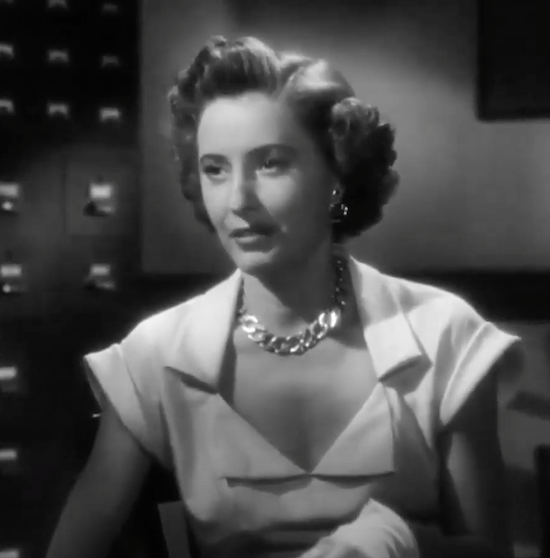
The File on Thelma Jordan isn’t a noir of the same caliber as Barbara Stanwyck’s more famous films. It’s not Double Indemnity, or Sorry, Wrong Number or even The Strange Love of Martha Ivers. But with Stanwyck as a femme fatale, you know you’re going to enjoy yourself.

***Slight spoilers, but far fewer than in the trailer.

Of the 1,00000000 things I love about Stanwyck, one is how adult she always is. She doesn’t play twee or girly–even on the rare occasions she uses baby talk to get her way. She’s sensual and knowing, fiercely intelligent and wry. You can never discount her. And you know–even if you don’t admit it to yourself–that she has the upper hand–or will soon.

In The File on Thelma Jordan, she finds herself an easy fall guy, Assistant District Attorney Cleve (Wendell Corey). Cleve has a lot going for him: a loving family, a beautiful wife. But his wife is a daddy’s girl, and he doesn’t like that daddy. It doesn’t help that his father-in-law has all the wealth and power Cleve doesn’t–or that Cleve owes him.

That’s why Cleve drinks and feels sorry for himself, and he’s doing just that when Thelma (Stanwyck) happens upon him in his office while seeking his boss. She wants to report attempted burglaries to her wealthy Aunt Vera’s home, but instead agrees to get a drink with Cleve. She’s game, agreeing to be his buddy during his troubles. Of course, a sexy, sympathetic buddy is what every Cleve desires.


You can guess what happens: a secret affair, the aunt’s house being broken into, a murder. With Thelma, there’s no question of innocence. The question is HOW guilty is she? Did she commit the murder, did her shady ex, or did some third involved party? Whoever did it, poor Cleve is complicit, and ends up having to prosecute Thelma in a not-so-effective, likely-career-killing kind of way.

I don’t find Wendell Corey that appealing in the role, but there’s a sincerity to him; you believe this is a good, usually bright guy doing dumb things. Cleve is a smarter version of Henry Fonda in The Lady Eve. He’s not all that wary, but he’s intelligent enough to know he’s been had.

But of course, who cares about Corey, or anyone else in this film noir? This is Stanwyck’s show. And though the storytelling never rises to her abilities, every minute with her on the screen is a joy. Whether she’s acting as Cleve’s relaxed buddy, his maybe-smitten love, a wary defendant, or a hardbitten woman of the world, Thelma is riveting. Don’t miss her in action.

Share
Posted in: 1950s films, Femme fatales, Film Noir/Crime/Thriller & Mystery Tagged: Barbara Stanwyck, femme fatales, film noir, The File on Thelma Jordan, Wendell Corey

The Prowler (1951): a Jealous Husband Film Noir

07/25/2023 by leah@carygrantwonteatyou.com 10 Comments


Most film noirs are cautionary as well as bad luck tales. But there’s a particular type that seems to be created by untrusting husbands and wives, the “you’ll be sorry if you cheat” noir. The most memorable for many of us are Fatal Attraction (1987) for the disloyal husband, Unfaithful (2002) for the straying wife. But the genre has a long history. The Prowler (1951) stands out in this list because it stars Van Heflin, whose charisma highlights just how easy the tumble into marital infidelity can be.

Van Heflin isn’t a name that stands out to any but classic movie fans despite his 1942 Oscar win, but his films do, particularly 3:10 to Yuma (1957) and Shane (1953), in which he plays steady husbands who can’t compete with the glamour of flashy gunslingers. In these films you feel the stamped-down passion of a man who has been worn down by hard work and harder luck. I prefer the roles in which Van Heflin plays lighter characters, like the gambler of The Strange Love of Martha Ivers (1946), the adventurer in Green Dolphin Street (1947), or Althos in The Three Musketeers (1948). These roles capture the sexy quicksilver nature and physicality of a man who once left acting to be a sailor.

***some early spoilers ahead***

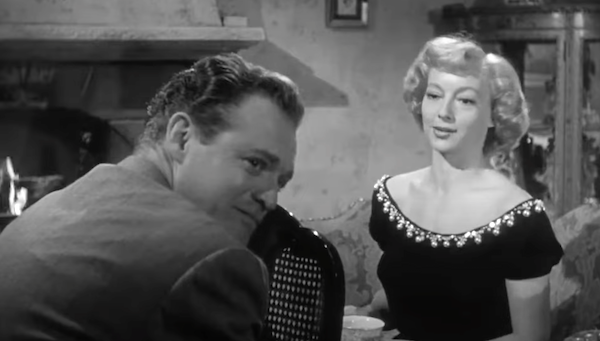
It’s that impulsiveness that makes Van Heflin so alluring as a cop in The Prowler. He might return to check on the lonely wife (Evelyn Keyes) who calls to report a peeping Tom, or he might not. He might call her back or pretend he doesn’t get her calls. He sets her at ease by sharing the Indiana roots he holds in common with her. But it’s his carefree manner of walking through her house that makes her prefer him to her older, stodgier husband, who–coded as the reference may be in a 50s film–seems to be impotent.

Unfortunately, the wife doesn’t notice the cop checking out her husband’s will in between visits to her bed. And so she doesn’t know for sure when he pretends to be the prowler in order to kill her husband whether it was an accidental killing (as the inquest claims), or not. When she marries the cop, she takes it for granted he’ll be pleased with her too-far-along pregnancy instead of seeing it as the danger it is. But as noir-aware audiences, we wonder, what happens when that bump gets bigger? I had eerie Fargo flashbacks as I watched the cop go about his plans. Will bystanders suffer the fate of those poor drivers in that Coen brother masterpiece? What about this new wife, who is now a liability? Suddenly, the unpredictability that attracted the now-widow looks less like sexiness, and more like the danger warned in the Coens’ own infidelity noir, Blood Simple (1984).

The Prowler plays its potential endings close to the vest, and the movie is bare and streamlined, as a good noir should be. It seems, in fact, like the film could have been written yesterday with a few tweaks. We audiences don’t know what the cop will do, but we are reminded that cheating is a risky game, especially for a woman before her biological clock runs out. So beware of the sexy Van Heflins of the world, men with quick smiles and chips on their shoulder. Beware of the man who acts casual as he rifles through paperwork in your home. Beware–the jealous spouses of the world warn we viewers–and keep him safely outside of your door.

Share
Posted in: 1950s films, Drama (film), Film Noir/Crime/Thriller & Mystery, Uncategorized Tagged: Evelyn Keyes, film noir, unfaithful spouses, Van Heflin

The Klutziest Bonnie & Clyde Ever: Gun Crazy (1950)

06/06/2016 by leah@carygrantwonteatyou.com Leave a Comment

GunCrazy
**Only very minor, preliminary spoilers here**

Gun Crazy begins with a boy getting caught for stealing a gun because he trips. The kid, Barton Tare, has a mysterious attraction to guns he can neither explain nor control. Others try to defend him, given that he has no desire to harm and isn’t a good thief. But he’s sent to reform school anyway, and after that and a bout in the army, the young man returns home and falls for a carnival sharpshooter, Annie Laurie Starr (Peggy Cummins). The two are both skilled in their expertise with weaponry and in their seduction of one another (clearly what brings them together), but their limbs just go haywire in all other contexts. When they turn to crime to satisfy Laurie’s lust for excitement and cash, the two can’t stop themselves from tripping, falling, and dropping the payroll.

The chief delight of this famous noir is Laurie’s ruthlessness; she’s one of the most fascinating femme fatales; the whole movie, you’re just waiting to see if her attraction to her now-husband, Bart (John Dall), will trump her self-interest.

LaurieGunCrazy
Bart’s a little screwy (as when he brings a gun to school as a kid and refuses to give it to teacher or superintendent). But there’s an aw-shucks, Jimmy-Stewartist innocence to his love for his wife, making her single-mindedness and easy manipulation of him both sinister and completely believable. When the going gets tough, you know Bart will save Laurie. What you don’t know is whether Laurie will lose a nail to save him.

Their gun skills, of course, make them a dangerous pair when they start to rob. But in peak moments, the pair keep FALLING, making you wonder how many capers they could have actually pulled off. Call me cynical, but I think some grace might help in a getaway. This lack of finesse might dissatisfy viewers looking for slick criminals in action, but being anything but nimble myself, I found their lack of coordination endearing–an unexpected trait that made me worry for their chances, and realize that I’ve seen this trait in cinematic bank robbers too seldom. Far too many action stars have amazing reflexes without Jason Bourne’s training; more of us stumble in real life, as the Darwin Awards and local news so often prove. I know I’m not alone in loving the pratfallers, even in a noir. (Usually, only minor characters make such silly mistakes.)

Of course, there’s a lot more to recommend the movie: its stylishness, the costumes of Cummins (clearly an inspiration for Faye Dunaway’s in Bonnie and Clyde), the many artfully composed shots. But its lack of predictability (thanks to screenwriters, blacklisted Dalton Trumbo and MacKinlay Kantor) is what kept me watching and wondering. I expected some hairy getaways, but not the twists I got. I expected a dastardly female, but couldn’t predict her moves. And I certainly didn’t expect–but loved–all the great moments like this, Bart’s first tripping incident, which led to all the rest:

Bartsfirstfall-GunCrazy

Share
Posted in: 1950s films, Anti-Romance films, Drama (film), Femme fatales, Film Noir/Crime/Thriller & Mystery, Romance (films) Tagged: best femme fatales, Claire Underwood, Dalton Trumbo blacklisted, film noir, films glorifying crime, Gun Crazy, John Dall, Peggy Cummins

They Live by Night: The Romeo & Juliet of Noir

08/09/2015 by leah@carygrantwonteatyou.com Leave a Comment

TheyLiveByNight-romance
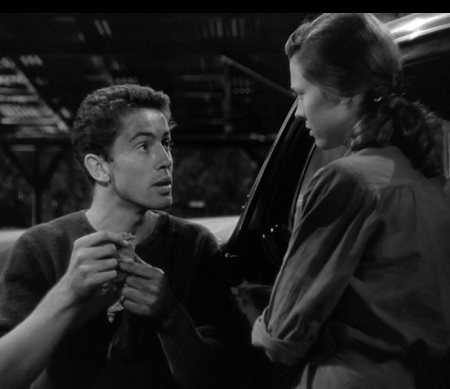
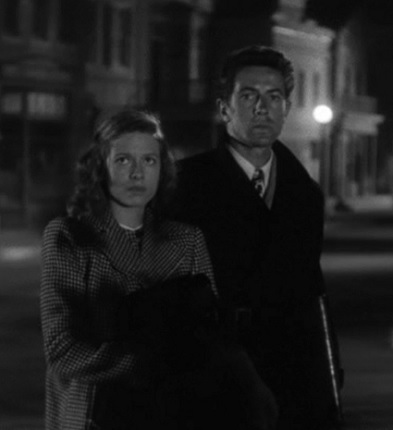
When I see a movie described as Bonnie and Clyde-like, I’m expecting an adrenaline-junkie couple, exciting escapes, violence. Imagine then my surprise to find They Live by Night is a surprisingly sweet tale of young newlyweds who long to–wait for it–go out to dinner together.

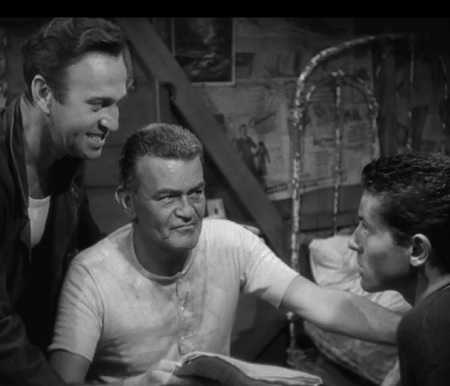
It’s true that initially, this film seems a typical noir. Bowie (Farley Granger) is an escaped convict, sprung by fellow criminals Chickamaw (Howard Da Silva) and T-Dub (Jay Flippen) so that he’ll be the getaway driver for their bank robberies.

DaSilvaGrangerFlippen
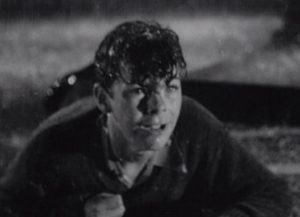
Jailed seven years for a murder he didn’t commit, Bowie goes along with their plans, thinking the loot will help him pay for a lawyer to prove his innocence. (Yes, that’s how naïve he is.) This supposedly scary criminal looks like this when he’s afraid a girl will disapprove of him:

Bowie, looking like a scared Ralph Macchio.

Resembling a scared Ralph Macchio….

But innocence is the theme of this movie–and not the corrupting of that innocence (as a noir might lead us to expect). While he does commit robberies, Bowie doesn’t seem very interested in them. He’s loyal to his partners, but ready to quit at any time. In fact, we see very little of his robberies in the film, and very much of his quiet time with his love. What makes it a noir is simple: he’s trapped by his past actions, and escape isn’t looking likely. His hopes for getting out of the mess he’s caused are sad to hear, even if they do endear him to Keechie (Cathy O’Donnell).

GrangerO'Donnell
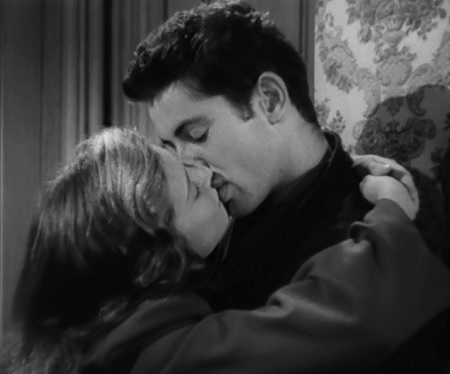
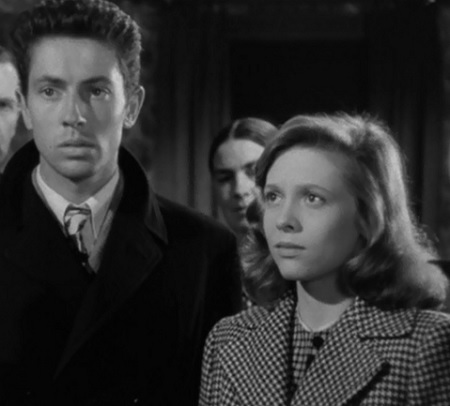
Keechie, whose drunken father hides the escapees, falls for  Bowie after his fumbling attempt to talk to her (she seems to be the first girl he’s met). When they spend time together after an injury and his partner Chickamaw’s bloody response to it given Bowie an undeserved reputation for villainy, the two become even closer. Their impulse decision to marry after she runs away with him shows them fearful, hesitant as they approach the altar–like the kids they are.

KeechieandBowieTheyLiveByNight

TerrifiedofMarriageBowieKeechie
These two are so innocent I kept wondering if they were even going to kiss.

At points, there’s so much giddiness when they smile at each other it’s easy to forget that these dark shadows on the screen portend something, that their romance probably isn’t headed anywhere better than Shakespeare’s famed lovers.’

BowieKeechieTheyLivebyNight
(I should mention, by the way, that I’ve never found Rome & Juliet romantic; I regard it as the tragedy of teenage-think-gone-wrong, when a new crush means forever-love, and a life without him/her is THE END. It’s difficult for me to fathom that others find fickle Romeo–who was in love with Rosaline the day before–romantic.)

While there’s no feud between the couple’s families in They Live by Night, Keechie’s father helps the police catch Bowie, and the latter’s partners refuse to let him go straight, giving us a bit of that lovely, narcissistic Capulet-Montague spirit.

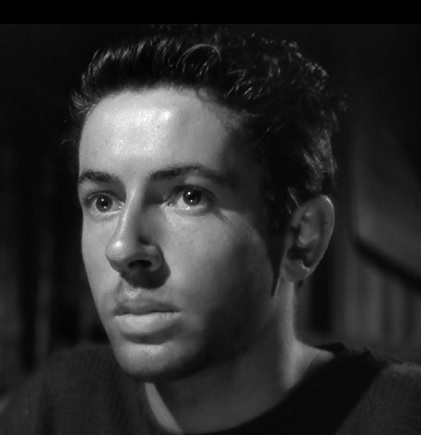
Despite the odds, Keechie and Bowie do manage to escape the patent absurdity of their names and the triteness of their situation, making us root against others hunting them. O’Donnell plays that same almost-too-sugary supporter as she did when portraying Wilma in The Best Years of Our Lives, but with enough toughness and grit to make us like her. Granger perfectly captures the blustering young lover trying to do the right thing, but kind of clueless about how to pull it off.

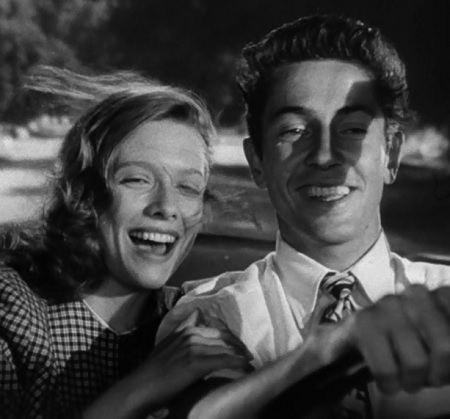
While the criminal partners of Bowie’s are fairly stereotypical, others the couple meet are not; the strange, quirky hotel proprietors and marriage officiants seem to promise sympathy and add interest to the story–though no one deserves as much trust as these two are willing to shell out. You just keep wondering how this kid could survive 7 years in prison and STILL be this childlike, or a girl could have a corrupt, alcoholic father; a criminal for an uncle; and remain such an optimist. And yet, they come across as real on the screen, and the freshness they bring to their experiences is enchanting, as with this scene of them ecstatic about going out for dinner.

TheyLiveByNight-smalljoysmarriage
I won’t reveal how it ends, but the film is suspenseful enough in spite of many slow interludes, and the characters compelling enough, to keep you watching, and hoping….

Share
Posted in: 1940s films, Film Noir/Crime/Thriller & Mystery, Romance (films) Tagged: Cathy O'Donnell, Farley Granger, film noir, Romance, Romeo and Juliet, They Live By Night

Recent Posts

  • 100 Years Later, Still Scary: Dr. Caligari
  • Escaping Out of the Past (1947)
  • A Weeper for Those Who Love Jerks
  • Thank You, Academy, for Not Infuriating Me
  • Challengers (2024) Is a Bad Movie

Subscribe to Blog via Email

Enter your email address to subscribe to this blog and receive notifications of new posts by email.

Categories

  • 1920s films
  • 1930s films
  • 1940s films
  • 1950s films
  • 1960s films
  • 1970s films
  • 1980s films
  • 1990-current films
  • 2020s films
  • Action & Sports Films
  • Anti-Romance films
  • Blogathons
  • Childfree
  • Comedies (film)
  • Drama (film)
  • Feminism
  • Femme fatales
  • Film Noir/Crime/Thriller & Mystery
  • Gloriously Silly Scenes
  • Horror
  • Humor
  • Mae West Moments
  • Musicals and dancing films
  • Oscars
  • Random
  • Romance (films)
  • Romantic Comedies (film)
  • The Moment I Fell for
  • Turn My Sister into Classic Movie Fan
  • TV & Pop Culture
  • Uncategorized
Share
Classic Movie Blog Hub Member

Recent Comments

  • leah@carygrantwonteatyou.com on Meg Ryan’s Fate Foretold in Joe Versus the Volcano
  • Ryan on Meg Ryan’s Fate Foretold in Joe Versus the Volcano
  • leah@carygrantwonteatyou.com on 100 Years Later, Still Scary: Dr. Caligari
  • The Classic Movie Muse on 100 Years Later, Still Scary: Dr. Caligari
  • leah@carygrantwonteatyou.com on 100 Years Later, Still Scary: Dr. Caligari

Archives

  • November 2025
  • September 2025
  • May 2025
  • March 2025
  • January 2025
  • November 2024
  • August 2024
  • July 2024
  • May 2024
  • March 2024
  • February 2024
  • December 2023
  • November 2023
  • October 2023
  • September 2023
  • August 2023
  • July 2023
  • May 2023
  • April 2023
  • March 2023
  • January 2023
  • December 2022
  • November 2022
  • September 2022
  • July 2022
  • May 2022
  • April 2022
  • March 2022
  • February 2022
  • October 2021
  • September 2021
  • April 2021
  • March 2021
  • February 2021
  • December 2020
  • October 2020
  • September 2020
  • July 2020
  • May 2020
  • April 2020
  • March 2020
  • February 2020
  • December 2019
  • October 2019
  • September 2019
  • June 2019
  • May 2019
  • April 2019
  • February 2019
  • January 2019
  • November 2018
  • September 2018
  • July 2018
  • June 2018
  • May 2018
  • April 2018
  • March 2018
  • February 2018
  • January 2018
  • November 2017
  • September 2017
  • August 2017
  • July 2017
  • June 2017
  • May 2017
  • April 2017
  • March 2017
  • February 2017
  • January 2017
  • December 2016
  • November 2016
  • October 2016
  • August 2016
  • July 2016
  • June 2016
  • May 2016
  • April 2016
  • March 2016
  • February 2016
  • January 2016
  • December 2015
  • November 2015
  • October 2015
  • September 2015
  • August 2015
  • July 2015
  • June 2015
  • May 2015
  • April 2015
  • March 2015
  • February 2015
  • January 2015
  • December 2014
  • November 2014
  • October 2014
  • September 2014
  • August 2014
  • July 2014
  • June 2014
  • May 2014
  • April 2014
  • March 2014
  • February 2014
  • January 2014

Meta

  • Log in
  • Entries feed
  • Comments feed
  • WordPress.org

Copyright © 2025 Cary Grant Won't Eat You.

Church WordPress Theme by themehall.com