Cary Grant Won't Eat You

Classic movies for phobics

  • About
  • eBooks
  • Previous Blogathons
Classic movies for phobics

Alfred Hitchcock

Oscar Rant, Part 3: Flower Moon’s Many Missteps

03/04/2024 by leah@carygrantwonteatyou.com 4 Comments

Spoilers–but not as many as Scorsese’s
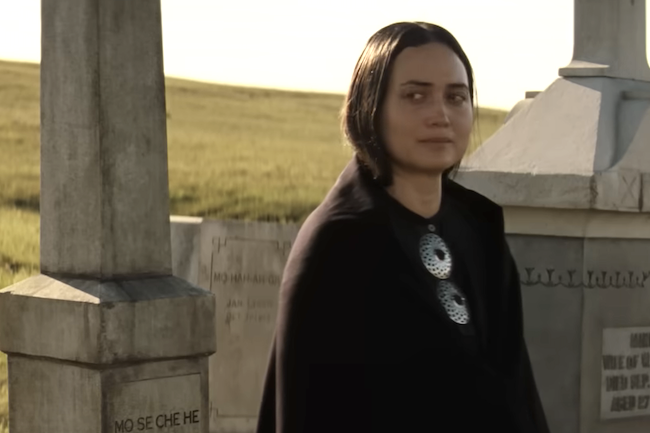

I knew I would struggle to warm to Martin Scorsese’s interpretation of a well-loved book. Killers of the Flower Moon is a heartbreaking, fascinating page turner. And it is a history book. I stayed up till 4 am to finish it. What I didn’t expect to do in watching Scorsese’s film of the same name was flinch. In trying to stay authentic and true to the Osage people, Scorsese walked into one of the oldest stereotypes. And the Academy is about to give his starring actress an Oscar for it.

The dignified, long-suffering man or woman of color is one of those stereotypes Hollywood has struggled to shake. There’s also a smug, self-satisfied attempt to award such films and performances with honors (Green Book, Driving Miss Daisy, The Help). When it comes to a group of people our country systematically oppressed, robbed, and killed–like the Osage and so many other American Indian tribes–granting the characters dignity can feel like a kind of reparation, minor as it may be. But it’s also dehumanizing to reduce a person to such a narrow set of traits.

I understand that Scorsese’s task was not easy. The American historical record is simply more complete when it comes to white men than for anyone else. Author/historian David Grann likely made FBI agent Thomas Bruce White Sr. his central character in part because he had so much information on him. Grann even includes a fascinating later history of his mercy toward prisoners who injured him in a prison break, which helps us understand the kind of man who would risk his life for others. And White was, indeed, a hero, and a fascinating one at that.

I get Scorsese’s attempt to avoid the white savior story he risked writing if White were his lead. But he had a dilemma: What do we know about Mollie Burkhart (Lily Gladstone)? We know she was rich. We know she lost many relatives to murder. That she believed in her husband, Ernest Burkhart (Leonard DiCaprio), far longer than she should have. We know that she was very sick. That’s not enough detail, if she’s your central figure. It was up to Scorsese to breathe life and complexity into her characterization, to make her wholly human in the way our 1920s racist, sexist historical record would not grant her–or lean on the descendants or family members who could tell him more.

Alas, Scorsese’s never been very good at female characters. This is no exception. Besides brief glimpses of a more complex woman during the courtship, he has her either sitting or in a sickbed looking resigned, sad, and stoic for 90% of the film. We don’t even feel the menace or experience her fear as she’s poisoned, as we would for a Alfred Hitchcock heroine, because we have little sense of her inner life.

We don’t get to see a sense of humor or any unique, humanizing quirks–we only know that she suffered. And with Eric Roth as his cowriter, whose credits include Forrest Gump (another film with underdeveloped female characters), what hope did he have of getting it right? Why, oh why, can’t this brilliant man recognize his limitations? There’s nothing wrong with specializing in dark white men as a genre. But this was not the subject matter for that focus. Why not let someone else write the screenplay? An Osage female writer would have been amazing; at the least, Scorsese could have chosen a woman.

Mollie’s is not the only half-baked characterization of the Osage in the film. The subtitles only occasionally translate the Osage language, which is used extensively. Instead, the subtitles spell out something like “speaking in Osage,” which was 1. evident 2. useless 3. distancing. Why not help us know the characters better by having them speak in English if you’re not going to bother to translate? (I kept hoping this was an issue with my streaming service, but I doubt it.) The occasional group scenes with Osage leaders stating the obvious didn’t help.

There was a fascinating real-life federal agent, John Wren (Tatanka Means), the only Native American who’d worked for the bureau by then. He assisted with the investigation and appears briefly in the film, and I kept thinking that Scorsese should have focused the narrative on him. What a fascinating angle that would have been! He was still an outsider to the Osage, but had more of an insider’s angle than the rest of the agents.

Instead, Scorsese doubles down on Leonardo DiCaprio’s Ernest, even minimizing the degree of his crimes by not covering his whole plan (or at least, tacit acceptance of the plan) to include his son and wife in the blow-up-the-house plot. Did he love Mollie? He seemed to in the book–and in how he handled the trial. But many dangerously abusive men have loved the women they attempt to murder. I’m not really interested in getting inside of their heads. Are you?

Also, where’s the excitement? We believe Ernest is pretty innocent for a long while in the book. We don’t know his uncle is a monster. The reveal is breathtaking in the book. Leaving out the suspense is a baffling choice.

It’s a shame to see all the wasted potential here: Robert De Niro is good in it and DiCaprio great (even if they are miscast; De Niro is no cowboy and both are at least two decades too old for their parts). Gladstone is very good with what she had to work with, and captures what we know of Mollie well. I enjoyed her subtlety.

There are so many beautifully shot scenes. That moment right before the bomb was especially powerful, as was the federal agents’ gathering scene. Scorsese shares the history and legal status of the Osage’s rights (or rather, lack of rights) without bogging down the narrative–not an easy thing to do. I thought the best part of the film was the start of the investigation by the private eyes: Whenever Scorsese feels comfortable, he does such great work. I loved how the movie helped me keep the characters straight, something I struggled with in an overpopulated book.

A lesser-known director might not have gotten this important story made into a film; I wanted so much to like it. Scorsese’s earnest attempt in that ending to finally give Mollie her due made me sad; I don’t think he succeeded. But maybe he’ll draw people back to the book, which does. I guess I’ll have to take some satisfaction in that.

Share
Posted in: 1930s films, 1940s films, 1950s films, 1990-current films, Drama (film), Oscars, Uncategorized Tagged: Alfred Hitchcock, Killers of the Flower Moon, movies not as good as books, Oscar nomination, overrated

Two Critics Pan Hitchcock’s Torn Curtain

07/06/2018 by leah@carygrantwonteatyou.com 16 Comments


Friends and fellow film buffs: Brian Wilkins and Mike Gutierrez have written wonderful guest posts here at Cary Grant Won’t Eat You—Brian, on fighting in Sword and Sandals films, and Mike, on his ideal casting for Hitchcock remakes. Today they’re joining the second annual Alfred Hitchcock blogathon to consider what the famous director could have been thinking with Torn Curtain (1966).

B: This all started because I had a memory of a movie where a drunken Paul Newman, at the Nobel Ceremony in Stockholm, chats up beautiful blondes and a physicist who may or may not be trying to defect to East Germany. So when Torn Curtain was still available, I texted Mike and said we should grab it.

There’s only one problem.

Torn Curtain is a Paul Newman and Julie Andrews vehicle, about a conference in Copenhagen that ends in a physicist possibly defecting to East Germany. And it’s not the movie I remembered. That movie is The Prize directed by Mark Robson. This was Torn Curtain, and as Mike put it…

M: Torn Curtain is a deeply stupid movie.

And it shouldn’t be.

It’s 1966.  Newman and Andrews are two of the biggest stars in the world. It’s true that Hitchcock was winding down by then, but he’d only done The Birds three years earlier. The three of them coming together for some Cold War intrigue sounds like a sure-fire hit, or at least a fun two hours. But that’s not what happened. And, frankly, I’m not sure what happened during the film.

Newman is “defecting,” but no one believes that for a minute. Andrews is his doting girlfriend who follows him to East Germany and decides to stay with him–betraying her country for a guy who has been lying to her. The East German secret police announce themselves as the “secret police,” which doesn’t seem like something the secret police should do. It’s not clear if Newman is working with the US government or is going completely rogue, but somehow he has ties to the resistance even though he’s just a scientist.

I could keep going–the plot is inane, the characters inconsistent, and Newman and Andrews seemed to have lost their charms on the flight to Berlin–but you get the point. So, Brian, what do you see as the reason this movie went off the rails?

B: They squeezed all the fun out of the movie. In every single case where you could find a joke or a bit of dash, they threw a lead blanket on it. I’m mostly blaming the writer.

But here’s the thing: I didn’t think it was humanly possible to have zero chemistry with Paul Newman. I’m pretty sure even inanimate objects have chemistry with Paul Newman. Even his crutch in Cat on a Hot Tin Roof looks into being leaned on. Julie Andrews looks like he started every take by mansplaining parliamentary procedure.

M: Do you think they took out the fun or had no intention of making a fun movie? I’m thinking the writer considered this his grand epic about a deadly serious topic and wanted to make a bold statement about love and patriotism and the threat of the Soviets; that he believed it was high art, Oscar-bait.

And tonally, it keeps shifting from a romance to faux-intrigue to, well, we should probably talk about how Paul Newman and some farmer’s wife re-imagined Sylvia Plath’s death on the Stasi officer. That scene manages the incredible trick of being both disturbing and boring.

B: Let me do some research <looks at Wikipedia for 2 minutes>…oh, shit, this was a hot mess. Hitchcock shopped the idea to Nabokov, who turned it down (genius) then gave the script to Brian Moore (shortlisted 3 three times for the Booker prize) who really should have known better. Moore complained Hitch had no sense of characters. Hitchcock complained Moore wasn’t funny. So Hitchcock thought he was making North by Northwest and Moore thought he was writing…a boring version of The Spy Who Came in From the Cold?

But to the murder. Listen, I hate to get all professional about this, but there are a million things to murder someone with in a kitchen other than a gas stove. It’s almost like the house frau in question was like, “Do you know how hard it is to get Stasi brains out of a cast iron pan? I just seasoned it!”

M: I just spent five minutes re-imagining this film as if Nabokov wrote it. Then I started imagining if he’d written The Sound of Music. “No, you cannot sing the Nazi’s away, Julie Andrews. No.” I digress.

B: Rolling pin. Cleaning chemicals. Towel garrote. Meat hammer. Fork.

M: Ice pick?

B: Only if he’s a real Communist (yes, that’s a Trotsky joke, David Ives fans).

M: This was one of the big set pieces, the one that shows us that Newman isn’t just a dainty scientist but a badass with a Ph.D. Now, you’re married to a scientist–who I’m certain would have used a paring knife—

B: Correct. Or poison.

M: …and you’ve met scores of scientists in your life: is there anything about Newman’s character that seems the least bit authentic? Or, a better question, what do you think Newman thought he was supposed to be? He’s never been so charmless. He has that great, knowing smirk in everything he does. What movie did he think he was in?

B:  I think Newman read the character as a boring CIA agent the whole time. His character “starts in Washington” and ends with a “teaching position.” He’s just a physicist who couldn’t actually cut it, but as a bureaucrat briefing real spies on what to steal, he’s sort of useful. And I think Paul Newman would hate that man intensely. I’m guessing he needed to fund some sort of charity for kids with horrific cancer. Seriously, that man is a sexy, sexy saint.

M: I’m not sure the first Mrs. Paul Newman would agree. There is a voodoo doll of Joanne Woodward out there floating in the aether.

B: I started wondering if Joanne Woodward would be better casting than Julie Andrews, but, honestly, I don’t think anyone could have chewing gum and twined a performance from this script. Is there any trace of Hitchcock at all with the escape scene?

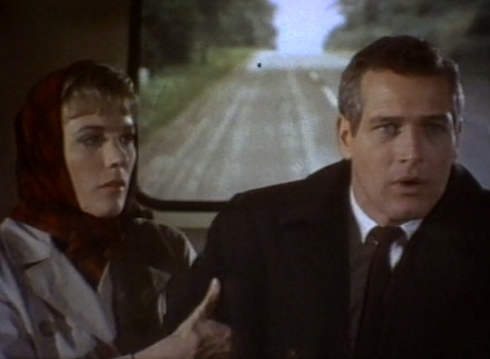
M: Sure. It’s an elaborate set piece–a bus chase before sneaking onto a ship–that’s supposed to be Hitchcock’s version of how he’d escape past the Berlin Wall. But it feels like a knock-off version of a Hitchcock climax, sort of like how 2 Days in the Valley ripped off Tarantino. The problem is that Andrews and Newman are passive characters in the escape. They’re sitting on a bus driven by someone else, and then shuffled onto a boat where they are shoved into baskets to sit in their own filth for days (weeks?) while someone else pilots the ship. Passive. It’s like Hitchcock forgot what made for great Hitchcock.

B: I never even thought of how this would be Hitchcock’s personal fantasy of how to get away: “Well, I’m certainly not going to run. And riding a motorcycle sounds sweaty. Perhaps I could just drift peacefully into freedom?”

M: Here’s the thing: Cary Grant kills a dude and saves the girl in North by Northwest.

Paul Newman sits in the back of the bus and hopes no one hurts him.

B: I think this film needs more dynamite, there, Butch. I tried to think of something I liked about this film but I’m coming up as empty as a housefrau looking for a murder weapon in a gun closet.

M: Yeah, I’ve got nothing. In the end, I found myself rooting for the Stasi.

B: Well, thank you for your patience, kind readers. I hope you’ve enjoyed being warned off what has to be in my top 5 worst movies of all time. See The Prize instead for all your Paul Newman Cold War-related hijinks. And …oh! Bear Island with Julie Andrews. It’s got the UN, it’s set off the coast of Norway, and there’s a possibly gold-filled U-Boat.

M: That sounds awesome. I’ve never seen it. Let me do some research <looks at Wikipedia for 2 minutes>…. You did it again: You got Julie Andrews confused with Vanessa Redgrave.

B: That’s more telling about my fantasy life than I would like. MEA CULPA!

Check out the other posts in Maddy Loves Her Classic Film‘s The Second Annual Alfred Hitchcock Blogathon, including her post on Rebecca!

Share
Posted in: 1960s films, Drama (film), Film Noir/Crime/Thriller & Mystery, Humor Tagged: Alfred Hitchcock, Paul Newman and Julie Andrews, Torn Curtain, What was he thinking films, worst films by good directors

Remaking Hitchcock

04/23/2016 by leah@carygrantwonteatyou.com 4 Comments

This week I’ve been lucky enough to convince author Michael Gutierrez into guest posting. Check out his wonderful book, The Trench Angel (which deserves cinematic treatment of its own).

Back in the early 90s, during a time when there were a spate of remakes of classic films, my grandfather posited: “Why don’t they just redo shitty movies?”

He was right, in a sense. Remaking the greats because you think they’ll appeal to a modern audience is usually a lost cause. His Girl Friday will always be better than Switching Channels, even if you add modern stars like Burt Reynolds (the 80s loved a good mustache). But “shitty movies” are often shitty for several fundamental, inalterable reasons, be it bad acting, poor production values, or, most likely, a terrible story idea. These are films that can’t be saved. Take Showgirls: you can blame star Elizabeth Berkley’s humorless performance or director Paul Verhoeven’s lack of visual dexterity, but the film would probably still blow even if you gave the camera to Scorsese and put Meryl Streep in pasties.

Yet, there’s a middle ground: remake mediocre films, movies that just missed being great for one or two specific, easily discernible reasons. It’s been done before, most recently with Ocean’s Eleven. The original Rat pack vehicle was poorly paced and weighed down by a lazy script, bad jokes, and half-in-the-bag performances. Enter George Clooney and Steven Soderbergh and you’ve got a remake that trumps the original.

Case in point is Alfred Hitchcock, a man who made plenty of just-misses. For every Rear Window or North by Northwest, you’ve got a handful of Suspicions. Hitchcock, himself, had no issue with remakes, re-doing The Man Who Knew Too Much twenty years after his original version. While many of his lesser films should be left alone (I’m looking at you Stage Fright), a few of his other movies were nearly great, but suffered under the weight of one or two specific flaws.

Here are three that Hollywood should re-do and I’ll even give them a hand by telling them how to do it.

Foreign Correspondent (1940)
The Story: American reporter Huntley Haverstock (Joel McCrea) is sent to Europe to dig up a story on the continent’s impeding war. While there, he finds himself caught up in a sinister international conspiracy, falls in love with the chief villain’s daughter (Laraine Day), while palling around in the Netherlands with fellow reporter Scott ffolliett (George Sanders).

The Good: There’s a great cat and mouse chase through a field of Dutch windmills and some fantastic Sanders scenes where he binge-eats the scenery.

The Problem: The romance between McCrea and Day has all the sexual charisma of an arranged marriage. In addition, Sanders steals the film. Even Hitchcock seems to realize he cast the wrong star, and pretty much turns over the last third of the film to the charming Englishman. Finally, the end transforms into a piece of pro-war propaganda, trying to convince America to join the fight against the Nazis. It made sense at the time, but now it dates the film.

The Solution: Cast Ryan Gosling and Marion Cotillard. Besides being capable performers, they’re both so pretty to look at. Plus, you could actually shoot the film in Amsterdam. Why aren’t there more films in Amsterdam?

The Lady Vanishes (1938)
The Story: Young European Iris Henderson (Margaret Lockwood) is travelling home via railway to get married. On the trip she befriends Miss Froy (Dame May Whitty), who suddenly disappears in transit, though the train has made no stops. Henderson and fellow passenger Gilbert Redman (Michael Redgrave) investigate, only to find themselves caught up in a sinister international conspiracy.

The Good: It’s a great set-up with some tense scenes, red herrings, and a bouncy tone. Plus, you’re on a train and trains are awesome.

The Problem: Lockwood doesn’t come across as someone willing to challenge a waiter, let alone a cabal of killers. It should have been Myrna Loy or Katharine Hepburn. Redgrave’s fine, but Cary Grant would have been better. There are also some really hokey special effects where the train looks like a child’s model set and Hitchcock spends too much time setting up the story and gives away the villain too quickly.

The Solution: I know they re-did this film with Jodie Foster as Flightplan, and I’ve heard it isn’t bad, but I can’t watch movies set on airplanes without a heavy, accompanying dose of Xanax, so let’s keep it on the train because trains are, as you know, awesome and put in Reese Witherspoon and Ethan Hawke. Give the characters some age and gravitas. Or if they won’t do it, Cotillard and Gosling will do.

The 39 Steps (1935)
The Story: Robert Hannay (Robert Donat) finds himself caught up in a sinister international conspiracy. There’s a lot of running through fake Scottish moors, an evil dude with half a finger missing, and Madeleine Carroll going full Stockholm Syndrome on Donat after he kidnaps her.

The Good: It sounds bad, but it isn’t. Seriously. It’s just not great. Even if the moor scenes were filmed on a sound stage, the running is fun and the scene at the end in the Palladium when Mr. Memory reveals the secrets of the 39 Steps organization is brilliant.

The Problem: How many memorable movies have you seen with Donat or Carroll? There’s a reason. Hitchcock once famously referred to actors as “cattle” and he must have gotten these two off the slaughterhouse floor. At times, you’re rooting for 39 Steps to kill Donat, while Carroll’s quick turn from kidnap victim to doting lover is super uncomfortable.

The Solution: Keep the missing finger, film on real Scottish moors, and bring in Charlize Theron and Tom Hardy. A Mad Max reunion. Unlike Donat, Hardy looks like he could actually land a punch and Theron seems like she’d take a little more convincing to fall in love with her kidnapper than a charming smile. Or, hell, just cast Gosling and Cotillard. That should work.

by Michael Gutierrez

Share
Posted in: 1930s films, 1940s films, 1990-current films, Femme fatales, Film Noir/Crime/Thriller & Mystery, Random Tagged: Alfred Hitchcock, remakes

Hitchcock Didn’t Get Jamaica Inn; Vince Gilligan Would

04/10/2016 by leah@carygrantwonteatyou.com 4 Comments

LaughtonandOHara-JamaicaInn2
**Warning: Some spoilers (though I don’t reveal the mastermind in the novel; Hitchcock alters the story enough for it still to be a mystery).

I just finished watching Breaking Bad, and was struck by the thematic similarities between it and Jamaica Inn, one of my favorite novels as a teen. Both involve major characters refusing to own the horrific nature of what they’ve set in motion, both include a slow-burning menace that frequently breaks into sudden violence, and both demonstrate the moral costs of greed–and the many innocent victims left in its wake.

While Walter White is the leader of a meth empire, the villain of Jamaica Inn is the mastermind behind a group of wreckers, who lure ships with false lights and then kill everyone aboard to get the loot without hanging for their crimes. While Joss, the rough-talking inn owner, initially seems to be the head of the operation, we soon learn that there’s a much colder and smarter man working above him.

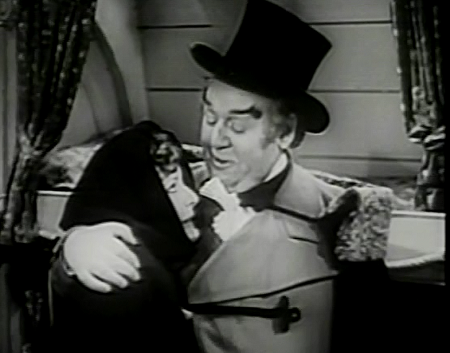
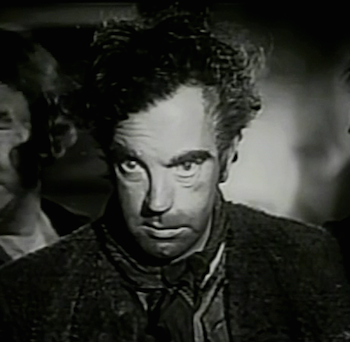
Joss (Leslie Banks)

Joss (Leslie Banks)

And though Joss has sympathetic qualities and weaknesses, the mastermind–whose identity we don’t learn until late in the story–cares for no one. Joss is terrified of him.

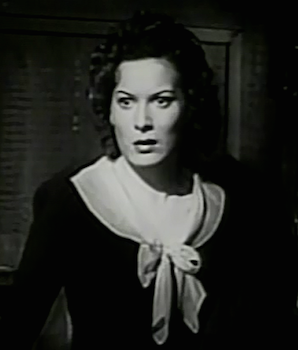
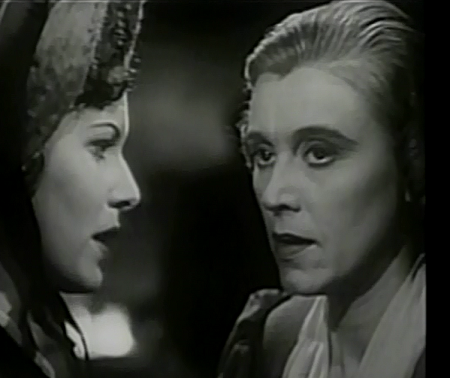
The heroine of the story is Mary (Maureen O’Hara in the film), who comes to Jamaica Inn completely unaware of the criminality of its keeper, her uncle.

MaureenOHara-JamaicaInn
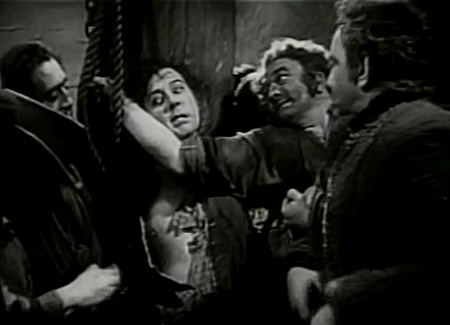
She soon discovers that something is off. The coachman doesn’t want to drop her off there. The inn doesn’t have any inhabitants besides the owners. The bar is full of shady characters.

Bar inhabitants

Bar inhabitants

There are odd noises at night. And then there’s her uncle’s warning: “There’ll be nights sometimes when you’ll hear wheels on the road…and those wheels will not pass on, but they’ll stop outside Jamaica Inn. And you’ll hear footsteps in the yard, and voices beneath your window. When that happens, you’ll stay in your bed, Mary Yellan, and cover your head with the blankets. Do you understand?”

Our fear as readers is slowly discovering what is going on. That mixture of unease and hope that things will improve keeps us engaged. And yet in the film adaptation, the director cuts that fear instantly by starting with the wreckers destroying a ship. Who, you ask, would make such a critical error? Ummm. Hitchcock?

Two of Alfred Hitchcock’s best known films–Rebecca and The Birds–originated in the writing of Daphne Du Maurier. In both cases, he displayed a sharp understanding of her intent, carefully reproducing the psychology of the narrator in the former and quietly building on the creepiness of the birds in the latter. That’s why his failure with Jamaica Inn (1939) is so baffling. The book is brilliant, the movie mediocre. The master of suspense completely botches the book’s beautifully crafted, slow-burning sense of menace with his timeline. He gives away Jamaica Inn’s mystery in the first scene. He reveals the mastermind (whose identity is uncovered late in the novel, when Mary mistakenly runs to him for help) within the first twenty-five minutes. As a result, I found the movie full of some nicely done set pieces, but very little suspense.

Similarly, Hitchcock just doesn’t get the characters. Jamaica Inn is terrifying because the characters feel powerless. Patience (Marie Ney) may love her husband, Joss (Leslie Banks), but it’s her fear that keeps her submissive to him–her fear of his violence toward her, of the violence he inflicts on others, and worst of all, of her moral corruption in enabling him.

Patience (Marie Ney)

Patience (Marie Ney)

She has become a flitting, barely there woman, purposely dwelling in a fantasy world to avoid facing what he and she have become. She can’t leave him because she’s been beaten down by psychological abuse. Mary (Maureen O’Hara) is terrified for her, must stay with her, because Patience’s utterly unable to act for herself. Basically, Patience is Season 5’s Skyler White without the will or resilience. The stand-by-her-man character Hitchcock has given her instead makes no sense (though Skyler White haters might have approved).

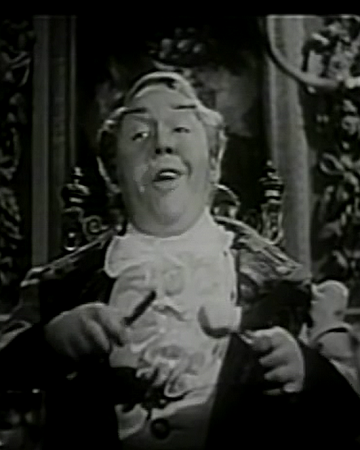
Even odder is the characterization of Mary. In the novel, she’s independent, sassy, and quick tempered, particularly when it comes to male arrogance and unwelcome handling. Yet there she is in the film, letting Sir Humphrey (Charles Laughton) paw her as he did his horse. She smiles; she claims he’s a gentleman. WHAT? Mary is no fan of the upper classes in the novel, nor is she easily charmed or manipulated.

Her enforced trip with the wreckers is terrifying in the book because she keeps witnessing–and is unable to prevent–the murders that enfold in front of her. What we witness in the novel is the annihilation of what was left of her innocence, and we feel how we do when we watch Breaking Bad‘s Jesse’s wrenching reactions to a child’s death. Yet in the movie version of Jamaica Inn, there Mary is, conveniently preventing the wreck, as if one woman could accomplish that when surrounded by men trying to force themselves on her. This is the work of a cheap action director, not a Hitchcock.

Clearly, the director got carried away by his desire to let Charles Laughton, a minor character in the book, dominate the film.

Eyebrows alone unforgivable

The eyebrows alone are unforgivable

Laughton also co-produced, so his elevation isn’t surprising. Because he is Laughton, mugging and having a field day with the material, the movie contains a number of funny moments, and a picturesque conclusion. Much can be forgiven, of course, since the film debuted O’Hara, gave us striking action scenes, and included understated humor (via the servants of Sir Humphrey). But so much is missed by turning this film into camp: that suspicion Mary feels when she hears but never sees a man alone in a room in the inn (the mastermind), or finds the rope hanging from a beam but can’t be certain it implies a hanging.

What a film it would have been with just a few glimpses into Patience’s fear, or her equally frightening resignation: “…if you came to guess but half of what I know, your hair would go grey, Mary, as mine has done, and you would tremble in your speech and weep by night, and all that lovely careless youth of yours would die, Mary, as mine has died.” Or for one scene like Mary’s eerie walk into her uncle’s house after an absence, when she sees the collapsed clock, hears the silence, and senses what’s happened. A fragment of fear, a suspicion, is so much more sinister than outright knowledge. Hitchcock knew this. As a New York Times reviewer wisely put it, “Having set his own standards, Alfred Hitchcock must be judged by them….” And by Hitchcock standards, Jamaica Inn is a failure. Too bad he chose such an excellent book to butcher. I see that just a few years ago, a miniseries attempted the story. I’m sure it’s better. But wouldn’t you like to see what Vince Gilligan could do with it?

This post is part of the Beyond the Covers blogathon, hosted by Speakeasy and Now Voyaging. Check out the wonderful entries here.

Share
Posted in: 1930s films, Drama (film), Film Noir/Crime/Thriller & Mystery, TV & Pop Culture Tagged: Alfred Hitchcock, bomb, Breaking Bad, Charles Laughton, Daphne du Maurier, Jamaica Inn, Maureen O'Hara, Skyler White, suspense film, Vince Gilligan

Hitchcock Fans, Watch The Gift (2015)

12/13/2015 by leah@carygrantwonteatyou.com 2 Comments

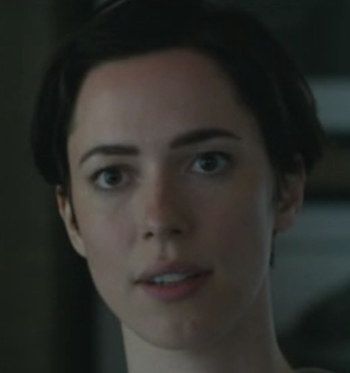
The beauty of watching The Gift (2015) is how often our own reactions to the film are reflected in Rebecca Hall’s expressive face: compassion, fear, doubt, suspicion.

RebeccaHall-TheGift
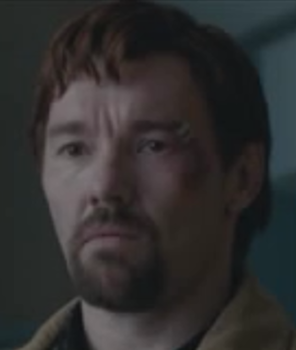
Her character, Robyn, is in a vulnerable state when she and husband Simon (Jason Bateman) move to a new town: She’s given up her job; she’s lost a child. Perhaps that’s why when Simon’s high school acquaintance, Gordo (Joel Edgerton), stops by frequently, Robyn considers him merely sweet and socially awkward, and her husband wants to cut all ties, avoid encouraging the creep.

Gordo’s weird to assume such intimacy, her husband suggests. In fact, he’s always been weird. She shouldn’t encourage Gordo, Simon warns; the creep must have a crush on her. As viewers, we tend to agree with Simon’s instincts, and yet….Simon’s behavior to Gordo verges on cruelty. And so much hostility seems to suggest he’s lying about their past. When Gordo pens a letter in response to the end of their friendship, he writes that he was willing to let bygones be bygones. But not now…

JoelEdgerton-TheGift
When seemingly vengeful acts start occurring, Robyn is unsure: Is it Gordo? Or is her susceptible state making her paranoid? More troubling than her fears are her observations of her husband. He seems to be undermining her confidence at work and dinner parties. There’s a hint of ruthlessness about him she clearly didn’t notice before. And she starts to catch him in lies. Whom exactly has she married? And what has he done?

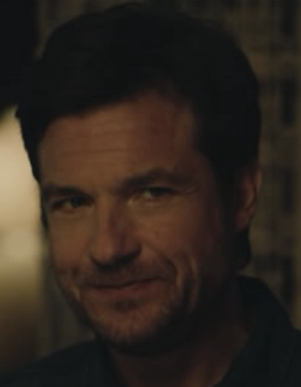
JasonBateman-TheGift
All three performances are stellar, with ambiguity in every shot of their faces, every word they speak. Edgerton seems sketchy from the start, but also kind and sensitive. He does triple duty as the costar, writer, and director of the film.

As Simon, Bateman appears loving toward and protective of his wife, but also condescending, and casually inconsiderate of others. Usually such a great everyman, Bateman plays this ambitious, morally questionable businessman with ease.

Robyn doesn’t know whether to trust herself at all, and so Hall’s gestures and smile are hesitant throughout. Hers is a winning, understated performance. As viewers, all we know for sure is that Robyn is far too nice, and we like her too much to be comfortable with her exposure–especially with all of those inadvisable, big glass windows in her home.

Women’s fears about the men in their lives are convincingly captured by Edgerton’s script. Others have written gorgeous pieces about Hitchcock’s similar insights. I can’t reach these authors’ eloquence, but I now always observe those traits in the latter’s films. As in Hitchcock’s Suspicion (or George Cukor’s Gaslight), The Gift is essentially about a marriage. While Edgerton has been praised for his building of suspense in the film, I like his subtle characterizations more, as when Robyn’s disgust at her husband’s callousness is echoed in the face of a neighbor, Lucy (Allison Tolman). I soon became less interested in the Should I be afraid? question, and more intrigued by another, much harder one: If my spouse treats another human being in a certain way, can I still like him? Is a momentary past cruelty just that, in the past? Or does it reflect who he is?

Joan Fontaine’s character always troubled me in Hitchcock’s film because she was too wrapped up in her own vulnerability to and love for her Johnnie (Cary Grant) to judge him as harshly as she should have for his immorality toward others. Robyn, despite her fragility, speaks up even for maybe-dangerous Gordo, and as a result never loses our investment in her–and that, Edgerton knows, is what keeps us hooked. If this is his first effort as a writer/director, I can’t wait to see what his next attempt will be.

Share
Posted in: 1930s films, 1940s films, 1990-current films, Film Noir/Crime/Thriller & Mystery Tagged: Alfred Hitchcock, Jason Bateman, Joel Edgerton, Rebecca Hall, The Gift

Want to View a Hitchcock? Try Notorious.

01/23/2014 by leah@carygrantwonteatyou.com 1 Comment

Vertigo was recently crowned the best film of all time, but the objectification of its heroine is hard to take on an empty stomach. Rear Window, also beloved by critics, is slow paced and clever rather than frightening, known for being groundbreaking in style. For the slow-burning suspense the master does so well, I’d begin with Notorious.

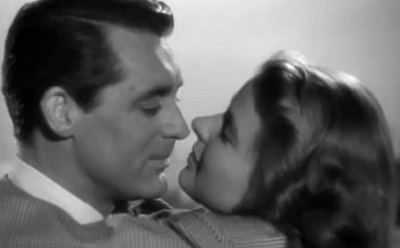
Grant and Bergman in Notorious

Grant and Bergman in Notorious

Technically, this is a film about a spy tracking down a Nazi plot. Actually, it’s about highly dysfunctional relationships, including the romance between stars Ingrid Bergman and Cary Grant, which you would find disturbing if the relationships between Bergman and the Nazi and the latter (Claude Rains) and his mother weren’t so much worse.

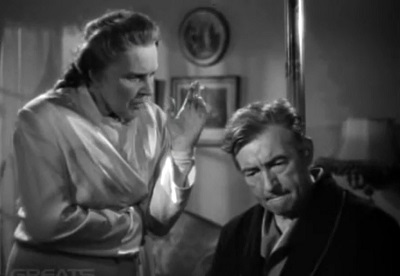
The spy (Rains) and his mother (Leopoldine Konstantin) making plans

The Nazi (Rains) and his mother (Leopoldine Konstantin) plotting

Bergman is in peril as the spy who marries the Nazi, and Grant’s hurt feelings get in the way of his assistance.  Watch it for the stars’ performances, your increasing fear about Bergman’s fate, and one of the creepiest mother-son relationships you’ll ever encounter. I haven’t been this horrified since I watched wholesome Angela Lansbury’s dangerous games with her son in The Manchurian Candidate (1962) or Lucille playing dress-up with hers in Arrested Development.

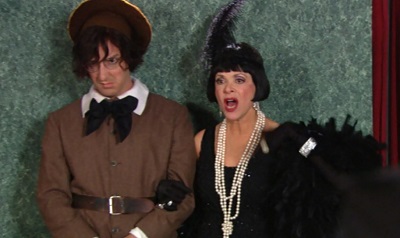
Buster (Tony Hale) and Lucille (Jessica Walter) in the “Motherboy XXX” episode

Buster (Tony Hale) and Lucille (Jessica Walter) in the “Motherboy XXX” episode

Share
Posted in: 1940s films, Film Noir/Crime/Thriller & Mystery, Romance (films) Tagged: Alfred Hitchcock, Arrested Development, Lucille Bluth, Motherboy

Recent Posts

  • 100 Years Later, Still Scary: Dr. Caligari
  • Escaping Out of the Past (1947)
  • A Weeper for Those Who Love Jerks
  • Thank You, Academy, for Not Infuriating Me
  • Challengers (2024) Is a Bad Movie

Subscribe to Blog via Email

Enter your email address to subscribe to this blog and receive notifications of new posts by email.

Categories

  • 1920s films
  • 1930s films
  • 1940s films
  • 1950s films
  • 1960s films
  • 1970s films
  • 1980s films
  • 1990-current films
  • 2020s films
  • Action & Sports Films
  • Anti-Romance films
  • Blogathons
  • Childfree
  • Comedies (film)
  • Drama (film)
  • Feminism
  • Femme fatales
  • Film Noir/Crime/Thriller & Mystery
  • Gloriously Silly Scenes
  • Horror
  • Humor
  • Mae West Moments
  • Musicals and dancing films
  • Oscars
  • Random
  • Romance (films)
  • Romantic Comedies (film)
  • The Moment I Fell for
  • Turn My Sister into Classic Movie Fan
  • TV & Pop Culture
  • Uncategorized
Share
Classic Movie Blog Hub Member

Recent Comments

  • leah@carygrantwonteatyou.com on Meg Ryan’s Fate Foretold in Joe Versus the Volcano
  • Ryan on Meg Ryan’s Fate Foretold in Joe Versus the Volcano
  • leah@carygrantwonteatyou.com on 100 Years Later, Still Scary: Dr. Caligari
  • The Classic Movie Muse on 100 Years Later, Still Scary: Dr. Caligari
  • leah@carygrantwonteatyou.com on 100 Years Later, Still Scary: Dr. Caligari

Archives

  • November 2025
  • September 2025
  • May 2025
  • March 2025
  • January 2025
  • November 2024
  • August 2024
  • July 2024
  • May 2024
  • March 2024
  • February 2024
  • December 2023
  • November 2023
  • October 2023
  • September 2023
  • August 2023
  • July 2023
  • May 2023
  • April 2023
  • March 2023
  • January 2023
  • December 2022
  • November 2022
  • September 2022
  • July 2022
  • May 2022
  • April 2022
  • March 2022
  • February 2022
  • October 2021
  • September 2021
  • April 2021
  • March 2021
  • February 2021
  • December 2020
  • October 2020
  • September 2020
  • July 2020
  • May 2020
  • April 2020
  • March 2020
  • February 2020
  • December 2019
  • October 2019
  • September 2019
  • June 2019
  • May 2019
  • April 2019
  • February 2019
  • January 2019
  • November 2018
  • September 2018
  • July 2018
  • June 2018
  • May 2018
  • April 2018
  • March 2018
  • February 2018
  • January 2018
  • November 2017
  • September 2017
  • August 2017
  • July 2017
  • June 2017
  • May 2017
  • April 2017
  • March 2017
  • February 2017
  • January 2017
  • December 2016
  • November 2016
  • October 2016
  • August 2016
  • July 2016
  • June 2016
  • May 2016
  • April 2016
  • March 2016
  • February 2016
  • January 2016
  • December 2015
  • November 2015
  • October 2015
  • September 2015
  • August 2015
  • July 2015
  • June 2015
  • May 2015
  • April 2015
  • March 2015
  • February 2015
  • January 2015
  • December 2014
  • November 2014
  • October 2014
  • September 2014
  • August 2014
  • July 2014
  • June 2014
  • May 2014
  • April 2014
  • March 2014
  • February 2014
  • January 2014

Meta

  • Log in
  • Entries feed
  • Comments feed
  • WordPress.org

Copyright © 2025 Cary Grant Won't Eat You.

Church WordPress Theme by themehall.com