Cary Grant Won't Eat You

Classic movies for phobics

  • About
  • eBooks
  • Previous Blogathons
Classic movies for phobics

Aftersun: Too Intimate for the Oscars, Rant Part II

01/29/2023 by leah@carygrantwonteatyou.com 4 Comments

Aftersun deserved best picture & directing Oscars this year, but it had no shot. The Academy doesn’t like to award intimate little stories about relationships. They like loud message films, and loud action films, and stories about men being men. And when they (rarely) pivot their patterns (Moonlight), it’s never for a woman helmer: It’s no accident that the only females who’ve won directing Oscars did so for stories about war, community job loss, and cowboys.

Academy voters like to throw a screenplay bone at the original, lovely intimate stories–though they occasionally alter that with acting (as with Aftersun) or song nominations/wins (as with Once). Even when a quiet, intimate little film like Il Postino is nominated for best picture, it wins for something else (in its case, score). That’s why when I’m searching for good films I don’t know from past Oscars, I go straight to the screenplay category. There I can find films that weren’t about the Academy trying to prove something, or the fact that many of them are too lazy to view all but blockbusters and movies with their friends in them.

What strikes me most about Academy voters is their fear. They’re afraid of being seen as racist, as they should be (#OscarsSoWhite), but they actually prove they are with nominations for movies like The Blind Side and Crash and Green Book. The pernicious roots of racism don’t lie in big headlines or loud messages or overt acts, but in the everyday moment, and the everyday moment is where all of us make mistakes of every kind. We are vulnerable there. Academy voters don’t like that space.

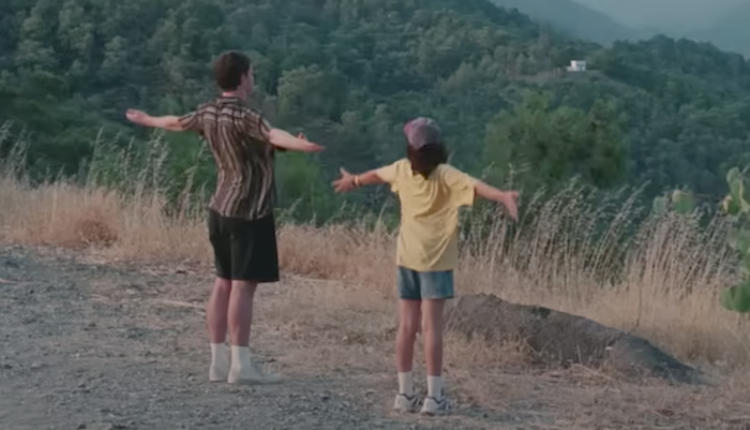
To nominate Aftersun for best picture or its writer-director Charlotte Wells would take guts. It’s not Oscar bait, and at first appears far less skillfully managed than it is. It fools you, posing as a student film, or just a kid’s camcorder records of her vacation with her dad. It’s slow. If you’re inattentive, you might find it boring. You don’t know at first the reasons for pauses; for impressionist shots; for quick flashes. You must be patient. But if you let the film in, you are caught up in the relationship between a charming young girl, Sophie (Frankie Corio), and her sweet dad, Calum (Paul Mescal). You soon sense, as when reading a book by Marilynne Robinson, that every little choice by the writer-director counts, that each choice has layers of meaning that build upon one another, and that the very everyday nature of the story is the point of the film. That’s what our relationships are about, our love, our pain, our loss, our joy. It’s missing the details of moments that haunt us later if the relationship is lost or even if it alters over time.

Aftersun is poignant because it’s about that, but more. About looking back and examining what you were too young or focused on understanding your own growing-up moments to understand, to see your father as human, with needs, pain, and insecurities. And Paul Mescal’s understated performance is much of what makes the film unforgettable.

This movie will stay with me a long time, will remind me to cherish the loved ones in my life, to try to be a more understanding person. I wonder how many people could say that about Avatar: The Way of Water.

Share
Posted in: 1990-current films, Drama (film), Feminism, Oscars Tagged: Aftersun, female director snubs, Frankie Corio, Oscar snubs, Paul Mescal, sexist Oscars

The Leo Grande Snub & More Oscar-Related Reasons I’m Pissed Off, Part I

01/25/2023 by leah@carygrantwonteatyou.com 8 Comments

Good Luck to You, Leo Grande. An enjoyable, meaningful film about a woman dealing with sex and her self-worth in middle age. A nuanced story, with a sympathetic portrait of sex workers. It gets nada from the Academy. A subtle, star-making turn by Daryl McCormack–ignored. And Emma Thompson not only snubbed, but not even listed as an Oscar snub. People couldn’t shut up about JLO not getting a nomination for Hustlers, but we’re going to forget that two-time-Oscar winner Emma Thompson was overlooked for one of her finest performances?

Viola Davis and Danielle Deadwyler Get No Nominations, and Ana de Armas Does for Razzie-Nominated Blonde. I read the book Blonde by Joyce Carol Oates, even liked it. I am not sure the director did. That film? Oh no. No. No. No. Was de Armas good in it? For what she had to work with, which was not much. That’s not an Oscar nomination. Look, I’m a Marilyn fan. That woman had some serious chops as a comedienne. But that tired trope of fragile waif Marilyn again, with some gross additions thrown into the mix? That film deserves NOTHING. I am sick.

Tár. It seemsTodd Haynes makes a movie every decade, and with the best of materials and actresses, manages to turn wonderful storylines and potential into snores.

Triangle of Sadness. A fight over a check that should have taken five minutes being stretched to such ludicrous proportions that I forgot what the movie was about. A diarrhea-puke-&-other gross bodily-function scene that takes excruciating amounts of time for NO REASON (and doesn’t make me laugh once). And, of course, the earth-shattering message that power and money corrupt? This is some shit, people. Literal and figurative. NO FEMALE DIRECTORS were chosen so that this gem could make it into the best-directing category.

Top Gun Maverick. I admit it: I didn’t see the thing. I couldn’t bear it after I found out Kelly McGillis wasn’t invited back. I’ll watch this, that Avatar sequel (please), and other action extravaganzas nominated for Oscars once a female blockbuster gets a berth on the list. In the meantime, please everyone, stop bellyaching that crowd pleasers never make it, while nominating male-only fare like Master and Commander and Gladiator. Why is everyone so forgetful? Crowd pleasers OFTEN make it, and even win. What the hell was Braveheart? A subtle indie film? What about Jaws? The Greatest Show on Earth (1952)? I mean, NO ONE saw those, right?

And I’m just getting started. Rant, Part I over. Stay tuned for Part II….

Share
Posted in: 1990-current films, Comedies (film), Drama (film), Feminism, Oscars, Uncategorized Tagged: Daryl McCormack, Emma Thompson, Good Luck to You Leo Grande, no female directors Oscars, Oscar snubs 2023, Razzies, Triangle of Sadness terrible, Viola Davis

The Banshees of Inisherin: NOT a Comedy

01/02/2023 by leah@carygrantwonteatyou.com 16 Comments

I watched a tragedy the other day. It got under my skin. Its characters wouldn’t let me be. But I was also a bit sorry I’d seen it. A friend used a perfect word for it: grim.

The film, The Banshees of Inisherin, is being called a black comedy, and some strange critics are calling it hilarious.

Hilarious?????

I love black comedies. I will howl at Shaun of the Dead and Serial Mom and Dr. Strangelove. But what Martin McDonagh’s new film makes me want to do is weep.

Have we forgotten Yorick in Hamlet? Or the dying Mercutio’s quip in Romeo and Juliet, “Ask for me tomorrow, and you shall find me a grave man”? Moments of humor do not make a tragedy a comedy. They highlight and accentuate the tragedy, make us feel for those who’ve suffered and make our sense of their losses heavier, more acute.

If you want to tell a story about a friend dying in the hospital, you don’t ONLY show that friend in the hospital. You show her lively and funny and nimble—help us see the distance between her then and now. Otherwise, all we audience members feel is a kind of generic sadness. We don’t think of your friend as an individual. We don’t understand the extent of the loss of this one amazing human being.

The Banshees of Inisherin is—on the surface–about the demise of a friendship for trivial reasons. But what it shows is how little it takes for one simple, everyday man’s life to spiral, for his days to go from easygoing to heartbreaking. And how that change brings out the worst in him. (The story is also a rather obvious metaphor about pointless warfare.)

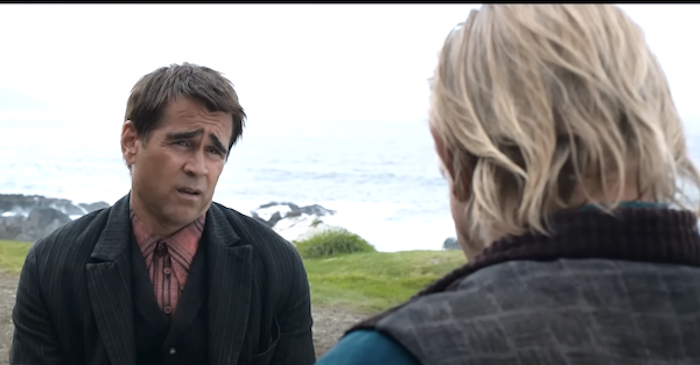
I find Martin McDonagh’s work fascinating. I agree that many of his films are black comedies. But not this film. It’s not ridiculous and theatrical or over the top in the way Seven Psychopaths or In Bruges or even Three Billboards and other black comedies are. The story is too simple, and the pain of Padraic’s (Colin Farrell’s) now broken life is far too minutely and intimately told for the humor to do anything but make us feel for his losses. (And yes, his friend’s actions are over the top, but so are Romeo’s.)

If you want to see just how talented Farrell is, watch the movie. If you’re in the mood for a sad tale about the destructiveness of poor decisions, watch.

But don’t view this film on one of your vacation days, like I did. And stop listening to those critics who think a few jokes make something a comedy.

If you want to weep afterward, it’s not a comedy.

Share
Posted in: 1990-current films, Drama (film), Humor Tagged: Brendan Gleeson, Colin Farrell, not a black comedy, The Banshees of Inisherin

“The Funnier Sex” with No Mae?

12/22/2022 by leah@carygrantwonteatyou.com 2 Comments

I just watched “The Funnier Sex,” an episode from CNN’s The History of Comedy. The segment features numerous current comediennes celebrating their groundbreaking predecessors. They highlight the sexism that marred their predecessor’s progress—especially that ridiculous view that women can’t be funny—and expressed how much harder it was for an attractive woman to also be considered funny. Lucille Ball—as usual—was singled out as the pretty woman who changed that for everyone.

Sigh.

Look, I love Lucy—we all do—and I get that most people’s sense of history is as developed as an ant’s. But are we going to ignore the vaudevillians entirely? Those women who used their sexiness to get away with cultural commentary? Who—like the standup artists who followed them—used live audience’s reactions to fine-tune their jokes, over and over again? You know, like STAND-UP COMICS??

In other words, WHERE IS MAE WEST?

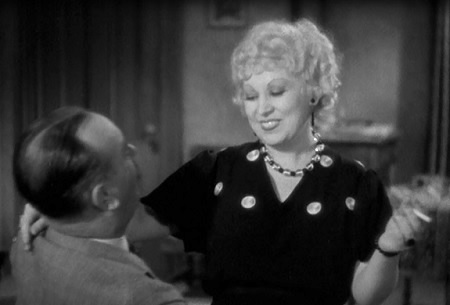
West was not, of course, the first female comedienne in America. But as someone who starred in vaudeville, broke out in film, made appearances on TV, and then produced a live Vegas show with Chippendale-like men, she was hardly an invisible influence on the comediennes who followed her. And her humor was MUCH more like that of the stand-up stars celebrated in the series than Lucy’s ever was—and far more risqué.

And Mae wrote her own material, managed to be a rom-com star into her 40s, and even saved a studio. Mae peddled and exploited her own attractiveness in her jokes. She was known as a bombshell, even if some of her snarky male contemporaries—and ours—use their own sexist views of curvy women’s bodies to question it.

Let’s review just one incident—on the smash second day of her play Sex in 1926, which she records in her autobiography, Goodness Had Nothing to Do with It: Only 85 people appeared for the first performance, disappointing the star and the manager, who blamed the scandalous title for ticket sales. But at the next day’s matinee, Mae observed lines of men from the naval base “two and three deep.” The house manager was scrambling for extra seats for his theater. “And you said it was a bad title,” noted Mae. And he replied, “I forgot about the sailors.”

Sound like a woman who wasn’t using her sex appeal for humor?

I understand that standup is not the same as vaudeville, but the latter was clearly a forerunner, certainly more than scripted TV.

Look, I enjoyed the episode from The History of Comedy. It featured some of my own heroes, including Joan Rivers and Rachel Bloom. But why, after all these years, are TV historians still ignoring the extraordinary impact of Mae West?

What other comedian wrote lines we still repeat 100 years later, such as one of the all-timers?:

“It’s not the men in my life that count, it’s the life in my men.”

I suspect I know the reason she’s bypassed—the same reason early groundbreakers are so often forgotten: Because the wave of female comediennes would take years to follow in her wake. Because she was so ahead of her time that she wasn’t even part of the same generation who would supposedly “change everything.”

But all the more reason to own her. All the more reason to celebrate her. All the more reason, CNN, to give the sexy, groundbreaking, hilarious woman her due.

Share
Posted in: Childfree, Humor, Mae West Moments Tagged: feminism, groundbreakers, Mae West, The Funnier Sex, The History of Comedy, women in stand-up

The Misunderstood Femme Fatale of Detour

11/07/2022 by leah@carygrantwonteatyou.com 12 Comments
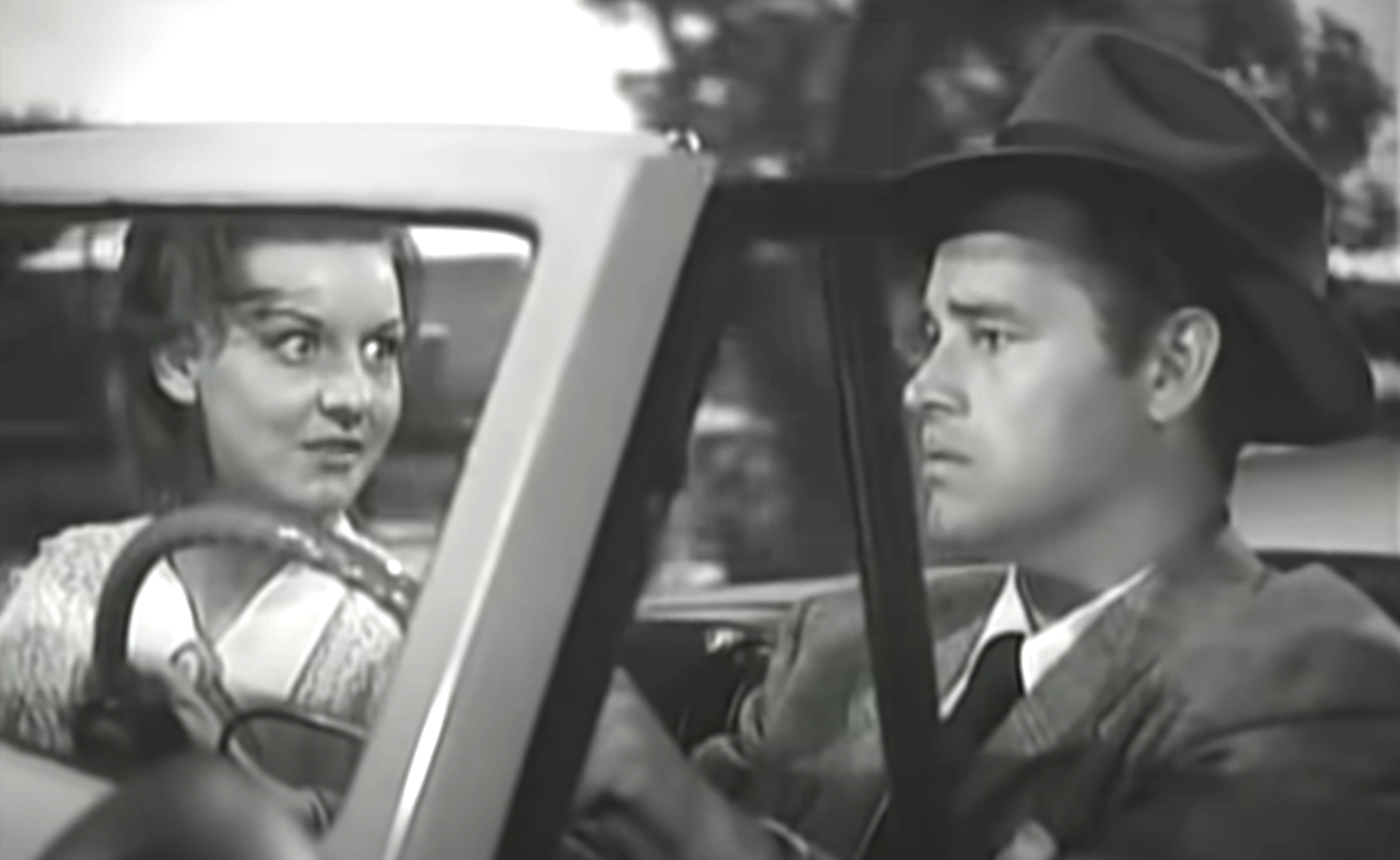
Ann Savage and Tom Neal in Detour (1945).


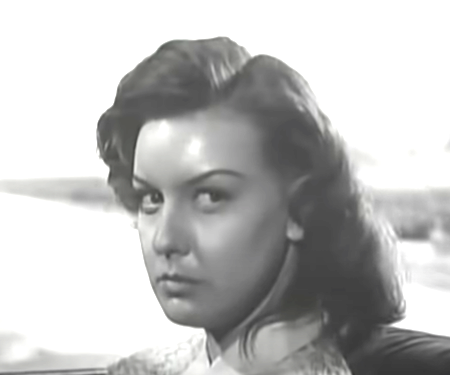
The common line on Detour (1945) is that it features one of the nastiest of femme fatales—a fascinating, feral creature. It’s true that Ann Savage as Vera is a powerhouse, and I can’t stop watching her. But is she really all that bad?

**Some plot reveals.***

So many reviewers skim over the incident that made Vera so raw in the first place. Yet to me, her reaction to that incident is what makes this B film worth watching. Can anyone honestly say they root for the sad-sack, self-pitying musician, Al Roberts (Tom Neal)?

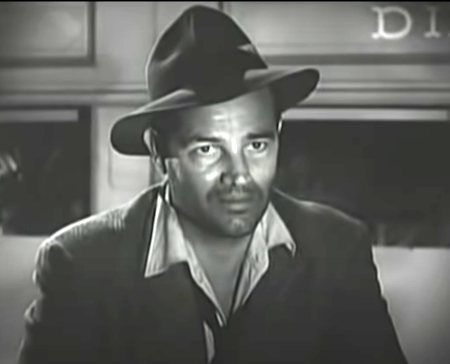
Tom Neal, the sad hero of Detour


What a dud this hero is. The movie is nothing until Vera enters the screen, and it’s nothing after she’s gone.

As far as her dangerousness, let’s review, shall we? Vera is a hitchhiker picked up by Charles Haskell Jr (Edmund MacDonald). We learn about her secondhand from Charles, who is complaining to his current passenger, Al, about the deep scratches on his hand. Charles says an “animal” inflicted the wounds on his body. “You know there ought to be a law against dames with claws,” he complains.

The reason for their disagreement is soon clear: “Give a lift to a tomato, you expect her to be nice, don’t you?….After all, what kind of dames thumb rides, Sunday school teachers?”

In other words, he thought she should be forced into sex with him because she must be that kind of girl. This dude felt entitled to rape her because she’s a hitchhiker. He assumes all men will agree with him (as Al does) that she’s nasty because she hurt him defending herself.

What’s intriguing—and unusual—about Detour for its time is that it gives voice to this assaulted woman. As soon as we meet Vera, we know she’s suffering from PTSD and doesn’t know how to manage her pain. Even Al, hardly an empath, says, “Man, she looked as if she’d just been thrown off the crummiest freight train in the world.”

Her angry words soon reveal that Charles is hardly the first man who has felt entitled to mistreat her: “I’ve been around,” she tells Al, looking at him intently, “and I know a wrong guy when I see one.”

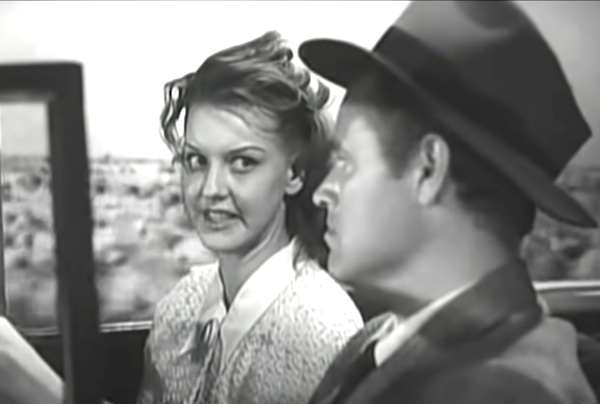
Ann Savage strikes out at Tom Neal in Detour.


That she lashes out at Al might be because of what she thinks he’s done—but it’s not the only reason.

Now Al is not the smartest dude, as Vera quickly realizes: “…You don’t have any brains.” He picks up a stranger right after he accidentally killed Charles and exchanged identities with him. If he were a smooth-talking liar, you could see him getting away with this move. If he were quick, you could see it too. But Al is not smooth. He is not quick. He is not smart. And he lies with all the skill of a toddler. He’s also unlucky because whom should he invite for a ride, but the only one who knows his identity is false? While many of his grievances are self imposed, it’s hard to argue with him that when it comes to encounters like his with Vera, fate was putting “out a foot to trip you.”

Vera’s instantly brutal to Al, whom she thinks killed her attacker. But she feels kinship with him too. She’s aiming for connection, an us-against-the-rich plan. She’s Bonnie and this idiot won’t be her Clyde. It pisses her off.

Ann Savage, the mistreated, angry heroine of Detour.


She wants him to recognize that they’re both presumed bad, that they don’t have a chance, so why not go for a con? Why not enjoy the advantages they have before everything goes to hell, as it certainly will, for people the deck is stacked against, like themselves? And when he won’t give in, she tries blackmail.

Her plan is not nice. She’s not nice. But I don’t find her nasty—even if some of her actions (and plans) are cruel. I find her tragic. She believes Charles’s wealth is part of what made him feel entitled to rape a poor girl, like her. She’s met a lot of men who act that way. Unfortunately, she didn’t find a man who could empathize with her suffering, or even enjoy a drink with her. She looked for something approximating an ally, and all she got was Al.

Oh Al. What a worthless character. He is a homme fatale BY ACCIDENT. He falls to pieces when a woman yells at him. He breaks into hives when he tries to sell a stolen car. Some theorize that he’s an unreliable narrator, deluding himself that he didn’t kill. Personally, I think he’s just deluded himself that his girlfriend wants him back. I don’t find Al’s psychology complex enough for any more sophisticated delusions.

But Vera? We lose her far too soon. If this film were the revenge fantasy this character deserves, she’d be living it up in Charles’s family mansion, smiling archly at the family as they bemoaned the loss of their heir.

“Oh yes,” she’d say, holding up champagne and affecting a snooty tone, “Wasn’t it a shame for Charles, all those women who did him wrong?”

This post is part of the Movies are Murder! blogathon hosted by the Classic Movie Blog Association (CMBA). Go check out all of the great entries.

Share
Posted in: 1940s films, Blogathons, Drama (film), Femme fatales, Film Noir/Crime/Thriller & Mystery Tagged: Ann Savage, Detour, femme fatale, homme fatale

The (Strange, Silly) Guest (2014)

09/17/2022 by leah@carygrantwonteatyou.com 4 Comments

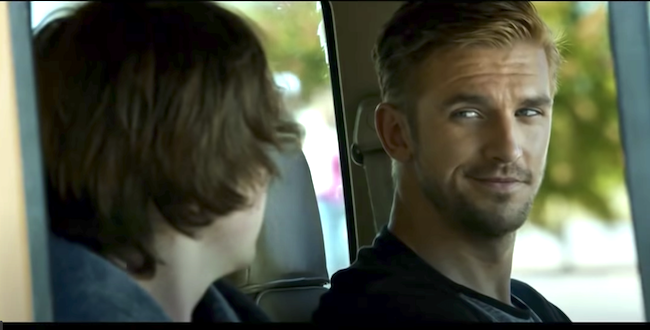
You have to hand it to Dan Stevens. Two years after his dramatic Downton Abbey exit, he starred in the camp treasure, The Guest, putting behind him one type of ponderous silliness for a decidedly lighter-weight version.

The Guest bears all the hallmarks of Lifetime fare in the first half: a mysterious, ridiculously attractive stranger. Hints that his motives—and past—might not be as innocent as his southern charm and “ma’am” courtesy would suggest.

A young woman who suspects him despite her parents’ trust (and her dad’s overeagerness to have a drinking buddy). And a young brother too pleased by the stranger’s help with his bullying problem to fear the degree of the man’s violence. Had that been all that The Guest was, I would have been happy enough.

But oh no, The Guest is much more. Because halfway through, it takes an abrupt 90 degree turn into campish horror/slapstick, without bothering to clarify basic character motives or anything else. In so doing, it gave me the best burst of unquenchable laughter I’ve experienced in some time.

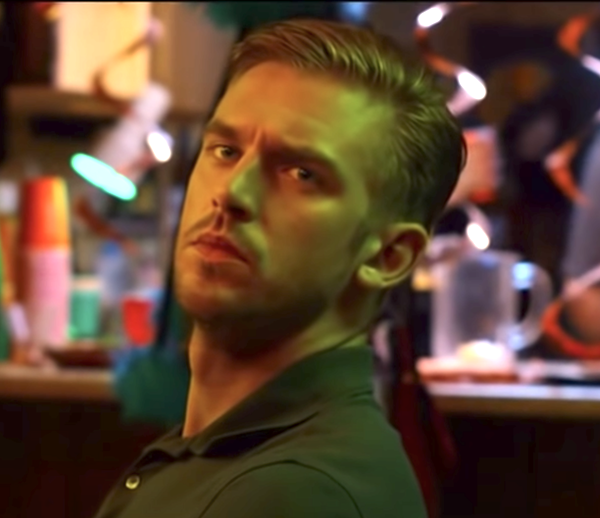
Dan Stevens just OWNS this film, reveling in his goofy role as only an actor with a deep-seated love for black humor could do. His tiniest gesture is hilarious. The film even pays tribute to a famous scene in one of my favorite noirs from the 40s—which I’ll link to, but won’t reveal. Because to give anything away in the second half would be a mistake. Instead, I’ll just give you the basic premise:

David (Stevens) visits the parents of his dead army buddy. They ask him to stay. Because of course they do. The mother (Sheila Kelley) plays Debbie Hunt in Singles, and she has always expected the best.

Soon, David’s actions become suspicious, and then the plot turns downright bonkers. Because of course it does. The actor playing the father, Leland Jones Orser, starred in the (deeply dark) black comedy Very Bad Things, which should have foretold it for me.

The viewing pleasure isn’t hurt by just how sexy Dan Stevens is in the role. He has clearly spent a lot of gym time in preparation, and his lean, beautiful body is a nice complement to those riveting blue eyes. One can hardly blame the daughter/heroine (Maika Monroe) for waiting until his behavior goes truly off the rails to seek help.

And one can hardly blame you for enjoying every minute of this eye-candy-filled, ridiculous romp of a film.

Share
Posted in: 1990-current films, Action & Sports Films, Anti-Romance films, Comedies (film), Film Noir/Crime/Thriller & Mystery, Humor Tagged: black comedy, camp, Dan Stevens films, Downton star, The Guest

Who Is the Biggest Charmer?

07/27/2022 by leah@carygrantwonteatyou.com 4 Comments

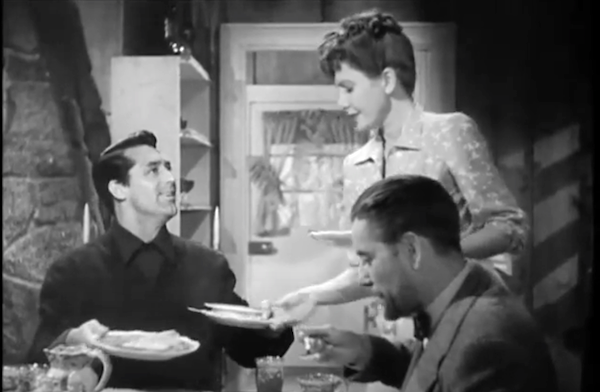
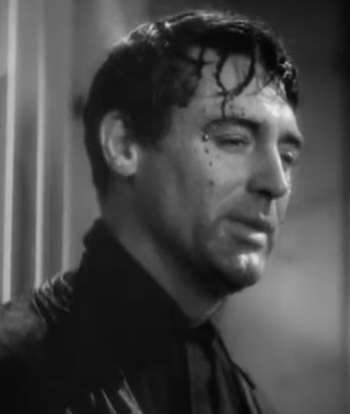
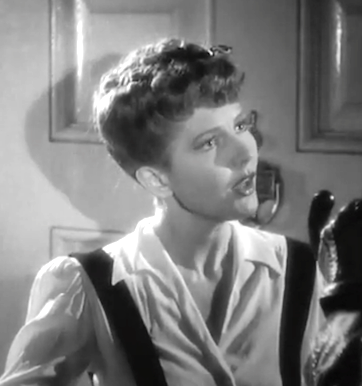
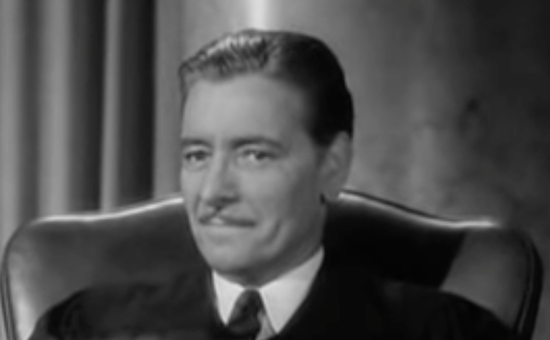
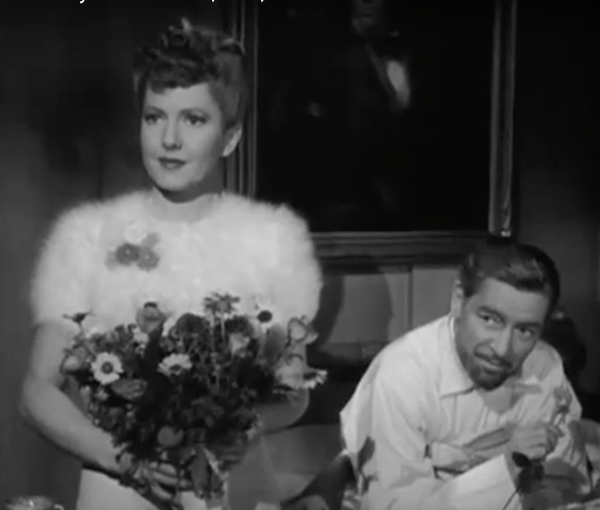
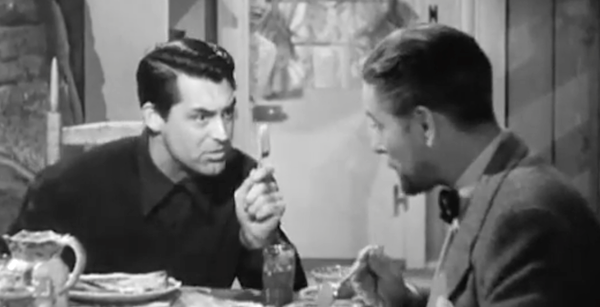
The Talk of the Town (1942) is a joyous experience. It features a romantic triangle between three actors who are absurdly charming: Jean Arthur, Cary Grant, and Ronald Colman. It’s a bit of an odd tale, but frankly, with these three people in the mix, who cares about plot?

You can’t watch Cary Grant’s smirking, musing, or flirting….

Hear Jean Arthur’s lovely tweety voice…

Or witness the sweetness of Colman’s subtle smile….

without giving into them, can you?

The only question is which of the three is the MOST charming.

Certain actors carry a patina of their roles with them. To me, Julia Roberts, Tom Hanks, Al Pacino, Robert De Niro, and Denzel Washington are all like this. Try to watch Tom Hanks without the echoing sweetness of Josh (Big) and his other early comedies winning you over; I can’t make it through half a minute of any of his movies without already loving the guy.

But it’s not often that THREE actors this charming share the screen, as they do in The Talk of the Town.

The story is a peculiar mishmash. Jean Arthur’s Nora, a teacher, is renting her house to a renowned legal scholar, Professor Michael Lightcap (Colman). Her old school chum, Leopold, is on the run from the law, accused of starting a fire in a mill that killed his foreman. He hides in her home right as Lightcap arrives and pretends to be her gardener to fool the new resident.

Lightcap may be the only person who can save Leopold’s life. The mill’s owner is egging on a mob to kill Leopold for his alleged crime. The fugitive, annoyed by Lightcap’s cold legal logic, moves Lightcap with his passion and firebrandy ways (couldn’t resist), which are what made the mill owner hate him to begin with. Nora finagles a job as a secretary to Lightcap to protect Leopold from being discovered by the mob–or by Lightcap.

A triangle really is the right word, as Nora is impressed by Lightcap’s prestige, intelligence, and ethics, and torn between these new feelings and her old affection for Leopold.

Yet it would be a mistake to leave Leopold and Lightcap out of the mix: the film is as much about intellectual as romantic affection. Whether Lightcap is most drawn to Leopold or Nora is a question that never gets answered.

And who can blame him? This is a charm off, my friends, and in every corner of this Isosceles is an actor—and by extension, character–you can’t help watching. Let’s dig a little deeper:

Jean Arthur

Whether she’s wisecracking as Saunders (Mr. Smith Goes to Washington), flirting without realizing it (The More, the Merrier), baffled (Easy Living), or earnest (Shane), Jean Arthur is adorable. I love seeing her in oversized PJs.

The look somehow captures her appeal–the way people underestimate her until that feisty, birdlike voice and the frustration she evokes so well (she should be annoying but somehow never is) draw you in and win you over.

Ronald Colman

I fell for Ronald Colman in Random Harvest, and woe betide the woman who ever watches that film: his “forgotten man” will haunt you. With a voice nearly as memorable as Arthur’s, the broken veteran in Random Harvest moves seamlessly from his shaken condition to the debonair man of consequence. He is equally convincing in both versions of himself. His gruffness in The Talk of the Town‘s start, therefore, never fools me for a second. This, my friends, is a sweetheart, make no mistake–and thus he proves to be. These two films came out in the same year, so perhaps others didn’t have this early love affair with him. But watch him in anything, and you fall for the man.

Cary Grant

Cary Grant, of course, is the most obvious charmer–playing, as he often admitted himself, the part of Cary Grant his whole life. He is never fully convincing as the local troublemaker driven by his ideals–until he questions his own judgment due to his admiration for Lightcap.

Cary Grant often seems to be in reflective mode, and his torn feelings about Lightcap play over that gorgeous face. But then, we are on his side as soon as we recognize that face. This is the slightly disreputable version of the actor you can’t help but adore, the rabble rouser with a naughty streak, with a pinch of The Awful Truth and Topper. You’re never convinced this is the Cary Grant of Suspicion, though he is accused of murder. Like with Arthur, you can’t ever count him out, even when he’s romantically (and ethically) paired against a potential Supreme Court justice, Lightcap.

So who do YOU think the winner of this charm-off would be, however it may end in the film? I leave it to you to decide.

Share
Posted in: 1940s films, Comedies (film), Romantic Comedies (film), Uncategorized Tagged: Cary Grant, Jean Arthur, Ronald Colman, The Talk of the Town

The Woman on the Beach (1947)

05/17/2022 by leah@carygrantwonteatyou.com 14 Comments

Yes, this movie is a mess: confusing dialogue, incomprehensible character development, choppy plot development, and some truly unfortunate music choices. But there are three good reasons to still watch Jean Renoir’s curious noir, my choice for the Classic Movie Blog Association Fun in the Sun! blogathon

  1. Robert Ryan’s performance as Scott. Can any man in noir perform intensity as well as Robert Ryan? I never feel any attraction or liking for Ryan’s characters in any film, but he certainly gets under my skin. Who better to play a Coast Guardsman with PTSD than Ryan? Scott is also impulsive, erratic, and passionate—and fully realized thanks to Ryan.
  2. The complexity–and unpredictability–of the “love” triangle. Scott falls for Peggy (Joan Bennett), a woman collecting firewood next to an old shipwreck, because she’s haunted, like he is. It doesn’t hurt that Peggy looks like Joan Bennett. Unfortunately for Scott, Peggy is married to an artist, Tod (Charles Bickford), who is, if possible, even more intense than Scott. We learn soon that Peggy accidentally blinded Tod in a drunken squabble. Her husband is so awful–abusive and violent and creepy–that we understand her fling with Scott and desire to escape with him. But things aren’t quite what they seem. There is something still between Peggy and Tod, mysterious as that connection might be to viewers. It’s not exactly love; it’s not exactly hate. It may just be toxicity–but there’s something there all the same. How will it all turn out? The film keeps us guessing.
  3. Jean Renoir. It’s odd to watch a film by such a famed director that is such an odd misfire. The story is that an advance viewing was a disaster for Renoir, and he was forced to make cuts and edits that didn’t serve the story. While that butchering IS clear, his original goal isn’t. But that’s what makes the film so intriguing. What did he want to say about these three tortured people, especially the original couple? What are we to make of how it starts, and how it ends? Why did he feel traditional noir tropes wouldn’t serve him, and yet set out to write (with Frank Davis) a noir anyway? And why choose this story to adapt? It’s hard to say, but the guesswork will keep you watching.

This review is part of the blogathon held by the Classic Movie Blog association, Fun in the Sun! Check out the excellent entries there, which are also mainly much happier viewings than this grim tale!

Share
Posted in: 1940s films, Blogathons, Femme fatales, Film Noir/Crime/Thriller & Mystery Tagged: Charles Bickford, Jean Renoir, Joan Bennett, Robert Ryan, The Woman on the Beach (1947)

In Praise of USA Up All Night

04/12/2022 by leah@carygrantwonteatyou.com 10 Comments

Today I felt a pang on hearing about Gilbert Gottfried’s death. Of course I found him annoying, but I also loved him. He–and Rhonda Shear–gave me USA Up All Night just when I needed it, a show that taught me valuable lessons that have stayed with me ever since. Here’s what I learned from that weekend stalwart, which, for the uninitiated, basically consisted of terrible, terrible movies playing from 11 pm /12 am till the wee hours on Fridays and Saturdays, with interludes of jokes, skits, and commentaries from the hosts.

  1. You Can Find Amusement in So Many Things. Camp was always appreciated in my family: my Uncle Ed’s running commentary on Slugs was a family reunion highlight. But in between those beloved family visits, I had Gottfried and Rhonda, poking fun of absurdly terrible B movies that no other channel would even play. Even Rhonda’s ridiculously perky enunciation of UP could make me laugh. To this day, I find enjoyment in so much pop culture that others don’t, and that’s partly thanks to USA Up All Night.
  2. Don’t Take Your Job Too Seriously. True, it’s hard to not laugh about your job when you’re commenting on Cheerleaders Beach Party. But Gottfried’s constant amusement (you could definitely see “This is my job?” in his expression) reminded me that every job doesn’t have to be a forever-career or vocation. Sometimes, you pay the bills doing something silly, and that’s OK. (And most of us do have absurd tasks even in the most serious of jobs.)
  3. Binging Movies Is Fun. Oh, you poor souls who didn’t learn this fact until Netflix. Gottfried and Rhonda (and the earlier host I never watched, Caroline Schlitt) taught us Gen Xers this back in the early 90s. Think of all the years of joy you missed!
  4. Embrace Your Awkward Self. Gottfried and Rhonda were never cool. They were goofy and absurd and nerdy and silly. But because they clearly didn’t care WHAT they were, they reminded me, an awkward teenage girl, that I didn’t have to be cool to have fun.
  5. Make Solitary Friday Nights an Occasion. In my twenties and early thirties, I moved states several times, each time alone. I was always either single or dating someone long distance, so Friday nights were rough on me. I hated the time it took to be moved from new friends’ weekday to their weekend rituals. To stave off the loneliness, I’d splurge on Fridays: wine, chocolate, good bread, and cheese. Maybe even takeout. I’d grab that remote and begin my movies, and all was right with the world. Sometimes, my preparations led to unhelpful comments by store clerks. (“Oooh-hoooh, honey, you’re having a romantic night tonight, huh?”) But in time, these Fridays became so peaceful and cathartic that I missed them when I had plans. (A bit of a foretaste of middle age, huh?) Would I have known to make an occasion of movie binging each Friday, without Gottfried and Rhonda’s example?
  6. You Never Know What Your Impact Will Be. I don’t think Gottfried could have anticipated that he’d be celebrated by a writer for USA Up All Night when he died thirty years later, do you? You just never know.

Share
Posted in: 1970s films, 1980s films, 1990-current films, Comedies (film), Humor, Random, TV & Pop Culture, Uncategorized Tagged: camp movies, Gilbert Gottfried, in memoriam, Rhonda Shear, USA Up All Night

A Tribute to Paddy, Cheerleader

03/09/2022 by leah@carygrantwonteatyou.com 13 Comments

As a new blogger, you often feel as if you’re just sending content into the ether, content no one will ever see or remark upon.

Why do I do it? you ask yourself. After all, you get no comments. You can see from your stats that only bots have viewed your posts. Why bother? you ask yourself. I should just give this up.

Until suddenly someone begins to post comments—and that someone isn’t your mom or English teacher. That someone is a stranger.

And she comes back—again and again. And her comments are wise and funny and generous and thought provoking, and they mean something to you not just because she’s a stranger, but because she’s GOOD. A great writer. Far more knowledgeable about the subject matter than you are. A frequent blog award winner.

And she still thinks YOU have something to say.

So you gain confidence. And you post more. Until you get the hang of it, get into the routine. Of course, it’s inevitable that you’ll slip. For months you won’t post. But when you do, there she is, as if to remind you, I care. I really do. Keep writing. And she makes you believe that there are others out there, not as confident as she perhaps, who are reading too.

And as you participate in blogathons, you notice that she’s doing this for others—many others. That her comments accompany so many posts, and that they’re never generic comments. They’re always specific, always thoughtful. How you smile to see her name! And you know that you should do the same, help others keep going. But you never manage to set the bar as high as she does.

That’s who Paddy of Caftan Woman was to me. I just learned of her death, and like many people who’d never met her, I mourned. I’ll never get to read any new posts from her—her funny, insightful, interesting pieces that taught me so much about classic films and film history. I’ll never get to see her name in my comments again, or experience her sympathy for my struggles in trying to convince my classic-movie-intolerant siblings. And neither will all the others she supported.

So I want to say thank you belatedly to Paddy, and to the virtual supporters like her who help writers keep going when we want to give up, when we wonder what the point is, when we feel like no one cares.

Today I’d like to post some images from classic film that remind me of Paddy and what she meant to me—and to so many others.

This is how I imagine Paddy wrangling me to keep writing:

Here’s the joy I felt when I saw her name in my comments:

And most of all, I think of this character when I envision Paddy: the wise one who knows how to be silly, to balance warmth and honesty with wit, to say just what’s needed, and to do what will always make you smile.

I miss you, Paddy.

Share
Posted in: Uncategorized Tagged: blogging, blogging community support, Caftan Woman, Paddy
« Previous 1 2 3 4 5 6 7 8 … 23 24 25 26 27 Next »

Recent Posts

  • 100 Years Later, Still Scary: Dr. Caligari
  • Escaping Out of the Past (1947)
  • A Weeper for Those Who Love Jerks
  • Thank You, Academy, for Not Infuriating Me
  • Challengers (2024) Is a Bad Movie

Subscribe to Blog via Email

Enter your email address to subscribe to this blog and receive notifications of new posts by email.

Categories

  • 1920s films
  • 1930s films
  • 1940s films
  • 1950s films
  • 1960s films
  • 1970s films
  • 1980s films
  • 1990-current films
  • 2020s films
  • Action & Sports Films
  • Anti-Romance films
  • Blogathons
  • Childfree
  • Comedies (film)
  • Drama (film)
  • Feminism
  • Femme fatales
  • Film Noir/Crime/Thriller & Mystery
  • Gloriously Silly Scenes
  • Horror
  • Humor
  • Mae West Moments
  • Musicals and dancing films
  • Oscars
  • Random
  • Romance (films)
  • Romantic Comedies (film)
  • The Moment I Fell for
  • Turn My Sister into Classic Movie Fan
  • TV & Pop Culture
  • Uncategorized
Share
Classic Movie Blog Hub Member

Recent Comments

  • leah@carygrantwonteatyou.com on Meg Ryan’s Fate Foretold in Joe Versus the Volcano
  • Ryan on Meg Ryan’s Fate Foretold in Joe Versus the Volcano
  • leah@carygrantwonteatyou.com on 100 Years Later, Still Scary: Dr. Caligari
  • The Classic Movie Muse on 100 Years Later, Still Scary: Dr. Caligari
  • leah@carygrantwonteatyou.com on 100 Years Later, Still Scary: Dr. Caligari

Archives

  • November 2025
  • September 2025
  • May 2025
  • March 2025
  • January 2025
  • November 2024
  • August 2024
  • July 2024
  • May 2024
  • March 2024
  • February 2024
  • December 2023
  • November 2023
  • October 2023
  • September 2023
  • August 2023
  • July 2023
  • May 2023
  • April 2023
  • March 2023
  • January 2023
  • December 2022
  • November 2022
  • September 2022
  • July 2022
  • May 2022
  • April 2022
  • March 2022
  • February 2022
  • October 2021
  • September 2021
  • April 2021
  • March 2021
  • February 2021
  • December 2020
  • October 2020
  • September 2020
  • July 2020
  • May 2020
  • April 2020
  • March 2020
  • February 2020
  • December 2019
  • October 2019
  • September 2019
  • June 2019
  • May 2019
  • April 2019
  • February 2019
  • January 2019
  • November 2018
  • September 2018
  • July 2018
  • June 2018
  • May 2018
  • April 2018
  • March 2018
  • February 2018
  • January 2018
  • November 2017
  • September 2017
  • August 2017
  • July 2017
  • June 2017
  • May 2017
  • April 2017
  • March 2017
  • February 2017
  • January 2017
  • December 2016
  • November 2016
  • October 2016
  • August 2016
  • July 2016
  • June 2016
  • May 2016
  • April 2016
  • March 2016
  • February 2016
  • January 2016
  • December 2015
  • November 2015
  • October 2015
  • September 2015
  • August 2015
  • July 2015
  • June 2015
  • May 2015
  • April 2015
  • March 2015
  • February 2015
  • January 2015
  • December 2014
  • November 2014
  • October 2014
  • September 2014
  • August 2014
  • July 2014
  • June 2014
  • May 2014
  • April 2014
  • March 2014
  • February 2014
  • January 2014

Meta

  • Log in
  • Entries feed
  • Comments feed
  • WordPress.org

Copyright © 2025 Cary Grant Won't Eat You.

Church WordPress Theme by themehall.com