Cary Grant Won't Eat You

Classic movies for phobics

  • About
  • eBooks
  • Previous Blogathons
Classic movies for phobics

Feminism

State of the Union: the Wish Fulfillment Edition

05/12/2014 by leah@carygrantwonteatyou.com 11 Comments

This post is part of The Great Katharine Hepburn blogathon. Be sure to check out the other entries!

The political satire in 1948’s State of the Union feels disturbingly fresh. Replace a phrase or two, and presidential nominee Grant Matthews’ (Spencer Tracy’s) speeches on the “working man” could fit into the Occupy Wall Street movement.

The film’s title, however, refers to not only what’s rotten in the state of the nation, but in the marriage between Grant (Tracy) and Mary Matthews (Katharine Hepburn).
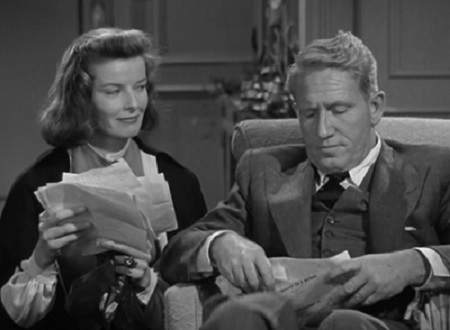
Mary and Grant Matthews

Mary and Grant Matthews

Sexy newspaper publisher Kay Thorndyke (Angela Lansbury) has seduced Grant with the aim of pitting him against her dead father’s political rivals.
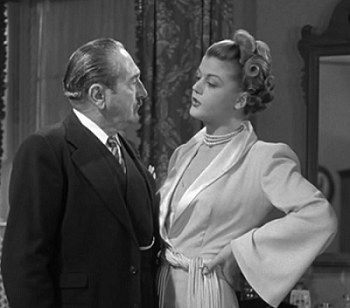
Kay and fellow schemer (Menjou)

Kay and fellow schemer (Adolphe Menjou)

Mary (Hepburn) agrees to pretend her marriage is strong for the sake of the campaign, as she believes her husband a “great man,” which, if he ever were, he ceases to be by the film’s close. The movie traces his idealism crumbling under the necessity of playing the political game, thanks, in no small part, to Kay’s machinations.

The dialogue is as sharp and cynical as you would expect in a Frank Capra film. My favorite comment is when Mary snaps that the slimy politician under Kay’s supervision (Adolphe Menjou) should be happy about what’s left of her own naiveté: “You politicians have remained professionals only because the voters have remained amateurs.”

The central problem of the film is how unsympathetic her husband Grant is. A self-made man with his “little guy” days far behind him, he pompously lectures businessmen and union leaders about how that little guy should be treated. Capra treats him as if he’s one of his innocents among the corrupt, like Mr. Deeds or Jefferson Smith, and it doesn’t work–Grant begins as a heel, and ends as a worse one.

And it’s hard to forget he’s betrayed a wife so cool she calmly knits while he’s doing acrobatics with his plane, handing campaign manager (Van Johnson) her bag to puke in.
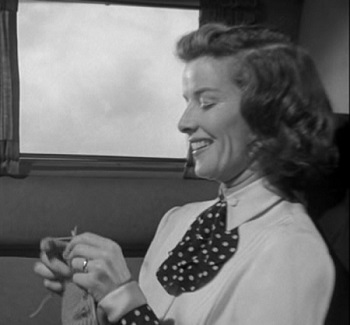
Mary during dangerous aerial acrobatics

Mary during dangerous aerial acrobatics

Luckily, we can ignore Grant and his speechifying and pay attention to the true delight of the film: Mary and Kay facing off against one another—Mary because she loves her husband, and Kay because she fears Grant will be swayed by his wife’s morals and thus lose the election.

The two real stars

The two real stars

Just listen to how they talk about each other:

Kay: “That woman’s got to [Grant]. She’s been feeding him that to-thine-own-self-be-true diet.”

Mary: “If this weren’t my house, I could tell her someplace she has to go to…” or “…I think Kay’d be more comfortable in a kennel.”

When Mary has to invite Kay to her house to cover up the affair, she tries to avoid doing what she apparently did once before: getting plastered and throwing Kay out. This is the moment in the film when I wanted to shake Capra. That’s the scene you left out???

We do get treated to seeing Mary drunk in defiance of orders from Kay and crew.
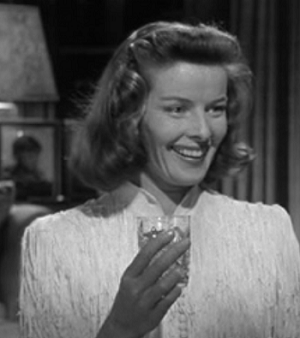
Mary rebeling

Mary rebelling

But I kept wishing for a The Women-style face off; the heroines are so powerful and interesting that in comparison, the men in the film (with the exception of Johnson and Mary’s butler) seem a waste of screen time. Luckily, the women are so fun to watch that they revive and redeem the film.

At one point Grant’s barber shares his wife’s conviction that a woman should be president. “That’s silly,” responds Mary. “No woman could ever run for president. She’d have to admit she was over 35.”

Though the quip is funny, no line coming out of Hepburn’s mouth was ever less convincing. Those who know anything about Hepburn realize she had confidence to spare, felt comfortable aging in front of the camera, and would have run for any office if she’d felt like it. Mary clearly has Hepburn’s spunk, and after all, a woman had run for president more than 70 years before this film, another woman with considerable moxie.

Would Mary have won? Of course not. But what speeches she would have written!

And for Capra not to give Kay more time in the film is criminal. Watch her command her editors to publish filth about all of the Republican candidates so that their united hatred for one another will make them choose her man (Grant) at the convention. That icy stare you recognize from The Manchurian Candidate (1962)? Yeah, this is a woman who could make it to the White House today for sure. She’s a predatory villain as thrilling to watch as Claire Underwood (Robin Wright) in House of Cards.
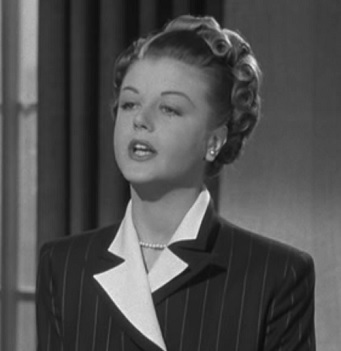
Kay commanding the troops

Kay commanding the troops

It’s probably enough that a film in 1948 starred such strong actresses playing powerful roles. I shouldn’t wish for what could have been, these two really facing off against each other, maybe even running against each other for office.

But what a film that would have been.

Share
Posted in: 1940s films, Blogathons, Drama (film), Feminism Tagged: Angela Lansbury, feminists, Katharine Hepburn, political satire, Spencer Tracy

Veep & Together Again: Hollywood & Female Leadership

05/08/2014 by leah@carygrantwonteatyou.com 10 Comments

Sometimes the stars align, and you can convert hours of procrastination into productivity. At least, that’s what I’m telling myself about this week’s blog post, which is the result of a Veep marathon and viewing of two Irene Dunne films in a row. Call it a stretch or serendipity, but I keep observing similarities between the Julia Louis-Dreyfus-helmed TV show about a vice president and Together Again (1944), a film about a small-town mayor. Both keep returning to some of the same themes for humor, and both succeed.

Fairy Tale Romance? Not for Them
In Together Again, Irene Dunne (as Anne Crandall) plays a widow who takes over as mayor after her husband dies. The film begins with a shot of a statue created in her husband Jonathan’s honor. The unlikely Cupid of the film, Crandall’s father-in-law (Charles Coburn), is disgusted by this hero worship, which he considers against his son’s wishes. He tries to convince his daughter-in-law to find a man.

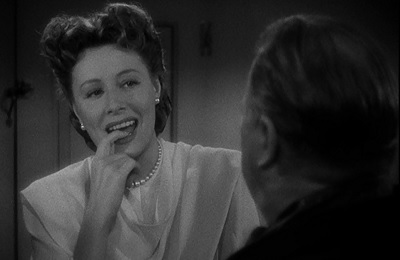
I can’t decide what’s more delightful: Crandall’s response, or her amusement in expressing it: “You can’t bear to see a woman living alone and liking it. No man can. Instinctively, it terrifies them. You’re a vanishing race and you know it. And the minute you lose your hold over us emotionally, wow. So naturally, your platform must be husbands are necessary. And they’re not really.”

Crandall mocking her father-in-law

His rebuttal, refreshingly, is not that singlehood is wrong; he just believes the state is not for her: “You talk like a free soul, but you’re the most manacled creature I’ve ever seen…Everything you do, everything you say, everything you breathe is the way Jonathan did it, said it, and breathed it. Why don’t you stop living his life and live your own?”

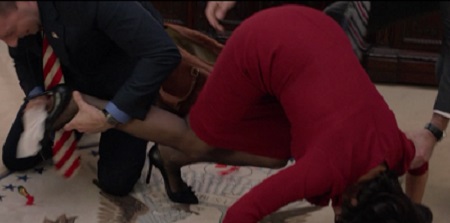
Veep’s heroine too is annoyed by others’ desire to fit her into a typical female role–in her case, as a happy wife and mother. At the start of Season 2, Julia Louis-Dreyfus attacks her former strategist (Gary Cole) for trying to force an image of the perfect family on her, which led to an uncomfortable river rafting trip with her daughter, her estranged husband, and his mistress. Their spat takes place in the Oval Office, and hilarity ensues when her lipstick marks up the sacred carpet.

Lipstick stain recovery effort

The Nonsense of Politics
Since Together Again is a romantic comedy, its primary interest, unlike Veep‘s, is not politics, but it has its moments, as in this great exchange between Randall and Mr. Witherspoon, who is in charge of the town’s sanitation and keeps leaving the south side blanketed in “a lot of old potato peelings.” His sorry excuses echo those that flood Veep:

Mr. Witherspoon: “It’s the manpower, your honor.”

Crandall: “Manpower, my eye. Use womanpower then.”

Mr. Witherspoon: “Women? To collect garbage?”

Crandall: “Why not? Women see more garbage in their lives than men do, don’t they? They might as well get paid for it.”

The scene highlights Randall’s power in the town. The joy of Veep, in contrast, is witnessing Meyer’s pathetic attempts to muster up the illusion of power she doesn’t have. And since we’re talking about D.C., the whole city is doing the same. After watching the jockeying for position among staffers, Congress members, and the administration, one wonders whether anything but ego is at stake for them. My favorite moment in the first season may be when the president’s lackey forbids the VP to adopt a dog because it’ll distract from the White House’s new pup: “Ma’am, you need to kill the dog. Not literally, but yeah, if it comes to it, yeah literally.”

Female Power: Is It All about the Hat?
Much of the plot of Together Again hinges on Crandall’s choice of a flirtatious hat over her usual professional attire when she goes to meet Corday (Charles Boyer), a sculptor in New York. The hat acts as a stand-in for the sexuality she’s been repressing as a widow. She’s bought it upon her father-in-law’s recommendation; he advised her when she departed their town to replace her functional one.

“When women starting wearing hats that look like hats,” he says, “they’re on the way out. At your age, you ought to be on the way in.”

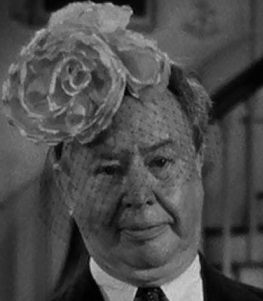
When Corday sees her in it, he assumes her a model rather than the mayor. Of course, no powerful woman could wear something so becoming, right? She hides the hat—and the nightclub raid she later gets involved in because of it—as soon as she returns home. But the hat keeps turning up again. My favorite moment is when her father-in-law walks in wearing it.

The father-in-law steals the show

Written seven decades later, HBO’s Veep focuses on a woman who is next in line to the president; it seems, on television at least, women have come a long way. But have they? Yes, the mayor of a tiny town is a far cry from the vice president of the United States, but perhaps not as far of a cry as we might wish. When Meyer asks why her presidential bid failed, her press secretary, Mike (Matt Walsh), responds, “You looked tired a lot and the hat….The hat hurt us. Your head looked weird in the hat; that’s all I’m gonna say.”

Convictions? What Convictions?
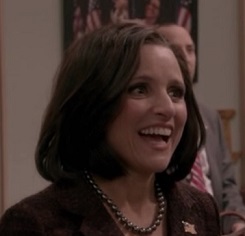
In Veep, it’s clear where Meyer’s convictions lie: she doesn’t have any. She puts an oil lobbyist on her clean jobs task force without hesitation. She tries to repress delight when a shipyard accident takes away her bad press. “Well, I think that worked out pretty good,” she says to her staff with a big smile.

Meyer-repressingjoy
(Of course, she tries to take it back when she discovers there were fatalities.) Self-interest trumps her idealism every time, which makes her a blast to watch.

**Spoiler ahead**

While Crandall’s political beliefs are only briefly sketched, her devotion to her dead husband and to the town he once led clearly dictates her behavior. She seems to be a very moral woman, bound by duty. Curiously, though, she seems content to leave the town she’s worked so hard to serve in the hands of her unscrupulous rival once she decides (as we know she will) to go after Corday.

The More, the Merrier
It’s refreshing to find in Veep a female led-show so entirely unconcerned with romance. But while her romantic interludes are brief and mildly funny, Meyer’s interactions with her staffers are fantastic. As a long-time Arrested Development fan, I was pleased to see Tony Hale (aka Buster) in another meaty role, treating Meyer’s various failures with compliments and tea and going to ridiculous lengths to satisfy her needs, as when he draws her chief of staff from her father’s bedside: “Something has happened to the vice president. I know your dad is dying and I’m really, really sorry, Amy, but I think Dana took Selina’s lipstick. It’s the one thing Selina asked for, and I don’t have it, and it’s ruining her night.”

I’ve left out much of the plot of Together Again in this review. The romance is fine, and Boyer a convincing lead. But it’s the Coburn-Dunne chemistry that kept me watching, especially when late in the film the two start riffing on youths’ views of aging. Coburn makes such a perfect Cupid that I can’t wait to see him play it in The More the Merrier.

Of course, there are other films and shows that tackle this same political ground. Parks and Recreation takes on the small-town concerns Crandall struggles with and makes them fresh and hilarious. But I could see little of Leslie Knope in Crandall or Meyer. Knope worships her town; Crandall belittles hers. And Meyer looks like a Knope foe: world-weary, cynical, and always out for herself.

Crandall and Meyer are alike, even if Meyer is looser ethically than her predecessor: both are hyper-aware of their public images and frustrated with the bureaucracy politics brings, but nevertheless, they manage to survive politics’ worst ravages, and in Crandall’s case, even find love along the way. And neither can resist a good hat.

Meyer and her assistant (played by Tony Hale)


Share
Posted in: 1940s films, Comedies (film), Feminism, Romantic Comedies (film), TV & Pop Culture Tagged: Charles Coburn, female leaders, female vice president, Irene Dunne, Julia Louis-Dreyfus, Veep

3 Classic Anti-Valentine’s Films for Sex and the City Fans

02/13/2014 by leah@carygrantwonteatyou.com 6 Comments

Single or attached, I’ve always loathed Valentine’s Day. When single, I’ve wondered why our couples-obsessed culture needs a day devoted to twosomes. When attached, I’ve pondered why I should celebrate en masse what’s supposed to be intimate. Therefore, my three recs today are for those who share my distaste for the day:

Female Bonding: Stage Door
For those who’d rather split a few bottles of wine with pals than brave pink-and-red-bedecked nightclubs this Friday, I recommend Stage Door, a film centered on women who live in an all-female boarding house as they try to make their big breaks on the stage.

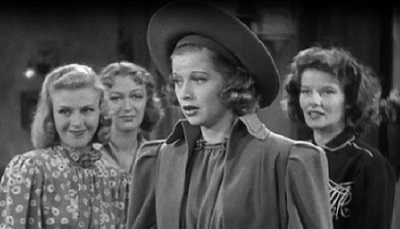
The heroines’ choice to remain single (and have casual boyfriends only) is celebrated rather than reviled by the film. If anything, the film mocks marriage. But don’t just view Stage Door (1937) for its politics; watch it to see the phenomenal cast interact: Ginger Rogers, Katharine Hepburn, Lucille Ball, Eve Arden. (The latter you may recognize as the principal in Grease; in her youth, she was always the smart-talking sidekick.)

Rogers, Arden, Ball, and Hepburn

Rogers, Arden, Ball, and Hepburn

The dialogue is so slick and cynical and quick that you’ll have a hard time keeping up with the one-liners, as when wealthy Terry’s (Katharine Hepburn’s) haughty tone annoys her impoverished fellow residents. Jean (Ginger Rogers) is not one to let an insult slide. When Terry snootily states, “Unfortunately, I learned to speak English correctly,” Jean fires back, “That won’t be of much use to you here. We all talk pig Latin.”

While the more famous classic movie about female friendships, The Women (1939), favors marriage with unfaithful partners over relationships with backbiting friends, this feminist flick celebrates the humor and loyalty between single women. In fact, I would argue that Stage Door’s women are in some ways more liberated than those in Sex and the City. Watch and see if you agree.

More of a feminist: Jean Maitland or Carrie Bradshaw? (Ginger Rogers & Sarah Jessica Parker)

More of a feminist: Jean or Carrie?


Revenge as Art:  Gilda
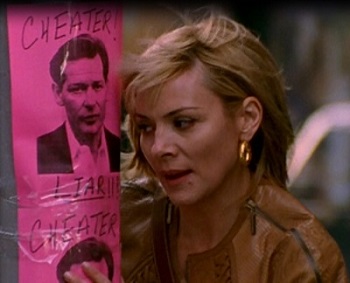
I enjoyed Samantha Jones’s (Kim Cattrall’s) revenge on boyfriend Richard Wright for his infidelity in Sex and the City: the dirty martini in his face, the papering of the city with posters describing his behavior.

Samantha in revenge mode

Samantha in revenge mode

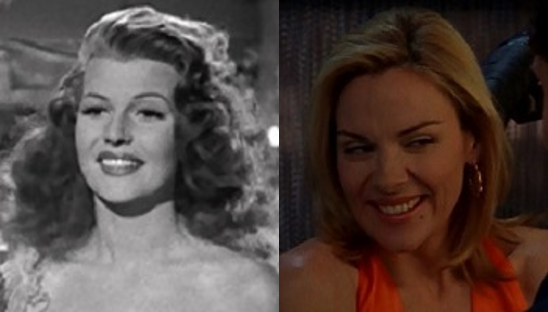
But this kind of takedown is kitten play compared to the work of Rita Hayworth in Gilda.

Gilda, who calls herself the "Bar Nothing," and her spiritual descendant, Samantha Jones

Gilda, the “Bar Nothing,” and her spiritual descendant, Sam

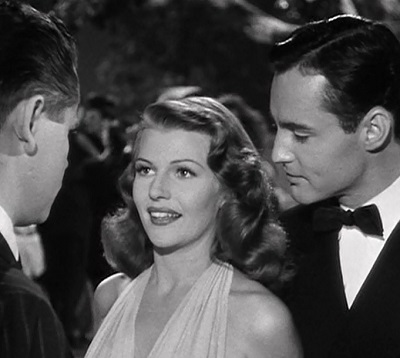
Like Samantha, Gilda (Hayworth) is in full command of her sexuality; it’s not difficult to discover why this WW II pinup was dubbed “The Love Goddess.” But her treatment of her ex, Johnny, is far more ruthless than her modern counterpart’s. First, she marries Johnny’s boss; then, she flaunts her affairs with other men to torment him further.

Gilda (Hayworth) torturing her ex

Gilda (Hayworth) torturing her ex

Gilda is so skillful a manipulator that you root for her to get what she wants, even if the ex she desires is no prize (and no mean manipulator himself).

Here’s an anti-Valentine’s Day conversation if ever there were one:

Gilda: “Would it interest you to know how much I hate you, Johnny?”
Johnny: “Very much.”
Gilda: “I hate you so much I would destroy myself to take you down with me.”

I think Samantha would be impressed.

Exploiting Men: Baby Face
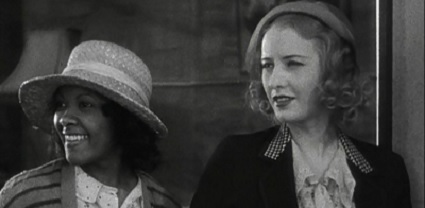
In an early episode of Sex and the City, “The Power of Female Sex,” Carrie’s fling has left a tip on her bedside table and she’s feeling ill at ease with the implications. The four friends discuss whether it’s ever acceptable to use your sexuality to get ahead. Barbara Stanwyck’s character in Baby Face (1933) has no such qualms: She leaves her hometown for NYC with the aim of doing just that.

The shocks accumulate quickly as you watch Baby Face: Lily’s (Stanwyck’s) father has been prostituting her since she was fourteen. A grandfatherly figure in her dad’s speakeasy recommends she leave home to sexually exploit men for personal gain, quoting Nietzsche to back his case.  Once in New York, Lily takes quick steps to follow his advice, seducing the HR assistant in a bank to get a job, and then sleeping her way floor by floor to the top. (The camera helpfully pans up to highlight each floor as she ascends.)

Lily (Stanwyck) on the make

Lily (Stanwyck) on the make

You might expect the movie to make the heroine suffer for her behavior, given the date of this film, but she is unmoved by the heartbreak and eventual tragedy she leaves in her wake (among her victims is a smitten John Wayne). Men have used her all her life. Lily figures it’s her turn, and the film clearly sympathizes with her reasoning. She calmly goes about her business of seducing men, accumulating jewels and bonds, and sharing her successes with her best friend, Chico (Theresa Harris).

Chico and Lily admiring another woman’s wealth before Lily starts to advance

Chico and Lily scheming

Here’s a typical exchange with a discarded lover who stops by Lily’s apartment:

Ex-Lover: “It’s been brutal not seeing you.”
Lily: “Yeah, well you better get used to it.”

When he returns and offers marriage, Lily answers, “So you want to marry me, huh? Isn’t that beautiful. Get out of here….”

Lily's reaction to a marriage proposal from a discarded lover

Lily’s reaction to a marriage proposal from a discarded lover

This is a strange film with a number of flaws, but you won’t care; it’s too much fun to watch this predator in action. (Be sure to watch the pre-release version; it’s much better.)

What are your favorite anti-Valentine’s films?

Share
Posted in: 1930s films, 1940s films, Anti-Romance films, Comedies (film), Drama (film), Feminism, Film Noir/Crime/Thriller & Mystery, Humor, TV & Pop Culture Tagged: Carrie Bradshaw, Gilda, Samantha Jones, Sarah Jessica Parker, Sex and the City, Stage Door
« Previous 1 2 3 4 5 6 7

Recent Posts

  • 100 Years Later, Still Scary: Dr. Caligari
  • Escaping Out of the Past (1947)
  • A Weeper for Those Who Love Jerks
  • Thank You, Academy, for Not Infuriating Me
  • Challengers (2024) Is a Bad Movie

Subscribe to Blog via Email

Enter your email address to subscribe to this blog and receive notifications of new posts by email.

Categories

  • 1920s films
  • 1930s films
  • 1940s films
  • 1950s films
  • 1960s films
  • 1970s films
  • 1980s films
  • 1990-current films
  • 2020s films
  • Action & Sports Films
  • Anti-Romance films
  • Blogathons
  • Childfree
  • Comedies (film)
  • Drama (film)
  • Feminism
  • Femme fatales
  • Film Noir/Crime/Thriller & Mystery
  • Gloriously Silly Scenes
  • Horror
  • Humor
  • Mae West Moments
  • Musicals and dancing films
  • Oscars
  • Random
  • Romance (films)
  • Romantic Comedies (film)
  • The Moment I Fell for
  • Turn My Sister into Classic Movie Fan
  • TV & Pop Culture
  • Uncategorized
Share
Classic Movie Blog Hub Member

Recent Comments

  • leah@carygrantwonteatyou.com on Meg Ryan’s Fate Foretold in Joe Versus the Volcano
  • Ryan on Meg Ryan’s Fate Foretold in Joe Versus the Volcano
  • leah@carygrantwonteatyou.com on 100 Years Later, Still Scary: Dr. Caligari
  • The Classic Movie Muse on 100 Years Later, Still Scary: Dr. Caligari
  • leah@carygrantwonteatyou.com on 100 Years Later, Still Scary: Dr. Caligari

Archives

  • November 2025
  • September 2025
  • May 2025
  • March 2025
  • January 2025
  • November 2024
  • August 2024
  • July 2024
  • May 2024
  • March 2024
  • February 2024
  • December 2023
  • November 2023
  • October 2023
  • September 2023
  • August 2023
  • July 2023
  • May 2023
  • April 2023
  • March 2023
  • January 2023
  • December 2022
  • November 2022
  • September 2022
  • July 2022
  • May 2022
  • April 2022
  • March 2022
  • February 2022
  • October 2021
  • September 2021
  • April 2021
  • March 2021
  • February 2021
  • December 2020
  • October 2020
  • September 2020
  • July 2020
  • May 2020
  • April 2020
  • March 2020
  • February 2020
  • December 2019
  • October 2019
  • September 2019
  • June 2019
  • May 2019
  • April 2019
  • February 2019
  • January 2019
  • November 2018
  • September 2018
  • July 2018
  • June 2018
  • May 2018
  • April 2018
  • March 2018
  • February 2018
  • January 2018
  • November 2017
  • September 2017
  • August 2017
  • July 2017
  • June 2017
  • May 2017
  • April 2017
  • March 2017
  • February 2017
  • January 2017
  • December 2016
  • November 2016
  • October 2016
  • August 2016
  • July 2016
  • June 2016
  • May 2016
  • April 2016
  • March 2016
  • February 2016
  • January 2016
  • December 2015
  • November 2015
  • October 2015
  • September 2015
  • August 2015
  • July 2015
  • June 2015
  • May 2015
  • April 2015
  • March 2015
  • February 2015
  • January 2015
  • December 2014
  • November 2014
  • October 2014
  • September 2014
  • August 2014
  • July 2014
  • June 2014
  • May 2014
  • April 2014
  • March 2014
  • February 2014
  • January 2014

Meta

  • Log in
  • Entries feed
  • Comments feed
  • WordPress.org

Copyright © 2025 Cary Grant Won't Eat You.

Church WordPress Theme by themehall.com