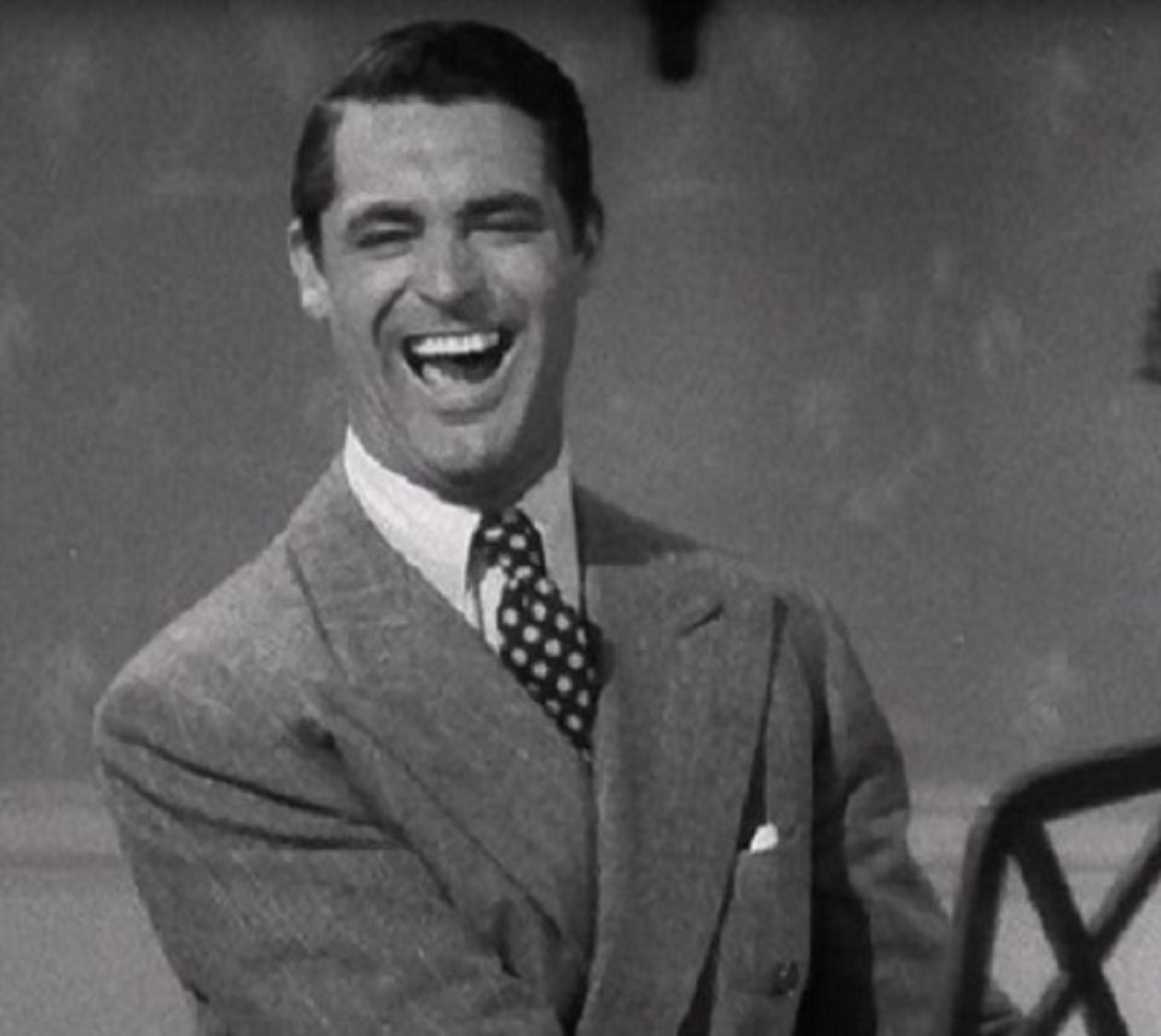
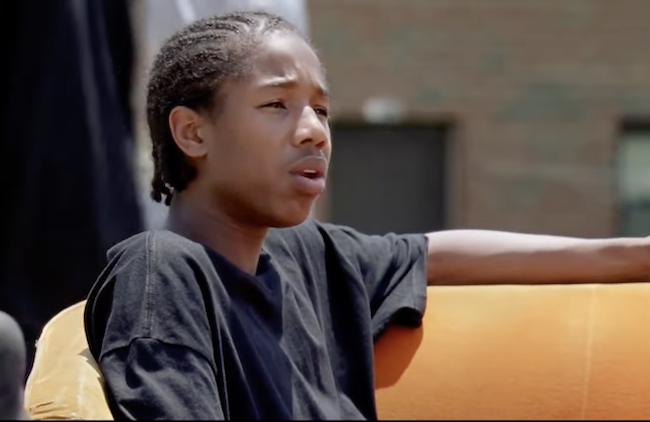
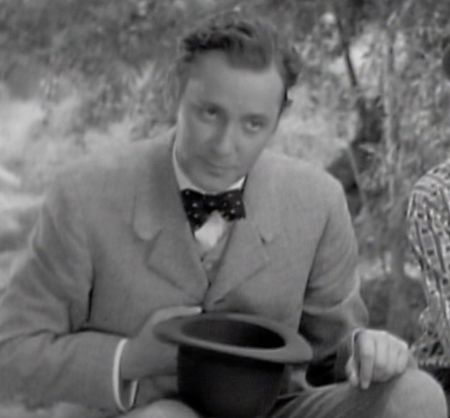
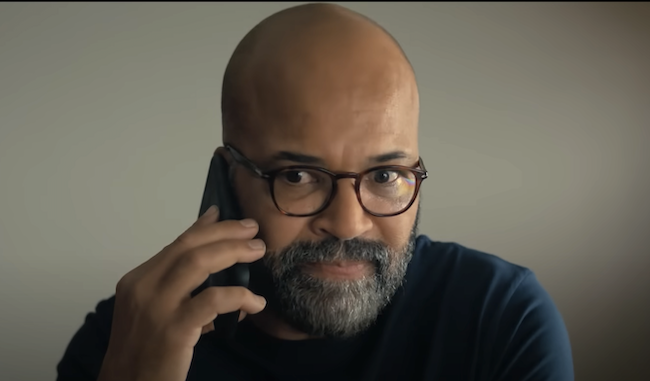
Well, some good choices, some bad in this year’s Oscars. But I’m going to focus on the fact that Michael B. Jordan got an Oscar. It wasn’t his best performance. But he’s deserved awards since Wallace.
Not a single Emmy for any of that stunning cast of The Wire. But at least this stellar performer is now an Oscar winner.
Hamnet.Can I say a performance like Jessie Buckley’s is good if it’s just one misery scene after another? I don’t know these characters enough to feel invested in them. The pacing is all wrong. I looked at my watch countless times. What were the slow-mo shots of trees and berries for? I didn’t cry. If I hadn’t known these were depictions of real people, I would have rooted for the plague. This is not the sign of a good movie.
Song Song Blue feels a bit like a Lifetime movie despite the great performances (especially Hugh Jackman’s). The timeline is very misleading. But I thought it affecting, which is more than I can say for Hamnet.
One Battle After Another. It’s an action movie. It’s a satire. It’s a comedy. And it all works. Fantastic acting, biting commentary about the current moment (not easy to pull off), an actually original car chase. the star-making turn of Teyana Taylor. It’s a movie I instantly wanted to rewatch despite its length. I don’t always like Paul Thomas Anderson. But he nailed this one.
Sinners. This is a daring movie. It’s inventive and thoughtful and metaphorical and just new. I don’t think it all works, especially the end. I might give the Oscar to Ryan Coogler anyway because this is a deeply creative film, and I believe directors who pull off something less polished but interesting deserve the accolades. The main reason I wouldn’t give this film the Oscar is my biggest surprise: I don’t think Michael B. Jordan is good in it.
This discovery has been a shock for me, someone who has loved him since his stunning performance in The Wire, who adored him even his small roles (Lie to Me). Who watched a superhero movie for him, loved Creed because of him. But here’s the thing: If you’re playing twins, I should be able to tell them apart. And I was so far from being able to do so that I nearly wrote down which person was wearing what so that I’d stop confusing the characters. Consider this: Tatiana Maslany played so many clones in Orphan Black that I couldn’t count them, and when acting as the main four clones, I could tell when one of them was pretending to be another. Jordan is nearly always good, but I found his performance dull here, even if he hadn’t muddled the storyline by not building enough distinctions between the two men. All the other performances — especially those of Wunmi Mosaku and Delroy Lindo — are memorable.
Sentimental Value. I really loved this film. Affecting, understated and simple, with characters so believable to me — especially the relationship between the two sisters — that I instantly felt invested. Stellan Skarsgård is great in it, even better than Sean Penn with his brilliant portrayal of the villain in One Battle After Another. Renate Reinsve is moving and subtle in it, but I liked the performance of Inga Ibsdotter Lilleaas even better. She plays the more grounded sister who is trying to keep the family together. She’s lovely in it.
Marty Supreme. I don’t know how to feel about this film. Timothée Chalamet is mesmerizing in the role, but as a movie, I don’t know. It gets boring in the middle, and I’m not sure what we come to in the end. The very end is terribly cliché. There’s sadly little ping pong. All the character’s hustles flow together and aren’t really hustles at all. The real person the film is based on seems far more interesting than the character drawn here. I enjoyed most of it, but I’m not sure I can call this a good film.
Blue Moon. I enjoyed this little character study. It’s more of a play than a film, but Ethan Hawke — who has never been my favorite star — is quite good in the role. As far as character studies, this is far more interesting than Marty Supreme.
If I Had Legs I’d Kick You. I’m a big fan of this little fever dream of a film, and Rose Byrne’s was the most stunning performance of all of those I saw this year. More nuanced than Buckley’s and Reinsve’s. Better than any of the men’s performances. By turns funny and heartbreaking and deadpan, Byrne’s acting is something to watch. She won’t win. But she should.
So there you have it: my views on the nominees I’ve seen so far. I’d love to hear others’ thoughts!
Oh Jeff, I get why you fell for Kathie (Jane Greer). That sexy voice, her air of mystery, those all-white get-ups, vacation drinks, and her nonchalant response to your chase. You really had no hope, did you? Especially once she started toweling you off from the rain.
Yeah, you were a goner, my friend. That was a given.
But I give you credit. You saw her shoot your former partner and realized too much siren for me. You viewed her clearly after that. When your new, sweeter lady love defended her by saying, “She can’t be all bad. No one is,” you (justifiably) answered, “She comes the closest.”
You are right that you were a chump, falling for a homicidal moll’s lies, but honey, in the world of noir suckers, you are Albert Einstein. You learned. You improved your life and your dating judgment (a lot of us don’t make it that far).
Problem is, my friend, you need to work on your shadiness. The detective career is not one in which fisticuffs save you from a bent former partner. You don’t have to kill, but you must learn some trickery and bluffing. To be honest, I’m not sure how you’ve remained above ground this long. I might not approve of Kathie’s answer, but I understand why she thought your self-defense inadequate.
You said it yourself when Ann’s wannabe boyfriend threatened, “I was going to kill you.” You quipped, “Who isn’t?” In those two words, you captured the gumshoe life, in which craftiness and sketchiness are survival requisites.
Luckily, you do have a key asset, Jeff. You are a planner. I need you to remember that neither Whit, nor Kathie, nor any of the henchmen involved have this basic quality. They live on spur-of-the-moment, unerringly bad decision making.
Let’s take your nemesis, Whit. He hired you, a ridiculously attractive man with sleepy eyes and a sultry voice, to retrieve his already traitorous girlfriend. (As my sister says, “That’s like sending Cindy Crawford to get your boyfriend.”)
You soon discovered she was a viper, didn’t you? Whit did too. She’d already nearly killed him. So what did he do when he discovered all the additional murderous shenanigans she’d been up to? He forced this woman into a corner, thinking what? She’d say, “Okay, honey. Off to jail I go”?
I know he looked like he was intelligent, Jeff. But he really wasn’t. And his surviving buddies are even dumber. They just outnumbered you with this tax killing plot. They didn’t — in any way — outsmart you.
Why then, Jeff, after some unlucky moves and bad timing, have you let the fatalism get to you? When Kathie said, “Let’s get out of here” after killing Whit, what did you mean by asking, “There’s someplace left to go?”
Of course there is, Jeff! You surely can double-cross a sociopath with no impulse control. This is no Phyllis Dietrichson, my friend. She’s not going to out-connive you. And do you honestly have a problem setting her up for the three killings she is either solely or jointly responsible for? Is calling the police so that you and she will die in a shootout a more ethical plan? Do you think any of the henchmen left care enough about Whit’s honor or have brains enough between them to hunt you down?
I know you think you can’t escape your past — that once you get into bed (in your case, literally) with evil, you don’t have a shot unless you go full-scale monstrous yourself and outsmart them all, Red Harvest (or its imitator, Miller’s Crossing)-style. And you’re too good of a person to go that route.
But do you need to? Most of your enemies are dead. Your fate is not as determined as you think. Your odds are far better than Kathie’s were in her gambling efforts in Acapulco. Her fingerprints are all over that home, and angel face or not, she is a gun-loving gangster’s moll (in a terribly sexist age), which doesn’t make for the best defense.
I know this is the noir way, Jeff: You must play the man defeated. You must see killing her (even indirectly) as the only escape from her wiles and the only protection for the woman and friend you love. I get it, Jeff. It makes for a good movie.
But you said it yourself, Jeff: “There’s a way to lose more slowly.”
And in this case, you actually had a chance to win.
Back Street (1932), directed by John Stahl, announces itself early on as belonging in the wronged illicit woman tearjerker canon. Charming Ray (Irene Dunne) enjoys befriending traveling salesmen at a beer hall in Cincinnati before the turn of the twentieth century, but all they do in return is try to bed her. Ray laughs at their efforts, expecting little else, but never giving in.
Spoilers ahead.
That is, until she meets Walter (John Boles), a flirt who steals her heart despite neon red flags, including:
Dispensing cheesy pickup lines during their meet-cute.
Suggesting she meet him at 10 pm on a random street for a date.
Announcing he’s a mama’s boy.
Admitting he’s engaged.
Ray sleeps with this worthless banker anyway, making the audience wonder just how little game those traveling salesmen had. Walter suggests she meet his mommy at the park one day. He’s hoping that said mommy will agree he should drop his fiancée if exposed to Ray’s considerable charm. (Apparently, he can’t break up without mama’s say-so.)
Unfortunately, Ray gets waylaid because her lovesick half-sister needs her help (because of course she does). Ray then wonders for the rest of her days what would have happened had she had made it to the park on time.
Walter’s response to her no-show is a red flag of its own: angry petulance. Instead of considering herself well rid of him, Ray is again smitten when she runs into him five years later in New York. She’s now a success at her firm, and he’s married to that fiancée and a father. He’s still obsessed with Ray, so they begin an affair. Without her permission, he gets her an apartment for their rendezvous.
As a kept woman, our bar-hopping extrovert resigns herself to solitaire and phone watching. We witness Ray helping her worthless lover with speeches and bank matters. Since he doesn’t want her considerable intelligence occupied with anything but him, she’s unemployed. He also doesn’t want her going out with friends; then she’d be unavailable for his stop-bys. In return, he misses their engagements and forgets to call her, mail her, or put any money in her bank for weeks on end.
We see Ray bemoaning her life to a neighbor in similar straits. Still, back she keeps going to this selfish jerk whose most discernible quality is neediness. She even turns down a chance to marry a sweet, successful former neighbor who loves her. What Ray needs, of course, is a good therapist. Too bad that isn’t really an option for her in this time.
Instead, we see her decades later, still lovely (it’s Irene Dunne, after all), still a mistress. She’s still beloved by Walter, but scorned by his adult children. When he has a stroke, she can only hear his voice on the phone. She can’t be by his side. When the stroke ends in death, his chastened son, finally realizing her true love for his father, offers to financially care for her.
Irene Dunne, who is amazing in this role, can make you weepy despite the unworthiness of her lover. We feel for her pain, even if we are mystified by its source. She looks at Walter’s photo at the end of the film, tells him she’s on her way, and dies. In her last moments, she wonders again if she would have had a better life if she’d shown up at the park.
Which leads me to wonder this: Would being the cheated-on wife (with kids) of this dolt be better? I mean, sure, it was a grim time for kept women. At least she wouldn’t be destitute or outcast if wedded to him. She’d also have the children she wanted.
Still, she’d be married to Walter, which means much more of her time with Walter. Why that doesn’t sound like a penance, I have no idea. Also, why wasn’t Ray regretting turning down her kindly neighbor in her last moments?
There are several curious things about this film. It’s pre-code, so it’s more sympathetic about her choices than the remakes (and there are several) probably are. There are moments (as at the end) the director, John Stahl, seems to give in to the soapy, romantic Romeo and Juliet of it all. But the director also gets the true tragedy: not only did Ray sacrifice a much happier fate to live in the “back streets” of a wealthy man’s life, but she did so for a singularly uninspiring man-boy played by John Boles.
If you’re gonna sacrifice everything, honey, at least let your lover be sexy. Who’d have guessed that Adolphe Menjou (in unacknowledged remake Forbidden) would come out the more attractive of the two leading men?
This is how Ray feels about her life:
Oh, Ray. Imagine if you’d never slept with Walter. Maybe you’d have still turned down your neighbor. Maybe you’d have never married. Still, you’d be hanging out in the beer hall with salesmen, which means you’d at least have had some fun. If there’s a moral lesson in here, it seems to be not to avoid premarital sex, but to avoid letting your first lover be a Walter. That’s the kind of judgment-clouding decision that can topple the worthiest women.
Interestingly, the novelist who wrote the story (and Imitation of Life), Fannie Hurst, had her own illicit thing going: a secret marriage, with she and her spouse living in separate homes, and she too (seemingly) mourned him desperately after his death.
Let’s hope he was more worth it than the character she created.
Sometimes you see an Oscars list, and you’re happy to see not what IS on it, but what isn’t. Some idealistic prognosticators theorized that this buzzy little tennis film called Challengers (2024) would get a bid. After all, its music had won a Golden Globe.
The only thing more annoying than the film, I can safely say, is that music.
I watched the movie out of lethargy. Anora (2024) had just completed, and Challengers started playing. I watched for a bit, idly thinking, “This has to get more interesting.”
Forty-five minutes in, I thought, “No, it really doesn’t” and turned it off.
I turned the movie on again a week later, committed to discovering what others saw in it, and can now say I liked it–the last five minutes, that is. I yawned through every minute of the rest.
So here’s what I saw:
There are some scenes of tennis, in which I had no stake.
There were some characters, so thinly developed I felt nothing for them–not even dislike. They reminded me of the fly that got into my home the other day after surviving the cold. It buzzed here. It buzzed there. No one could say why. I did watch it. I watched Zendaya too. She’s pretty. I liked her clothes. She flitted here; she flitted there. She frowned a lot, sometimes in sunglasses.
There are two other characters. There’s some implication they all want to have sex. The preview suggests that, as does the brief scene it captures. Actually, they don’t. They don’t seem to like anything, including sex. A sandwich is eaten with more relish than they gaze at each other. The sandwich was my second favorite part.
The tennis was at least more active than the characters’ faces. Right when I would wonder, “What is the point of this?” some loud, abrupt, terrible music would come in, but only after a very awkward pause, kind of like an angry teenager turning on speakers full blast to drown out parents, but a teenager unaccustomed to how speakers work. Then the music would go away for no reason, and then come back. Much like my fly. EDM is bad enough at any time, but I’ve never experienced a less artful use of music in any film, at any time. Apparently, this is what wins an original score award at the Golden Globes these days.
And besides the last five minutes, which I did enjoy?
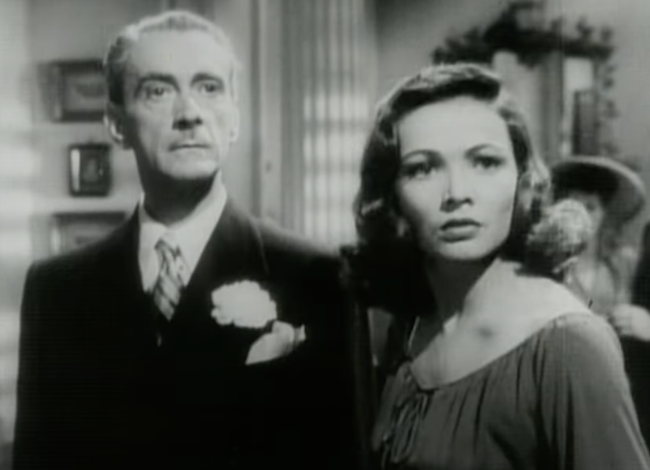
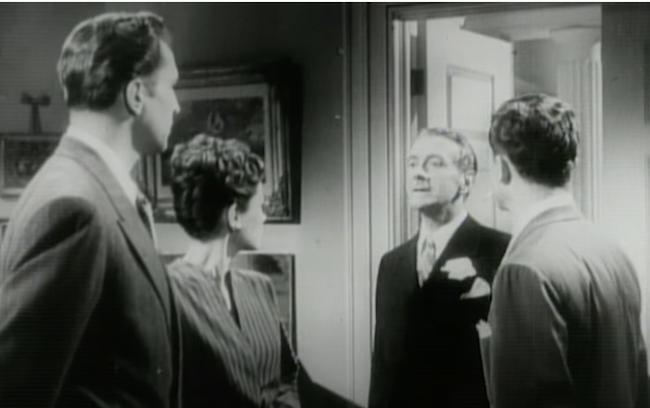
Laura is a curious film. I always think of it as the male gaze on steroids, as we know so little of the heroine apart from the versions we get from the men who surround her: the portrait artist, the boyfriend, the best friend and the cop. All are obsessed with her, and all want their version of the murdered heroine to supersede the others.’
That’s why I chose the film for A Haunting Blogathon: In the Afterlife, hosted by the Classic Movie Blog Association. Crime writer James Ellroy once said something about Laura being the ultimate film for cops, and I think he’s right: the victim you only learn of from diaries, from photos, from others’ words. You never quite know who she was.
Surely, it would be easy for those driven to solve a homicide (especially one that remains out of reach) to become possessive about what they know and haunted by what they don’t. (Ellroy, whose mother was murdered, explores his own haunting in My Dark Places, a fascinating read, as is the book that inspired him: Joseph Wambaugh’s true-crime masterpiece, TheOnion Field.)
It’s not hard to imagine becoming enamored with and fascinated by a victim who looks like Gene Tierney. In this particular story, however, the hauntings turn from reasonable to pathological.
What I love about the film is that the versions of Laura these men (and one woman) tell don’t quite add up. Her housekeeper, Bessie (Dorothy Adams), describes Laura as the sweetest lady on earth, and certainly Gene Tierney’s perfect face and that sentimental theme song seem to confirm those impressions.
But would such an angel be best friends with Waldo Lydecker, enjoying his poisonous remarks about her admirer and fellow party guests, as we see her do (in his version of her story, of course)?
Is she really a woman who, as fiancé Shelby Carpenter (Vincent Price) claims, will indulge any visitor, day or night? He has treated his bride-to-be like a doormat. Since he wants to continue to do so, this tenderhearted version of Laura is convenient for him. But Laura does, in fact, dump him, and despite occasional remarks seems little affected by the poor woman (cheater or not) who got killed in her doorway. Not exactly the heart-on-her-sleeve, always-forgiving softie he takes her for.
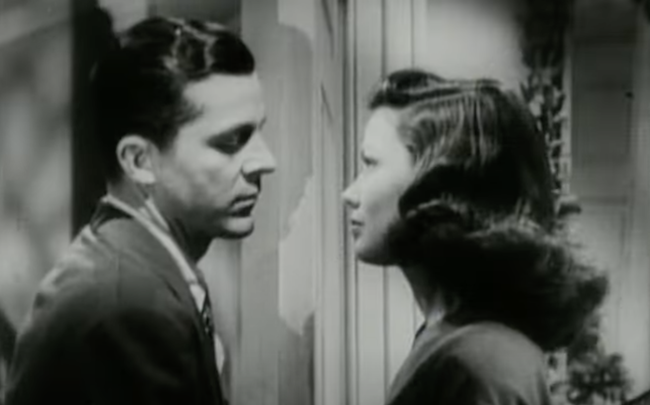
Of course, Lydecker isn’t wrong in accusing Det. Lt. Mark McPherson (Dana Andrews), Laura’s most recent admirer, of being a creep. McPherson wants to buy a portrait of her when she’s dead and becomes instantly possessive of her after she returns to life.
Who instantly hits on a stranger (worse than that, assumes she’s already his) while she’s still in shock?
Even if she is vulnerable enough to think she’s in love too, it would be wise and kind to wait–I dunno–48 hours? He also chooses for the moment of his wooing a party during which the following things are happening to his new love:
Her fiancé has basically just said to her, “Yeah, I know you killed my lover, and that’s cool,” after inviting said lover into Laura’s home and into her clothes during the latter’s wedding week.
Someone has just been murdered in Laura’s home, and this cop/admirer has invited people over to it for a gathering before she’d had time to sage it, obsessively clean it, or call a real estate agent to put it on the market.
Her aunt, Ann Treadwell (Judith Anderson), has confessed–casually, I might add–that she’s toyed with murdering Laura herself.
And oh yeah, our heroine is still in grave danger from the best friend who tried to off her.
Our infatuated cop follows up this uproariously fun party by pretending he’s arresting her, ruining her reputation in front of her friends, because he can’t control his feelings without taking her into the police station. Ummm, what?
McPherson is right that Laura has surrounded herself by “dopes”–if by dopes he means a heartless group of friends and lovers, with some sociopathy in the mix. He’s just wrong not to include himself in the description. Andrews is quite handsome and feigns calm (with his trusty toy), so it’s easy to think of this detective as the hero in the beginning, but that impression soon wanes.
Right after returning home and shocking Bessie, Laura says gently, “I’m not a ghost, really,” and then jokes, “Have you ever heard a ghost ask for eggs?” But her claims ring hollow. Though she’s physically in the room, I would argue Laura still is a ghost through no fault of her own. Real/imagined impressions of her haunt her admirers and herself.
Actual men are also looming in her life, refusing to let her be who she wants to be, love whom she wants to love, or take five minutes to recover from life-altering trauma. And then there’s the method her best friend chose to kill her with: buckshot (interesting that Waldo doesn’t even reconsider that method during his second attempt). It’s not bad enough he wants to kill her. He wants to obliterate her.
If I were Laura’s true friend (or her therapist), I’d say, “Hey, honey. It time to hightail it out of town. A transfer overseas would be ideal. Also, you may want to keep that phone number unlisted.”
Today I’m starting a new series for this blog for all of us who haven’t slept in months and fear we won’t for some time: Gloriously Silly Scenes. We all need some sweetness and light right now, and luckily for all of you, I have been self-medicating on fluffy joy in movie form since two of my aunts, Betty and Ellen, introduced me to Teddy in Arsenic and Old Lace as a child. My two sisters and I would run around my aunt’s room, shouting “Charge!!” with one arm aloft as we watched the film, giggling hysterically.
My effort to seek silly films became a fully deliberate act due to two life-changing events in my teens: 1. My discovery of USA Up All Night. 2. The moment my good friend Carrie and I went to see Joe Versus the Volcano (1990) in the theater. To all of you who love cry-laughing in silent rooms, to all of you amused by what was never intended to be funny at all, and to all of you who embrace deeply weird and/or unabashedly ridiculous humor, you will understand that the impossibly grim opening credits of Joeversus the Volcano were a revelation to me. The choice of “Sixteen Tons.” The mud. The one flower. The evocation of old labor folklore (I kept thinking of John Henry). It wasn’t just silly. It was thrillingly so.
The whole film is a treasure. I could write a poem about the suitcase shopping sequence alone. But for this moment, I’d like to pause on comic gem Dan Hedaya, who would crack up an entirely different generation as the affectionate father/terrifying litigator/threatener of potential dates in Clueless. In Joe vs. the Volcano, he is the boss of three employees: one dour, but expressive silent man; the despondent Joe (Tom Hanks); and the almost deflated but somehow still chipper-while-sniffling assistant (Meg Ryan).
The office scene opens with the clatter of a typewriter and the buzz of failing overhead lights. The whole scene is bathed in sickening shades of yellow and blue. As you take in the comically awful office, with decor that brings back my impressions of “break rooms” in fast food restaurants in the 80s or those airport smoking lounges when the bans started taking effect, you hear the boss (Hedaya) in the background, talking on the phone:
“I know he can get the job, but can he do the job? Harry. Yeah, Harry, but can he do the job? I know he can get the job, but can he do the job? I’m not arguing that with you. I’m not arguing that with you. I’m not arguing that with you. I’m not arguing that with you, Harry! Harry, Harry, yeah Harry, but can he do the job? I know he can get the job, but can he do the job? I’m not arguing that with you….Who said that? I didn’t say that. If I said that, I would have been wrong….I’m not arguing that with you. Yeah, Harry. I know he can get the job….”
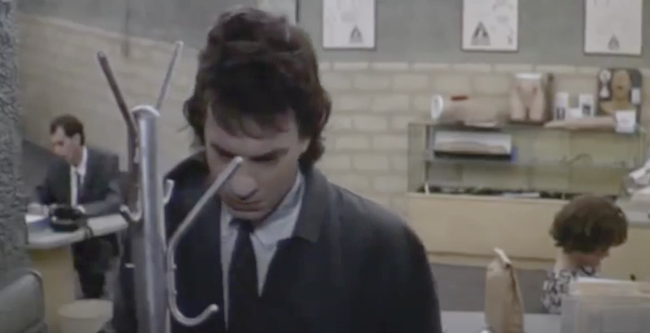
As his boss talks, Joe walks in and tries to hang his hat on the coat rack, but it breaks. He attempts to make coffee with that awful chalky powdered creamer, empty cups everywhere.
The boss’s infuriating refrain (awesomely comic, thanks to Hedaya’s delivery) couples perfectly with Joe’s return from his lunch break, where he received dire news about his health. We aren’t surprised that Joe finds his workplace repellant afterward (he describes it as a “sink”). What’s ridiculous is that it took him four and half years to recognize it.
After he quits and the boss belittles him in response, Joe says, “I should say something,” the catalyst for the film. The fact that Joe says this aloud, the fact that anyone who spent five minutes in that room would need a moment of insight to leave, the boss’s and assistant’s befuddlement that anyone would quit–any one of these things would be hilarious. In concert, they are genius.
There really is nothing like Tom Hanks in breakdown mode, as anyone who has seen The Money Pit knows. And after Joe decides to quit, he begins a funny rant about his job, claiming that the fluorescent “zombie” lights are “sucking the juice” out of his eyeballs and that the coffee “tastes like arsenic.” His transition from lethargy to energy is exhilarating, as is his combination of giddy physical comedy and dry, understated truth-telling.
In case you don’t have time for the whole film and need the laughs, here’s the start of the scene and the moment Joe quits. This was my pre-Office Space bad job film, and it has never been supplanted in my affections.
If you can, watch the whole film. It’s an oddly philosophical story (written by the man who penned Doubt). The Ossie Davis cameo is amazing. It’s that rare film that lets Ryan flex her full comic muscles instead of making her ride on charm. And the film reveals Hanks at his comic best.
As for the rest of the film, airtight suitcases, orange soda, and brain clouds. What’s not to love?
(If you have any gloriously silly scene requests, let me know!)
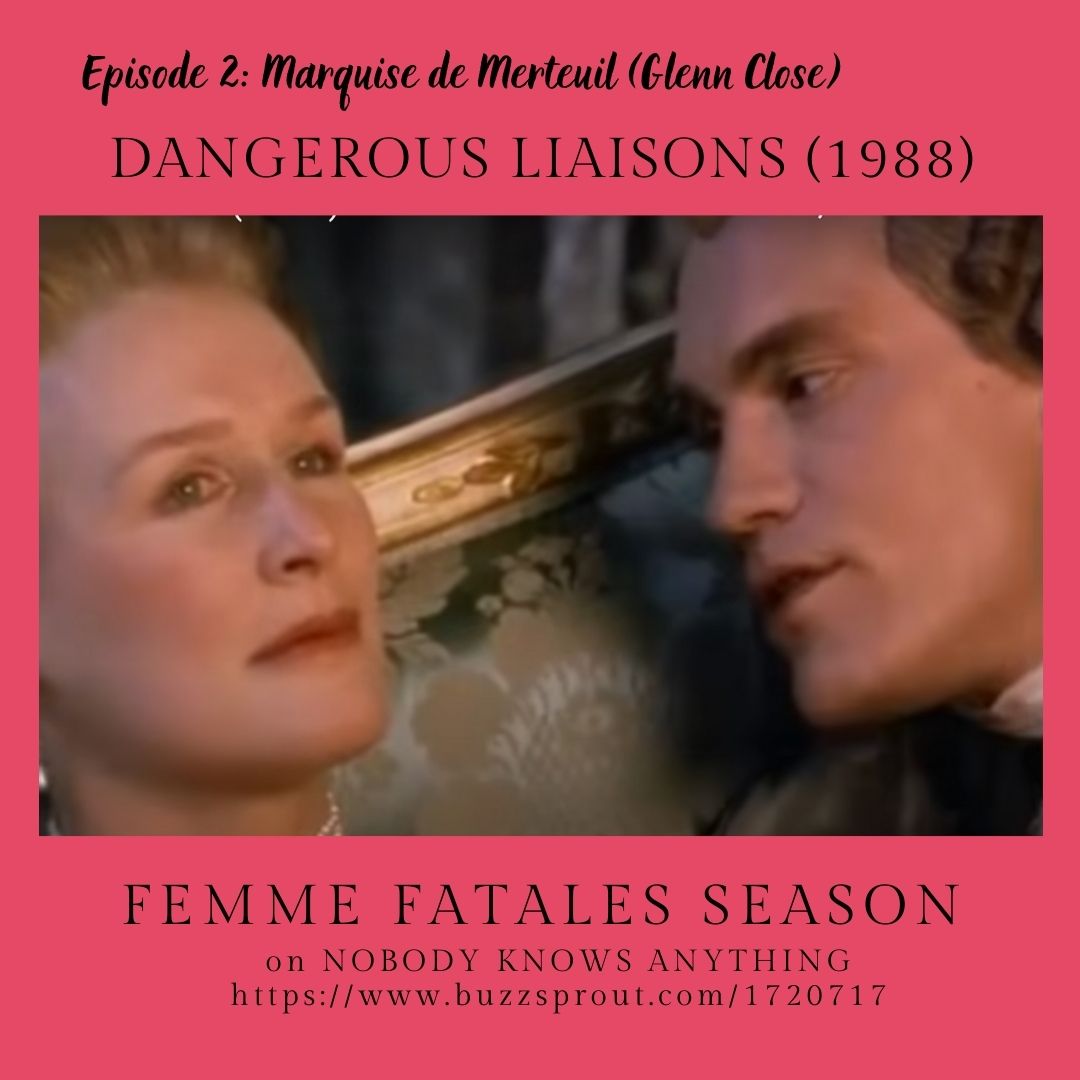
Episode 2 of the femme fatales season of Nobody Knows Anything is up!! Dangerous Liaisons, a film that pits the dueling wits of Glenn Close and John Malkovitch against each other in a fight over love and power . . . . and also, Keanu Reeves is there, being strangely perfect in eighteenth-century dress. We ask this critical question: Can the femme fatale ever win? (Just why Close didn’t get the Oscar for this is a big mystery.)
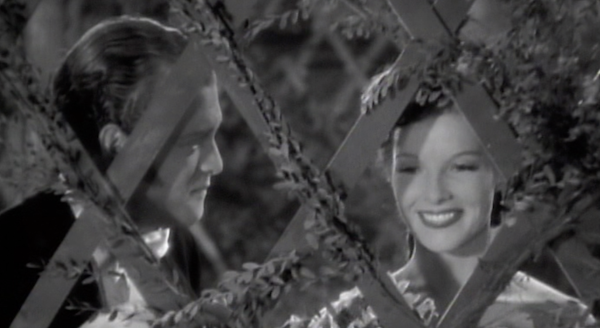
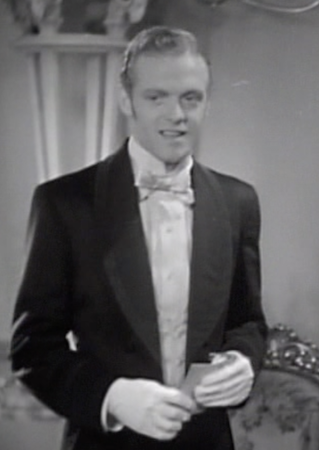
The first time you see Van Heflin (Lord Gerald Waring Gaythorne) in A Woman Rebels (1936), his debut role, you do a double take.
I had to look closer, to make sure it was indeed Van Heflin and not Leslie Howard. A word I never thought I’d apply to him is slight. He’s quite slender in it, but it’s not so much his form as his lack of presence–such a strange first impression of a gravely-voiced, burly sailor-turned actor who is riveting as a farmer in Shane, a suffering family man in 3:10 to Yuma, a powerful adventurer in Green Dolphin Street and hero in The Three Musketeers. The actor who would later fairly sing with physicality and gravitas seems so forgettable in his first moments onscreen, even timid. Luckily, he has a promising second act late in the film.
The story begins with Heflin playing the rake who tempts a Victorian heroine, Pamela Thistlewaite (Katharine Hepburn). We don’t see the charm and sex appeal that are so seductive and sinister in The Prowler and charming in The Strange Love of Martha Ivers. (It seemed fitting that the repeat scene of his seductions is literally Madame Tussauds wax museum.) Later love interest Thomas Lane (Herbert Marshall) comes across as more attractive than Heflin. Read that sentence again. Yeah, that bad.
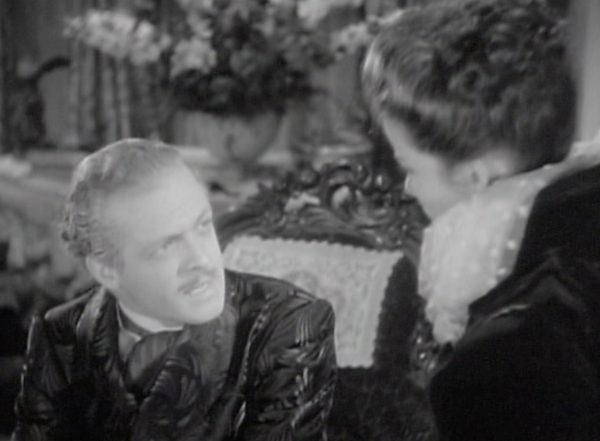
But late in the film, Lord Gaythorne returns as a bitter middle-aged man who despises his wife (who is not Pamela). And suddenly, in a lounging jacket of all things, you see it: THERE HE IS.
The slow confidence of Heflin’s stroll. HIs measured way of speaking. His intensity as he describes his hatred of his spouse. There is the compelling actor I fell hard for in The Strange Love of Martha Ivers. The always naturalistic performer whose moments onscreen are so believable, visceral and real. The man who isn’t conventionally attractive, yet is so sensual because he’s so confident and alive. The kind of actor he will be is not fully on the screen yet, but you see his promise.
The film itself is not great but ahead of its time, based on a 1930 novel by brave feminist Netta Syrett, who also had feminist artist sisters–or, as they were called then, “new women.” And while everyone around her is lackluster, Katharine Hepburn nails the role.
Pamela has a child out of wedlock, passes it for her sister’s, and then has a stunning career as an outspoken writer/editor speaking out for women’s rights and other issues. In between, she has a funny meet-cute scene with Thomas.
The film and many of the characters (I won’t reveal which) refuse to shame Pamela for her actions, even when her secret threatens her and her daughter’s happiness. The movie falls in the same camp as Hepburn’s other intriguing feminist roles from the 30s, such as Christopher Strong.
The story is unevenly told with some weird plot holes, and you have to suffer through some weak female performances and the aforementioned drags-down-everything Marshall. He doesn’t have quite as sleep-inducing of an effect as George Brent, but close. Sadly, this may be his most charming performance, and yet–look at this expression and tell me you don’t feel like you took a sedative.
You have to wonder with some smoother plotting and better acting around her whether the film could have really been something, as fascinating and unconventional as it was, instead of yet another bomb that got her in box-office-poison trouble. It doesn’t help that Hepburn has zero chemistry with either of her love interests.
Luckily, there’s enough in Hepburn’s performance and the surprises of the story to keep you watching. And to see that beginning of Heflin’s allure is quite fun. You have to love Hepburn recommending Heflin’s casting after seeing him in a play. (And how much would you have liked to have seen them perform on stage together with his version of the Jimmy Stewart character in The Philadelphia Story?) She knew even in the mid-30s what he had in him. Yet another of the thousand reasons to adore the great Kate.
Check out other striking debuts and final acting performances in the Classic Movie Blog Association’s Screen Debuts and Last Hurrahs blogathon this week!
I’ve ranted about the films I didn’t watch–and didn’t want to–but three of the films nominated for Oscars this year are great films.
NO spoilers.
American Fiction. Clever, funny, and original, this satire/dramedy delivers genuine laughs while also addressing heartbreak. We also experience a mature commentary on race we so rarely see on film. Great performances: Jeffery Wright is dead on, nuanced and believable; Issa Rae is fun; and Sterling Brown is compelling. I particularly loved that scene when he dances with his mom. Great acting all through. I still haven’t seen Rustin and suspect Colman Domingo definitely deserves the Oscar. But of those I have seen who are nominated, I wish Wright would get it for his subtle, winning performance. Of course, it won’t happen.
As someone who has been in higher ed, writing, and publishing, I loved the way the film skewered these professions. Clearly, Cord Jefferson knows what he is talking about. I kept wondering how the film would end–there’s no real way to tie this one in a bow without trivializing the problems with racism that are aired, so I liked that Jefferson didn’t take the easy way out. This one is likely to be a film I watch over and over. Obviously, Jefferson should have been up for best director. I suspect of all the films up for Oscars this year, this one will endure the longest.
TheZone of Interest. How clever to focus a Holocaust film not on the evil doers’ atrocities, but on the simpler, more everyday trait of turning a blind eye to others’ tragedies. There’s an uneasy feeling as you watch, of how many times you shut off the news, how many times you try not to think about others’ suffering throughout the world. This film, unlike the bloated movies that are nominated for best editing, is VERY well edited, with perfect, often unexpected choices. It’s relentless in its focus and powerful in its impact. It has a documentary feel to it, and I love how true director Jonathan Glazer, made the choice to fictionalize less than the source material, relying on actual letters and histories to authentically capture this horrifying family.
Anatomy of a Fall. First of all, Sandra Hüller deserves an Oscar for this role. What a performance! Many people have said that this film is really about a marriage. And it is–a very complicated, intensely believable marriage. If that were all that this movie did, it would deserve an Oscar nomination. But it does something more. This film is truly about a child and what he lives with, not knowing if his mother might be guilty of killing his father. This is a perspective we too rarely see on film (or even on documentary coverages of crime), and it’s devastatingly captured here. Wow. Also, this kid is something. The director, Justine Triet, definitely deserves this nomination.
And, while I’m here, one final wish denied: Andrew Scott gave a stunning performance in All of Us Strangers. Actually, Claire Foy deserved a nod for that film too. Definitely worth the watch if you can take a little weirdness.