Cary Grant Won't Eat You

Classic movies for phobics

  • About
  • eBooks
  • Previous Blogathons
Classic movies for phobics

Comedies (film)

Mae West’s Theme Show: Miss Fisher’s Murder Mysteries

05/30/2016 by leah@carygrantwonteatyou.com 2 Comments

EssieDavisasFisher
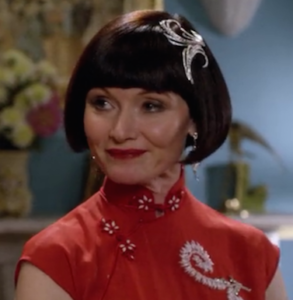
Sexually adventurous, unapologetic, averse to marriage, in control, attractive to all men–and in her 40s. Phryne Fisher (Essie Davis) is the kind of character feminists have despaired of seeing onscreen, and yet there she is, captivating her Australian viewers, and now American ones, who have binge watched her on Netflix as quickly as I have. She’s a 1920s heiress who solves crimes, and the rather dainty title of the show–Miss Fisher’s Murder Mysteries–doesn’t capture the boldness of its heroine at all.

Of course, being an appreciator of all things Mae West would love, I claim this would be her current TV show of choice, just as Elle King’s “Ex’s & Oh’s” would be her theme song. Essie Davis has just the right attitude for her role, and while she isn’t Mae West (who is?), the two would clearly get along. Not that the characters the two actresses play are doubles. The slow strut of West’s characters contrasts with Fisher’s quick energy, and while West’s characters clearly take pride in their sexual conquests, Fisher simply relishes them, as if so many lovers are simply a matter of course.

EssieDavisasPhryne Fisher
This is what you do when you’ve survived WWI, Fisher suggests: you have FUN. And yet, like West’s heroines, she never belittles her more demure fellow females; her closest companion (and employee), Dot (Ashleigh Cummings), is a devout, chaste Catholic (in more modern terms, Charlotte York to Fisher’s Samantha Jones).

The show is also praised for its female writers, its attention to historical detail, and, of course, its fashion. I can’t begin to describe those glorious costumes, but others have here and here. Like West’s characters, Fisher likes silk and feathers and furs and jewels, and wears them with panache.

MissFisherfashion2 MissFisherFashion
There are many other reasons to watch the show. The mysteries are fun, but in the end, I don’t care about them any more than I do in The Thin Man or Psych. Just gimme some more of Fisher’s chemistry with the detective (Nathan Page), more of her lascivious looks, more of her joyful dancing, more of her comments on singlehood, more of her liberality toward those mistreated by her time period, and in many cases, still by ours (gay friends, communists, anarchists, pacifists, prostitutes, working women, etc.) Give me more of the clothes. And most of all, give me more of that lust for life that has made me fall for Mae West. Please, please, you wonderful writers and you very busy star, give us a Season 4.

This post is part of my monthly West moment series.

Share
Posted in: 1930s films, 1940s films, Comedies (film), Feminism, Mae West Moments, TV & Pop Culture Tagged: Essie Davis, feminists, Miss Fisher's Murder Mysteries, older women as sex objects, Phryne Fisher, Samantha Jones, TV

Happy Films: You Were Never Lovelier (1942)

05/22/2016 by leah@carygrantwonteatyou.com 12 Comments

YouWereNeverLovelier
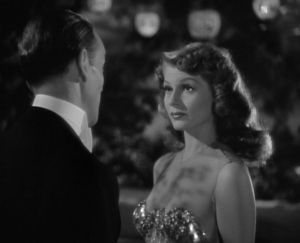
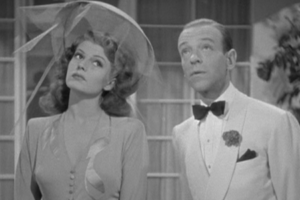
When asked to pick a film that I’d equate with ice cream for a sweet-inspired blogathon, I recalled the Rita Hayworth-Fred Astaire confection, You Were Never Lovelier. The plot is so silly: a sexist father, Eduardo Acuña (Adolphe Menjou), creates an imaginary secret admirer for his daughter, Maria (Rita Hayworth). He thinks he can handpick her suitor and pretend the boy is writing the love notes he himself is penning. But Maria mistakes a dancer, Robert (Fred Astaire), for her admirer, and much confusion ensues. It’s hard to explain why a story like this could win over its audience, especially since Maria is ridiculously susceptible, Robert directionless, and the film’s portrayal of Argentinians fantastical. And yet….What’s the primary feeling while watching? Utter delight. Try to watch it without grinning, rewinding, and pressing play again.

Why, you might ask?

Well, here’s our hero, Robert (Fred Astaire), dancing on a desk to protest Acuña’s refusal to consider him for his nightclub:

https://carygrantwonteatyou.com/wp-content/uploads/2016/05/AstaireYouWereNeverLovelier-sc.mp4

There’s the very funny meet cute between Robert and Maria, an encounter that doesn’t go well thanks to some snarky remarks by the former, who doesn’t know who she is.

MeetCute-YouWereNeverLovelier
And there’s the heavenly dancing. Within one scene Rita Hayworth and Fred Astaire make you forget the implausibility of the story because these are two of the most expressive dancers ever. From their first dance in, you’re entranced by their characters’ romance. How could you not be convinced, after watching them together?

https://carygrantwonteatyou.com/wp-content/uploads/2016/05/RitaandFred.mp4

The sweet, Oscar-nominated score is lovely, and the songs are catchy. “I’m Old-Fashioned” always makes me smile. Listen to Ella Fitzgerald’s version, or even better, watch a much longer clip than I’ve posted here at TCM, with Hayworth lip syncing it (sung by Nan Wynn) to Astaire’s Robert.

And that’s just one scene. I envy all of you who haven’t seen this film. You’re in for a treat.

This post is part of the Classic Movie Ice Cream Social, hosted by Fritzi of Movies Silently: a celebration of those movies and recipes that make us smile.

Share
Posted in: 1940s films, Blogathons, Comedies (film), Musicals and dancing films, Romantic Comedies (film) Tagged: best dancing movies, classic film, feel-good film, Fred Astaire, musicals, Rita Hayworth, You Were Never Lovelier

Gary Cole’s Brilliant Lumbergh

05/15/2016 by leah@carygrantwonteatyou.com 12 Comments

It says something about me–the fact that I have a red Swingline stapler. I was a proselytizer where Office Space (1999) was concerned: My rec of the film was one of the ways I earned credibility with roommates and dates (the stapler itself was a parting gift from a convert). I even held viewing parties of the movie in grad school to remind peers that life could be worse: we could be in cubicles writing TPS reports.

So when asked to pick a favorite bad guy for this year’s villainathon, Gary Cole’s Bill Lumbergh seemed an obvious choice. The only surprise is that I needed someone (in this case, my sister, whose coworker gave her suspenders covered in flair) to remind me.

GaryCole-BillLumbergh
What I find so compelling about Cole’s performance is that he uses his attractiveness to add to the sleazy quality of his character. That sexy bedroom voice; that graceful, lounging pose are hilarious when employed to deliver directives rather than pick-up lines. Note how his arm rests on Peter’s cubicle, his slow, almost sensual movements with the coffee. Cole knows he’s sexy, and just how to use that sensuality to make us laugh.

Of course, Cole has always been a comedic gem, as Veep fans can attest. I fell for him in The Brady Bunch Movie (1995) and A Very Brady Sequel (1996), but others have been following him much longer. Despite the longevity and versatility of his career, he has little name recognition. Yet I would guess most comedy fans out there know the name Bill Lumbergh. Of what could have been a throwaway villainous role, Cole created THE example of corporate villainy–obsessed with minutiae, valuing bottom line above all, utterly impervious to human responses to his actions. When watching him, you have the feeling that the feds could be busting down the office doors in a raid, and Lumbergh would still calmly walk over to his employees’ desks, and ask about memos.

Consider his approach to Peter (Ron Livingston) at the start of the film. Lumbergh (Cole) greets him by asking what’s happening, with so little affect that Cole illustrates in two words how little management cares. His slow drawl of “yeah” is one of the most memorable lines in a quotable movie, largely because it means nothing at all. It’s simply a transition into the corporate speak he’s about to utter. (It is also such a favorite word of his that he even says it before “hi” on answering machine messages.) What I find hysterical about Lumbergh is the distance between the exaggerated words he uses (“special,” “terrific,” “great”) and Cole’s flat delivery. Even in Peter’s nightmares about Lumbergh sleeping with his girlfriend, his arch enemy is still uttering his favorite banalities in a near-monotone (“mmmkay?” is another favorite).

Lumbergh’s facial expressions are as funny as his words. Observe his gaze at the birthday cake prepared for him, as if he can’t wait for this attempt at office civility to end. His thanks, especially how “special” this celebration for him is, demonstrates the degree of his insincerity.

Cole relishes exaggerating just how awful this man is. (I think he particularly enjoyed that line about pesticide to Milton.) But why I find Lumbergh such a compelling villain is just how real he is, how perfectly he embodies the ugly side of American capitalism. Other villains are more theatrical, exciting, but they don’t scare me; they are so clearly fictional. But as we viewers watch Lumbergh, we think, I know this guy. He’s someone we’ve met. He’s someone we’ve worked with (but hopefully not under). He represents, as Peter claims, “all that is soulless and wrong.” And he’s not going away anytime soon.

This post is part of the Great Villain blogathon sponsored by Speakeasy, Shadows and Satin, and Silver Screenings. Go see some brilliant entries here.

Share
Posted in: 1990-current films, Blogathons, Comedies (film), TV & Pop Culture Tagged: Bill Lumbergh, Gary Cole, Office Space

Top 4 Lazy Evening Films on Netflix

05/01/2016 by leah@carygrantwonteatyou.com 2 Comments

So you feel like doing nothing tonight, just want a film to make you smile? Here are four movies now on Netflix that I dare you to watch without grinning.

4. Bowfinger (1999)
Steve Martin, a conniving producer/con man down on his luck, forces paranoid action megastar Kit Ramsey (Eddie Murphy) into his film by stalking him and shooting his scenes without his knowledge. You in yet? Written by Steve Martin. Now?:)

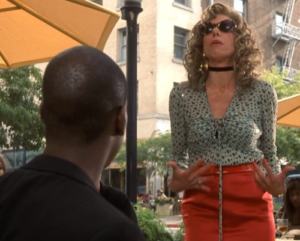
Favorite moment: Carol (the amazing Christine Baranksi), who doesn’t know Kit is being manipulated, begins her scene with him by ambushing him at a restaurant, ranting about soybeans and aliens.

BaranskiMurphy-Bowfinger
Bowfinger is not a comedy classic, but it’s a pointed satire on Hollywood—so silly and so fun.

3. Charade (1963)

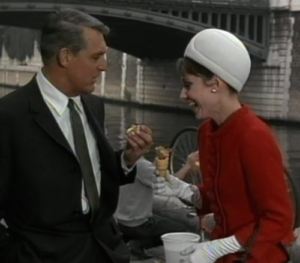
HepburnGrant-Charade
Cary Grant, Audrey Hepburn, and Walter Matthau (1963) star in this lighthearted romance/thriller. Basically, you feel no worry for Regina (Hepburn), despite the danger she’s in, and will give only cursory attention to the mystery itself, despite its fascinating twists and turns. Instead, you’ll just enjoy the cleverness of the script and watching Hepburn and Grant having a blast together.

2. Money Pit (1986)

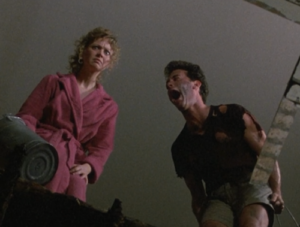
MoneyPit-HanksLong
This updated version of Mr. Blandings Builds His Dream House (1948) is hilarious whether or not you’ve ever been foolish enough to build a house. With Tom Hanks at his broadest, comedic best, and Shelley Long before her ego got too big for her. I know everyone else will claim the original better (Loy, the paint scene!), but Philip Bosco and Maureen Stapleton are so funny in it, and Hanks in hysterics makes me giggle every single time.

1. Begin Again (2013)

BeginAgain-RuffaloKnightley
Not as brilliant as Once, but writer/director John Carney manages again to craft a story that’s moving and sweet and joyful without ever veering into sentimentality–or even romance. A celebration of music and collaboration as cures for what ails us, with charming performances by Keira Knightley and Mark Ruffalo. Quick warning: If you don’t want the fragile, soulful tunes in your head for the rest of the week, don’t watch.

Share
Posted in: 1960s films, 1990-current films, Comedies (film), Romantic Comedies (film), TV & Pop Culture Tagged: Begin Again, Bowfinger, Charade, Money Pit

Schoolboy Fantasies: The Mannequin in Film

03/26/2016 by leah@carygrantwonteatyou.com 2 Comments

Pygmalionfilms-WalkerGardner
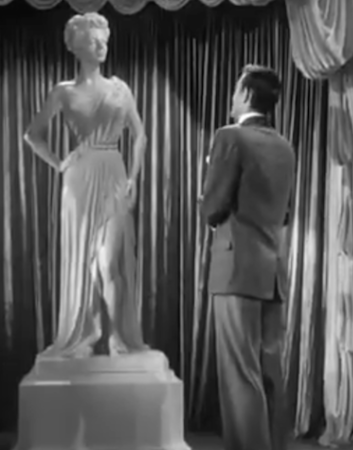
One Touch of Venus
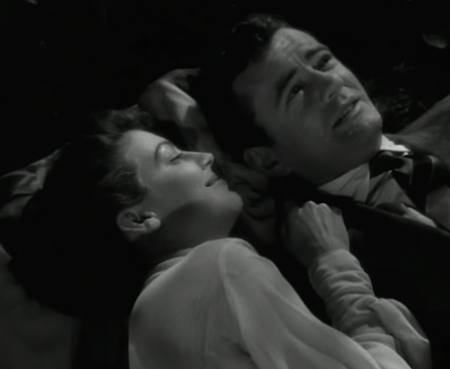
(1948) is a combination of myth and the classic Pygmalion tale: What if a window dresser kissed a statue of the love goddess, and instead of getting institutionalized, became an object of the suddenly warm-bodied immortal’s affection?

RobertWalkerAvaGardner
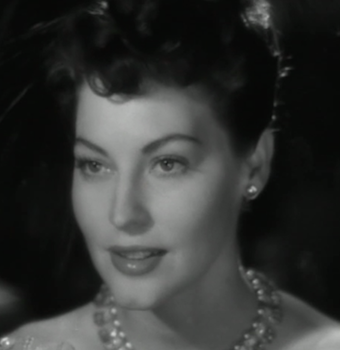
The execution of the film is as silly as the premise; the movie (a musical in its previous version) can’t decide what it wants to be, and a rom-com with a few singing interludes doesn’t quite cut it, nor can its star (Ava Gardner) figure out what form her acting should take (statue-like? goddess-like? human like?) (I suspect this is the film Beckinsale watched before The Aviator.)

But in spite of its unevenness, there’s something strangely fascinating about the film, something very meta in its casting, for example. Just a few years later Gardner would pose for a strikingly similar statue by a different artist in The Barefoot Contessa (1954), as if to confirm just how otherworldly her beauty was.

AvaGardner-Venus
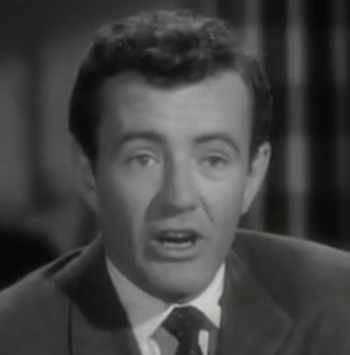
Her gorgeousness is contrasted to Eddie’s (Robert Walker’s) awkwardness. His character (unlike the versatile actor himself) has very little charisma, wit, wealth, or personality to recommend him.

RobertWalker-Venus
She’s attainable,
boys, the casting director might as well have called out. Even this geeky window dresser can get her.

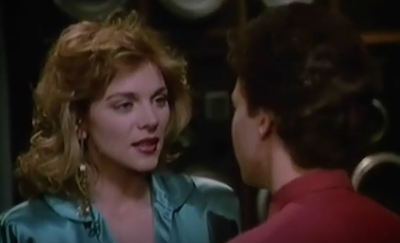
What’s odd is how frequently this statue story gets played out in film, and how similar the casting is in each case. The closest versions in terms of character dynamics came out in the 80s, Mannequin (1987) and Weird Science (1985). In each version, the unattainable beauty is not only attracted to an awkward, boyish goof, but pursues him: Venus chases Eddie when he flees, just as the mannequin-come-to-life Emmy (Kim Cattrall) seduces awkward store employee Andrew McCarthy in Mannequin (1987).

Cattrall-McCarthy-Mannequin
Lisa (supermodel Kelly LeBrock) pouts at the abandonment of her creators, socially awkward Gary (Anthony Michael Hall) and Wyatt (Ilan Mitchell-Smith), in Weird Science (1985). 

Beauty & the geek

Beauty & the geek

Sex objects?

Sex objects?

It is, in other words, a very transparent stick-it-to-the-cheerleader-who-snubbed-me schoolboy fantasy, and its pervasiveness in film culture is a testament to the power of denial.

What elevates One Touch of Venus beyond unintentional camp is the presence of Eve Arden as the smart-talking secretary of the store owner (Tom Conway) who bought the statue. Her responses to the absurdity of Venus’s (and by extension, Gardner’s) beauty are hilarious: her reaction to the siren’s tiny shoes, to the impact of her presence on the male body, to the inevitable comparisons a gal must draw to her own form after encountering the goddess’s.

ArdenandConway
I also enjoyed the occasional winks to the audience, as when Eddie tries to make sense of Venus’s presence, and Gardner coos, “Now don’t ask a lot of questions, you’ll only get confused.” Or when he asks about former lovers Venus has converted to animal or inanimate form, then decides he doesn’t care: “You can turn me into a fire hydrant or a mountain goat if you want to, it’s worth it.” Such moments point to the funny parody this film could have been, with just a touch more consistency of style–and a lot less romance.

Share
Posted in: 1940s films, 1990-current films, Comedies (film), Romantic Comedies (film), TV & Pop Culture Tagged: Anthony Michael Hall, Ava Gardner, Film, Kelly LeBrock, Kim Cattrall, Mannequin, One Touch of Venus, Pygmalion, Robert Walker, sex object, teenage fantasy, Weird Science

Which Will Rogers Clip Should Poli Sci Fans See?

03/12/2016 by leah@carygrantwonteatyou.com 2 Comments

Will Rogers-pres
I keep thinking of one of Will Rogers’ famous lines as I observe the loopholes the GOP leadership is exploring to oust Trump: “If stupidity got us into this mess, why can’t it get us out?” (Don’t you think Lindsey Graham, with his recent political zingers, and clear future as a humorist, is likely studying the old cowboy right now?)

I have never seen one of Rogers’ films/full sketches, and yet I love understatement, Rogers’ specialty. So for today’s post, in honor of DC’s caucus, and whatever might happen there, I’m putting out a request to all of you classic comedy buffs out there. Which Rogers film/clip do I have to see?

Share
Posted in: Comedies (film) Tagged: Donald Trump, Film, Lindsey Graham, political humor, political satire, stupidity got us into this mess, Will Rogers

Mae West’s Klondike Rebellion

03/06/2016 by leah@carygrantwonteatyou.com Leave a Comment

MaeWest-KlondikeAnnie
There’s something terribly wrong and terribly right about Klondike Annie’s (1936) odd musical tribute to Asian sensuality. It’s one of the few moments of the film when Mae West seems somewhat genuine. Elsewhere, she can’t sell the censored treatment of her material, so she doesn’t try. She adopts an expression that looks more like indigestion than anything else, and makes us wonder what’s going on inside that canny mind of hers.

In the film, Rose (West) dislikes and fears her sugar daddy, Chan Lo (Harold Huber). She’s tired of his dangerous possessiveness and plans to escape, but before she does, she entertains her lover’s nightclub customers. She’s not in charge of her fate in the film–imagine that condition for West! (Of course, sex with an Asian man MUST be torture in those racist times. Sigh.)

Another actress would have teared up while singing this lusty song, trying to capture her character’s likely emotional state. West? She’s finally enjoying herself, expressing her love for romance, which they won’t let her do throughout the rest of the movie. (After all, a mistress is supposed to regret and hate sex, according to the Production Code.) In this strange musical interlude, however, West refuses to play Rose at all. Her expressions as she sings make no sense in terms of the character’s dilemma, but then, neither does the plot.

I wish I could know what West was really thinking while crooning, “I’m an Occidental Woman, in an Oriental mood for love.” Instead, I’ll take a few guesses:

“I could get used to an Asian lover, MmmmmHmmmm. But not this guy they stuck me with. Harold?”

“I’m slamming this headpiece on Breen’s head, first chance I get.”

“So this made it past the censors, and the knife scene didn’t? They’ve got a thing or two to learn about the power of suggestion.”

“That extra over there looks yummy. Look at those muscles on him. Better see what he’s doing after.”

“Movies now are for suckers. Next show I write: Gal makes it to Santa Fe. Starts a brothel. Has 50 men a day. Now, what’s my first line…”

This is part of my monthly tribute to West. Click here for more posts on this hilarious pioneer.

Share
Posted in: 1930s films, Comedies (film), Feminism, Mae West Moments Tagged: Klondike Annie, Mae West

Big Fish: A Kettle of Oscar Snubs

02/13/2016 by leah@carygrantwonteatyou.com 4 Comments

EdwardandgiantBigFish
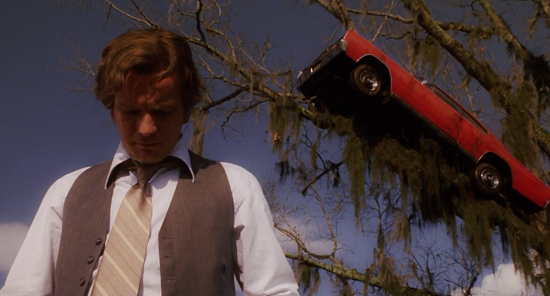
Director Tim Burton’s beautiful Big Fish was shut out of all Oscar nominations in 2004 but for original score (which it didn’t win). The director’s work is often dismissed as creative, but too weird, or lovely, but lacking in feeling. The same critiques, by the way, the Coen brothers and Wes Anderson hear often. Yet in Big Fish, Burton vividly renders the elusive, big-hearted whimsy of Daniel Wallace’s book, telling a father-son story that is sad, wise, and funny all at once.

Let’s discuss the many nominations it should have received, starting with the most egregious omission:

Best Actor in a Supporting Role
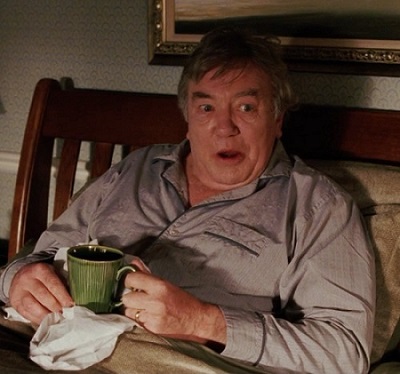
AlbertFinneyBigFish
Billy Crudup, not Albert Finney, is the star of the film. Will (Crudup) resents his father, Edward (Finney), for always traveling away from home while he was a kid, even suspects he had a second family. The yarn-telling skills that endear others to Edward annoy his son, who considers his father a liar. “You’re like Santa Claus and the Easter bunny combined,” Will says, “just as charming and just as fake.” The two haven’t spoken in several years, until Edward’s final illness draws his son home to resolve their issues. Edward prickles at his son’s anger: “I’ve been nothing but myself since the day I was born, and if you can’t see that, it’s your failing, not mine.”

Finney’s performance is magical. There’s no other word for it. How much personality and spirit he’s able to convey, even though he spends most of the film in bed! And Ewan McGregor exudes his usual charm, as he captures Edward as a youth, full of outsized ambition and enthusiasm. Burton lets us see Edward’s young adulthood not through the actual events, but through the imaginative way he recounts them: the boy spits out of his mother’s body like a cannonball when born, he sees his death in a witch’s eye, saves his town from a giant. When Edward leaves home and travels down a forsaken road, he spots a sign: Warning: Jumping Spiders. Edward’s description of this obstacle illustrates both the amusing cadence of his language, and his indomitable spirit: “Now there comes a point when a reasonable man will swallow his pride and admit that he’s made a terrible mistake,” narrates McGregor. “The truth is, I was never a reasonable man.”

In 2004’s Academy Awards, the supporting actors were Benicio Del Toro (21 Grams), Alec Baldwin (The Cooler), Djimon Hounsou (In America), Ken Watanabe (The Last Samurai), and Tim Robbins (Mystic River). I admire all of these actors, and have seen all but 21 Grams. I’d put Finney over them all, and Ewan McGregor (also supporting) over most. Baldwin was very good, but it’s not his most nuanced performance. Hounsou played a very one-dimensional role (as he typically does despite his skills), and I barely recall either Ken Watanabe’s or Tim Robbins’ performances.

But Finney’s? I’ve never been able to get it out of my head. As Edward, he is haunting and lovable, resentful and stubborn and inexpressibly sweet.

Had he been mistakenly chosen for a Best Actor nomination, Finney still should have been in the list, which included Sean Penn (Mystic River), Jude Law (Cold Mountain), Ben Kingsley (House of Sand and Fog), Bill Murray (Lost in Translation), and Johnny Depp (Pirates of the Caribbean). I would have been torn between him and Murray as deserving of the win.

By the way, Jessica Lange plays Edward’s wife. She wasn’t in the film enough to earn a nomination, I suspect, but what an impact she makes in her few lovely moments, capturing the endurance of the love affair that is at the root of 90 percent of his stories. (No wonder she doesn’t share her son’s anger.) Here are the sweethearts in a tub together, fully clothed:
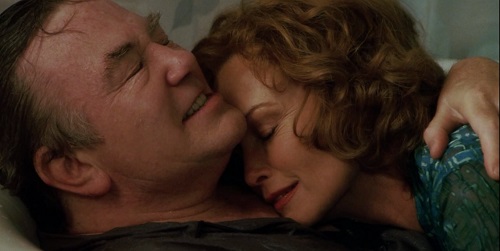
LangeandFinney

Best Director, Best Picture
Nominees, Best Picture: The Lord of the Rings: The Return of the King (winner), Lost in Translation, Master and Commander: The Far Side of the World, Mystic River, and Seabiscuit.

Nominees, Best Director: Winner Peter Jackson (The Lord of the Rings: The Return of the King), Fernando Meirelles (City of God), Sofia Coppola (Lost in Translation), Peter Weir (Master and Commander), and Clint Eastwood (Mystic River)

Jackson and his film probably deserved the win among those nominees, as the weight of translating Tolkien to film was so daunting that the man deserved a medal simply for attempting it, much less succeeding. And Meirelles created one of the most riveting and best edited films I’ve ever seen. It must be the foreign language that knocked it out of best-pic contention, to the Academy’s shame (as it definitely deserved the win).

But I do quibble with the other best picture and director nominees. Lost in Translation was a creative film, but without Bill Murray at the helm, would have been forgettable. The unspeakably dull Master and Commander proved to me once and for all that male voters dominate the Academy. If “chick flicks” can’t be nominated, why do I have to put up with something that’s one step up from a video game? Seabiscuit was a winning story, but a bit too saccharine, and Mystic River, like everything Eastwood does, was overwrought and completely lacking in subtlety.

It’s hard to imagine many of the voters bothered to watch Big Fish, as surely it outranks Seabiscuit in sentiment, and manages to say something meaningful about the power of story, its capacity to help us not only overcome obstacles, but survive loss. Surely storytellers—i.e., those involved in film—would have gravitated to such a theme?

Best Writing, Adapted Screenplay
Nominees: The Lord of the Rings: The Return of the King (Fran Walsh, Philippa Boyens, Peter Jackson, winners), American Splendor (Shari Springer Berman, Robert Pulcini), City of God (Bráulio Mantovani), Mystic River (Brian Helgeland), and Seabiscuit (Gary Ross)

This category was tough in 2004, but it’s clear that few voters read the novel, understood the challenge of translating it to film. Unlike Seabiscuit, for example, this was not a traditional narrative. It’s a recursive, poetic recounting of moments. It’s even divided into fragments rather than chapters. The book intentionally circles, the author explaining in interviews that myth does as well. And in truth, so do our lives: so many moments in our existence recall others. Our bodies may decline in a chronological fashion, but our minds, our experiences, don’t work that way at all. As the film’s script explains, “Fate has a way of circling back on a man, and taking him by surprise.”

The scene of Edward’s death, for example, is repeated multiple times throughout the book, each version telling readers something different. John August distilled the story, threaded enough of the moments together to form a comprehensible narrative, and yet retained the recursive, fanciful spirit of the original. His achievement, quite simply, is a triumph. And though I would leave those first three films on the list, I think Mystic River or Seabiscuit should have been bumped to include August’s work.

Best Art Direction-Set Decoration; Best Cinematography
I’ll confess that I feel in deepest water when I discuss the visuals of a film. I don’t think, however, that many would dispute that the enchantment of Big Fish is largely a result of its execution of Burton’s vision; it’s rare that I am so enthralled by what I see that I long to take a snapshot of every moment. I’m curious why this film wasn’t considered worthy of awards based on artistic merit, if nothing else for the images’ perfect cohesiveness with the storytelling. Edward complains that his son doesn’t tell stories well, that he gives “all of the facts, none of the flavor.” That certainly cannot be said of the art direction of this film. In parting, I’ll just leave you with a few of my favorite visuals:

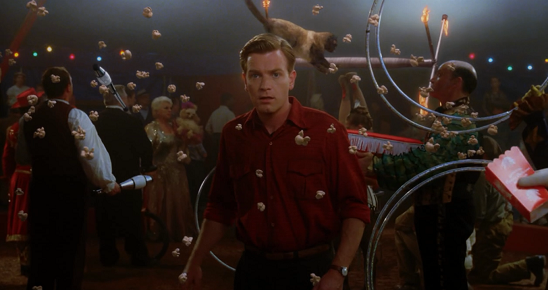
JennycrushBigFish

Timestandingstill-BigFish

carintreeBigFish

daffodilsBigFish
This post is part of The 31 Days of Oscar blogathon, hosted by Aurora of Once Upon a Screen (@CitizenScreen), Kellee (@IrishJayHawk66) of Outspoken & Freckled, and Paula (@Paula_Guthat) of Paula’s Cinema Club. Visit their sites for all of the wonderful entries. Kellee is hosting the snubs.

Share
Posted in: 1990-current films, Blogathons, Comedies (film), Drama (film), Humor, Oscars, Romance (films), Romantic Comedies (film) Tagged: Albert Finney, Big Fish, Daniel Wallace, Ewan McGregor, John August, Oscar snubs, Tim Burton

Mae West Quote of the Week: Religion vs. Jewels

01/30/2016 by leah@carygrantwonteatyou.com Leave a Comment

She Done Him Wrong
“You know it was a toss-up whether I go in for diamonds or sing in the choir. The choir lost.”

The line would be funny regardless, but West does so much with it: She pauses in between the sentences for emphasis. She follows up the words with an arch look at her love interest of the hour (Cary Grant) and then smokes. She struts up and down the room an unnecessary amount of times in their short conversation. She makes a number of references to position and anatomy before and after the gems (which are clearly a stand-in for her sexual escapades).

Thought for the day: Ever wondered whether any woman in this world could be as suggestive in an hour as She Done Him Wrong‘s Lou (West) in five minutes?

This quote is part of my monthly tribute to West.

Share
Posted in: 1930s films, Comedies (film), Mae West Moments, Romantic Comedies (film) Tagged: Cary Grant, great quotes, innuendo, Mae West, She Done Him Wrong

Joel McCrea: Stalling Director Preston Sturges

01/23/2016 by leah@carygrantwonteatyou.com 16 Comments

McCreaPalmBeachStory
This essay is part of Cinema Maven’s Symbiotic Collaborations blogathon, featuring wonderful director/star pairings. Click here for all the great entries.

When I was a kid, my sisters and I used to play with the record player. We loved to speed it up to make it sound like Mickey Mouse. I mention it because when I watch Preston Sturges’ films, I feel like the record player has become stuck on Mickey Mouse mode: everyone is running, shouting, falling, frantic. There are actors whose characteristics are uniquely suited to Sturges’ pace: Eddie Bracken’s exaggerated physicality, for example. Barbara Stanywck’s rapid speech.

Much of the humor of writer/director Sturges’ worlds is when someone slower enters the stage, and can’t keep up. Henry Fonda in The Lady Eve is so out of place that Sturges felt the need to underline it by having him reach the ship full of con artists and gold diggers in a small boat that’s been “up the Amazon.”

But certain actors do more than act as foils to Sturges’ frantic pace. They change the terms, slow things down, act as resistors to his electric current. They are part of the Sturges world, and wise about their companions, not naive, like Fonda’s Charles. We don’t laugh at them, but with them as they, like older siblings, view The Miracle of Morgan’s Creek-type mania around them, and urge everyone to settle down. Joel McCrea was the perfect Sturges resistor.

McCrea
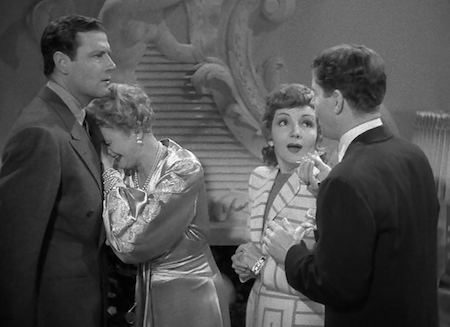
In The Palm Beach Story, he arrives in Florida to discover his wife Gerry (Claudette Colbert) flirting with J.D. Hackensacker III (Rudy Valee), scheming to apply the millionaire’s funds to her husband’s projects. As he tries to reason with her, Tom (McCrea) finds the dizzy chatterbox The Princess Centimillia (Mary Astor) flitting about his handsome form, and his own competition so woefully naive that he serenades Gerry. On McCrea’s face you can see as well as hear the sigh, the “Now this,” the years of putting up with his wife’s silliness, and now these idiots, and you can’t help but laugh.

McCreaPalmBeachStory-scene
Without grandstanding, without chewing the scenery, McCrea has stolen our attention from the mesmerizing Colbert with a few perfect expressions and the solidity of his presence. Suddenly, we’re rooting for him, for them, not for her success. Given the amount of his screen time, it’s a remarkable achievement, and makes you realize why Sturges would nab him for three of his films.

McCrea was even more essential, of course, to Sullivan’s Travels, which came out the year before. Consider the challenge: The lead must act as a stand-in for Sturges, pronouncing the need for comedy in times of trouble. Sullivan (McCrea) is, like Sturges, a director, who thinks he should experience poverty so that he can direct meaningful dramas instead of his usual farces. If the star of Sullivan’s Travels preaches the final lines or overplays his insights (in the theater with the convicts) about the value of comedy, the film becomes hokey. If the character comes across as stupid in not realizing humor’s importance earlier, the ending will feel forced. The actor must, in short, act naive/be deluded at the start of the film, but not be naive. An intelligent, understated performance is essential to delivering Sturges’ message, which is really an endorsement of his entire career (and thus not something he could have taken lightly). And so Sturges chose McCrea.

McCreaSullivansTravels
When we talk about comic timing, we often think of rapidity. But McCrea’s calming presence is part of what makes him so funny. While others around him continue their frantic scrambling, he walks and talks fairly slowly, his deliberation in sharp contrast to their quicker motions and thoughts. He underscores their rush, and makes us laugh. As Sullivan, he is very observant, as a comedic director should be, and gives us just enough of a pause to witness, to understand as he does. As in The More the Merrier, a brilliant comedy Sturges didn’t direct, McCrea gives us the space to recognize the layers of his personality, with Sturges’ regular troop (in this case, following their director in a motor home) left to be the screwball types who summon the simpler laughs.

Although I think most would call Sullivan’s Travels the perfect Sturges-McCrea pairing, I wish fewer people would dismiss The Great Moment. Because it’s not a comedy, of course, it flopped. (A drama? From Sturges?) But it’s truly a remarkable biopic. A dentist, Dr. W. T. Morgan (McCrea), publicly demonstrated the use of ether in an operation in 1846, and therefore helped make all of our surgeries since less painful. But it seems Morgan displayed less admirable behavior afterward, was more intent on getting credit than in the useful application of his discovery. Sturges highlights something beautiful about the man’s life by beginning after his death (after a short scene celebrating his biggest success), and ending the movie with Morgan’s decision to expose his discovery in this public demonstration (thus making unlikely his success in patenting).

The movie isn’t about the main character at all, but instead about an idea: Does an “incandescent” moment, a moment of self-sacrifice for others, make up for the pettiness of one’s life? It’s this rising above the history of events that I so rarely see in biopics, this understanding that recording events isn’t enough; you have to be saying something about them. McCrea’s measured timing lends a kind of gravity and dignity to the role, lets us see the heaviness and pain of Morgan’s decision to sacrifice for others.

McCreaTheGreatMoment
And because McCrea is so likeable, we’re able to acknowledge the character’s usual selfishness (at least as Sturges saw it), and understand it too. I can’t say it’s my favorite film of Sturges’, but it has stuck with me; I find it haunting, which is surprising given Sturges’ light touch. I wish more aspiring directors would learn from it.

Joel McCrea was in three of Preston Sturges’ films, two of his most famous. I know I should be grateful to have that many, but oh! How I wish there were more.

Don’t forget to check out the other entries in the blogathon!

Share
Posted in: 1940s films, Blogathons, Comedies (film), Drama (film), Romantic Comedies (film) Tagged: biopics, Cinema Maven, Joel McCrea, Preston Sturges, Sullivan's Travels, The Great Moment, The Palm Beach Story
« Previous 1 2 3 4 5 6 7 8 9 10 11 Next »

Recent Posts

  • Colbert’s Midnight (1939), Rom-Com Magic
  • Say Anything Is The Sure Thing’s Lame Younger Brother
  • Wallace Got an Oscar
  • Oscar Noms 2025: Gems & Duds
  • 100 Years Later, Still Scary: Dr. Caligari

Subscribe to Blog via Email

Enter your email address to subscribe to this blog and receive notifications of new posts by email.

Categories

  • 1920s films
  • 1930s films
  • 1940s films
  • 1950s films
  • 1960s films
  • 1970s films
  • 1980s films
  • 1990-current films
  • 2020s films
  • Action & Sports Films
  • Anti-Romance films
  • Blogathons
  • Childfree
  • Comedies (film)
  • Drama (film)
  • Feminism
  • Femme fatales
  • Film Noir/Crime/Thriller & Mystery
  • Gloriously Silly Scenes
  • Horror
  • Humor
  • Mae West Moments
  • Musicals and dancing films
  • Oscars
  • Random
  • Romance (films)
  • Romantic Comedies (film)
  • The Moment I Fell for
  • Turn My Sister into Classic Movie Fan
  • TV & Pop Culture
  • Uncategorized
Share
Classic Movie Blog Hub Member

Recent Comments

  • leah@carygrantwonteatyou.com on Colbert’s Midnight (1939), Rom-Com Magic
  • leah@carygrantwonteatyou.com on Colbert’s Midnight (1939), Rom-Com Magic
  • leah@carygrantwonteatyou.com on Colbert’s Midnight (1939), Rom-Com Magic
  • 960 A Avenue Coronado CA on Colbert’s Midnight (1939), Rom-Com Magic
  • Jonathan Cowles on Colbert’s Midnight (1939), Rom-Com Magic

Archives

  • May 2026
  • March 2026
  • November 2025
  • September 2025
  • May 2025
  • March 2025
  • January 2025
  • November 2024
  • August 2024
  • July 2024
  • May 2024
  • March 2024
  • February 2024
  • December 2023
  • November 2023
  • October 2023
  • September 2023
  • August 2023
  • July 2023
  • May 2023
  • April 2023
  • March 2023
  • January 2023
  • December 2022
  • November 2022
  • September 2022
  • July 2022
  • May 2022
  • April 2022
  • March 2022
  • February 2022
  • October 2021
  • September 2021
  • April 2021
  • March 2021
  • February 2021
  • December 2020
  • October 2020
  • September 2020
  • July 2020
  • May 2020
  • April 2020
  • March 2020
  • February 2020
  • December 2019
  • October 2019
  • September 2019
  • June 2019
  • May 2019
  • April 2019
  • February 2019
  • January 2019
  • November 2018
  • September 2018
  • July 2018
  • June 2018
  • May 2018
  • April 2018
  • March 2018
  • February 2018
  • January 2018
  • November 2017
  • September 2017
  • August 2017
  • July 2017
  • June 2017
  • May 2017
  • April 2017
  • March 2017
  • February 2017
  • January 2017
  • December 2016
  • November 2016
  • October 2016
  • August 2016
  • July 2016
  • June 2016
  • May 2016
  • April 2016
  • March 2016
  • February 2016
  • January 2016
  • December 2015
  • November 2015
  • October 2015
  • September 2015
  • August 2015
  • July 2015
  • June 2015
  • May 2015
  • April 2015
  • March 2015
  • February 2015
  • January 2015
  • December 2014
  • November 2014
  • October 2014
  • September 2014
  • August 2014
  • July 2014
  • June 2014
  • May 2014
  • April 2014
  • March 2014
  • February 2014
  • January 2014

Meta

  • Log in
  • Entries feed
  • Comments feed
  • WordPress.org

Copyright © 2026 Cary Grant Won't Eat You.

Church WordPress Theme by themehall.com