Cary Grant Won't Eat You

Classic movies for phobics

  • About
  • eBooks
  • Previous Blogathons
Classic movies for phobics

Month: August 2023

Bergman’s Weird Wife in Stromboli
08/28/2023 by leah@carygrantwonteatyou.com 14 Comments


I’ve always been curious about the film that united director Roberto Rossellini and actress Ingrid Bergman in their illicit romance. How red-hot would an affair have to be to lead to a public censure in the US Senate and a six-year ostracism from Hollywood?

I was prepared for something akin to Mr. and Mrs. Smith (2005), where the chemistry of actors (and new lovers) Angelina Jolie and Brad Pitt inflamed the screen.

Of course, I neglected to consider a few things before viewing: 1) the absence of the director as an actor in the film, 2) the film’s very un-Hollywood use of everyday people as actors–in this case, fishermen in Stromboli, a small island off of Sicily, 3) the plot.

The Keystone Cops would have been just as likely to show up as a red-hot romance.

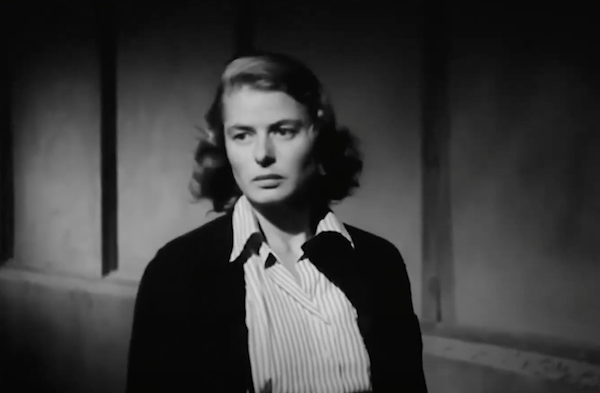
But in one way, I was still on the right track about Stromboli (1950): you can’t keep your eyes off of Bergman, and she IS unbelievably sexy in the film.
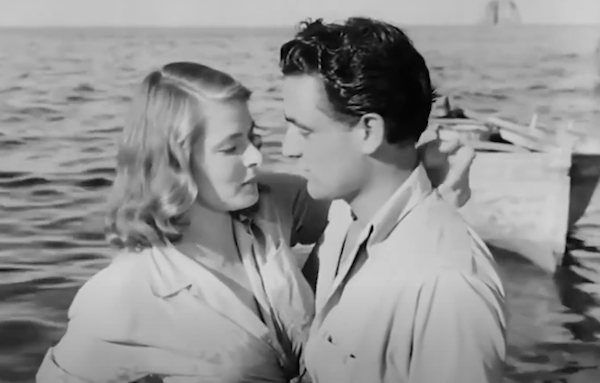

The nature of that sexiness is curious because this is a very, very odd movie. I found myself siding with early American critics, who called it dull. I agreed; it was dull. But it was also haunting, with a grim take on marriage quite unusual for its time.

Bergman’s character, Karen, is fascinating because she is one of the least sympathetic, most selfish brides I’ve ever witnessed onscreen. She marries a poor but handsome ex-POW, Antonio (Mario Vitale), to get out of a displaced persons camp.
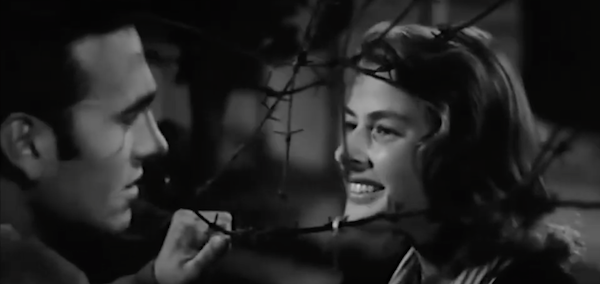

When he brings her home to his fishing village, she doesn’t even try to be civil–to anyone. She attacks her new groom for taking her there. She tells him this place is terrible, that she’s too refined for it and can’t stay. Kind of harsh right after his release from a camp, huh?

In fairness, the village does suck, at least for Karen. There’s an active volcano that can erupt at any moment. Their house is a shack. There’s little to do or see. The townspeople are super judgy and foreigner-averse, which doesn’t make Karen, a Lithuanian, feel very welcome.
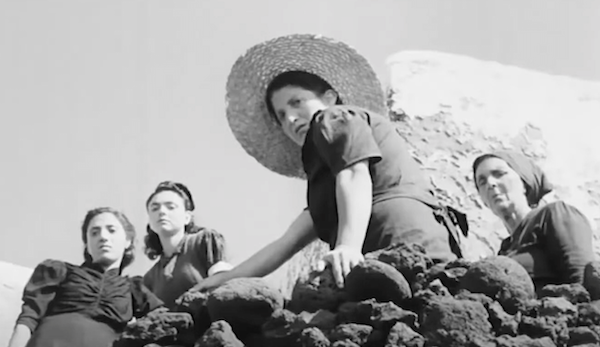

But it’s hard not to pity (at first) the poor husband who just takes Karen’s verbal abuse and hostile glances–especially when he quietly accepts an underpaid fishing job to buy her a better life.
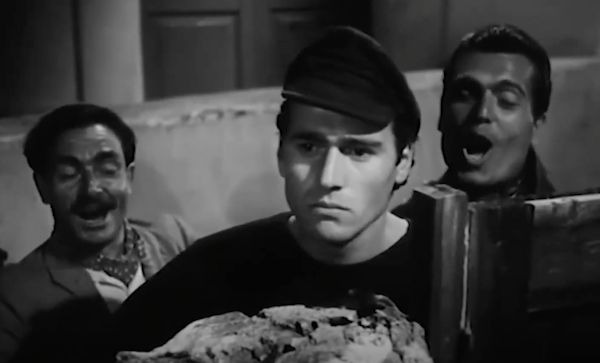

She starts filling the home with the worst decor I’ve ever seen–and hides away her husband’s family photos and religious icons, which she despises. Apparently, this process gives her some pleasure. She’s appalled when he doesn’t love what’s she done, including the weird flowers she’s painted on the walls, kindergartener style. (I told you this film was bizarre, right?) She decides to use a sewing machine in the home of an apparent madam, despite warnings. Then she’s mad at others for thinking she’s loose.

But just when I’m ready to care only about him, her husband proves he’s brutish, like she’s claimed: he beats her for making him look like a cuckold. Now, we audience members don’t have anyone to like in the film.

As for Karen, it’s not long after the house decorating that she begins to plot her escape. Her method is to throw herself at every man who might get her out of there, including–wait for it–the village priest. And the seduction act Bergman pulls is something to witness. I’m not sure how anyone resists it, transparent as her motives are, because this is Ingrid Bergman throwing herself at you, men!! And she has moves. (Narratively, it would have made sense to choose a less attractive actress, but I fully enjoyed full-seduction Bergman. It’s easy to understand how Rossellini fell for her while filming.)

But it’s not just her sensuality that has the audience enthralled by Karen. Her breathless confidence in herself in the face of hostility and discomfort and abuse and foreignness is something to witness. You can’t help but root for her even as you question her decisions. Bergman displays confidence not just through her voice and expressions, but through a kind of ease with her body typical of athletes and dancers. In another world and in another time, you think, what couldn’t this single-minded woman do!? No wonder she’s so angry about her lot!

Unfortunately, Karen soon proves that her poor judgment is not limited to her words and decor. On a lark, she stops by her husband’s job while he’s fishing for tuna with his crew in a ploy to earn his affection. WHO DOES THIS???

This choice is one of the plot devices that seems to be an excuse for Rossellini to include a beautiful neo-realistic scene. It’s easy to understand Rossellini’s reputation as a director when it comes to cinematography. It was fascinating to watch the brutal and dangerous process of catching these huge, gorgeous fish and killing them as the refined wife looks on, horrified.

Later gorgeous scenes include when the volcano erupts, and the town flees for the sea. The escape is fascinating and frightening to watch, and beautifully rendered. (In typical fashion, Karen is only concerned about her own rescue when she sees motorboats.)

**Spoilers coming**

Stromboli is most famous for its ending. Fresh from volcano PTSD, Karen takes off, despite being pregnant. She heads over the still-active volcano alone to get to the side of the island where she plans her escape. She dumps her suitcase in exhaustion after breathing in copious amounts of smoke. She passes out after admitting defeat.
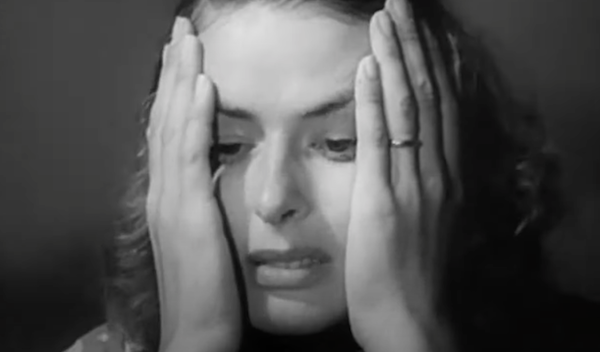

But when she wakes, she calls aloud to God, asking for strength, proclaiming that her experience has been too awful to endure and that she must depart. Whether she really means awful for her or for her unborn child (or for both) is unclear despite her words. Hollywood later added a voiceover suggesting she returned to her husband, a disturbing “happily ever after,” given his violence and decision to forbid her exit by nailing the front door shut while she was inside.

But I don’t buy Hollywood’s interpretation. Karen seems more intent on the birds above her, on the flight still possible with God’s help. The end is ambiguous, it’s true–I can’t be sure I’m right. What ISN’T ambiguous is how miserable Rossellini makes marriage look–which is interesting as he’s breaking up Bergman’s and his own.

Regardless of what anyone makes of the film, Bergman’s performance is unforgettable, and not to be missed by her fans. The extended final scene of her climb and pleas is breathtaking: her resignation, her desperation, her anguish, her hope. This woman deserved all of her three Oscars and then some, and it’s a pleasure to watch her commanding the screen in this stunning finish. If nothing else, watch that.

This post is part of The Wonderful World of Cinema‘s 6th Wonderful Ingrid Bergman Blogathon. Check out the other celebrations of Bergman here!

Share
Posted in: 1950s films, Action & Sports Films, Anti-Romance films, Blogathons, Drama (film), Feminism Tagged: Ingrid Bergman, Ingrid Bergman's best performances, neo-realism, Roberto Rossellini, Stromboli (1950)

The Stunning Talent in Stormy Weather (1943)

08/13/2023 by leah@carygrantwonteatyou.com 2 Comments


How ridiculous is the amount of talent in Stormy Weather (1943)?

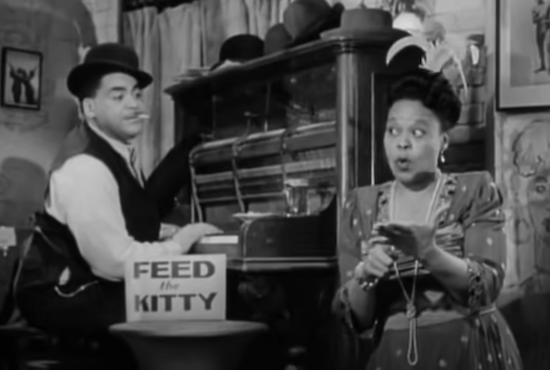
You’ve got Fats Waller and Ada Brown performing “That Ain’t Right,” a scene that obviously inspired Aretha Franklin’s “Think” in The Blues Brothers (1980).


My favorite lines in a hilarious call and response song about his greed for her money are Ada’s: “I took you to a nightclub. I bought you pink champagne. You rode home in a taxi while I caught that subway train, that ain’t right.” His responses include admissions that she’s correct; he does just want her money.

And as if that weren’t enough of a cameo, jazz legend Waller follows it up with a rousing “Ain’t Misbehavin.'”

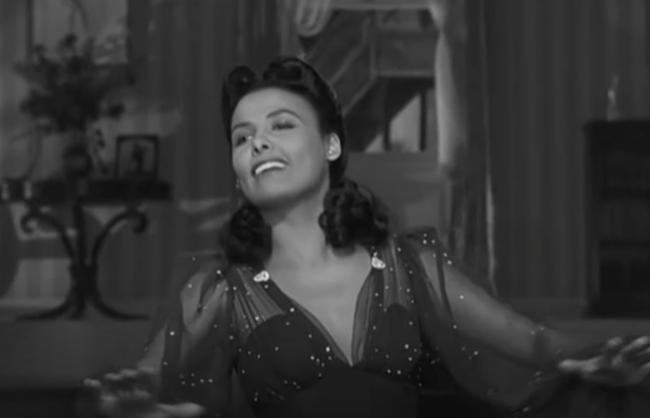
The movie stars the dazzling Bill “Bojangles” Robinson, perhaps best known now for his tap sequences with Shirley Temple. Lena Horne costars. Her performance of “Stormy Weather” is only slightly lovelier than her duet with Robinson of “I Can’t Give You Anything but Love.” She’s at the top of her game, and he’s in the late stages of his career, but his magnetism and skill are still impossible to ignore.

And then there’s the dance sequence during “Stormy Weather” by Katherine Dunham and her troop, which is both mesmerizing and marked by a degree of smoking sensuality I can’t believe made it past the censors. (Seriously, how did anyone miss those gyrations?)

Cab Calloway is his usual charismatic, velvet-voiced self, especially in the exhilarating “The Jumpin’ Jive” (years before he’d charm Gen Xers with the rendition of his hit “Minnie the Moocher” in The Blues Brothers).

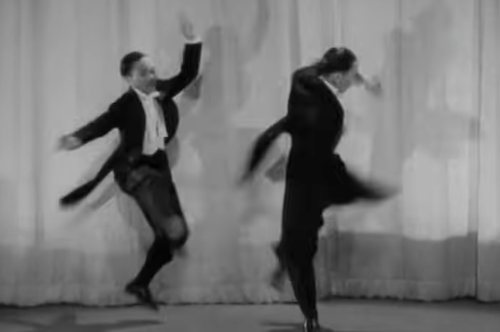
And then of course, we have the coup de grâce during “The Jumpin’ Jive”: the Nicholas brothers’ awe-inducing dance number, which Fred Astaire called the best dance performance on film.


Fayard and Harold Nicholas would wow such luminaries as George Balanchine, Gene Kelly, and Mikhail Baryshnikov. Their students would include Michael and Janet Jackson. (If you get a chance, watch fan Gregory Hines’s befuddled description of their impossible dance sequence in Stormy Weather. You can understand. Can two humans DO that???)

Sadly, it’s easy to guess why Stormy Weather is so chockfull of those at the top of their field: there were so few leading roles for black musicians, actors, and dancers in the 1940s. You can imagine why casting directors would stack that film and the other 1943 all-black musical, Cabin in the Sky, with all the big names they could get.

But that knowledge doesn’t stop you from experiencing shock the whole way through: At the flood of famous people you’ve heard of showing up on the screen. At music and performances that are far too good for a Hollywood musical. And by dancing that would have you in tears if you weren’t so busy smiling. The Nicholas brothers’ breathtaking grace and athleticism are nothing short of miraculous. And watching geniuses fully enjoy their art with that level of exuberance?

Try not to rewind and watch it again.

Share
Posted in: 1940s films, Musicals and dancing films Tagged: Ada Brown, best dance sequences, best musicals, Bill Robinson, Cab Calloway, Fats Waller, Fayard and Harold Nicholas, Lena Horne, Nicholas brothers, Stormy Weather (1943)

The 8 Movie Characters I’d Bring to See Barbie

08/06/2023 by leah@carygrantwonteatyou.com 6 Comments

If I could bring any film characters with me to the Barbie movie, this crew would come along. We would shout, complain, and advise (quite loudly), and so an empty theater–and an earlier viewing by me–would be critical. But just try to imagine with me, how perfect this party would be….(Mild spoilers ahead.)

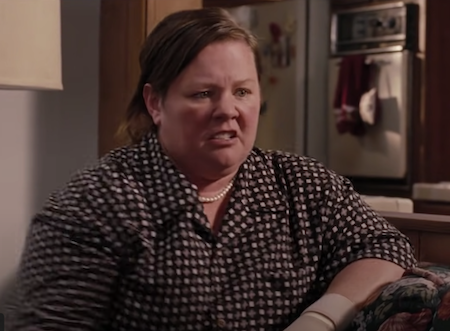
1: Megan (Melissa McCarthy) from Bridesmaids (2011)


This confident, hilarious, non-nonsense woman needs to give Barbie a pep talk. I did love Gloria (America Ferrera)’s speech, but Megan’s would be one for the ages.

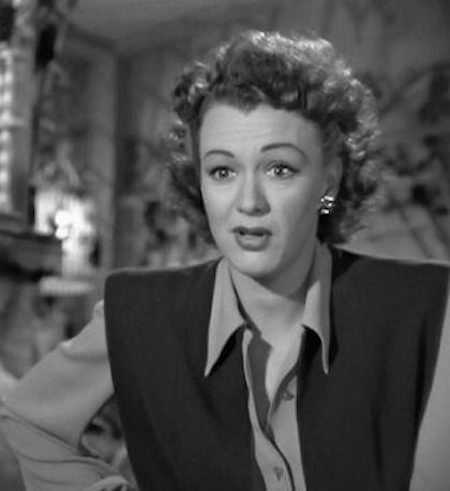
2: Ida (Eve Arden) from Mildred Pierce (1945)


What Megan can do with yelling and pounding, Ida can do with an eyebrow. Ida’s dry, blistering one liners about Ken’s power grab would be epic.

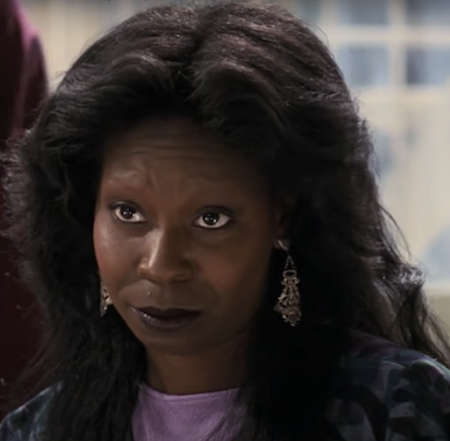
3: Oda Mae Brown (Whoopi Goldberg) from Ghost (1990)


I’ll be honest–this may be just because I want her to say, “Barbie, you in danger, girl,” when the doll puts on fluorescent rollerblading gear.

4: Tira (Mae West) from I’m No Angel (1933)


Tira’s running commentary on Ryan Gosling’s abs and what she’d do to his character on the beach would have everyone in the theater howling with laughter. I’d love to hear her tell Barbie to keep relishing that many Kens in her life. And how much I’d anticipate her reaction to the ending!

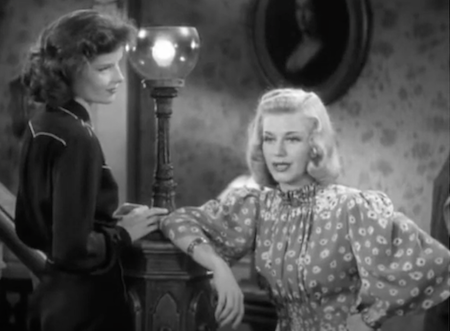
5 & 6: Stage Door (1937) Roommates Terry (Katharine Hepburn) & Jean (Ginger Rogers)


Obviously, I’d want the ENTIRE Footlights Club to accompany me, since there simply is no wittier all-female repartee on film (the famously catty The Women ensemble can’t compare). Don’t believe me? Lucille Ball is in the supporting cast. These sexual-harassment-fighting, badass feminists would be FABULOUS commentators, and I’m so sad I can’t follow their pop culture podcast right now.

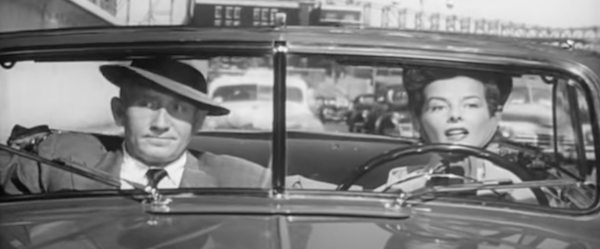
7 & 8: Adam (Spencer Tracy) and Amanda (Katharine Hepburn) from Adam’s Rib (1949)


What could be better than to hear a brilliant couple with perfect dialogue critique the work of screenwriting couple Greta Gerwig and Noah Baumbach? And with the way Amanda just slays in arguing women’s rights in the courtroom, I long to hear what she’d say to those fools in the Mattel boardroom.

There you have it. My eight favorite Barbie movie companions. Who would yours be?

Share
Posted in: 1990-current films, Childfree, Comedies (film), Feminism, Humor, Uncategorized Tagged: Adam's Rib, Barbie movie, Eve Arden, feminism, Ginger Rogers, Katharine Hepburn, Mae West, Melissa McCarthy, Whoopi Goldberg

Recent Posts

  • 100 Years Later, Still Scary: Dr. Caligari
  • Escaping Out of the Past (1947)
  • A Weeper for Those Who Love Jerks
  • Thank You, Academy, for Not Infuriating Me
  • Challengers (2024) Is a Bad Movie

Subscribe to Blog via Email

Enter your email address to subscribe to this blog and receive notifications of new posts by email.

Categories

  • 1920s films
  • 1930s films
  • 1940s films
  • 1950s films
  • 1960s films
  • 1970s films
  • 1980s films
  • 1990-current films
  • 2020s films
  • Action & Sports Films
  • Anti-Romance films
  • Blogathons
  • Childfree
  • Comedies (film)
  • Drama (film)
  • Feminism
  • Femme fatales
  • Film Noir/Crime/Thriller & Mystery
  • Gloriously Silly Scenes
  • Horror
  • Humor
  • Mae West Moments
  • Musicals and dancing films
  • Oscars
  • Random
  • Romance (films)
  • Romantic Comedies (film)
  • The Moment I Fell for
  • Turn My Sister into Classic Movie Fan
  • TV & Pop Culture
  • Uncategorized
Share
Classic Movie Blog Hub Member

Recent Comments

  • leah@carygrantwonteatyou.com on Meg Ryan’s Fate Foretold in Joe Versus the Volcano
  • Ryan on Meg Ryan’s Fate Foretold in Joe Versus the Volcano
  • leah@carygrantwonteatyou.com on 100 Years Later, Still Scary: Dr. Caligari
  • The Classic Movie Muse on 100 Years Later, Still Scary: Dr. Caligari
  • leah@carygrantwonteatyou.com on 100 Years Later, Still Scary: Dr. Caligari

Archives

  • November 2025
  • September 2025
  • May 2025
  • March 2025
  • January 2025
  • November 2024
  • August 2024
  • July 2024
  • May 2024
  • March 2024
  • February 2024
  • December 2023
  • November 2023
  • October 2023
  • September 2023
  • August 2023
  • July 2023
  • May 2023
  • April 2023
  • March 2023
  • January 2023
  • December 2022
  • November 2022
  • September 2022
  • July 2022
  • May 2022
  • April 2022
  • March 2022
  • February 2022
  • October 2021
  • September 2021
  • April 2021
  • March 2021
  • February 2021
  • December 2020
  • October 2020
  • September 2020
  • July 2020
  • May 2020
  • April 2020
  • March 2020
  • February 2020
  • December 2019
  • October 2019
  • September 2019
  • June 2019
  • May 2019
  • April 2019
  • February 2019
  • January 2019
  • November 2018
  • September 2018
  • July 2018
  • June 2018
  • May 2018
  • April 2018
  • March 2018
  • February 2018
  • January 2018
  • November 2017
  • September 2017
  • August 2017
  • July 2017
  • June 2017
  • May 2017
  • April 2017
  • March 2017
  • February 2017
  • January 2017
  • December 2016
  • November 2016
  • October 2016
  • August 2016
  • July 2016
  • June 2016
  • May 2016
  • April 2016
  • March 2016
  • February 2016
  • January 2016
  • December 2015
  • November 2015
  • October 2015
  • September 2015
  • August 2015
  • July 2015
  • June 2015
  • May 2015
  • April 2015
  • March 2015
  • February 2015
  • January 2015
  • December 2014
  • November 2014
  • October 2014
  • September 2014
  • August 2014
  • July 2014
  • June 2014
  • May 2014
  • April 2014
  • March 2014
  • February 2014
  • January 2014

Meta

  • Log in
  • Entries feed
  • Comments feed
  • WordPress.org

Copyright © 2025 Cary Grant Won't Eat You.

Church WordPress Theme by themehall.com