Cary Grant Won't Eat You

Classic movies for phobics

  • About
  • eBooks
  • Previous Blogathons
Classic movies for phobics

The Palm Beach Story

Classic Movies with Awesomely Silly Plots
05/25/2020 by leah@carygrantwonteatyou.com 16 Comments
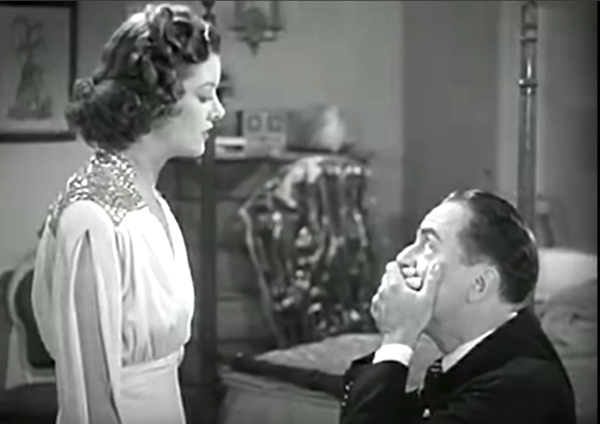
Picture of Myrna Loy and William Powell in I Love You Again

It’s not unusual to find a film with a strikingly ridiculous plot. I spent many Friday nights as a teen watching USA Up All Night (hosted by Gilbert Godfrey). How I loved taking in gloriously dumb films, hour after hour.

But to find movies with such plots that are genuinely good? That’s a whole other level of enjoyment. Now add 80 years or so, and the film is STILL GOOD, STILL FUNNY? That’s a comedic masterpiece.

Last Tuesday I wrote a post on feel-good silly films, and rated them according to their degree of silliness. (In a homage to Spinal Tap, I let the ratings go to eleven rather than ten.) So today, I’m going to list five films with plots so absurd they deserve that 11 silliness quotient fully. And not coincidentally, these films are a blast to watch. In no particular order:

The Palm Beach Story (1942)
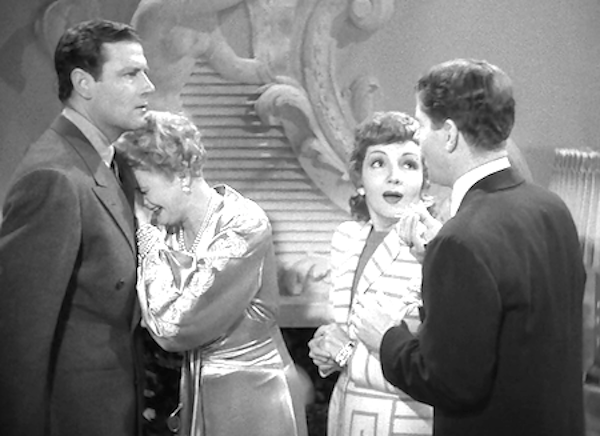
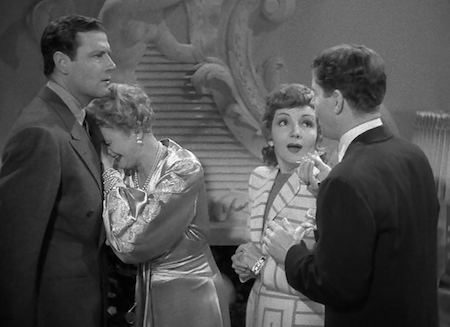
PIcture of Joel McCrea, Mary Astor, Claudette Colbert, and "Rudy" Vallée, The Palm Beach Story

A woman (Claudette Colbert) leaves her broke husband (Joel McCrea) so that she can marry a millionaire and use his money to fund her original husband’s brilliant project. She heads to Palm Beach to find such a millionaire, aided by a “wiener king ” and trigger-happy hunters. The writer/director is Preston Sturges, so you know you’re in for a treat.

Easy Living (1937)
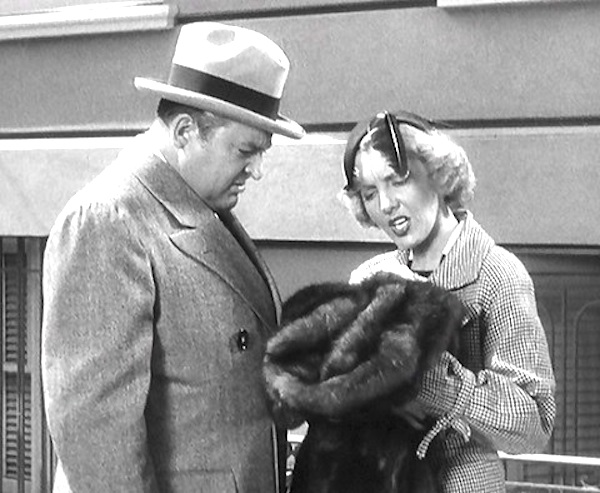
Edward Arnold and Jean Arthur in Easy Living

A banker (Edward Arnold) in a fight with his extravagant wife (Mary Nash) throws her fur coat off the roof of their home. The coat hits the hat of a bus passenger (Jean Arthur). The banker’s attempts to compensate the passenger destroy her reputation, but do aid her income. If you need a teaser to be convinced, check out the banker’s and passenger’s hilarious fight about loan interest.

Arsenic and Old Lace (1944)
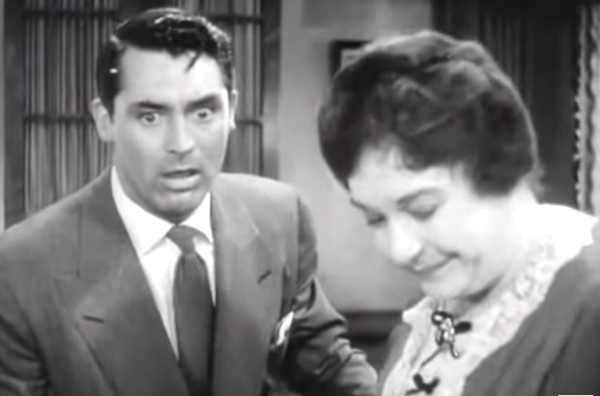
Cary Grant and Josephine Hull in Arsenic and Old Lace

Mortimer (Cary Grant) has always known his cousin (John Alexander) is a bit off. After all, his cousin thinks and acts like Teddy Roosevelt, building his canal. But in visiting his beloved aunts (Josephine Hull and Jean Adair), Mortimer discovers they have some issues as well: they’re serial killers murdering lonely old men. “Teddy” assumes the dead bodies are yellow fever victims and takes them in stride. But Mortimer begins to fear for his DNA. A screwball classic.

I’m No Angel (1933)
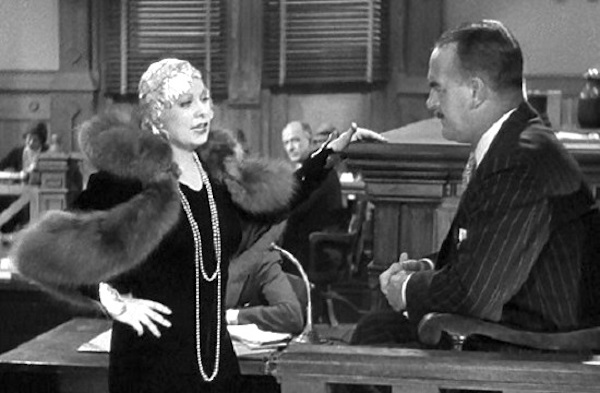
Mae West, courtroom scene, I'm No Angel

A lion tamer (Mae West) becomes the talk of high society, even winning a classy lover who plans to marry her (Cary Grant). The circus fears losing her income, so they convince the lover that their star is cheating on him. When her lover leaves her, the tamer sues him for breach of promise. She acts as her own lawyer, spending 90 percent of the trial strutting and seducing the jury in what may be the funniest courtroom scene ever.

I Love You Again (1940)
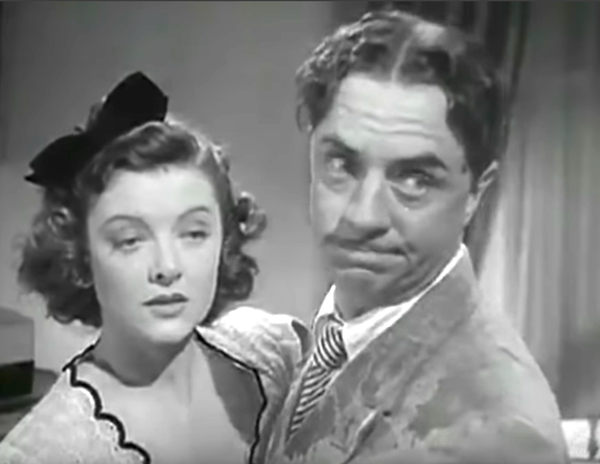
William Powell and Myrna Loy in I Love You Again

A man (William Powell) gets hit on the head and becomes an old self he’s forgotten, a swindler, instead of the upright prude he now is. He decides to live the prude’s life as he looks for a score and becomes intrigued by the uptight man’s wife (Myrna Loy), whom the swindler version of himself never met. She, sick of his stodgy ways and unaware of his change, wants to divorce him. The question is, will the man’s wife fall in love with his older self? I feel dizzy just explaining this amnesia plot, but it’s The Thin Man’s Loy and Powell team, so what’s not to love?

There you have it. Five ridiculous plots. Five ridiculously fun movies. And I haven’t even scratched the surface of this topic! Anyone who wants to share their favorite silly plot, please do so in the comments!

Share
Posted in: 1930s films, 1940s films, Comedies (film), Humor, Mae West Moments, Romantic Comedies (film) Tagged: Cary Grant, Claudette Colbert, Easy Living, I Love You Again, I'm No Angel, Jean Arthur, Mae West, Powell and Loy, Preston Sturges, screwball classics, silly classics, The Palm Beach Story

Joel McCrea: Stalling Director Preston Sturges

01/23/2016 by leah@carygrantwonteatyou.com 16 Comments

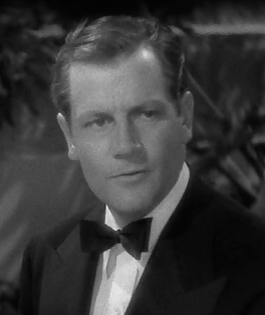
McCreaPalmBeachStory
This essay is part of Cinema Maven’s Symbiotic Collaborations blogathon, featuring wonderful director/star pairings. Click here for all the great entries.

When I was a kid, my sisters and I used to play with the record player. We loved to speed it up to make it sound like Mickey Mouse. I mention it because when I watch Preston Sturges’ films, I feel like the record player has become stuck on Mickey Mouse mode: everyone is running, shouting, falling, frantic. There are actors whose characteristics are uniquely suited to Sturges’ pace: Eddie Bracken’s exaggerated physicality, for example. Barbara Stanywck’s rapid speech.

Much of the humor of writer/director Sturges’ worlds is when someone slower enters the stage, and can’t keep up. Henry Fonda in The Lady Eve is so out of place that Sturges felt the need to underline it by having him reach the ship full of con artists and gold diggers in a small boat that’s been “up the Amazon.”

But certain actors do more than act as foils to Sturges’ frantic pace. They change the terms, slow things down, act as resistors to his electric current. They are part of the Sturges world, and wise about their companions, not naive, like Fonda’s Charles. We don’t laugh at them, but with them as they, like older siblings, view The Miracle of Morgan’s Creek-type mania around them, and urge everyone to settle down. Joel McCrea was the perfect Sturges resistor.

McCrea
In The Palm Beach Story, he arrives in Florida to discover his wife Gerry (Claudette Colbert) flirting with J.D. Hackensacker III (Rudy Valee), scheming to apply the millionaire’s funds to her husband’s projects. As he tries to reason with her, Tom (McCrea) finds the dizzy chatterbox The Princess Centimillia (Mary Astor) flitting about his handsome form, and his own competition so woefully naive that he serenades Gerry. On McCrea’s face you can see as well as hear the sigh, the “Now this,” the years of putting up with his wife’s silliness, and now these idiots, and you can’t help but laugh.

McCreaPalmBeachStory-scene
Without grandstanding, without chewing the scenery, McCrea has stolen our attention from the mesmerizing Colbert with a few perfect expressions and the solidity of his presence. Suddenly, we’re rooting for him, for them, not for her success. Given the amount of his screen time, it’s a remarkable achievement, and makes you realize why Sturges would nab him for three of his films.

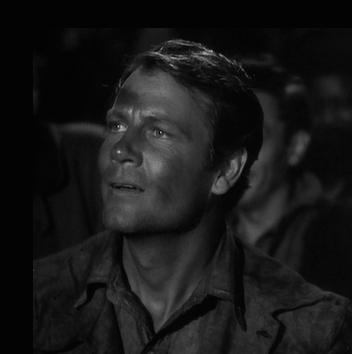
McCrea was even more essential, of course, to Sullivan’s Travels, which came out the year before. Consider the challenge: The lead must act as a stand-in for Sturges, pronouncing the need for comedy in times of trouble. Sullivan (McCrea) is, like Sturges, a director, who thinks he should experience poverty so that he can direct meaningful dramas instead of his usual farces. If the star of Sullivan’s Travels preaches the final lines or overplays his insights (in the theater with the convicts) about the value of comedy, the film becomes hokey. If the character comes across as stupid in not realizing humor’s importance earlier, the ending will feel forced. The actor must, in short, act naive/be deluded at the start of the film, but not be naive. An intelligent, understated performance is essential to delivering Sturges’ message, which is really an endorsement of his entire career (and thus not something he could have taken lightly). And so Sturges chose McCrea.

McCreaSullivansTravels
When we talk about comic timing, we often think of rapidity. But McCrea’s calming presence is part of what makes him so funny. While others around him continue their frantic scrambling, he walks and talks fairly slowly, his deliberation in sharp contrast to their quicker motions and thoughts. He underscores their rush, and makes us laugh. As Sullivan, he is very observant, as a comedic director should be, and gives us just enough of a pause to witness, to understand as he does. As in The More the Merrier, a brilliant comedy Sturges didn’t direct, McCrea gives us the space to recognize the layers of his personality, with Sturges’ regular troop (in this case, following their director in a motor home) left to be the screwball types who summon the simpler laughs.

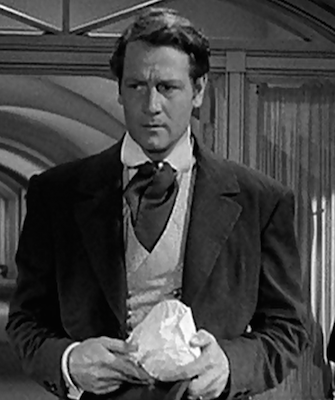
Although I think most would call Sullivan’s Travels the perfect Sturges-McCrea pairing, I wish fewer people would dismiss The Great Moment. Because it’s not a comedy, of course, it flopped. (A drama? From Sturges?) But it’s truly a remarkable biopic. A dentist, Dr. W. T. Morgan (McCrea), publicly demonstrated the use of ether in an operation in 1846, and therefore helped make all of our surgeries since less painful. But it seems Morgan displayed less admirable behavior afterward, was more intent on getting credit than in the useful application of his discovery. Sturges highlights something beautiful about the man’s life by beginning after his death (after a short scene celebrating his biggest success), and ending the movie with Morgan’s decision to expose his discovery in this public demonstration (thus making unlikely his success in patenting).

The movie isn’t about the main character at all, but instead about an idea: Does an “incandescent” moment, a moment of self-sacrifice for others, make up for the pettiness of one’s life? It’s this rising above the history of events that I so rarely see in biopics, this understanding that recording events isn’t enough; you have to be saying something about them. McCrea’s measured timing lends a kind of gravity and dignity to the role, lets us see the heaviness and pain of Morgan’s decision to sacrifice for others.

McCreaTheGreatMoment
And because McCrea is so likeable, we’re able to acknowledge the character’s usual selfishness (at least as Sturges saw it), and understand it too. I can’t say it’s my favorite film of Sturges’, but it has stuck with me; I find it haunting, which is surprising given Sturges’ light touch. I wish more aspiring directors would learn from it.

Joel McCrea was in three of Preston Sturges’ films, two of his most famous. I know I should be grateful to have that many, but oh! How I wish there were more.

Don’t forget to check out the other entries in the blogathon!

Share
Posted in: 1940s films, Blogathons, Comedies (film), Drama (film), Romantic Comedies (film) Tagged: biopics, Cinema Maven, Joel McCrea, Preston Sturges, Sullivan's Travels, The Great Moment, The Palm Beach Story

A Cinematic Argument for Gun Control: The Ale & Quail Club

07/05/2015 by leah@carygrantwonteatyou.com Leave a Comment

Ale&QuailClub-PalmBeachStory
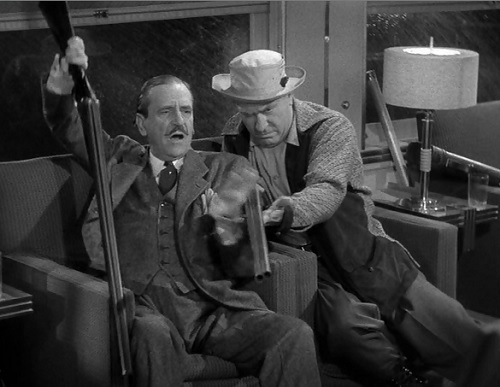
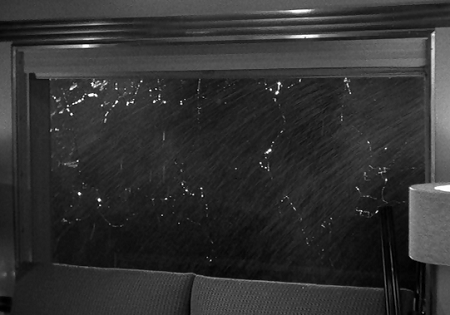
The Palm Beach Story (1942), Preston Sturges’ rom-com about love & money, features many screwball moments. But few would deny that the screwiest are with the trigger-happy Ale & Quail Club. I have heard many arguments over the years claiming we need tighter governance over gun ownership. But none have been more compelling than simply watching this hunting club in action.

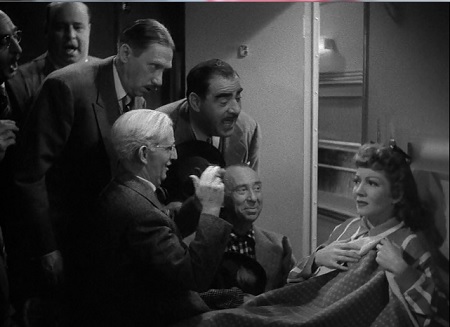
Near the start of the film, Gerry (Claudette Colbert) is leaving her husband, Tom (Joel McCrea). Believing her extravagance is holding him back, she seeks a rich lover to–wait for it–help his business. She dodges Tom at the train station, and convinces a group of millionaires (the Ale & Quail Club) to buy her a ticket to Palm Beach. What she doesn’t know is just what kind of group she’s joined.

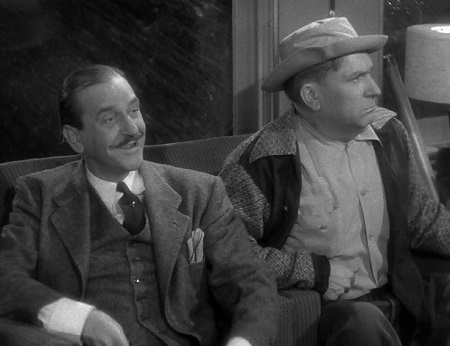
They dance with her; they sing to her, their intoxication becoming more evident by the moment. They serenade her with “Sweet Adeline,” to her evident annoyance:

ReactiontoSerenadeClaudetteColbert
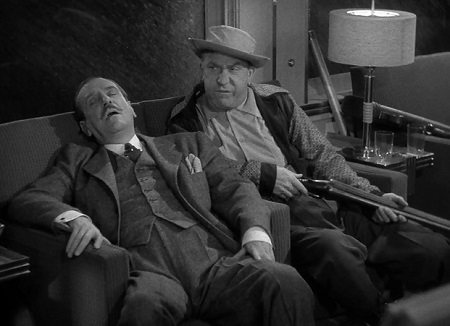
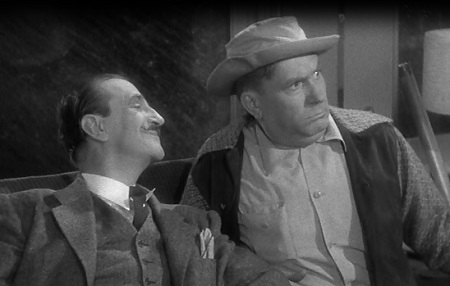
But not just hers. Two of the hunting club’s members haven’t joined the singing–one (William Demarest) because he detests such unmanly behavior, the other (Jack Norton) because his drunkenness has reached the pass-out point.

SweetAdelinereactionDemarestGordon
Demarest asks their private car’s steward, George (Ernest Anderson), to throw up crackers, and pretends to shoot them, saying, “Bang bang.”

BangBangDemarestGordon
Naturally, his companion (Gordon) claims he’s missed, and the two make a $50 bet about who can make the best shot. Gordon, too drunk to be handling weapons, shatters the window.

firstcasualtywindow
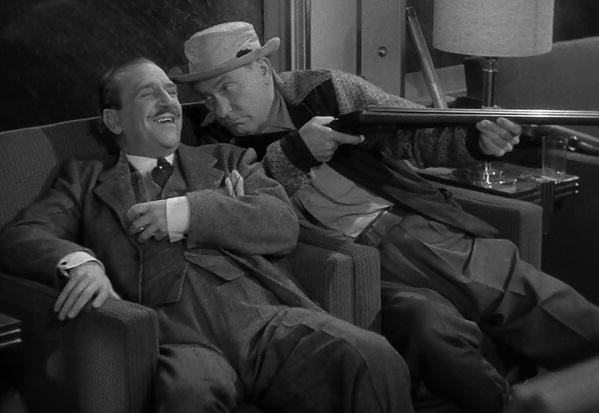
Demarest is shocked, and Gordon proud of his accomplishment.

ShockatSuccessDemarestandGordon
He claims the win.

JackGordonproudofwindowshot
“Wait a minute,” says Demarest. “you’re using real shells.”

“Well, what did you think I was using,” Gordon answers, “bird seed?”

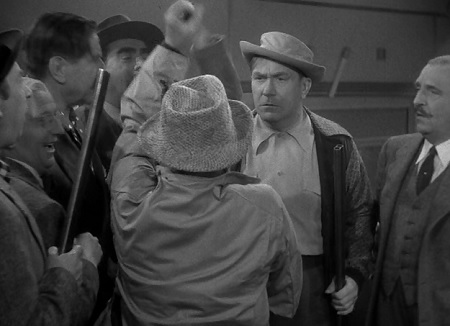
At this point, we might expect Demarest to cry foul. Instead, he loads his own weapon, and chaos ensues as they shoot up the car, with George ducking for safety. The singers in the other room, instead of trying to stop their friends, rush to join the party, calling, “Crap shooting.”

After they’ve completely busted up the car, one member realizes that Gerry, who was almost taken out when she checked to see what was happening, has disappeared.

she'sgone
Demarest suggests a posse.

PoseeledbyDemarest
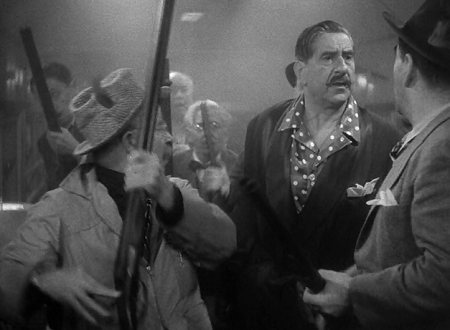
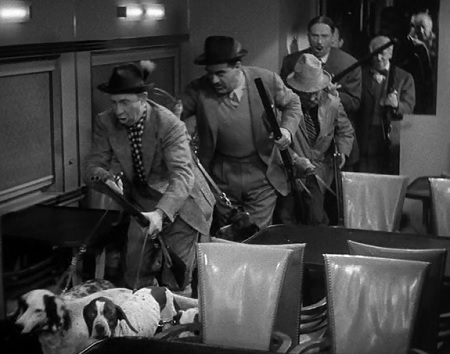
Gordon says they need their dogs, so the club gathers the canines from the other car, singing, “A Hunting We Will Go” as they stalk Gerry.

HuntingPartyAle&Quail
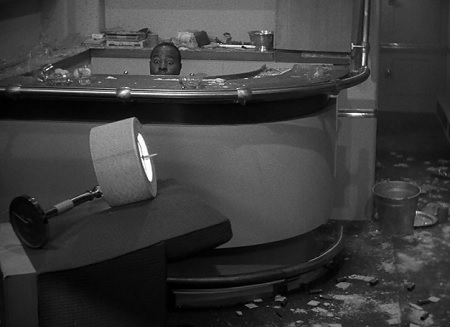
After they terrify multiple guests, the club is forced to return to their car. Naturally, they sing some more before the conductors discover what’s become of the car–and George.

George-PalmBeachStory
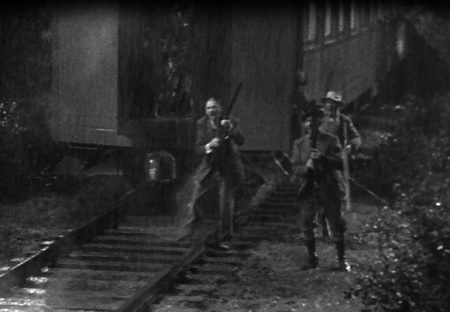
In our last view of the group, they try to protest their private car being disconnected from the train–with their weapons still in hand.

AleandQuailLastScene
If you haven’t seen it, this ridiculous scenario is, as you can imagine, hilarious. You’ll quickly remember all those Dick Cheney hunting jokes, perhaps the funny Parks and Recreation hunting trip.

But it’s also a terrifying scenario if you shift the light a little: a posse of men chasing after a woman, one black man hiding from the white men threatening him, loaded guns everywhere, a train full of potential victims, and not one person among the group sober. You will laugh–as I did–to see these goofy men, and their strange notion of partying. But you may also find yourself thinking, “You know, some of these guys would have failed a good background check….”

Share
Posted in: 1940s films, Comedies (film), Romantic Comedies (film) Tagged: Dick Cheney hunting jokes, Jack Gordon, Parks and Recreation hunting trip, Preston Sturges, Second Amendment, The Palm Beach Story, William Demarest

Recent Posts

  • 100 Years Later, Still Scary: Dr. Caligari
  • Escaping Out of the Past (1947)
  • A Weeper for Those Who Love Jerks
  • Thank You, Academy, for Not Infuriating Me
  • Challengers (2024) Is a Bad Movie

Subscribe to Blog via Email

Enter your email address to subscribe to this blog and receive notifications of new posts by email.

Categories

  • 1920s films
  • 1930s films
  • 1940s films
  • 1950s films
  • 1960s films
  • 1970s films
  • 1980s films
  • 1990-current films
  • 2020s films
  • Action & Sports Films
  • Anti-Romance films
  • Blogathons
  • Childfree
  • Comedies (film)
  • Drama (film)
  • Feminism
  • Femme fatales
  • Film Noir/Crime/Thriller & Mystery
  • Gloriously Silly Scenes
  • Horror
  • Humor
  • Mae West Moments
  • Musicals and dancing films
  • Oscars
  • Random
  • Romance (films)
  • Romantic Comedies (film)
  • The Moment I Fell for
  • Turn My Sister into Classic Movie Fan
  • TV & Pop Culture
  • Uncategorized
Share
Classic Movie Blog Hub Member

Recent Comments

  • leah@carygrantwonteatyou.com on Meg Ryan’s Fate Foretold in Joe Versus the Volcano
  • Ryan on Meg Ryan’s Fate Foretold in Joe Versus the Volcano
  • leah@carygrantwonteatyou.com on 100 Years Later, Still Scary: Dr. Caligari
  • The Classic Movie Muse on 100 Years Later, Still Scary: Dr. Caligari
  • leah@carygrantwonteatyou.com on 100 Years Later, Still Scary: Dr. Caligari

Archives

  • November 2025
  • September 2025
  • May 2025
  • March 2025
  • January 2025
  • November 2024
  • August 2024
  • July 2024
  • May 2024
  • March 2024
  • February 2024
  • December 2023
  • November 2023
  • October 2023
  • September 2023
  • August 2023
  • July 2023
  • May 2023
  • April 2023
  • March 2023
  • January 2023
  • December 2022
  • November 2022
  • September 2022
  • July 2022
  • May 2022
  • April 2022
  • March 2022
  • February 2022
  • October 2021
  • September 2021
  • April 2021
  • March 2021
  • February 2021
  • December 2020
  • October 2020
  • September 2020
  • July 2020
  • May 2020
  • April 2020
  • March 2020
  • February 2020
  • December 2019
  • October 2019
  • September 2019
  • June 2019
  • May 2019
  • April 2019
  • February 2019
  • January 2019
  • November 2018
  • September 2018
  • July 2018
  • June 2018
  • May 2018
  • April 2018
  • March 2018
  • February 2018
  • January 2018
  • November 2017
  • September 2017
  • August 2017
  • July 2017
  • June 2017
  • May 2017
  • April 2017
  • March 2017
  • February 2017
  • January 2017
  • December 2016
  • November 2016
  • October 2016
  • August 2016
  • July 2016
  • June 2016
  • May 2016
  • April 2016
  • March 2016
  • February 2016
  • January 2016
  • December 2015
  • November 2015
  • October 2015
  • September 2015
  • August 2015
  • July 2015
  • June 2015
  • May 2015
  • April 2015
  • March 2015
  • February 2015
  • January 2015
  • December 2014
  • November 2014
  • October 2014
  • September 2014
  • August 2014
  • July 2014
  • June 2014
  • May 2014
  • April 2014
  • March 2014
  • February 2014
  • January 2014

Meta

  • Log in
  • Entries feed
  • Comments feed
  • WordPress.org

Copyright © 2025 Cary Grant Won't Eat You.

Church WordPress Theme by themehall.com