100 Years Later, Still Scary: Dr. Caligari
A friend and I both have this habit of picking up other people’s stray books, starting to read, and then forgetting where we are. One day, that friend picked up mine, Don DeLillo’s White Noise. I waited for her reaction, wondering if she’d be as overcome by it as I had been. After a pause in reading, she looked up at me and said, “This is literature.”
I always think of that moment when I’m reading or watching something and am stunned by its brilliance. That stirring of excitement is what I felt just a few minutes into The Cabinet of Dr. Caligari (1920).
I wasn’t even sure beforehand I’d like the movie. Horror is not my usual. I’d heard of the film and was curious. But I will admit to some fear that whatever special effects it managed in 1920s terms would be too silly for the story to frighten a 2020s audience.
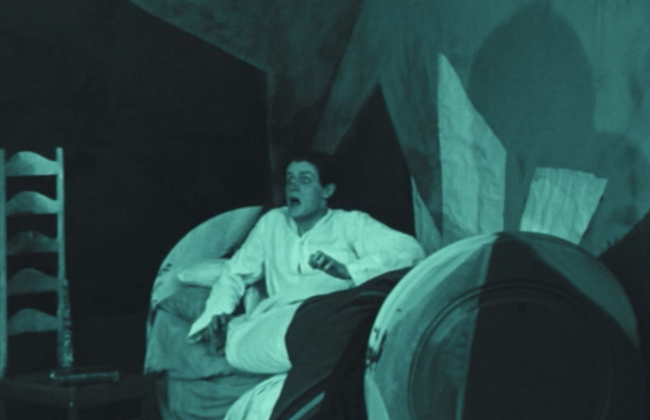
What I didn’t count on, of course, were the joys of German Expressionism. I didn’t even know the intriguing Nosferatu was part of the same movement. The exaggerated, fanciful staging, set design, lighting, camera angles, use of shadows and makeup of The Cabinet of Dr. Caligari take the film into the world of fairy tale. Because there is no attempt to make anything look “real,” the film quickly joins the terrain of nightmare. (One hundred years don’t really make a difference when it comes to nightmares.) Most say the film is either influenced by or a direct commentary on WWI, which explains much of the plot and the traumatized state of its leads.
I’ll share just the basics so that I don’t spoil its considerable suspense. (Side note: What is that AMAZING font on the title cards throughout? I want to use it for everything!!)
The acting begins with an older man sharing his ghostly encounters with a young man, Franzis (Friedrich Feher), who says he and his fiancée (Jane Olsen). have their own terrifying tale to tell. She walks by trancelike in white, like she’s straight of casting for Ophelia.
Franzis then brings up a mysterious “him” from his past, who appears in his own little shot, looking extremely creepy (with his hair dyed black and white on top, skunk style). This “him” navigates a gorgeous setting of crooked street drawings. Him, of course, is Dr. Caligari (Werner Krauss).
The frame quickly dissolves into a scene of a new character, whom we’ll soon learn is Alan (Hans Heinrich von Twardowski), overjoyed about his town’s fair. He goes to Franzis’s place to convince him to join. Franzis is clearly a pre-traumatized, lighter, and happier version of the man we met in the opening scene. Meanwhile, Dr. Caligari is trying to get a permit for the same event.
We soon discover Dr. Caligari’s act will involve a somnambulist named Cesare (Conrad Veidt). As Act II begins, we learn there’s been a murder in the town. I won’t share any more of the plot.
The film is beautiful. Whether the story is using a painted set or a constructed one — and this film uses both — each set is a haunting piece of artwork. The framing of every shot is striking. (I wouldn’t recommend anyone experiencing vertigo watch this film. The oddly angled everything can make you feel a bit off even on the most balanced of days.) Surely, every haunted house created in every town since owes a debt to this film.
Dr. Caligari makes you wonder what you’re seeing and not, explores the nature of sanity and authority and otherwise makes you feel ill at ease and worried for its characters. It also keeps you reflecting on its messaging and incredible artistry long afterward. I enjoyed the acting, especially Veidt’s as Cesare and, of course, Krauss, who just owns this role. But EVERYTHING is good about this film. Never with any other scary movie have I wanted to freeze every frame, just to examine how each touch builds toward this symphony of mood building.
If you haven’t seen it yet, I envy your first encounter.
Explore a host of haunting films by visiting the entries of my talented peers in the Classic Movie Blog Association’s Early Shadows & Pre-Code Horror blogathon.
