Cary Grant Won't Eat You

Classic movies for phobics

  • About
  • eBooks
  • Previous Blogathons
Classic movies for phobics

Stage Door

Sexual Predators in Film: Weinstein, 1937
11/10/2017 by leah@carygrantwonteatyou.com 8 Comments


All this talk of Harvey Weinstein and now Louis C.K. has me thinking about Stage Door (1937), that fascinating film featuring a dormitory of smart-talking women clamoring for parts on the stage, and suffering the sexist overtures of a very slimy producer along the way. The film was produced the same year the words “casting couch” were first published in Variety, according to Matthew Dessem. How the film got made is clear: it’s a feminist anthem against sexual predation, yes, but it’s carefully camouflaged as one of the funniest comedies of its era. Critics praised the witty, fabulous dialogue, ignoring or underplaying the blatant warning directed at female aspirants to stage or screen.

The story begins with Jean Maitland (Ginger Rogers) trying to oust roommate Linda Shaw (Gail Patrick). Jean’s a sarcastic gal from the wrong side of the tracks, too proud and ethical to give into seductions in exchange for parts or furs. Her roommate, however, is an opportunist, and has given up her reputation in exchange for gifts from her wealthy keeper, sables and sapphires she rubs in Jean’s face.
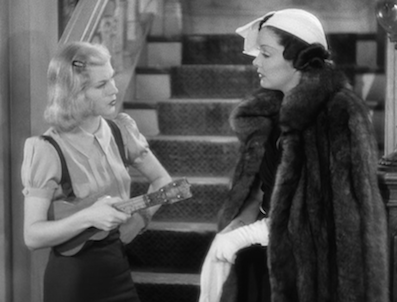

The two separate to achieve peace, but Jean isn’t long for a solitary room; enter her new roommate, heiress Terry (Katharine Hepburn), who wants to star on the stage too. She thinks her peers haven’t made it big yet because they lack ambition. Her slow recognition of her own privilege will become the axis around which the plot revolves. Initially mocked by the dorm residents who resent her for slumming, she does make one friend, Kay Hamilton (Andrea Leeds), the acknowledged talent of the bunch.
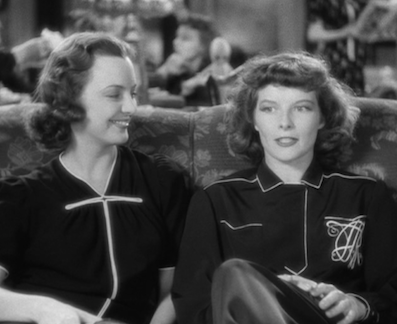

Sympathy and admiration for Kay will lead Terry to understand that her poverty-stricken companions aren’t slackers, but cynics battered by experience. They face obstacles she doesn’t, and have no safety net if they fall.

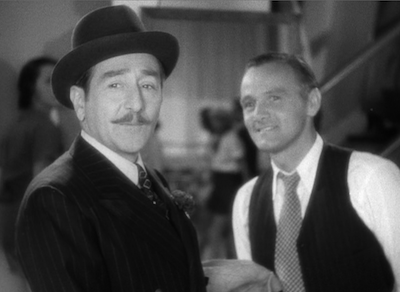
While Katharine Hepburn’s Terry is learning how the hungry half lives, Jean encounters Linda’s lover, Anthony Powell (Adolphe Menjou), who eyes her in an audition. The fact that finding prey is his goal in being a producer is clear, as when he says to a dancing school director, “I very likely won’t produce anything unless I can find an angel. You haven’t seen any flying around, have you?” After an uncomfortable amount of leering at a dancing pair, he asks about “the little blonde.” His pal obligingly offers the information, of course, and soon Jean has unwittingly taken a job given to her so that Powell has access to her charms. We can see in all of these moves a clear pattern: he’s after/has sex with the girl, she gets the role. Jean’s response when she sees Powell and Linda at the club where she’s been hired says everything:
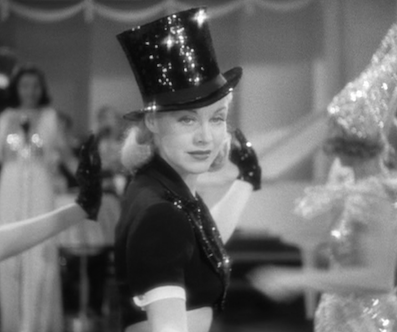

Jean’s barbs at Powell (and at his choice of a mistress) have no effect.
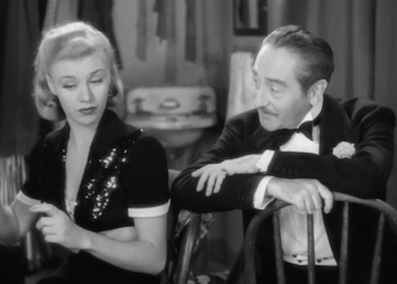

But then Jean decides it’s time to teach her former roommate Linda a lesson, steal her guy. Jean doesn’t plan to have sex with him, but what’ll it hurt her to drink a little champagne, have a meal or two that isn’t stew?

But the bigger reason for dating an undesirable man is evident: If Jean doesn’t play nice, what happens to her job? Her dancing partner, Annie, suggests as much multiple times. When Jean complains about his creepiness, saying she needs a “tin overcoat” as protection, her partner responds, “You should be glad he looked at you at all.”  Jean doesn’t need her partner’s pestering; she knows full well that “…if I don’t go out with him, I’ll probably lose my job, and so will Ann, and I’ll be right back where I started from.”

Of course, Powell has plans of his own: ply Jean with alcohol, tell her a sob story about his life, talk about her name in lights and himself as the reason, and get what he wants. If she isn’t exactly sober enough to consent, what does he care? Creepily, his butler knows just how to disappear. As Linda warns her (to protect her meal ticket), the butler is “deaf,” so she “really won’t have to bother to scream for help.”

Luckily, Jean gets too sad-drunk on the first trip to his penthouse to make his “seduction” fun. He decides she isn’t worth the trouble, but she (too buzzed to catch the drift of their last talk) thinks she’s beginning to like the guy. The next night, when Terry is having an actual business meeting with him in the penthouse (as Weinstein’s actresses thought), Jean charges in.
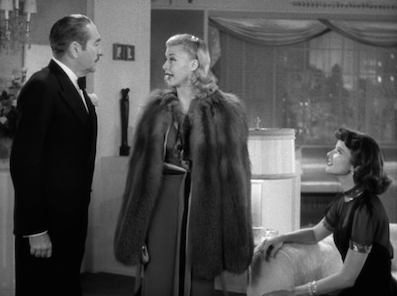

Terry fakes drunkenness and sexiness to keep Jean away from the predator, and it works.


Jean realizes he’s as worthless, creepy, and unfaithful as she initially thought, and leaves. The audience is grateful for Jean’s escape, having seen the disaster Powell leaves in his wake: poor Linda has nothing but trinkets in exchange for sexual favors–gifts not even sizable enough to get her out of that dorm. (How thin is her arrogance!) We know how short Jean’s casting-couch career would be after her favors, given that roving eye. The actress in the story with true talent (Kay) who doesn’t succumb to (and apparently was never offered) the producer’s embraces is literally starving as he puts off her auditions for his dalliances, and will soon reach an even sadder fate.

I kept thinking of Terry when the Weinstein revelations came out, not just because she was brave in the story, but because she could be. Of course, Terry too is the object of male manipulation. The only reason she’s up for a part is her father’s secret meddling (He’s finagled her starring role so that she’ll fail and realize she should come home and marry a rich boy like a good little girl. Nice support, huh?) Although she does have a disgustingly condescending father, Terry is safe. That money gives her power of her own, and she can afford to confront the Anthony Powells of this world. It’s really the lesson of the Weinstein story, isn’t it? Predators go after those with no power, so those with it have to be the ones to stand up. And not just men, but female stars, the Meryl Streeps, who have status of their own and can be immune from predators’ hushing machinations. Several media outlets have justifiably called out the male actors and directors who did nothing about Weinstein, and the employees, like that pal in Stage Door, who abetted the behavior. But I’m disappointed too in the prominent women, those who weren’t personally affected, but could have done something…and didn’t. (Streep claims she didn’t know; even if she didn’t, others with star power did.)

At first I thought that the sexual predator storyline and feminist response to it were from Edna Ferber, a friend of Hepburn’s and the original play’s cowriter. Ferber may have been inspired by memories from childhood, I reasoned. According to Janet Burstein, Ferber learned about men’s less pleasant side in her youth, when everyday wants meant she “had to run a gauntlet of anti-Semitic abuse from adult male loungers, perched on the iron railing at the corner of Main Street, who spat, called her names, and mocked her in Yiddish accents.” That disgust on Jean’s face when she spots the way Powell looks at her? Yeah, that’s written by an author who knows. But the play Ferber cowrote was completely redone for the screen by Morrie Ryskind and Anthony Veiller. And according to some sources, the movie’s verisimilitude has less to do with the screenwriters than with Gregory La Cava, who sought the stories of and the funny dialogue of the women he directed, and encouraged improvisation. But then again, the stories of such men were everywhere, then and now, and needed no writer to reveal the behavior. Anyone watching and listening–as La Cava apparently did–could hear and expose them.

I hope one day this film–and La Cava–get more credit for the kind of heroic feminism we see so rarely on the screen or in life. Eighty years ago, this film exposed the terrible repercussions of sexual predation, and instead of suggesting that victims should be blamed for not standing up–as even current headlines do–put the responsibility squarely on the man at fault. More, it gave a path for correction, by showing who could do something to fight back, and revealing the privilege that might blind him/her to what was really going on. How many films in the decades since have done the same?

Share
Posted in: 1930s films, Comedies (film), Drama (film), Feminism Tagged: classic film, films about sexual predators, Ginger Rogers, Harvey Weinstein, Katharine Hepburn, Louis C.K., Stage Door, the casting couch

Fabulous Fights: Ginger Rogers & Gail Patrick in Stage Door (1937)

01/31/2015 by leah@carygrantwonteatyou.com 19 Comments

PatrickRogers-shove
This post is part of Backlots’ 4th Annual Dueling Divas Blogathon. Check out the other entries!

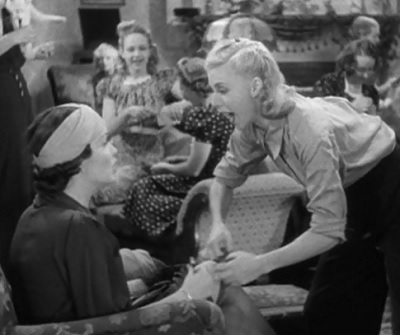
If you haven’t seen Jean (Ginger Rogers) squabble with Linda (Gail Patrick) in Stage Door, I envy you. It’s just such a pleasure. Three minutes into the movie, they are already at it: Jean thinks Linda has stolen her stockings—again—and she’ll forcibly remove them if she has to.

PatrickRogers-stockings-2
The two are roommates in the Footlights Club, a residence for aspiring stage performers, and their uncomfortably close quarters obviously are doing nothing for either’s temper. Linda denies the theft, calling Jean a “hoyden” and “guttersnipe.” Jean, sensitive to cracks about her class, says she’ll “slap [Linda’s] ears flat against the back of her head.” It takes the manager to prevent blows.

It’s the end of their relationship as roommates, but just the beginning of our enjoyment of their rivalry.

GingersRogersyellingupstairs
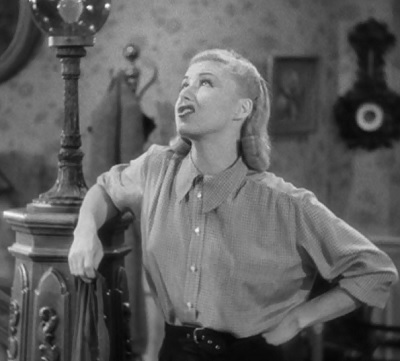
Jean particularly enjoys mocking Linda about her age and her lover, Anthony Powell (Adolphe Menjou).

“If you were a little more considerate of your elders,” Linda smirks to Jean, “maybe Mr. Powell would send his car for you someday….Course he would probably take one look at you and send you right back again. But then you’d have to expect that.”

“Oh, is that so?” Jean answers, imitating Linda’s superior tone.

“Do you know I think I could fix you up with Mr. Powell’s chauffeur?” Linda adds. “The chauffeur has a very nice car too.”

“Yes, but I understand that Mr. Powell’s chauffeur doesn’t go as far in his car as Mr. Powell does.”

“Even a chauffeur has to have an incentive,” says Linda.

“Well, you should know,” Jean snaps.

StageDoor-PatrickandRogers
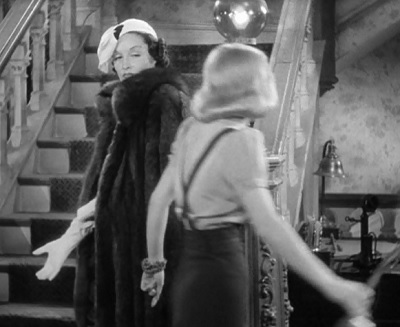
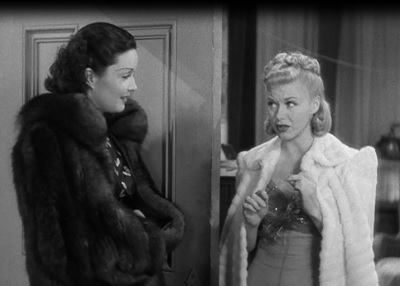
Although she judges Linda for sleeping with Powell, Jean still envies her for the rich food and garb her actions afford her. “Say, I think it’s very unselfish for those little animals to give up their lives to keep other animals warm,” she says, admiring Linda’s furs.

GingerRogersGailPatrickcoat
“You know they’re very smart little animals,” Linda answers. “They never give up their lives for the wrong people.”

“Well,” says Jean, “you understand the rodent family much better than I do.”

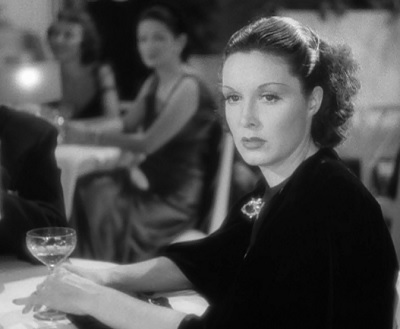
Unfortunately for Linda, Mr. Powell takes a liking to Jean, and hires her for a gig at his nightclub. Sitting next to her boyfriend, Linda realizes just whom he’s hired…

LindaSeesJean-GailPatrick
And Jean isn’t much happier to see her former roommate…

JeanseesLinda-GingerRogers
A few minutes later, Jean jabs at Linda with her cane, and the latter calls her “riffraff.”

Powell is curious about—but not put off by—Jean’s disinterest in him. “You don’t like me, do you?” he asks her.

“Oh, how could I help but like a man who takes his mother out to a nightclub,” coos Jean. “That was your mother you were sitting with?”

Jean decides to date him, even though he initially made her want to “run home and put on a tin overcoat.” How could she resist such revenge while getting a taste of the finer things in life?

AdviceGailPatrickGingerRogers
Linda tries to be philosophical about her lover’s betrayal, warning Jean it just better be temporary. “It’s one thing to borrow a friend’s friend,” she explains. “It’s another thing to hold him….”

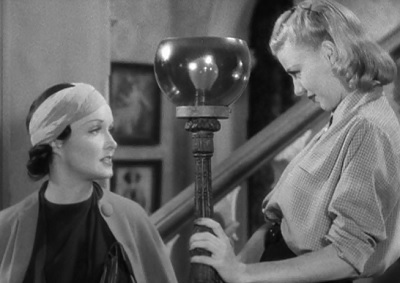
Linda even gives her former roommate some advice, which, of course, is intended to poison their first date. “May I come in?” she begins, entering her room.

“Oh sure, I guess you’ll be safe,” Jean says, “the exterminators won’t be here till tomorrow.”

“How did they miss you on their last visit?” Linda quips.

StageDoor-GailPatrickGingerRogers
“Must be galling to you older women to lose your meal ticket to younger riffraff,” gloats Jean.

“Just a leave of absence, dearie,” explains Linda, “and in the meantime, I have my lovely sable coat and my star sapphire to keep me company.”

“It’s lovely, but I’m afraid you paid too much for it.”

The dialogue gives you a taste of these two together, but I can’t capture the chemistry, or the sparkling delivery—Ginger Rogers, with her snappy sarcasm, at her tough-gal best. Gail Patrick, with the flawless cool customer routine she perfected the year before in My Man Godfrey. The two together are magnetic.

The best part? There’s another rivalry in the film too—between Rogers and Katharine Hepburn, which is almost as fun.

For more dueling divas, check out the other entries in the blogathon!

Share
Posted in: 1930s films, Blogathons, Comedies (film), Feminism, Humor Tagged: Divas, fights, Gail Patrick, Ginger Rogers, Stage Door, women

3 Classic Anti-Valentine’s Films for Sex and the City Fans

02/13/2014 by leah@carygrantwonteatyou.com 6 Comments

Single or attached, I’ve always loathed Valentine’s Day. When single, I’ve wondered why our couples-obsessed culture needs a day devoted to twosomes. When attached, I’ve pondered why I should celebrate en masse what’s supposed to be intimate. Therefore, my three recs today are for those who share my distaste for the day:

Female Bonding: Stage Door
For those who’d rather split a few bottles of wine with pals than brave pink-and-red-bedecked nightclubs this Friday, I recommend Stage Door, a film centered on women who live in an all-female boarding house as they try to make their big breaks on the stage.

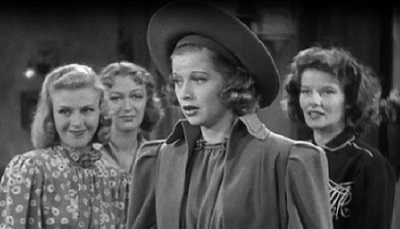
The heroines’ choice to remain single (and have casual boyfriends only) is celebrated rather than reviled by the film. If anything, the film mocks marriage. But don’t just view Stage Door (1937) for its politics; watch it to see the phenomenal cast interact: Ginger Rogers, Katharine Hepburn, Lucille Ball, Eve Arden. (The latter you may recognize as the principal in Grease; in her youth, she was always the smart-talking sidekick.)

Rogers, Arden, Ball, and Hepburn

Rogers, Arden, Ball, and Hepburn

The dialogue is so slick and cynical and quick that you’ll have a hard time keeping up with the one-liners, as when wealthy Terry’s (Katharine Hepburn’s) haughty tone annoys her impoverished fellow residents. Jean (Ginger Rogers) is not one to let an insult slide. When Terry snootily states, “Unfortunately, I learned to speak English correctly,” Jean fires back, “That won’t be of much use to you here. We all talk pig Latin.”

While the more famous classic movie about female friendships, The Women (1939), favors marriage with unfaithful partners over relationships with backbiting friends, this feminist flick celebrates the humor and loyalty between single women. In fact, I would argue that Stage Door’s women are in some ways more liberated than those in Sex and the City. Watch and see if you agree.

More of a feminist: Jean Maitland or Carrie Bradshaw? (Ginger Rogers & Sarah Jessica Parker)

More of a feminist: Jean or Carrie?


Revenge as Art:  Gilda
I enjoyed Samantha Jones’s (Kim Cattrall’s) revenge on boyfriend Richard Wright for his infidelity in Sex and the City: the dirty martini in his face, the papering of the city with posters describing his behavior.

Samantha in revenge mode

Samantha in revenge mode

But this kind of takedown is kitten play compared to the work of Rita Hayworth in Gilda.

Gilda, who calls herself the "Bar Nothing," and her spiritual descendant, Samantha Jones

Gilda, the “Bar Nothing,” and her spiritual descendant, Sam

Like Samantha, Gilda (Hayworth) is in full command of her sexuality; it’s not difficult to discover why this WW II pinup was dubbed “The Love Goddess.” But her treatment of her ex, Johnny, is far more ruthless than her modern counterpart’s. First, she marries Johnny’s boss; then, she flaunts her affairs with other men to torment him further.

Gilda (Hayworth) torturing her ex

Gilda (Hayworth) torturing her ex

Gilda is so skillful a manipulator that you root for her to get what she wants, even if the ex she desires is no prize (and no mean manipulator himself).

Here’s an anti-Valentine’s Day conversation if ever there were one:

Gilda: “Would it interest you to know how much I hate you, Johnny?”
Johnny: “Very much.”
Gilda: “I hate you so much I would destroy myself to take you down with me.”

I think Samantha would be impressed.

Exploiting Men: Baby Face
In an early episode of Sex and the City, “The Power of Female Sex,” Carrie’s fling has left a tip on her bedside table and she’s feeling ill at ease with the implications. The four friends discuss whether it’s ever acceptable to use your sexuality to get ahead. Barbara Stanwyck’s character in Baby Face (1933) has no such qualms: She leaves her hometown for NYC with the aim of doing just that.

The shocks accumulate quickly as you watch Baby Face: Lily’s (Stanwyck’s) father has been prostituting her since she was fourteen. A grandfatherly figure in her dad’s speakeasy recommends she leave home to sexually exploit men for personal gain, quoting Nietzsche to back his case.  Once in New York, Lily takes quick steps to follow his advice, seducing the HR assistant in a bank to get a job, and then sleeping her way floor by floor to the top. (The camera helpfully pans up to highlight each floor as she ascends.)

Lily (Stanwyck) on the make

Lily (Stanwyck) on the make

You might expect the movie to make the heroine suffer for her behavior, given the date of this film, but she is unmoved by the heartbreak and eventual tragedy she leaves in her wake (among her victims is a smitten John Wayne). Men have used her all her life. Lily figures it’s her turn, and the film clearly sympathizes with her reasoning. She calmly goes about her business of seducing men, accumulating jewels and bonds, and sharing her successes with her best friend, Chico (Theresa Harris).

Chico and Lily admiring another woman’s wealth before Lily starts to advance

Chico and Lily scheming

Here’s a typical exchange with a discarded lover who stops by Lily’s apartment:

Ex-Lover: “It’s been brutal not seeing you.”
Lily: “Yeah, well you better get used to it.”

When he returns and offers marriage, Lily answers, “So you want to marry me, huh? Isn’t that beautiful. Get out of here….”

Lily's reaction to a marriage proposal from a discarded lover

Lily’s reaction to a marriage proposal from a discarded lover

This is a strange film with a number of flaws, but you won’t care; it’s too much fun to watch this predator in action. (Be sure to watch the pre-release version; it’s much better.)

What are your favorite anti-Valentine’s films?

Share
Posted in: 1930s films, 1940s films, Anti-Romance films, Comedies (film), Drama (film), Feminism, Film Noir/Crime/Thriller & Mystery, Humor, TV & Pop Culture Tagged: Carrie Bradshaw, Gilda, Samantha Jones, Sarah Jessica Parker, Sex and the City, Stage Door

Recent Posts

  • 100 Years Later, Still Scary: Dr. Caligari
  • Escaping Out of the Past (1947)
  • A Weeper for Those Who Love Jerks
  • Thank You, Academy, for Not Infuriating Me
  • Challengers (2024) Is a Bad Movie

Subscribe to Blog via Email

Enter your email address to subscribe to this blog and receive notifications of new posts by email.

Categories

  • 1920s films
  • 1930s films
  • 1940s films
  • 1950s films
  • 1960s films
  • 1970s films
  • 1980s films
  • 1990-current films
  • 2020s films
  • Action & Sports Films
  • Anti-Romance films
  • Blogathons
  • Childfree
  • Comedies (film)
  • Drama (film)
  • Feminism
  • Femme fatales
  • Film Noir/Crime/Thriller & Mystery
  • Gloriously Silly Scenes
  • Horror
  • Humor
  • Mae West Moments
  • Musicals and dancing films
  • Oscars
  • Random
  • Romance (films)
  • Romantic Comedies (film)
  • The Moment I Fell for
  • Turn My Sister into Classic Movie Fan
  • TV & Pop Culture
  • Uncategorized
Share
Classic Movie Blog Hub Member

Recent Comments

  • leah@carygrantwonteatyou.com on Meg Ryan’s Fate Foretold in Joe Versus the Volcano
  • Ryan on Meg Ryan’s Fate Foretold in Joe Versus the Volcano
  • leah@carygrantwonteatyou.com on 100 Years Later, Still Scary: Dr. Caligari
  • The Classic Movie Muse on 100 Years Later, Still Scary: Dr. Caligari
  • leah@carygrantwonteatyou.com on 100 Years Later, Still Scary: Dr. Caligari

Archives

  • November 2025
  • September 2025
  • May 2025
  • March 2025
  • January 2025
  • November 2024
  • August 2024
  • July 2024
  • May 2024
  • March 2024
  • February 2024
  • December 2023
  • November 2023
  • October 2023
  • September 2023
  • August 2023
  • July 2023
  • May 2023
  • April 2023
  • March 2023
  • January 2023
  • December 2022
  • November 2022
  • September 2022
  • July 2022
  • May 2022
  • April 2022
  • March 2022
  • February 2022
  • October 2021
  • September 2021
  • April 2021
  • March 2021
  • February 2021
  • December 2020
  • October 2020
  • September 2020
  • July 2020
  • May 2020
  • April 2020
  • March 2020
  • February 2020
  • December 2019
  • October 2019
  • September 2019
  • June 2019
  • May 2019
  • April 2019
  • February 2019
  • January 2019
  • November 2018
  • September 2018
  • July 2018
  • June 2018
  • May 2018
  • April 2018
  • March 2018
  • February 2018
  • January 2018
  • November 2017
  • September 2017
  • August 2017
  • July 2017
  • June 2017
  • May 2017
  • April 2017
  • March 2017
  • February 2017
  • January 2017
  • December 2016
  • November 2016
  • October 2016
  • August 2016
  • July 2016
  • June 2016
  • May 2016
  • April 2016
  • March 2016
  • February 2016
  • January 2016
  • December 2015
  • November 2015
  • October 2015
  • September 2015
  • August 2015
  • July 2015
  • June 2015
  • May 2015
  • April 2015
  • March 2015
  • February 2015
  • January 2015
  • December 2014
  • November 2014
  • October 2014
  • September 2014
  • August 2014
  • July 2014
  • June 2014
  • May 2014
  • April 2014
  • March 2014
  • February 2014
  • January 2014

Meta

  • Log in
  • Entries feed
  • Comments feed
  • WordPress.org

Copyright © 2025 Cary Grant Won't Eat You.

Church WordPress Theme by themehall.com