Cary Grant Won't Eat You

Classic movies for phobics

  • About
  • eBooks
  • Previous Blogathons
Classic movies for phobics

review

Happy Birthday to Classic Film’s Cupid, Charles Coburn

06/19/2017 by leah@carygrantwonteatyou.com 6 Comments


Today you need to embrace your love, ask out that crush, comfort your lovelorn friend, or play matchmaker yourself.

Why?

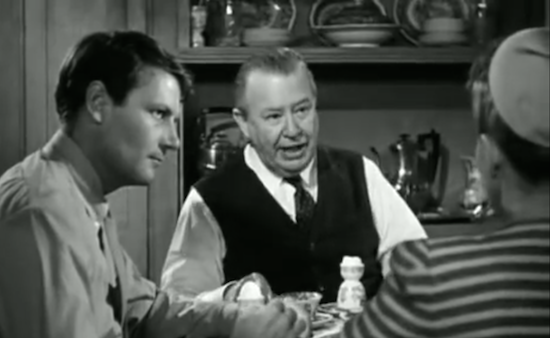
Because it’s Charles Coburn’s birthday. You know: the warm uncle/grandfather/parent type who plays the part of wing man, aiding couples in love. A Coburn character is the friend/relative you’ve always wanted, his cool common sense cutting through the neuroses, doubts, and faults that jeopardize a blooming love match or hinder an existing one. With such a friend, the couples always head to matrimony, or find new reasons to appreciate the spouses they have. So be a little kinder to those you love–or hope to love–today. In Coburn’s honor.

Share
Posted in: 1940s films, Random, Romantic Comedies (film) Tagged: best wingman in film, Charles Coburn, classic movie cupid, Heaven Can Wait, review, romantic sidekick, The More the Merrier, Together Again

Jack Lemmon & Restraint

03/31/2017 by leah@carygrantwonteatyou.com 8 Comments


Of course I’ve been dying to see The Fortune Cookie (1966). Who wouldn’t want to view the first pairing of Jack Lemmon and Walter Matthau, the two whose seamless chemistry led to almost 30 years of hilarious cinematic repartee?

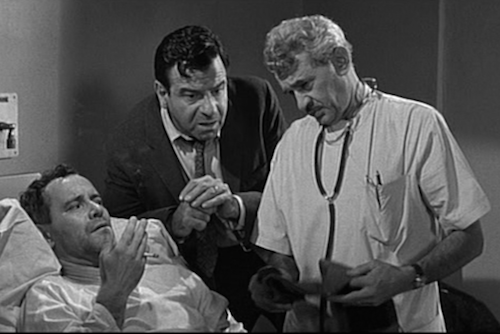
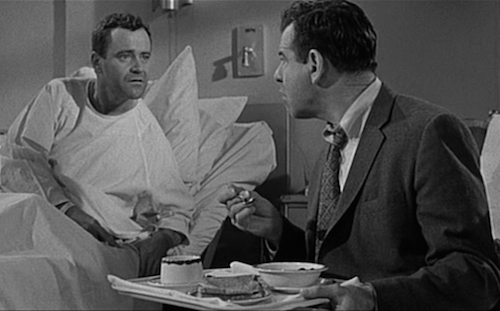
Matthau won his only (!) Oscar for the role of Willie Gingrich, an ambulance chaser who capitalizes when his brother-in-law, sports cameraman Harry Hinkle (Lemmon), gets injured by a football star running a play. Look at the people Gingrich can sue! The TV station! the Cleveland Browns! Of course, Hinkle was barely hurt, but an old injury might appear new, and thus enriching. If only Gingrich can get his brother-in-law to go along, he’ll be a millionaire! Of course, there are obstacles: his brother-in-law’s stupid scruples, for example, are holding up the path to gold.


Luckily, Gingrich has an ace up his sleeve: Hinkle never got over his ex-wife, Sandy (Judi West), and she’s an anxious for the dough as Gingrich is.

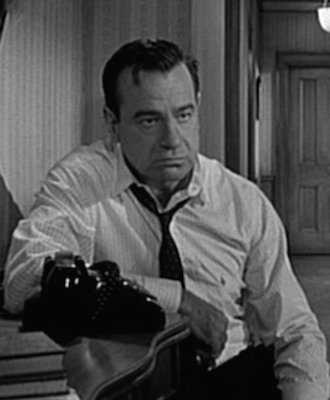
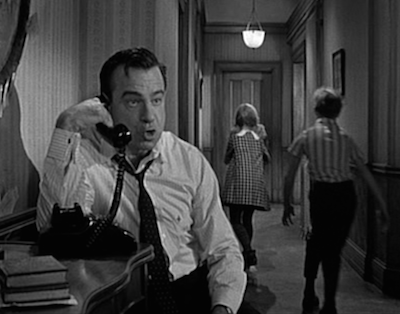
Gingrich is a magical character, a monstrous anti-hero whose avarice is fascinating to witness. He’s Saul Goodman with an even darker sense of humor. I particularly love when he calls Sandy, saying he’s glad to have her as part of the “organization” conning the Browns (not to mention fooling her ex with fake affection). His children interrupt the call, prompting Gingrich to yell out (with a straight face), “Why don’t you kids go play on the freeway?”

Gingrich’s reaction to love getting in the way of profit is typical of him:


His hope to avoid his kids is displayed from the start of the film; his face dims when they’re present, but glows when opportunity arises. He’s only animated when they skate away:


With Gingrich on the screen, you can’t look away, and he’s in nearly every scene. Why he was considered “supporting” and Lemmon the star is one of those mysteries of Oscar nominations no one outside of the industry ever understands.

In terms of plot, not much else happens. Hinkle agrees to fake a grave injury to win back his wife, who pretends better motives for her return in order to get at the money. ‘Boom Boom’ Jackson (Ron Rich), the player who hit Hinkle, slowly falls to pieces about what he thinks he’s done, to Gingrich’s delight (verisimilitude!) and Hinkle’s growing horror. What happens by the end of the movie, most viewers could predict, but given that Billy Wilder is the director and cowriter (with I.A.L. Diamond), there are wonderful twists along the way.

What’s notable about Lemmon’s performance is its generosity. Lemmon can play, often did play, a ham. His first Oscar, over a decade before, was for his scene-stealing, exuberant character in Mister Roberts. Yet here he is, ceding every scene to Matthau, and letting the latter’s role glitter just enough for his supporting Oscar. A less confident, thoughtful, or serious actor would have made Hinkle showier. But not Lemmon. When Hinkle finally stands up to Gingrich, we do see the dam of the character’s (and Lemmon’s) restraint burst, but only briefly, and even then, the goofiness pales in comparison to Matthau’s darkly funny turn as Gingrich. And as we all know, Lemmon only pales when he feels like it. Hinkle’s character is a subdued, passive one, and Lemmon never forgets it.

When I decided to join the Lemmon blogathon hosted by Crítica Retrô and Wide Screen World, I wondered which Lemmon I would see in The Fortune Cookie: the desperate and dark type he captures in Glenglarry Glen Ross, but this time played for humor? The sarcasm he spins in The Out of Towners? The nearly shrill silliness of his role in Some Like It Hot? How many actors has Lemmon been, just as a comedian?

Given how fun his banter typically is with Matthau, I expected to see the two out-goofing one another here. But I find it charming to discover something else: a realism to their dynamic, a sort of half-tolerant contempt that rings true for two characters joined by a marriage rather than by love or blood. A willingness (in real life) for one artist to help out another—in this case, Lemmon aiding Matthau with his one and only Oscar win. Their dynamic is definitely less fun than at the height of their powers in the wonderful Grumpy Old Men. Yet there’s something sublimely sweet about where it all started, and–though I didn’t think it possible–that makes me love Lemmon all the more.

For wonderful tributes and analyses of Lemmon’s work, check out the Jack Lemmon blogathon hosted by Le at Crítica Retrô and Rich of Wide Screen World.

Share
Posted in: 1960s films, Blogathons, Comedies (film) Tagged: ambulance chaser movie, Billy Wilder, characters like Saul Goodman, first film with Matthau and Lemmon, Jack Lemmon, review, The Fortune Cookie (1966), Walter Matthau

Airplane!: The Joy of Recognizing Classic Movie References

03/11/2017 by leah@carygrantwonteatyou.com 2 Comments

**Spoilers about George Gipp ahead**

The other day I was watching Airplane! with some friends. For the first time, I caught that the film includes a hilarious spoof of Knute Rockne’s “Win One for the Gipper” speech, that speech leaders of underdogs everywhere like to imitate. Popularized by Knute Rockne-All American (1940), the speech was given by the famous Notre Dame football coach when his team was losing against Army in 1928. In the speech he references his former player, George Gipp, the National Football Hall of Famer who died tragically in his mid-twenties. Pat O’Brien plays Rockne beautifully in the movie, capturing some of the cadence of his words, and using understated sadness where another would have gone for drama. Eight years after his famous player’s death, Rockne discusses Gipp’s last words with his losing team (in real life, and in the film):

“I’m going to tell you something I’ve kept to myself for years,” says Rockne (O’Brien). “None of you ever knew George Gipp (Ronald Reagan). It was long before your time. But you know what a tradition he is at Notre Dame… And the last thing he said to me: ‘Rock,’ he said ‘sometime, when the team is up against it — and the breaks are beating the boys — tell them to go out there with all they got and win just one for the Gipper…’ I don’t know where I’ll be then, Rock,’ he said – ‘but I’ll know about it – and I’ll be happy.'”

Of course, the team wins, and history is made.

Ronald Reagan’s deathbed scene in the film, of course, meant he was associated with the name George Gipp, as different as they were. Gipp, phenomenally talented as a football player, was very modest about his accomplishments. He was an interesting man, too: actually preferred another sport, spent time gambling with out-of-towners who thought South Bend hicks could never beat them (afterward secretly giving his winnings to charity). Always, Gipp displayed an allergy to limelight.

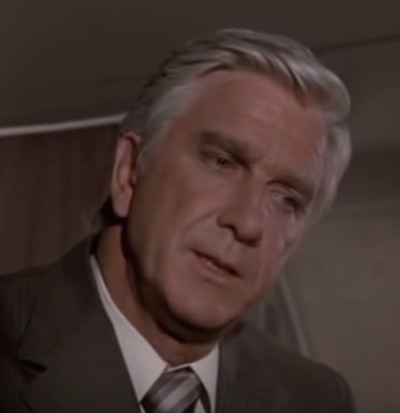
Once I learned Gipp’s true story, I became horrified that Reagan’s presidency had turned Gipp’s legacy into a promotion campaign. Of course, Airplane! (1980) would capitalize on the humor of this discrepancy. The movie came out before Ronald Reagan’s first White House term, but the politician had made two runs for the Republican nomination before getting it in 1980; there are digs on his acting in the film. And then the perfect parody: In a moment when Ted Striker (Robert Hays) is despairing about his poor chances of landing the plane, with death certain for all if he doesn’t, in comes Dr. Rumack-Don’t-Call-Me-Shirley (Leslie Nielsen) to give Striker a hilarious pep talk. Almost word for word, it’s Rockne’s speech. Nielsen even captures the coach’s understated style. To give a football speech in such a moment is very tacky–in even more ways that most viewers might suspect: Rockne died in a plane crash. Screenwriters Jim Abrahams, David Zucker, and Jerry Zucker capture inappropriate uses of Gipp’s name and of his coach’s tribute by using both inappropriately in their own film.

But I wasn’t thinking of any of those details as I watched. What I felt was a thrill, that delightful shock of recognition every classic film fan feels when she sees or hears a reference to an old favorite. And I didn’t think it was possible, but Airplane! is even funnier than I thought. How marvelous.

Share
Posted in: 1940s films, 1980s films, Action & Sports Films, Comedies (film), Drama (film), Humor, TV & Pop Culture Tagged: Airplane!, Film, George Gipp, Knute Rockne, Knute Rockne: All American, Leslie Nielsen, review, Ronald Reagan, Win One for the Gipper

The Odd Stew of Designing Woman

12/16/2016 by leah@carygrantwonteatyou.com 14 Comments


It’s surprising the screenplay for Designing Woman (1957) won George Wells an Oscar, given its strange stew of marital conflict, mob threats, brain damage, fashion, and acrobatic fight moves. But there is a cleverness to it, and some insights about marriage one doesn’t usually get in a comedy. So while not exactly an amazingly tasty stew, it’s curious enough in flavor to keep you watching, and the fourth-wall-breaking format leads to moments of humor throughout, especially through the thoughts of the ex-girlfriend.

Of course, being a fan of complex heroines, I hoped Designing Woman would have a double meaning, that Lauren Bacall’s fashion designer bride had sneaky moves up her perfectly tailored sleeves. Alas, no such luck. Marilla (Bacall) is a sophisticated businesswoman, but traditional when it comes to her sports reporter husband, Mike (Gregory Peck). The two have married after a very short affair, and much of the story hinges around his utterly unnecessary concealment of a former flame, Lori (Dolores Gray), and Marilla’s anxiety about it. The couple is so prickly over this conflict that they endanger Mike’s life as he hides from the mob. (Mike, it seems, is more truthful in reporting than in life, and has ticked off a boxing fixer with mob ties.)

So here are my thoughts on the memorable moments of this Vincente Minnelli-helmed comedy: the flavorful additions, the questionable spices, the discordant ingredient that nearly destroys the whole, and a wonderful final pinch of flavor.

The Flavorful Moments
Confession to the Ex
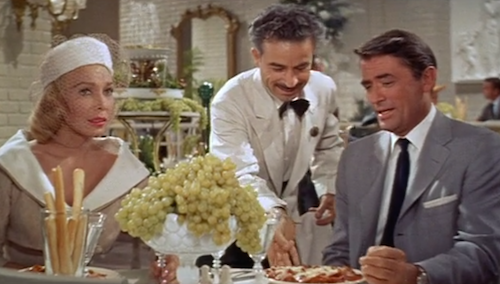
Mike’s former girlfriend, Lori (Dolores Gray), adds wonderful comedy to the plot, which has gotten a little too sweet in the opening meet-cute aftermath. Mike keeps not getting around to breaking his marriage to her, and she, sharing her reflections with us, reveals, “He was so pathetic I had to help him out.” She generously delivers the breakup news, and then adds a jab he completely misses: “I’d have probably done the same thing myself if I’d found the right man.”

After she relieves him from hurting her feelings, she observes him to be as “grateful as a Saint Bernard.” Her initial euphoria over her own maturity and strength soon dissolves: “But then I made a mistake. I asked him to tell me about her, and he made a bigger mistake, he told me.”


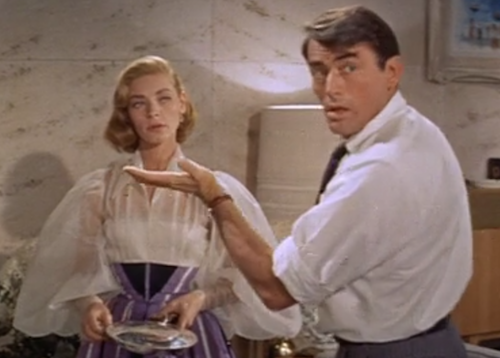
Rolling her eyes, she listens: “I heard all about her eyes, and her hair and her figure….I heard all about her fine sense of humor, and her clothes, and the cute way she had of tilting her head when she laughed….After a while I knew her like a sister.” And of course, she gets a thoroughly justified revenge with a strategic placement of his ravioli plate.

Party Scenes
The movie highlights the divisions between this high-class business leader and her working-class husband in various ways, most successfully with their apartments: his small and messy; hers refined, large, and including what he calls an “outside flunky.” Before he’s had time to look around his new place, all her friends arrive and rush her, barely registering his presence as he tries to excuse the embarrassingly short pants he’s wearing (his own being smeared with ravioli). Even when he leaves the room to change and returns, her distracted friends ignore him. And she is oblivious to his annoyance and embarrassment as she dons and then leaves behind his handsome form. The scene is perfectly orchestrated to reveal his disconnection and loneliness, and the way she’s suddenly made him feel alienated and extraneous in his own home and marriage.

In the aftermath, she’s dismissive of her career to soothe his ego, the embodiment of a bride worried about losing her new man. Luckily, she’s humbled herself enough to ease his insecurity (sigh, at least she doesn’t give up the career). The later party scene, with her rehearsal and his poker game colliding, is so cacophonous it’s actually hard to watch, but perfectly captures just how unalike their work lives are. Both of them are occasionally petty and jealous as they try to navigate in one another’s worlds, and yet come back together through their feelings for one another. The movie never suggests this union will be easy, and there’s something refreshing about that, and–unlike many romantic comedies–very honest.

The Fight Scene
The hilarious antics of the final fight scene make for good comedy. It’s well orchestrated, especially a brilliant final touch (see below). In a favorite moment, Mike observes that his wife doesn’t know how to help, as she can’t identify who is on Mike’s side, and who is not. I loved this reflection, as it echoes my reaction to every bad action sequence I’ve seen in the past decade. I so often can’t tell characters apart once the fists or legs start flying.

The Rotten
I don’t expect PC treatment of subject matter in my 50s films, but usually, I can cringe a bit at unfortunate touches and move on. Unfortunately, much of the comedy of Designing Woman hinges around making fun of a former boxer’s brain damage. Yes, you read that correctly. Maxie (Mickey Shaughnessy) is tasked with protecting Mike from the mob, but can never quite figure out what town he’s in, or what it is he’s supposed to do. Mike is by turns exasperated with him and condescending toward him. Marilla’s not much better, and sometimes worse. Mickey Shaughnessy’s performance is, unfortunately, often convincing, making his character’s brain damage poignant when the actor’s going for funny. The only way to enjoy this comedy is to block out whenever he’s on the screen, which is often.

The Brilliant Final Touch
Early in the film, in a typical bro kind of way, Mike objects to the effeminate dancing style of Marilla’s friend and colleague, musical director Randy (Jack Cole). You can just hear the homophobic chains in Mike’s mind churning as he watches those fluid, flamboyant movements, even before he imitates him to Marilla. But when the mob is beating up Mike and his friends, Randy appears and starts taking out half of them with his dance moves. I haven’t seen dance fighting this fun since Kevin Bacon’s in Footloose.

https://carygrantwonteatyou.com/wp-content/uploads/2016/12/DesigningWomanClips.mp4

It’s in this moment of brilliance that you know Minnelli’s at the helm, and you’re so glad. I only wish we’d  seen more such flourishes of his style because I could watch that clip over and over again. There, as elsewhere, I was more interested in the musical Marilla was designing for, than the marriage she was trying to save. The problem is, I think Minnelli was too. Luckily, there’s enough of the lovely costumes (and how Bacall wears them), enough of the self-absorption of those running the musical (who find the mob fight merely distracting) to intrigue and entertain. And of course, you can always rewatch Randy….

Hope you’ll enjoy the many other contributions to this Minnelli blogathon hosted by the marvelous Michaela of Love Letters to Old Hollywood.

Share
Posted in: 1950s films, Comedies (film), Musicals and dancing films, Romantic Comedies (film) Tagged: Designing Woman, Gregory Peck, Lauren Bacall, review, Vincente Minnelli films

Goin’ to Town: Feel-Good Classic

12/10/2016 by leah@carygrantwonteatyou.com Leave a Comment


How do you explain the joy of Mae West after a long hiatus? I’ve saved Goin’ to Town for a rough day, and it had the hoped-for effect. I may not get everything in my life right, but I have an instinct for good medicine: Mae had me grinning within seconds.

Cleo (West) first appears in an embrace with a guy we know isn’t the boyfriend obsessed with her. She’s, of course, some kind of dance hall singer. We see the boyfriend asking for her, and then the film cuts to the guy she’s kissing:

Lover: “Now I’d like to take you away from all this.”

Cleo: “All this? Oh, I get you. Yeah, for a long time I was ashamed of the way I live.”

Lover: “You mean to say you reformed?”

Cleo: “No, I got over bein’ ashamed.”

(Spoilers) West wasn’t exactly a fan of realistic plots, but this one is a doozy: Cleo’s boyfriend has promised her an oil ranch after they marry, and seemingly within minutes is dead, and the ranch hers. (“Well, that’ll help pay for my feelings.”) She falls for a British high-class type who runs her oil fields, and shoots off his hat and lassoes him to express her attraction (her definition of “coaxing”). He doesn’t think she’s classy enough, so she heads to Buenos Aires to buy her way into society and impress this snob.

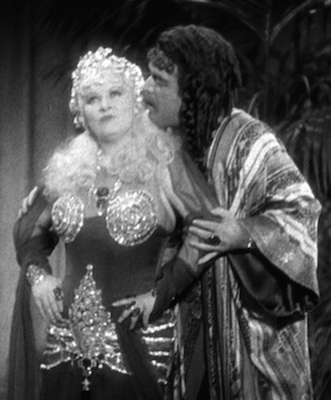
Entrée into society, in West’s world, includes winning a horse race and performing as an unlikely soprano in a Samson and Delilah opera. Her outfit in the latter, with sequins highlighting breasts and hips, is hilariously provocative, seeming to confirm her scandalous background rather than winning respect from the elite.


The elite, of course, are so worthless in this film—including her boring object of desire, Edward Carrington (Paul Cavanagh)—that Cleo’s fight for status, even going so far as a marriage of convenience to well-born Fletcher Colton (Monroe Owsley), makes little sense. Of course, even in this conventional, post-Code desire to set aside a colorful past, West subverts the screenplay formula: Cleo’s utterly unashamed of hers:

Socialite: “Speaking of relatives, Mrs. Colton, have your ancestors ever been traced?

Cleo: “Well, yes, but they were too smart, they couldn’t catch ’em.”

Critics, both West’s contemporaries and ours, attack the film’s silliness, her toned-down innuendos, the reduced number of her beaus. It’s not West at her peak, they say. Low on the list of West films, they report. Something’s lost, they carp. You know what? Get over it. The film’s fun, and her victorious final song a riot. While West’s magic in She Done Him Wrong might be enough to fuel a steam engine, I’ll take enough to fuel a car. It’s still West. It’s still entertaining. The plot moves at a crazy clip, so just when you fear a sad/dramatic plot twist is going to overtake the action, poof! It’s gone. And in the meantime, you get enough of her slow stroll, enough hilarious comments, and enough silliness to break through a day’s doldrums, and make  you smile again.

Share
Posted in: 1930s films, Comedies (film), Feminism, Mae West Moments Tagged: comedies, feel-good movie, Goin' to Town, Mae West, review

In Defense of Netflix: Jessica Jones & OITNB

08/18/2016 by leah@carygrantwonteatyou.com 10 Comments

I’ve been flirting with dumping Netflix for some time: That terrible customer service debacle a few years back. The fact that despite their extensive classic movie DVD library, their classic movie streaming choices are tired, and frequently movie-of-the-week bad. The prices I have to pay to watch two of my favorite current shows–Veep and The Americans–elsewhere.

But Netflix retains me with the television fare they DO have. Many of my beloved comedies still play there, including Psych (yes, I embrace my juvenile side) and It’s Always Sunny (which I would argue had the best satires on both gun control arguments and our treatment of the mentally ill in recent seasons). And then there are its foreign TV shows, which are fascinating and frequently feminist, as with Miss Fisher’s Murder Mysteries.

So do I stay, or do I go?

My flirtation ended last night. My loyalty is secured. Orange Is the New Black‘s season 4 finale was not only brilliant, but important. The final images from that and the penultimate show are lingering, as riveting stories do, helping me recognize nuances I missed on the first pass. I’m not sure whether Netflix execs are enlightened, or its creators masters of spin, but either way, I don’t care: Marvel’s Jessica Jones and OITNB had more to say about rape culture and racism, respectively, than almost anything else I’ve read or watched in the last few years.

Marvel’s Jessica Jones

JessicaJones
Let’s start with Jessica. The weird thing is that I watched the show at all. I have never bought a comic book. My 80s nostalgia for the Hulk and Wonder Woman notwithstanding, I have little interest in comics, graphic novels, anime, video games, or superhero stories.

I’d never heard of Jessica Jones, and wasn’t impressed by her dull name (this from a Williams, but I digress). The ads and reviews, however, kept saying noir, catnip to the classic movie fan, so yes, I gave it a try.

How to explain it? More eloquent voices have already chimed in on its influence, so I’ll just say that its portrayal of the aftermath of rape was devastating. The show captures the heroine (and victim’s) trauma and the insidious reactions of others around her to it: The lack of belief in what happened to her. The ignorant assumptions that a domestic violence victim can easily leave his/her abuser. The belief of the monstrous villain that she could love him. The wider society’s privileging of his viewpoint over hers. The terrifying use of smiling, and all it implies about how women are treated.

The intensity and darkness of the show are lightened by Jessica’s (Krysten Ritter’s) snarky sarcasm and wit. She is, indeed, like the noir private investigators before her.

Fascinatingly, the show uses enough of its superhero trappings (and is so suspenseful) that you don’t realize how thoroughly it’s portraying its message until you mull on it afterward. And how moving that message is: that the victim who fights for others like her is as superheroic as they come.

Orange Is the New Black, Season 4

OITNB
The diverse cast alone is reason to watch: when else will you see women of so many shapes, sizes, colors, ethnicities in starring roles? Forget the main character, Piper. She’s just there as an introduction, and functions only to remind us that white privilege doesn’t die behind prison doors. By focusing on a minimum security prison, with inmates often there for foolish, momentary (and sadly frequently, bad romantic) choices, the show enables us to put ourselves in the women’s place. And once there, we are hooked on their stories, soon relating even to those who have committed grave crimes.

Previous seasons focus on other villains, but this season firmly placed the private prison system in its crosshairs, to devastating effect. People argue whether this show is a comedy or drama (when it’s of course both), but the drama definitely trumps this season, the comedy only there to relieve it. Jenji Kohan, the show’s creator, clearly wanted to indict the immorality of this privatization, and how it furthers the prejudice already inherent in the prison system. At first I thought the primary focus was on our criminalization of mental illness, and indeed, that is one of the saddest arcs of the season. But ultimately, the focus is on race: how it affects the corrections officers’ actions, how even well-meaning white prisoners (and by extension, the wider society) miss the significance of Black Lives Matter. I don’t think you can miss that significance after watching Season 4. Of course, you can’t fully feel the season’s impact if you haven’t fallen for the show and its characters over Seasons 1-3. But that just means you have more good material in front of you….

Are either of the shows perfect? No. But the flaws don’t take away from what they’re accomplishing in terms of messages and storytelling.

Of course, it’s possible Netflix will later lose its way. But while these are its choices for original programming, they’ve got me.


**Note: the Justice Dept. just said they’d end the use of private prisons.

Share
Posted in: Feminism, Film Noir/Crime/Thriller & Mystery, TV & Pop Culture, Uncategorized Tagged: Black Lives Matter, critiques, feminism, Jessica Jones, Marvel, Netflix original programming, OITNB, Orange Is the New Black, race, rape culture, review, Season 4, TV

Sympathetic Liars: The Book of Mormon & Beat the Devil

06/26/2016 by leah@carygrantwonteatyou.com 2 Comments

BeattheDevil-JenniferJones
Kooky. Bizarre. Silly. Odd. Original. It’s difficult to sum up the strange charm of Beat the Devil (1953), that Truman Capote-penned film* that fits no genre and makes no sense. You have the feeling as you watch that Capote must have been tripping, but his quirky personality, not to mention the strange antics that took place on the set–arm wrestling competitions between him and Humphrey Bogart, celebrity drop-ins who dictated costuming, etc.–may do something to explain its odd mishmash of mystery, comedy, and social commentary. I’ve never been a fan of Jennifer Jones, but she won me here as Mrs. Gwendolen Chelm, a seemingly ordinary wife who has the imagination of Capote, and no compunction about confusing her fantasies with reality. She is truly the director of the show. Just ask this question: “What would a film be like if a compulsive, whimsical fantasist got to rule the plot?” Your answer is Beat the Devil.

The film’s heroine reminds me of Arnold from the hilarious musical The Book of Mormon, and his twisting of the Mormon faith to convert Ugandans. (Minor spoiler: If you haven’t seen it, Elder Arnold Cunningham adds Boba Fett and some unfortunate AIDS-curing frogs to his faith’s origin story.) While an everyday liar provides little narrative interest, Chelm’s degree of imagination, as with Wes Anderson’s many heroes, seems to color the world with such an enormous brush that it’s hard not to become enthralled by her, as Bogart’s character is throughout Beat the Devil.

I dare not attempt to explain the plot to you, what little there is of one. It’s better if you simply start watching and see where it takes you. That’s clearly what Capote intended, and as any casual reader of his life knows, hanging out with Capote on a boring, rainy Sunday was probably thrilling. Watch the film. It’s as close to experiencing the mind of that fascinating socializer and entertainer, that creator of world-famous parties and disastrous scandals, as any of us are now likely to get.

*According to Gerald Clarke, Truman’s biographer, John Huston’s screenplay contribution was probably negligible.

Share
Posted in: 1950s films, Comedies (film), Film Noir/Crime/Thriller & Mystery, Humor, TV & Pop Culture Tagged: Arnold Cunningham, Beat the Devil, compulsive liars on film, Film, Jennifer Jones, review, The Book of Mormon, Truman Capote

The Dark Humor of High Noon (1952)

06/12/2016 by leah@carygrantwonteatyou.com 6 Comments

HighNoon
**Contains spoilers**

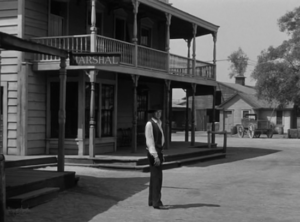
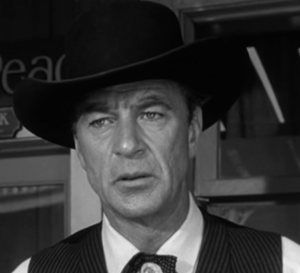
When I watched High Noon many years ago, I was struck by its pacing, its intensity, its seriousness. This time, I kept laughing. There’s something comic about watching Marshal Will Kane (Gary Cooper) aimlessly tread around the town, waiting for someone, anyone to assist him. I found myself curious (having forgotten most of the details) not whether he’d find aid, but just what methods of bailing on responsibility his fellow townspeople would employ.

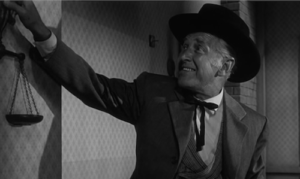
The judge (Otto Kruger) is, of course, is my favorite. Having passed sentence on Frank Miller (Ian MacDonald), a killer who has now been freed and is headed to town for revenge, the judge opts for exiting pronto. He tells Kane, the marshal who caught Miller, to do the same. His advice is a cynical history lesson about how little one can rely on civilian ethics when danger is afoot–an account of Athenians who welcomed a tyrant they’d once banished, and watched as he executed their government; an incident much like one that recently occurred in a nearby town. The judge shares these accounts as he casually packs away his flag and scales of justice.

ScalesofJusticeOttoKruger
His assessment about the value of the people he’s leaving to the mercy of an outlaw is almost as breathtakingly cold as the clock speech in The Third Man: “This is just a dirty little village in the middle of nowhere. Nothing that happens here is really important. Now get out.” The former marshal (Lon Chaney, Jr.), Kane’s mentor, is likewise a ray of light: “People got to talk themselves into law and order..down deep, they don’t care. They just don’t care.” Poor Kane is asking for just a bit of support before he takes on a posse, and these are his cheerleaders.

Of course, it’s hard not to love Kane, even as you wonder whether there’s a better way to overcome Miller than the one he’s devised (i.e., shoot it out).

Cooper-HighNoon
“I’ve got lots to do,” Kane keeps saying as the minutes creep by. But really, he doesn’t. He has to warn Helen Ramirez (former lover to both him and Miller), ask for volunteer deputies, and write a brief will. But this is a small town, easily navigated, and these tasks are quickly accomplished. What he really has to do is busy himself to avoid dwelling on the cowardice of his companions and his own slim chances for survival if he stays in town until noon, when Miller is arriving.

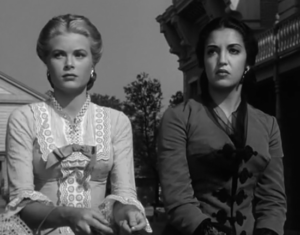
While Ramirez (Katy Jurado) is the most interesting character, it’s clearly Kane’s new bride, Amy (Grace Kelly), who brings on the dark humor.

JuradoandKelly
First, there’s the fact that she’s just had the biggest bummer of a wedding day ever. Then there’s the small detail that she’s a Quaker who has married a marshal. I don’t think I have to tell you that she may not be the wisest of women. Sure, he’s retiring; the new marshal is arriving the next day, and the newlyweds are planning to leave town and to run a store elsewhere before they hear about Miller. But surely five minutes of Kane’s obdurate behavior during courtship would have enlightened Amy that this whole conversion business–of both faith and career–wasn’t going to work so well. (Admittedly, given the pickings we see of the townspeople during the film, she may still have made the best choice of a mate she could.) And of course, it’s quite amusing that a woman who has to overcome her beliefs–not dodge them–is the only helper Kane receives. No wonder Kane throws his star on the ground after besting Miller.

That the film would include such darkness isn’t surprising from a screenwriter (Carl Foreman) who had been blacklisted before High Noon even came out. What he was witnessing of former friends and those he must have once respected couldn’t have led to idealism. Apparently, John Wayne scorned the film as anti-American, and Rio Bravo is a reinterpretation, with more admirable townspeople. While I agree with the movie’s distance from Wayne’s optimism, I think Foreman’s (and the original story’s) cynicism goes much deeper than any individual country, any specific belief system. It’s a simple, sadly humorous morality tale about human nature: while there may be rare moments of heroism (like Kane’s), typically, when the going gets tough, the “tough” scatter.

Share
Posted in: 1950s films, Action & Sports Films, Drama (film), Humor Tagged: best Westerns, dark humor, Gary Cooper, Grace Kelly, High Noon, movie, review

Surreal Reproduction: When Bette Met Mae (2014)

04/17/2016 by leah@carygrantwonteatyou.com Leave a Comment

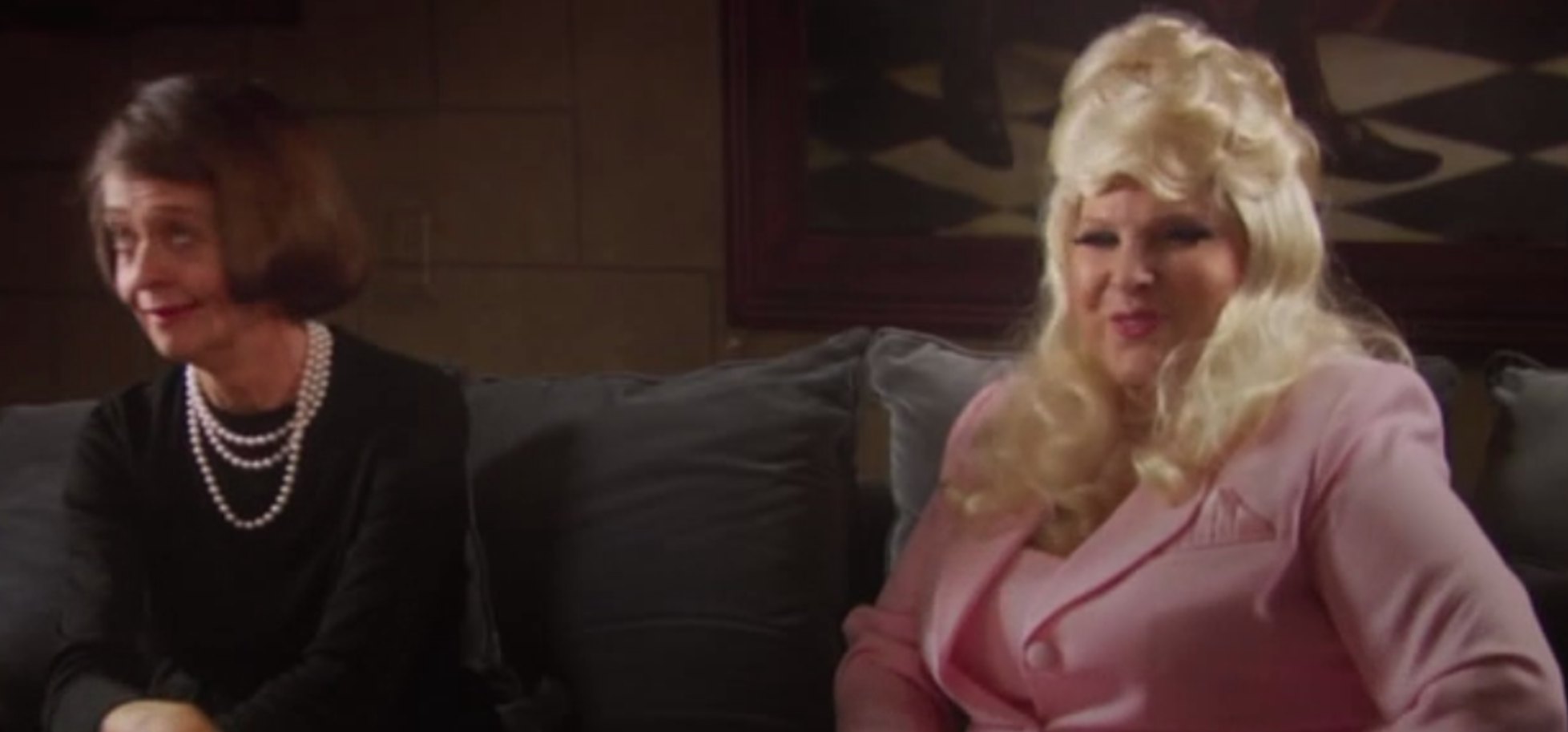
WhenBetteMetMaeOn November 13, 1973 Wes Wheadon was the bartender for a party that joined  superstars Mae West (Victoria Mills) and Bette Davis (Karen Teliha) for the first time. He captured their encounter on audio tape, and then reenacted the event with lip-syncing actors, producing it more than 40 years later.

On the one hand, the film is fascinating–capturing the mutual admiration between these two strong female icons, particularly Davis’s for her hilarious predecessor. On the other, the poor quality of the audio gives me a skeezy feeling, like this recorder was hidden in a drawer and the actresses unaware, or the whole thing was faked or improperly edited for effect (not hard with such easily imitated voices). I know that the time period and recorder quality are likely responsible for the seeming sketchiness, but since both women are long dead and the event likely forgotten, it’s hard not to question even as you’re enjoying the interplay between these heroines of the screen.

I was fascinated by Davis’s descriptions of her battles for control and for actors’ rights, as with her recounting of Ronald Reagan’s tenure as SAG president. She suggests he sold out his fellow actors for the sake of his own future political gain.

Such blunt talk from Davis (who is drinking vodka and OJ throughout) is typical of the film. Her lines throughout are funny, and often outrageous:

“My enthusiasm is exhausting.”

“I tried to turn for years (into a lesbian). I thought it’d be so simple.”

(on the idea of marrying another man) “You kidding? End up supporting them?”

And some of West’s lines are equally fabulous, as in response to Davis’s question of whether she’d marry now (at 80):

“Well, I’d wanna see him first.”

But what I like best are West’s descriptions of the making of I’m No Angel, and her reflection that she’d always wanted to be a lion tamer (because of course she did). And her thoughts about her writing, as when she admits it could take her a day to come up with a great line. The studios besides Paramount, she claims, “were kicking against me too” during the Production Code years. She explains one of her methods to preserve her material. Originally, she says, the films would be shot and screened, and then the censors would shout out what they wanted eliminated. Instead, she had censors read and cut lines from her screenplays before they were filmed. She would add material before sharing the script that she knew they’d eliminate (“I start putting in stuff that I myself wouldn’t do”), hopefully preserving more of her actual lines in the process.

And, of course, one of the pleasures of the movie is when both women express their reactions to the male impersonators who’ve loved them so much over the years….

I can’t exactly recommend the film, as Wheadon’s narration is cheesy, and much of the interview is hard to hear, making its accuracy difficult to trust. But it IS a fun, remarkable conversation (true as experienced/not), and if you have Amazon Prime, it’s free.

This post is part of my monthly series on West.

Share
Posted in: 1990-current films, Feminism, Humor, Mae West Moments, Random Tagged: Bette Davis, Mae West, review, When Bette Met Mae (2014)

Like The More the Merrier? (1943) Watch Singles (1992)

10/04/2015 by leah@carygrantwonteatyou.com 2 Comments

It’s curious what will relegate a film to “dated” status. Of the last 30 years of rom-coms, Singles (1992) would make my top five. Yet due to its grunge soundtrack and location in then-trendy Seattle, Cameron Crowe’s paean to dating has been forgotten. I wonder why The More the Merrier (1943), with a whole premise based on the WWII housing shortage in D.C., hasn’t suffered a similar fate. The two movies resemble one another in many unexpected ways, and deserve credit for being what films in their genre–despite its name–so rarely are: funny and romantic.

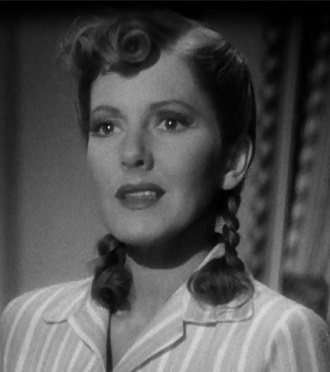
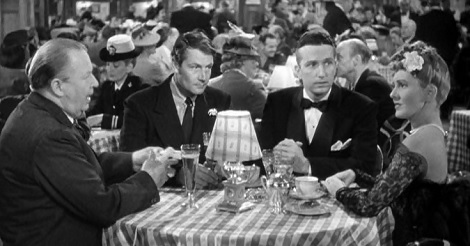
Both films are notable for their winning leading ladies. That trembling voice of Jean Arthur’s; equally able to capture passion, sense, and vulnerability; her perfectly timed delivery; and her gentle expressions all have so completely overcome audiences by the start of The More the Merrier that she remains the center of our attention despite considerable competition from her roommates: sexy Joel McCrea as Joe and adorable Charles Coburn as matchmaker Benjamin Dingle.
JeanArthur
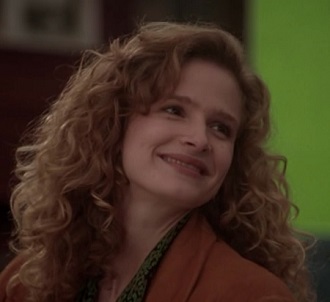
Kyra Sedgwick, the heroine of Singles, was one of those charismatic, promising starlets who gave up her career for her family (husband Kevin Bacon & kids), only to claim it back years later with The Closer. In Singles, you can see what might have been had she stuck around instead of leaving us with one-note Jennifer Aniston.
KyraSedgwickSingles
As Linda, she woos you in the first few minutes with her dismay over her broken car, reluctant acceptance of masculine help, and joy when the knight proves to not be a player. Her mobile face catches every emotion–reluctant trust, passion, joy, and ultimately, of course, despair, as she’s, of course, wrong about him, and her resolve not to let her heart be broken again sets the stage for her resistance to the film’s hero, Steve (Campbell Scott).

KyraSedgwickCampbellScott
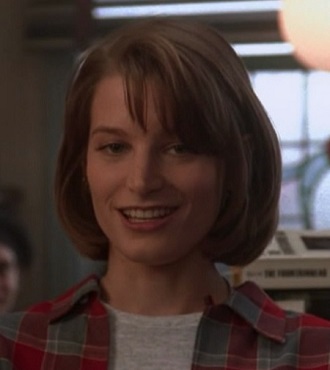
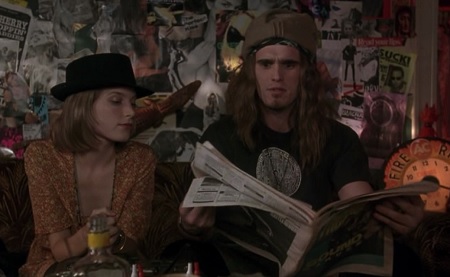
Since Singles is an ensemble film, we’re also treated to heroine Janet (Bridget Fonda), who is passionate about her hilariously untalented rocker boyfriend, Cliff (Matt Dillon). I’m not sure why Bridget Fonda never took off. She’s so endearing in this role, apparently a part written just for her. She’s funny and vulnerable and cute and tough all at once.
BridgetFonda-Singles
Her lovable fragility reminds me of Jean Arthur’s as Connie. And like Connie, Janet recognizes more about her boyfriend’s lack of commitment to her than she’s willing to admit. While he prioritizes his band over her, again and again, we watch Janet registering it, even as she supports him.
MattDillonandBridgetFonda-Singles
When the inevitable breakup comes, we’re not surprised; Janet is not as clueless as she chooses to appear at the start of the film, when she expresses faith in Cliff’s fidelity despite evidence she shouldn’t:

“Look, Janet, you know I see other people still, right? You do know that, don’t you?” says Cliff.

“You don’t fool me,” Janet answers.

“Janet, I could not be fooling you less.”

Likewise, Connie knows her fiancé’s career trumps their relationship–and her needs. She’s just so busy selling his good salary and reliability that she’s unaware just how hollow she sounds as she’s bragging. Her dismay at Dingle and Joe meeting him says it all.
TheMoreTheMerrierensemble
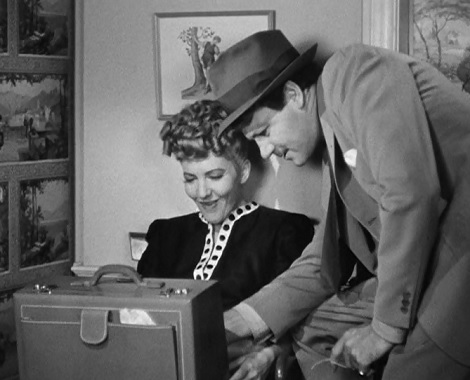
Luckily, Connie has matchmaker Benjamin Dingle (Charles Coburn) forcing her to confront her future husband’s selfishness. Dingle knows a deal helping her fiance’s career will make him dump Connie for the night, leaving the path open for the far hotter and sweeter Joe (Joel McCrea). The sign for Connie that Joe’s worth her time? He could have read her diary, and didn’t. He bought her a wedding gift–no strings attached–that displays his understanding of her: a travel bag with neat compartments, for a girl so organized she’s planned out every minute of her morning.
JeanArthurandJoelMcCrea
Singles
is all about paying attention to such signs: What should make you keep committing? What should make you give up? As writer/director Cameron Crowe obviously realized, it’s important to pay attention when single, or you’ll get your heart caught by someone who’s not worth it, making you less receptive to the lover actually worth your time.

For Steve (Campbell Scott), the sign is simple: a flick of the finger: Linda (Sedgwick) opens the car door lock for him, surely a sign that she likes him in spite of their prickly date.

Janet (Fonda) has been so beaten down by bad dates that such little gestures are all she’s now expecting of a guy, as captured in one of the film’s best scenes. She’s in the waiting room to get her breasts enlarged (her shortcut to Cliff’s loyalty).

“Tell me, from a girl’s point of view, what do you really want from a guy?” asks Steve, who has accompanied her for moral support.

“Well, when I first moved out here from Tucson,” Janet begins, warming to the theme, “I wanted a guy with looks, security, caring, someone with their own place, someone who said bless you or Gesundheit when I sneezed, you know? And umm, someone who liked the same things as me, but not exactly, and someone who loves me.”

“Tall order,” he answers.

“Yeah, I scaled it down a little,” she admits, her disappointment deflating both expression and voice.

“Well, what is it now?”

“Someone who says Gesundheit when I sneeze, although I prefer bless you, it’s nicer.”

As it turns out, the surgery doesn’t happen: Janet’s nerdy plastic surgeon (Bill Pullman) advises against it, suggesting she looks great now. Although no romance develops between them, his kind words make her realize how much she’s compromised for Cliff, just as in The More the Merrier, Dingle makes Connie recognize how little her fiancé values her. While Connie’s realization leads to endless tears, Janet is relieved. She gives Cliff one last chance, sneezing as he’s ranting about a poor review of his band.

“Hey babe?” he answers, handing her a tissue. “Don’t get me sick. I’m playing this weekend.”

Janet glances at the tissue box and then over at her boyfriend.
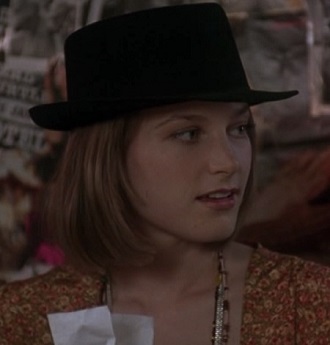
BridgetFonda-Singles-sneeze
Wait a minute,
she reflects in a voiceover. What am I doing? I don’t have to be here. I could just break up with him.
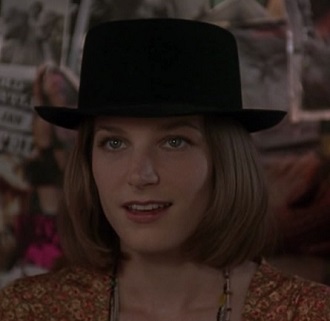
BridgetFonda-Singles-sneeze2
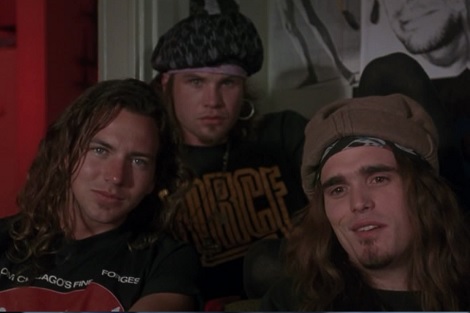
After dumping him, she dances alone, almost as beautifully as Connie does early in The More the Merrier. I won’t spoil where the story goes from there–for Janet, Linda, or the other quirky characters of Singles. Watch the film. Even if the love stories don’t get you, the funny sight of Pearl Jam members playing backup for Cliff will–one of many, many reasons even “chick flick” accusers can warm to this hilarious, charming rom-com.
MattDillonandPearlJam

Share
Posted in: 1940s films, 1990-current films, Romantic Comedies (film) Tagged: Alice in Chains, Bridget Fonda, Pearl Jam movie, review, rom-coms, Singles film, Soundgarden, The More the Merrier
1 2 Next »

Recent Posts

  • 100 Years Later, Still Scary: Dr. Caligari
  • Escaping Out of the Past (1947)
  • A Weeper for Those Who Love Jerks
  • Thank You, Academy, for Not Infuriating Me
  • Challengers (2024) Is a Bad Movie

Subscribe to Blog via Email

Enter your email address to subscribe to this blog and receive notifications of new posts by email.

Categories

  • 1920s films
  • 1930s films
  • 1940s films
  • 1950s films
  • 1960s films
  • 1970s films
  • 1980s films
  • 1990-current films
  • 2020s films
  • Action & Sports Films
  • Anti-Romance films
  • Blogathons
  • Childfree
  • Comedies (film)
  • Drama (film)
  • Feminism
  • Femme fatales
  • Film Noir/Crime/Thriller & Mystery
  • Gloriously Silly Scenes
  • Horror
  • Humor
  • Mae West Moments
  • Musicals and dancing films
  • Oscars
  • Random
  • Romance (films)
  • Romantic Comedies (film)
  • The Moment I Fell for
  • Turn My Sister into Classic Movie Fan
  • TV & Pop Culture
  • Uncategorized
Share
Classic Movie Blog Hub Member

Recent Comments

  • leah@carygrantwonteatyou.com on Meg Ryan’s Fate Foretold in Joe Versus the Volcano
  • Ryan on Meg Ryan’s Fate Foretold in Joe Versus the Volcano
  • leah@carygrantwonteatyou.com on 100 Years Later, Still Scary: Dr. Caligari
  • The Classic Movie Muse on 100 Years Later, Still Scary: Dr. Caligari
  • leah@carygrantwonteatyou.com on 100 Years Later, Still Scary: Dr. Caligari

Archives

  • November 2025
  • September 2025
  • May 2025
  • March 2025
  • January 2025
  • November 2024
  • August 2024
  • July 2024
  • May 2024
  • March 2024
  • February 2024
  • December 2023
  • November 2023
  • October 2023
  • September 2023
  • August 2023
  • July 2023
  • May 2023
  • April 2023
  • March 2023
  • January 2023
  • December 2022
  • November 2022
  • September 2022
  • July 2022
  • May 2022
  • April 2022
  • March 2022
  • February 2022
  • October 2021
  • September 2021
  • April 2021
  • March 2021
  • February 2021
  • December 2020
  • October 2020
  • September 2020
  • July 2020
  • May 2020
  • April 2020
  • March 2020
  • February 2020
  • December 2019
  • October 2019
  • September 2019
  • June 2019
  • May 2019
  • April 2019
  • February 2019
  • January 2019
  • November 2018
  • September 2018
  • July 2018
  • June 2018
  • May 2018
  • April 2018
  • March 2018
  • February 2018
  • January 2018
  • November 2017
  • September 2017
  • August 2017
  • July 2017
  • June 2017
  • May 2017
  • April 2017
  • March 2017
  • February 2017
  • January 2017
  • December 2016
  • November 2016
  • October 2016
  • August 2016
  • July 2016
  • June 2016
  • May 2016
  • April 2016
  • March 2016
  • February 2016
  • January 2016
  • December 2015
  • November 2015
  • October 2015
  • September 2015
  • August 2015
  • July 2015
  • June 2015
  • May 2015
  • April 2015
  • March 2015
  • February 2015
  • January 2015
  • December 2014
  • November 2014
  • October 2014
  • September 2014
  • August 2014
  • July 2014
  • June 2014
  • May 2014
  • April 2014
  • March 2014
  • February 2014
  • January 2014

Meta

  • Log in
  • Entries feed
  • Comments feed
  • WordPress.org

Copyright © 2025 Cary Grant Won't Eat You.

Church WordPress Theme by themehall.com