Cary Grant Won't Eat You

Classic movies for phobics

  • About
  • eBooks
  • Previous Blogathons
Classic movies for phobics

Mad Men

Mad Men Meets Sex and the City: The Best of Everything
06/28/2015 by leah@carygrantwonteatyou.com 16 Comments

Baker-BestofEverything
This post is part of the Modern Era portion of the Classic Movie History Project Blogathon, sponsored by Aurora of Once Upon A Screen, Ruth of Silver Screenings and Fritzi of Movies, Silently. Previous days are covered here: Silent Era and Golden Age. Thanks to Flicker Alley for sponsoring and promoting this event.

Ever since Mad Men ended, I’ve been wondering about Peggy’s real-life equivalents, from the woman who coined “A Diamond Is Forever,” to those who paid a far greater cost for their romantic missteps than Peggy did. I’ve been curious about ’50s and ’60s movie versions of the career girl as well. Films covered single women in the city from the silent era on, but naturally, I viewed the movie based on the book Don Draper was reading at the start of the show, Rona Jaffe’s The Best of Everything.

Jaffe is an interesting figure in herself; her characters are based on her own experience in publishing, and her friends within it. She earnestly explained to Hugh Hefner (what a choice!) that her goal in writing the book was to normalize and destigmatize the experience of those girls who felt ashamed and alone in their mistakes: their dalliances with married men, the children they bore (or didn’t) as a result.

The controversial film version (1959) quickly lands us in the center of the action in a publishing company, and I was instantly hooked by the drama: the boss (Brian Aherne) who casually pinches his workers’ rears, the secretaries trying to balance social lives and unreasonable work demands, the crowded shared apartments and crammed lunch spots. (The film is given props for fashion, and deserves it. It’s a visual feast throughout.) Right away, we get a sense of what women had to put up with just to get paid, and not well.
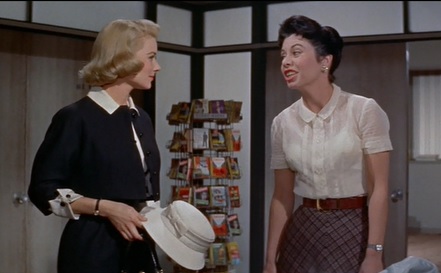
First day on the job

First day on the job

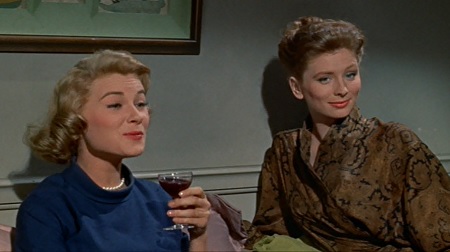
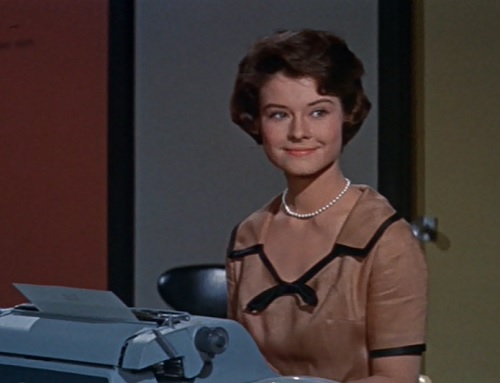
Newcomer to  the city Caroline (Hope Lange) rooms with coworkers Gregg (supermodel Suzy Parker) and April (Diane Baker) in a miniscule apartment, and the three instantly become tight friends despite having little in common: Gregg is the adventurous bombshell/aspiring actress, April the innocent, and Caroline, the sophisticate who is trying out work until her fiancé returns to the U.S. and marries her.
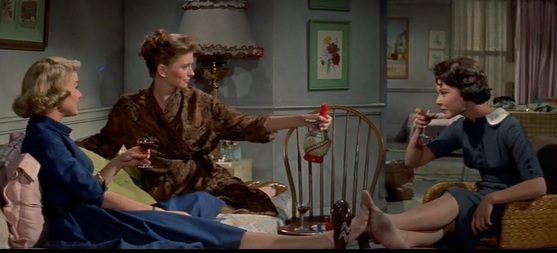
Single roommates in the city

Single roommates celebrating

Caroline and Gregg talk about lovers with April

Caroline and Gregg talk about lovers with April

The three unite in hatred of Amanda Farrow, the harsh editor who has chosen success over marriage, and scorns the secretaries who didn’t have to go through as much as she did to advance.

JoanCrawford-Farrow
She has a smidgen of Miranda Priestly of The Devil Wears Prada in her, but there’s pathos and empathy to Farrow too. She may fail to support her many secretaries’ ambitions, but she tries to save them from her romantic fate, from awful men. And The Best of Everything is full of them.

The Sex and the City ladies might have faced a lot of freaks, but at least they had some personality; the men of The Best of Everything are as interchangeable as the vice presidents in American Psycho. A recent play of the book even used cardboard cutouts of men to emphasize the point.

What’s puzzling is what these interesting women see in these duds. Effervescent April (Baker) falls for a guy who is so obviously a sleaze he might as well be wearing a signboard to announce it. Hope’s fiancé announces he’s married a rich girl instead of her—over the phone—and then expects her to sleep with him afterward. And get this: dazzling Gregg (Parker) falls so hard for a director (Louis Jourdan) that she goes into a crazy, stalking tailspin when he dumps her. (Yes, nothing inspires sexual obsession so much as heartthrob Gigi‘s Gaston. What??)

JourdanBestofEverything
Since the men are so patently lacking in any redeeming qualities but sleep inducement, the film’s attention to them rather than the workplace and roommate dynamics is disappointing, as the latter, when they’re the focus, are well developed and fascinating. Caroline advances quickly to the rung above secretary (a reader), but is accused by an alcoholic friend, Mike (Stephen Boyd), of faux ambition, just to avoid her romantic life (by the way, this is the love interest we’re rooting for).

Ambitions attacked

Ambitions attacked

Yet between the romantic interludes (and their sad repercussions) are intriguing signs of the second wave of feminism to come: Farrow (Crawford) leaves the marriage she impulsively makes with an old flame, returning to work, and we have the sense that she’s better for it. Caroline is promoted again. Abortion is presented as the fault of men who are careless with the hearts (and bodies) of naïve women—not the deserved end for loose ones. Female solidarity* prevails throughout, as when one of our heroines slaps a faithless boyfriend of the other. (*In one brief, funny exception, the secretaries all try to pass off work on one another.) The workplace even has moments of startling modernity, as with the hilariously painful bonding “picnic,” with its forced fun and workers getting drunk in self-defense. There’s enough worth watching in the film, in short, to get viewers through the unearned suds of these worthless romances.

Single women have fled to New York for all kinds of reasons, in all kinds of ages: post-Civil War belles, without men or funds; rural women leaving farms for factories; aspiring starlets, hoping for a berth at the glamour-girl dorm, The Barbizon Hotel (an upscale Footlights Club, a la Stage Door). These women certainly didn’t find the “best of everything.” But they still managed to live out enough of the excitement of the big city to keep other women coming, to keep dreamers hankering for if not the best of everything, the thrill of aspiring for it.

Share
Posted in: 1950s films, Blogathons, Drama (film), Feminism, Romance (films) Tagged: city, Joan Crawford, Mad Men, Sex and the City, single girls

The Sadistic Spouse: Charles Boyer in Gaslight

04/23/2014 by leah@carygrantwonteatyou.com 22 Comments

This post is part of the Great Villain Blogathon cohosted by Speakeasy, Shadows and Satin, and Silver Screenings. Check out other entries on one of their sites!

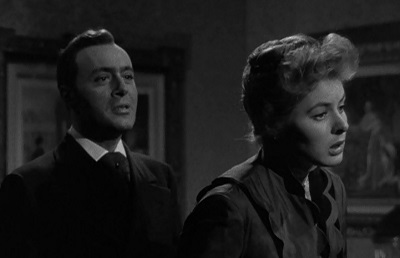
When it comes to villains, Gregory Anton in Gaslight lacks the theatricality of The Joker or Lecter. He wants the presence of Harry Lime or the narcissism of Ellen Harland. He doesn’t chill the viewer as do Maleficent and Mrs. Danvers. On the surface, therefore, Gregory might not seem a villain worthy of comment. As played by Charles Boyer, the role is so two-dimensional as to approach camp. You can almost hear Boyer saying to himself, “Time for the faux-loving face—wait, too long on that one, stern face time.”

Boyer's stern face

Boyer’s stern face

Yes, Gregory seems as commonplace a villain as his name would suggest. But in terms of his effect on his victim, Gregory is a master among villains. Having convinced his new wife, Paula (Ingrid Bergman), to move back to the house where her aunt was murdered, he creates a series of sounds and sights he pretends not to notice. He expresses concern at Paula’s supposedly imaginary observations; he chides her for forgetfulness when items disappear (due to his own actions). She believes him because she loves him. The term “gaslighting,” which originated with this story, refers to Gregory’s sinister brand of psychological abuse: trying to convince his wife she’s going insane. While the motives of his actions are not immediately apparent, he clearly feels no remorse for his cruelty.

Convincing his wife she's crazy

Gregory, celebrating his victory over his wife

So often, we side with the criminal in a plot like this one: with a wife this gullible, it’s easy to go for the laugh rather than the shiver. It would be common too to dismiss Paula as stupid, to fail to sympathize due to her blindness and fragility. But the nineteenth-century timeline of the story counters our usual impulses, making us uneasy and fearful from the start. (Just what were those stories about men committing their wives to asylums on questionable grounds again?) And Paula is not just any victim: She is a victim played by Ingrid Bergman.

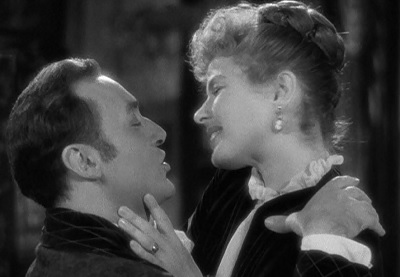
Bergman beautifully illustrates the extent of her heroine’s downfall at Gregory’s hands. She is incandescent as a woman in love before his plot takes off.

Gregory's pretense of love

Paula in love

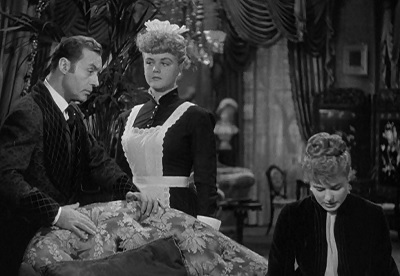
Her fears about her sanity, which first dim, and then blot out any semblance of happiness or reason, are terrifying to watch. Just when she thinks she can trust in his love for her and have faith in herself again, Gregory cuts off her giddiness with a chilling expression, claims she’s unwell, forgetful, unworthy, childish. Her jealousy of a cruel maid (Angela Lansbury) he flirts with in her own home is nothing, he suggests, but a sign of her sickness.

Using the maid to torture his wife

Using the maid to torture his wife

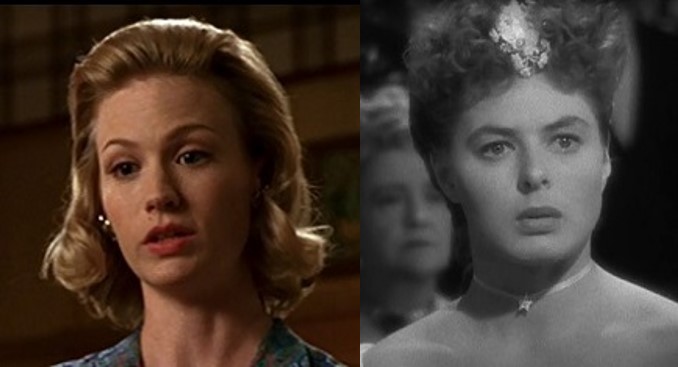
Think of Betty Draper in the first season of Mad Men, then quadruple the vulnerability, make Don evil rather than sick, take away his love, and remove any right Betty has to defend herself against his duplicity, and you have poor Paula in Gaslight.

Season 1 Betty Draper a powerhouse compared to Paula

Season 1 Betty Draper a powerhouse compared to Paula

Paula’s weakness is her love for her husband; without it to prey upon, Gregory would have no chance of winning this psychological battle against her. And it’s just this level of cruelty she can’t accept. Of course she finds her own forgetfulness more believable. Not content with the damage he’s done, Gregory shuts her away from others, guaranteeing she spends most of her time obsessing over whether she’s mad–hardly a healthy pastime. How long, we wonder, CAN Paula stay sane, trapped in a loveless marriage, a frightening house, and fears she can no longer control? While there’s hope in the form of a suspicious detective (Joseph Cotten), even if Paula escapes, can anyone recover from this kind of treatment?

Despite a largely passive performance, Bergman is stunning to watch in Gaslight. I can think of no actress but Meryl Streep who could accomplish so much with just expressions, who could deliver enough pain and fear to carry the film and beat out Barbara Stanwyck, Bette Davis, Claudette Colbert, and Greer Garson for the Oscar.

Bergman as situation worsens

Paula as her situation worsens

Just a few years after Gaslight, Bergman would fall for Roberto Rossellini and become involved in an affair with him so scandalous Congress and many of her American fans would condemn her. But she would make a Hollywood comeback less than a decade later, and her union with the famous director would result in a daughter, Isabella, who, in a curious twist, would make a splash of her own as a victim in another famous film, Blue Velvet. Who could forget torch singer Dorothy Vallens, the target of creepy villain Frank Booth (Dennis Hopper)?

Like mother, like daughter

Like mother, like daughter

 Be sure to check out the other villains in the blogathon!

Share
Posted in: 1940s films, Anti-Romance films, Blogathons, Drama (film), Film Noir/Crime/Thriller & Mystery, TV & Pop Culture Tagged: Betty Draper, Charles Boyer, Gaslight, Ingrid Bergman, Mad Men, marriage, villain

Recent Posts

  • 100 Years Later, Still Scary: Dr. Caligari
  • Escaping Out of the Past (1947)
  • A Weeper for Those Who Love Jerks
  • Thank You, Academy, for Not Infuriating Me
  • Challengers (2024) Is a Bad Movie

Subscribe to Blog via Email

Enter your email address to subscribe to this blog and receive notifications of new posts by email.

Categories

  • 1920s films
  • 1930s films
  • 1940s films
  • 1950s films
  • 1960s films
  • 1970s films
  • 1980s films
  • 1990-current films
  • 2020s films
  • Action & Sports Films
  • Anti-Romance films
  • Blogathons
  • Childfree
  • Comedies (film)
  • Drama (film)
  • Feminism
  • Femme fatales
  • Film Noir/Crime/Thriller & Mystery
  • Gloriously Silly Scenes
  • Horror
  • Humor
  • Mae West Moments
  • Musicals and dancing films
  • Oscars
  • Random
  • Romance (films)
  • Romantic Comedies (film)
  • The Moment I Fell for
  • Turn My Sister into Classic Movie Fan
  • TV & Pop Culture
  • Uncategorized
Share
Classic Movie Blog Hub Member

Recent Comments

  • leah@carygrantwonteatyou.com on Meg Ryan’s Fate Foretold in Joe Versus the Volcano
  • Ryan on Meg Ryan’s Fate Foretold in Joe Versus the Volcano
  • leah@carygrantwonteatyou.com on 100 Years Later, Still Scary: Dr. Caligari
  • The Classic Movie Muse on 100 Years Later, Still Scary: Dr. Caligari
  • leah@carygrantwonteatyou.com on 100 Years Later, Still Scary: Dr. Caligari

Archives

  • November 2025
  • September 2025
  • May 2025
  • March 2025
  • January 2025
  • November 2024
  • August 2024
  • July 2024
  • May 2024
  • March 2024
  • February 2024
  • December 2023
  • November 2023
  • October 2023
  • September 2023
  • August 2023
  • July 2023
  • May 2023
  • April 2023
  • March 2023
  • January 2023
  • December 2022
  • November 2022
  • September 2022
  • July 2022
  • May 2022
  • April 2022
  • March 2022
  • February 2022
  • October 2021
  • September 2021
  • April 2021
  • March 2021
  • February 2021
  • December 2020
  • October 2020
  • September 2020
  • July 2020
  • May 2020
  • April 2020
  • March 2020
  • February 2020
  • December 2019
  • October 2019
  • September 2019
  • June 2019
  • May 2019
  • April 2019
  • February 2019
  • January 2019
  • November 2018
  • September 2018
  • July 2018
  • June 2018
  • May 2018
  • April 2018
  • March 2018
  • February 2018
  • January 2018
  • November 2017
  • September 2017
  • August 2017
  • July 2017
  • June 2017
  • May 2017
  • April 2017
  • March 2017
  • February 2017
  • January 2017
  • December 2016
  • November 2016
  • October 2016
  • August 2016
  • July 2016
  • June 2016
  • May 2016
  • April 2016
  • March 2016
  • February 2016
  • January 2016
  • December 2015
  • November 2015
  • October 2015
  • September 2015
  • August 2015
  • July 2015
  • June 2015
  • May 2015
  • April 2015
  • March 2015
  • February 2015
  • January 2015
  • December 2014
  • November 2014
  • October 2014
  • September 2014
  • August 2014
  • July 2014
  • June 2014
  • May 2014
  • April 2014
  • March 2014
  • February 2014
  • January 2014

Meta

  • Log in
  • Entries feed
  • Comments feed
  • WordPress.org

Copyright © 2025 Cary Grant Won't Eat You.

Church WordPress Theme by themehall.com