Cary Grant Won't Eat You

Classic movies for phobics

  • About
  • eBooks
  • Previous Blogathons
Classic movies for phobics

Joan Blondell

Depressed Heroines & Classic Film: Three on a Match

09/19/2020 by leah@carygrantwonteatyou.com 4 Comments

Is there anything scarier than Bette Davis playing nice?

I see that sunny face, that sugary smile, and I’m just waiting for the other sledgehammer to drop. It’s unnerving in films like Three on a Match (1932) that she acts like a sweetheart throughout. It’s a terrible waste, of course. But early Hollywood didn’t know what they had in Bette. (Kind of like Amy Sherman-Palladino, who had Melissa McCarthy in her Gilmore Girls cast playing an annoying, bubbly local instead of, I dunno, someone funny. But I digress.)

Three on a Match is a peculiar, truly half-baked film in many ways. But it’s also a riveting one, and chock-full of stars. And its pace is breathless (it barely passes the hour mark). I’m not going to spoil the big plot developments near the end–too interesting–but I will spoil some of the earlier developments, so be warned.

First of all, when you have Edward Arnold and young Humphrey Bogart playing scary gangsters, you know you’re in for a good time.

(Not that their danger combined holds a candle to the terror that is sweet Bette, but….)

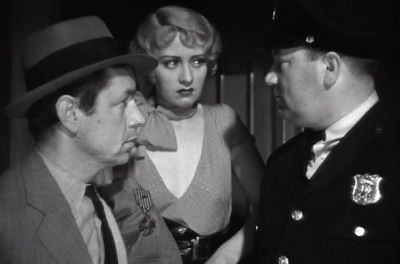
You have Joan Blondell, playing to type (which is always marvelous).

Warren William plays an unexpectedly bland part. And then there’s Ann Dvorak in a performance that should have secured her career, especially after her breakout in Scarface the same year.

The premise of the film is fascinating; it’s from an old WWI superstition about the danger of lighting three people’s cigarettes from the same match, an act said to doom one.

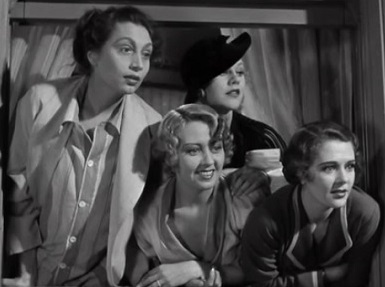
Three former schoolmates–played by Blondell, Dvorak, and Davis–get together to catch up on their lives and light that match, and soon one’s fate will rise, the other’s will fall, and the third’s (Davis) will be largely irrelevant, her presence simply for the sake of the film’s title.

The doomed character emerges early on because lovely Vivian (Dvorak) is unhappy despite a seemingly perfect husband, house, and kid, and while we modern viewers quickly identify her as depressed, no such word is uttered in the film. What’s fascinating is that though Vivian ditches her husband, starts sleeping with a gangster, neglects her child, and becomes a drug addict, the movie still extends sympathy for her, just as The Hours would do years later for women dissatisfied with their roles. “Pre-Code,” you remind yourself. “Pre-Code.” Vivian’s lust for the gangster is startlingly evident, as is her later addiction.

But where the film excels in a nuanced portrayal of a complicated woman, it stumbles with the supposed bond between the three schoolmates. When Vivian hooks up with the gangster, she hides from her husband, who is desperate to find her and their son. Mary (Blondell) gives her away. We understand that betrayal, given the squalor the son is living in. But then Mary takes Vivian’s place at her husband’s side. This is a pretty shady act, calling her motives into question. Yet we’re not asked to see it that way. It’s like the film is saying, “Well, Vivian wasn’t taking advantage of this wealthy dad, so someone should.” Vivian’s lack of anger for Mary could have been very interesting–if the film had suggested that there should have been any. And as for the third schoolmate, Ruth (Davis), why is she in the film at all? All Ruth does is read while babysitting Vivian’s child. And smile. And smile some more. It’s unnerving and unnecessary, and if you were as terrified as I was by What Ever Happened to Baby Jane? and The Little Foxes, you’ll find it downright creepy.

Just when you’re thinking this bizarre relationship between the women isn’t really working for you, the film turns sinister and you can’t turn away. Bogart gets his chance to shine in a truly evil role.
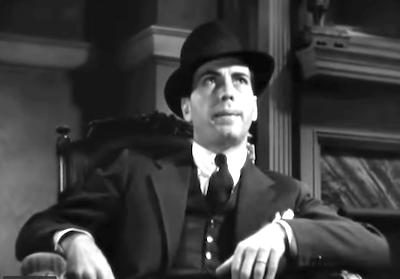
Vivian gets boxed into a hopeless situation, and you fear for her, wondering what she can do to retain some smidgen of the woman she was before addiction took hold.

Dvorak holds her own against Bogart in powerful scenes that make you wonder why you know so little of her.
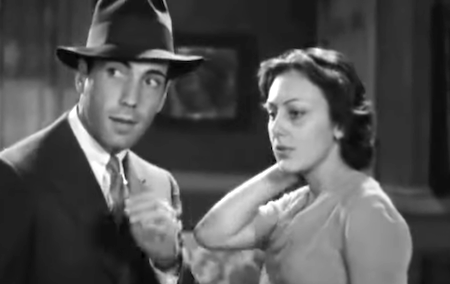
Alas, it’s a familiar story: Dvorak ticked off the bosses. It turns out she objected to the studio’s choice to pay her the same amount as her (very forgettable) son in Three on a Match, but she did enjoy the year-long honeymoon she took with her husband instead of putting out films for them.

I like to imagine Dvorak taking off on that honeymoon, leaving behind the sexists who would soon censor sympathetic characterizations of complex women, like Vivian. It might not have been a long-lasting victory, but it makes me smile just the same. And if you watch her heartbreaking, memorable performance in Three on a Match, you’ll feel the same.

Share
Posted in: 1930s films, Drama (film), Film Noir/Crime/Thriller & Mystery Tagged: Ann Dvorak, Bette Davis, Bogart's early films, depression & classic film, Joan Blondell, Three on a Match

The Depression Satire, Gold Diggers of 1933

01/11/2015 by leah@carygrantwonteatyou.com 6 Comments

GoldDiggersof1933
What does the term gold digger really mean, in the context of the Depression? Today we think of Kanye’s gold digger; buying gold and liposuction, maybe holding a lap dog and wearing furs; not a showgirl escaping destitution. For a musical, Gold Diggers of 1933 is surprisingly earnest, managing to both entertain and make us empathize with the plight of its subjects—and by extension, its audience. As a producer in the movie assures his performers, “I’ll make ’em laugh at you starving to death….”

The film begins with showgirls performing in gold-coin bedecked, barely-there costumes. They’re singing the famous, “We’re in the Money,” led by Fay (Ginger Rogers).

WereintheMoney
We suspect there’s irony at play; after all, Fay sings a verse of it in Pig Latin.

Rogers's language play

Rogers’s language play

And of course, we’re right to be skeptical about those claims: before the song ends, the creditors bust in, close the show, and guarantee not a soul singing will be anything but broke.

Clearly, this isn’t the slight film the title, or its greatly inferior sequel, might lead a modern viewer to expect. I was just reading about Girls, wondering if I could handle another season of Lena Dunham’s show about over-privileged, under-motivated friends in the city. I kept thinking of that show when the camera panned from the closed show to a small posting illustrating these singers’ (dissimilar) lack of options:

TheaterSign-GoldDiggers
The camera then turned to a letter beneath the flat door of three of the performers, a rent demand from their landlady.

All three are sharing a bed. They wake up late, with nowhere to go. “Come on, let’s get up and look for work. I hate starving in bed,” gripes Polly (Ruby Keeler).

“Name me a better place to starve,” replies Trixie (Aline MacMahon). The famished roommates steal milk from the neighbors. Trixie reassures the others it’s okay because the milk company “stole it from a cow.”

I know that there’s a place for anyone’s woes; that life (and the films and shows depicting it) is not a comparison game. But the scene reminded me of why Girls so often, despite its cleverness, has left me flat. I’m just not very engaged by women without ambition or integrity. But women who can manage wit when they’re living on bread and snatched milk? Yes, please. Give me more.

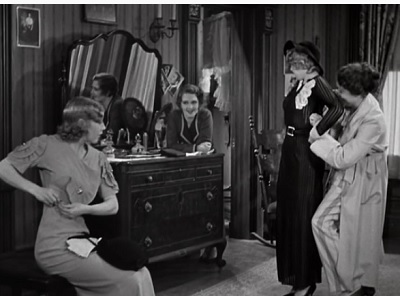
When Fay arrives to announce a new show, the women band together to give one of them—Carol (Joan Blondell)—a complete outfit to impress the producer. They’ve hocked too many stockings and dresses to do anything else.

DressingCarol-GoldDiggers
A tearful Carol calls to tell them it’s true that there’s work and that the producer, Barney (Ned Sparks), is on his way; however, he soon confesses he has no funds to start the musical. As eloquent as Carol’s response is to his trickery, her expression is even more so:

JoanBlondell-GoldDiggers
Luckily, the women’s singer-and-composer neighbor, Brad (Dick Powell) is available. He impresses Barney with his music, especially the tune which best fits the producer’s Depression theme. More importantly, Brad offers the money to put on the show.

(Just an early spoiler) Brad is secretly a member of a wealthy family, and his proud brother, Lawrence, is not pleased to see his sibling in a musical, and even less pleased the boy is in love with Polly (Keeler). Lawrence’s (Warren William’s) banker, Faneuil H. Peabody (Guy Kibbee), convinces his client all showgirls are gold diggers, and Lawrence therefore rushes to quash the romance.

The two men go to the girls’ apartment to pay off Polly, but mistake Carol for her. Enraged by their condescension, Trixie and Carol decide to pretend Carol is Polly and take the two haughty men for all they’re worth to teach them better manners (and teach us that the title of this film is as ironic as its opening song).

MacMahon as Trixie can occasionally grate, but Guy Kibbee is wonderful as the elderly, lascivious lawyer, the man whom Trixie feels is “the kind of man I’ve been looking for. Lots of money and no resistance.”

BankerandTrixie-Aline MacMahon
Trixie plans to marry the banker in spite of her lack of attraction for him (“You’re as light as a heifer,” she says when she dances with him). She just needs to fend off Kay (Rogers), who wants a meal ticket too.

Carol has no such plans. She’s just angry. The film wants us to understand that Kay and Trixie are just desperate—but understandable—exceptions to the rule. Most of the showgirls, far from being the “parasites” Lawrence assumes, are as ethical and proud as Carol and Polly are. Slowly, though, Carol, in spite of herself, begins to fall for the handsome snob.

The women’s antics are entertaining, especially when they fool the men into buying them pricey hats. But the men’s conviction they’re hanging out with these lovelies just to do Brad good is even funnier. Since this is a pre-Code film, there’s no dearth of skimpy clothing and sexual references. Lawrence soon passes out drunk after confessing love for Carol, and she and Trixie move him to their bed, knowing he’ll assume he’s had sex with faux-Polly and will be too compromised to object to Brad marrying the real one.

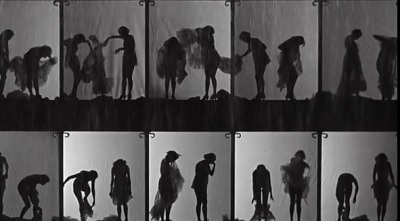
Sexual innuendo is evident throughout the musical numbers in the show, especially since this is a Busby Berkeley film. One of my favorite acts is about couples “Pettin’ in the Park.” When it rains, the women retreat to change, returning to their men in metal dresses.

Berkeleynumber-parkdressing
The men are frustrated and outraged they can’t access their partners’ bodies.

PowellandKeeler-PettinginthePark
Luckily for them, a peeping toddler (yes, you read that right) gives the star (Powell) a tool to break through his love’s (Keeler’s) metal, which he’ll presumably pass to the others.

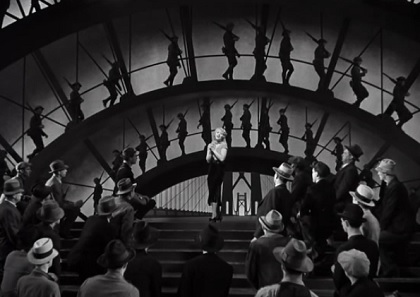
But Berkeley doesn’t keep with this light tone for all of his numbers. The film ends with the Depression tune that Barney promised, with Carol singing, “Remember My Forgotten Man.”

Alone on a street in seductive attire, she first talks, then sings, “Remember my forgotten man?/You put a rifle in his hand./You sent him far away./ You shouted, ‘Hip hooray,’ but look at him today.”

Showing the cop the homeless man a veteran

Carol defending a forgotten man

The song moves from one woman, to another, then builds into an anthem of men and women attacking the government for not doing more to help the veterans and farmers who’ve worked hard for their country, only to end homeless in breadlines, unable to support the women who love them.

ForgottenMan-GoldDiggers1933
Their women are left not only witnessing their men’s suffering, but with children to support as well as themselves–alone. Carol’s provocative attire and presence on the street are no accident, of course. There is one type of work she can get without her man.

The song is heartbreaking. How rare to find a movie, a musical, that captures the national plight like this, especially after such light fare. But of course, the song is also a reminder that there was nothing truly light about the whole film. Is Trixie a greedy gold digger for wanting a rich husband rather than starving as she waits for a show not to be canceled? The oldest and least attractive of the bunch, she knows she must beat Fay to the lawyer’s libido, or she’s probably headed for the streets. The relatively happy unions of these women don’t blind the audience to the fact that there are a lot of girls in that show, a lot of women without secretly-rich neighbor-lovers, without pliable elderly bankers, but with landlady’s notes waiting for them under the door.

Share
Posted in: 1930s films, Comedies (film), Romantic Comedies (film), TV & Pop Culture, Uncategorized Tagged: Busby Berkeley musical, Depression, Dick Powell, Ginger Rogers, Girls, Gold Diggers of 1933, Joan Blondell, Lena Dunham

Recent Posts

  • 100 Years Later, Still Scary: Dr. Caligari
  • Escaping Out of the Past (1947)
  • A Weeper for Those Who Love Jerks
  • Thank You, Academy, for Not Infuriating Me
  • Challengers (2024) Is a Bad Movie

Subscribe to Blog via Email

Enter your email address to subscribe to this blog and receive notifications of new posts by email.

Categories

  • 1920s films
  • 1930s films
  • 1940s films
  • 1950s films
  • 1960s films
  • 1970s films
  • 1980s films
  • 1990-current films
  • 2020s films
  • Action & Sports Films
  • Anti-Romance films
  • Blogathons
  • Childfree
  • Comedies (film)
  • Drama (film)
  • Feminism
  • Femme fatales
  • Film Noir/Crime/Thriller & Mystery
  • Gloriously Silly Scenes
  • Horror
  • Humor
  • Mae West Moments
  • Musicals and dancing films
  • Oscars
  • Random
  • Romance (films)
  • Romantic Comedies (film)
  • The Moment I Fell for
  • Turn My Sister into Classic Movie Fan
  • TV & Pop Culture
  • Uncategorized
Share
Classic Movie Blog Hub Member

Recent Comments

  • leah@carygrantwonteatyou.com on Meg Ryan’s Fate Foretold in Joe Versus the Volcano
  • Ryan on Meg Ryan’s Fate Foretold in Joe Versus the Volcano
  • leah@carygrantwonteatyou.com on 100 Years Later, Still Scary: Dr. Caligari
  • The Classic Movie Muse on 100 Years Later, Still Scary: Dr. Caligari
  • leah@carygrantwonteatyou.com on 100 Years Later, Still Scary: Dr. Caligari

Archives

  • November 2025
  • September 2025
  • May 2025
  • March 2025
  • January 2025
  • November 2024
  • August 2024
  • July 2024
  • May 2024
  • March 2024
  • February 2024
  • December 2023
  • November 2023
  • October 2023
  • September 2023
  • August 2023
  • July 2023
  • May 2023
  • April 2023
  • March 2023
  • January 2023
  • December 2022
  • November 2022
  • September 2022
  • July 2022
  • May 2022
  • April 2022
  • March 2022
  • February 2022
  • October 2021
  • September 2021
  • April 2021
  • March 2021
  • February 2021
  • December 2020
  • October 2020
  • September 2020
  • July 2020
  • May 2020
  • April 2020
  • March 2020
  • February 2020
  • December 2019
  • October 2019
  • September 2019
  • June 2019
  • May 2019
  • April 2019
  • February 2019
  • January 2019
  • November 2018
  • September 2018
  • July 2018
  • June 2018
  • May 2018
  • April 2018
  • March 2018
  • February 2018
  • January 2018
  • November 2017
  • September 2017
  • August 2017
  • July 2017
  • June 2017
  • May 2017
  • April 2017
  • March 2017
  • February 2017
  • January 2017
  • December 2016
  • November 2016
  • October 2016
  • August 2016
  • July 2016
  • June 2016
  • May 2016
  • April 2016
  • March 2016
  • February 2016
  • January 2016
  • December 2015
  • November 2015
  • October 2015
  • September 2015
  • August 2015
  • July 2015
  • June 2015
  • May 2015
  • April 2015
  • March 2015
  • February 2015
  • January 2015
  • December 2014
  • November 2014
  • October 2014
  • September 2014
  • August 2014
  • July 2014
  • June 2014
  • May 2014
  • April 2014
  • March 2014
  • February 2014
  • January 2014

Meta

  • Log in
  • Entries feed
  • Comments feed
  • WordPress.org

Copyright © 2025 Cary Grant Won't Eat You.

Church WordPress Theme by themehall.com