Cary Grant Won't Eat You

Classic movies for phobics

  • About
  • eBooks
  • Previous Blogathons
Classic movies for phobics

humor

Defeat Future Trumps: Teach Humor

11/16/2016 by leah@carygrantwonteatyou.com 4 Comments

davechappelle-electionparody
“The human race has one really effective weapon, and that is laughter.” —Mark Twain

When Trump clinched the nomination in Indiana, I felt betrayed not by my fellow citizens, but by my art. I teach humor, write humor, believe in humor. And I couldn’t deny it: Trump’s skill with a joke was exactly what had enabled everyone to dismiss his threat, to not take (or pretend not to) his words about minorities and women as genuine. Humor had concealed the truth of Trump, like some fearsome Larry “Lonesome” Rhodes without Patricia Neal.

Of course I have always known there’s a brand of humor that’s not about empathy, but divisiveness: Tina Fey’s evil stepbrother. It’s the kind we learn the first time a bully mocks an outsider on the playground, and we laugh along. But I’ve always believed the most effective humor stems from the truths of being human: our common insecurities, foolishness, fears, and faults. In American, of course, humor is also about optimism, the kind of self-delusion that fills gyms January 1st with those who actually believe they’re going to change—this time.

What I’d never recognized was the danger of the appalling lack of empathetic humorists in the conservative camp. I’d gloried, in fact, that I could claim all the Jon Stewarts and Stephen Colberts and Chris Rocks and Tina Feys. And conservatives had only the worthless, sniping, sexist Bill O’Reillys and Rush Limbaughs, the ones who enjoyed belittling others.

The Daily Show got me through the horror of November 2004, gave me release in laughter and hope. It’s a power humorists have always provided: enabling us to cope, cutting the anger, making us believe again. The show gave me exactly what it was clear Trump supporters have not gotten: relief—and power.

As Twain recognized, laughter is a weapon, whether it’s used for bonding or separating. Give a man or woman who feels hopeless a way to laugh, and triumph comes with it. But when there’s no unifying humor, and a cruel substitute takes its place, what weapon is there to smash it out?

For many years colleagues have told me humor is “tricky” to teach, that only certain students “have it,” and I’ve grumbled under my breath, and kept teaching it on my own. But it’s exactly this kind of thinking that has led us to where we are now, with humor represented by the few, and so many feeling voiceless. No wonder Trump felt so fresh and empowering to so many.

I regret all the years I didn’t push humor, didn’t at least teach it to my own graduate students. Because what we need now are empathetic conservative humorists—not only to fight those bullies out there, but because let’s face it, liberals: we need to be mocked too. And it’s only in seeing what we have in common—especially our flaws and fellow suffering—that we can unify again. (In fact, Trump’s lack of ability to laugh at himself was what scared me most.)

So teachers, let me assure you: Humor is EASY to teach. And talk about making students like writing! I once taught a section of creative nonfiction focused on humor. Several students realized they’d signed up for it by mistake; some, who stared at me in horror, dropped it immediately; others took a chance. Very few actually thought they’d be any good at it. But by semester’s end, every one of those self-proclaimed unfunny people was writing humor with confidence and pride. Students LOVE writing comedy if you give them just a little encouragement; for many students, you have to do little more than give them permission. My students reflected that being funny was just being honest about what they felt and observed: their thoughts when stuck in a class or on a date they didn’t enjoy, the horrors of parking etiquette.

Most of all, my students had discovered that humor is about owning your own vulnerability, or as Carol Burnett puts it, “Comedy is tragedy plus time.” Instructors, if you can teach drama, why can’t you teach humor?

In most courses, I just teach humor for one class period. I screen a table on the board, showing that most humor is about contrast: inflated expectations versus realty, hopes for the self versus how things turned out, lessons you should have learned versus ones you did, how you hoped others would act versus how they did. This subject matter can be tragic or comic. Those of us reeling from last Tuesday are focused on the tragedy. But Chris Rock and Dave Chappelle took the same subject matter and spun it into humor. They used contrasts; they used truth. I know they made me laugh, really laugh, for the first time since I woke up to Trump’s win. Would you really want to deny your students that kind of relief? Consider carefully before you do: Comedy is power. And dismissing it—as we all have so painfully learned—can be anything but funny.

Share
Posted in: Comedies (film), Drama (film), Humor Tagged: comedy, empathy, humor, recovery from election, relief in humor, teaching humor, Trump

Beating the March Madness Blues with Knute

03/26/2014 by leah@carygrantwonteatyou.com 4 Comments

Little Mercer defeating the Big Bad Duke. That stunning Laettner shot you prayed wouldn’t go in. Davidson paying for busloads of its students to attend the Elite Eight. If you were born near corn and have since transplanted to either coast, I don’t care how thin your grasp of the finer rules (a pick and roll?) or how few Big 10 games you’ve managed to catch on your TV. Come March, homesickness arrives in the form of a basketball hitting a gym floor. So you fill out two brackets (one with viable predictions, another with your 13-seed team triumphing), frantically text childhood friends, and download a NCAA app, hoping to recapture some of the thrill that is watching the Madness in the Midwest.

In my case, the outsized crankiness ushered in with Selection Sunday, as I rambled to all in ear range about the cruelties of New England living: hockey on the big screens and game commentary drowned out by 80s tunes in sports bars, radio stations blaring Spring Training garbage. Why hadn’t I flown to watch the games in Chicago again, as my two sisters and friend once had? So I decided in breaks between shouting over Cinderella beauties alone in my living room (with an occasional pity join-in by my uninterested spouse), I would console myself with a sports film. Since I already have viewed my favorites (Hoosiers & Hoop Dreams) many times, and classic basketball flicks are scarce, I chose the movie starring our former president and the much-loved other Midwestern sport, Knute Rockne-All American (1940).

Pat O'Brien and Ronald Reagan in Knute Rockne-All American

Pat O’Brien and Ronald Reagan in Knute Rockne-All American

It’s hard to believe now that Notre Dame was ever an underdog, but if you’ve been to South Bend, you understand: a sleepy town you wouldn’t know was there but for the golden dome, breathtaking church, and lovely campus buildings. Of course, once Rockne (Pat O’Brien) started making a name for himself and the school, he was lured by the big-name programs, but like many loyal coaches who followed him (I’m looking at you, Shaka Smart), he stayed put.

Of course, the whole beginning of the bio-flick, I was waiting for George Gipp (Ronald Reagan), the stunning athlete who would set off Rockne’s career in his four seasons of play (1916-1920). Though I expected it, I was startled to see the ex-president so young, handsome, and fit.

Gipper was an intriguing person, hardworking in games, but nonchalant about practice, and more committed to baseball than football. Particularly surprising was his habit of shying from the limelight: He was known for dodging reporters. The film doesn’t explore another interesting trait: he liked to gamble, fooling out-of-towners who suspected he was just a naïve hick. And then he quietly would give much of the money to those in need.

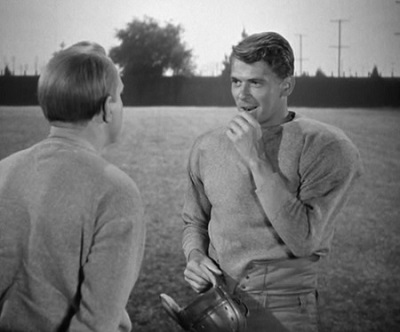
Reagan delivering Gipp's famous speech

Reagan delivering Gipp’s famous speech

His famous sickbed speech was thankfully muted in the film, without crass Hollywood dramatization, and Reagan delivered the lines well: “Rock, some day when the team is up against it, when breaks are beating the boys, ask them to go in there with all they’ve got, win just one for the Gipper. I don’t know where I’ll be then. But I’ll know about it, and I’ll be happy.”

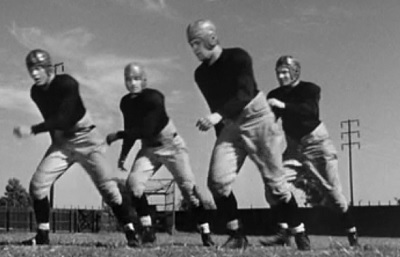
The rest of the movie is, as you would guess by its title, about Rockne rather than his illustrious player: the coach’s dedication to his team, the success of his program, and the sacrifices he made for his athletes. Rockne was renowned not only for popularizing the forward pass, but for his commitment to teamwork over individual talent. Sound familiar, NCAA basketball fans? In a funny scene, Rockne watches chorus girls and takes notes on their performance that will become the famous shift he teaches first his wife, and then his Four Horsemen (the gifted group who led the Fighting Irish to 28 wins and only 2 losses). How like a coach to appreciate the coordination of dancers. We always think of basketball in balletic terms too: seamless passes, graceful turns and fakes, fluid jumps to the rim.

The Four Horsemen mid-shift

The Four Horsemen mid-shift

What I enjoyed most about Knute Rockne-All American was the man himself, especially his unusual, clipped patterns of speech and motion, which Pat O’Brien captures perfectly without ever slipping into parody. (See footage of the real man here.) Rockne’s intelligence is established early on, when a famous chemist in his department tries to turn him into one. But it’s his enthusiasm for his boys that gets you, even when his wife has to go without vacation for 17 years as a result (probably true since his widow was involved with the film and unlikely to forget such a betrayal). When Rockne disappoints his team with a bad decision, the devastation of this loyal coach is painful to watch.

The most celebrated moment in the film is when Rockne repeats Gipp’s words to his players in the locker room during a losing game. The scene is surprisingly understated, even for its time: No close-ups to show tears in the eyes of athletes. No uplifting music except for the muffled marching band in the background. No shouting. It feels less like a moment to rile up the team than the coach’s need to honor a promise. Affected as I was by the speech, I couldn’t refrain my dismay at the ways that modest athlete’s name has been abused since. Reagan—or his PR machine—used the line for political gain repeated times; our most camera-happy chief of state is now referred to as “The Gipper.”

Rockne (O'Brien) delivering Gipp's words

Rockne (O’Brien) delivering Gipp’s words

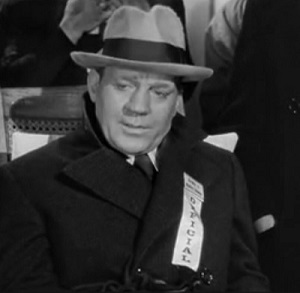
Late in the film, college football is accused of the usual: passing failing students, subsidizing players, subverting the intentions of an education, etc., so Rockne goes to New York to defend his team and football as a whole to a committee of educators investigating the charges. How disturbingly prescient the claims were. But Rockne’s defense is powerful, as when he’s asked whether he changes his athletes’ grades:

“Any player who flunks in his class is no good to his coach, nor to the school he attends. And any coach who goes around trying to fix it for his athletes to become eligible scholastically when mentally they’re not is just a plain everyday fool.”

Shortly afterward, a professor on the committee expresses his skepticism about sports: “Where do these elaborate spectacles of sport fit into the scheme of education?” he says. “How would you grade an average athlete’s contribution to the national intelligence?”

Rockne has spent his life answering this question, and does so now with spirit:
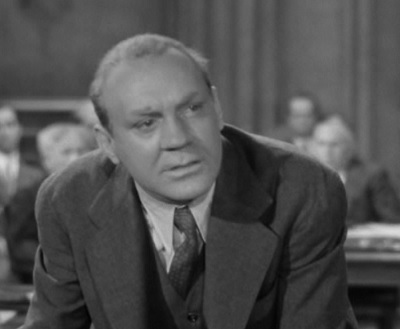
“…To limit a college education to books, classrooms, and laboratories is to give to education too narrow a meaning for modern times….We’ve tried to build courage and initiative and tolerance and persistence, without which the most educated brain of man is not worth very much….Now I don’t know, I don’t know how you grade a boy for learning these things, professor…But wouldn’t it be a good idea not to grade anybody’s contribution to the national intelligence, until all the results are in, maybe five or ten years after graduation, when his record and character are not hung on the wall like a diploma, but inside the man himself?”

Rockne (O'Brien) defending football

Rockne (O’Brien) defending football

I nearly cheered. I wonder if everyone could listen to Rockne’s words with as little cynicism as I did. But year after year, college athletes are among my hardest-working students, and former high school players write that their teams made them less selfish, more mature, stronger leaders, better people. And maybe that explains my bafflement that the New Englanders around me fail to embrace March Madness as I do, maybe thinking of it as only another gambling opportunity, another set of games, just brackets whole or broken. Perhaps they are too disgusted by the power and dollar signs we now associate with the NCAA to watch its most famous tournament, or think because appearances by most of their own teams are rare that it isn’t worth their time.

But I found in Knute Rockne-All American a perfect supplement to my March Madness optimism, which, despite my blues at being away from home, returned with the first upset. There are so few reliable forms of inspiration in our lives, and even fewer that we can experience collectively. But for a short span of weeks, even just a night, we can witness heart and teamwork triumphing over power and ability; we can experience a little school we’ve never heard of and players we’ve never seen get on that floor and ignore the hoopla and the lights and what big money has wrought—and just play. We watch these games expecting to be inspired. And like Rockne’s once-underdog team, with every play, with every goal, whether they win or lose, they deliver.


Share
Posted in: 1940s films, Action & Sports Films, Drama (film) Tagged: college basketball, Film, humor, Knute Rockne, March Madness, NCAA, The Gipper

Like Liz Lemon’s Sugarbaker Meltdown? See Bette Davis in All about Eve

03/20/2014 by leah@carygrantwonteatyou.com Leave a Comment

I always love a comedic meltdown, and 30 Rock‘s Liz Lemon (Tina Fey) is brilliant at them. In one of my favorite episodes, The C Word (Season 1, Episode 14), Lemon tries to earn a reputation as a nice boss by spoiling her staff. Of course, her subordinates quickly exploit her kindness, resulting in an all-nighter to finish their work and one of my favorite breakdowns of all time: Lemon forces her employees to watch a Designing Women episode she taped at 5:30 a.m., hoping to channel Julia Sugarbaker’s (Dixie Carter’s)  strong-willed feminism, but succeeding only in destroying the tape and breaking into hysterics.

LizLemonenraged

Like in a later episode’s meltdown (Season 1, Episode 17), when Jack Donaghy (Alec Baldwin) says Lemon has “gone chicken killer” on him, Fey plays the moment perfectly. I am a Designing Women fan as well, but if Lemon really wanted to see histrionics for the ages, she should have put All about Eve into her VCR instead.

In the film, theater star Margo Channing (Davis) has been generous to her one-time fan, now employee, Eve (Anne Baxter), whom she finds destitute at the start of the story. But slowly, Margo begins to question Eve’s loyalty. Once she suspects Eve of flirting with her boyfriend, Bill (Gary Merrill), Margo begins insulting everyone, essentially sabotaging her own party for him, and it’s hilarious to watch. Early in the night, her friend (the gifted Thelma Ritter) asks, “And there’s a message from the bartender. Does Miss Channing know that she ordered domestic gin by mistake?”

“The only thing I ordered by mistake is the guests,” answers Margo.

And the party’s just the beginning.

BetteDavisenraged

If you want to see rage done right, you can’t do better than Bette Davis, and with a script this perfect, there’s no holding her back. As Addison DeWitt (George Sanders), the drama critic, says about Margo’s increasingly bad behavior as the party progresses, but could just as easily have characterized Davis’s entire performance in the film, “You’re maudlin and full of self-pity. You’re magnificent!”

Share
Posted in: 1950s films, Comedies (film), TV & Pop Culture Tagged: 30 Rock, Bette Davis, humor, Liz Lemon, Tina Fey

Recent Posts

  • 100 Years Later, Still Scary: Dr. Caligari
  • Escaping Out of the Past (1947)
  • A Weeper for Those Who Love Jerks
  • Thank You, Academy, for Not Infuriating Me
  • Challengers (2024) Is a Bad Movie

Subscribe to Blog via Email

Enter your email address to subscribe to this blog and receive notifications of new posts by email.

Categories

  • 1920s films
  • 1930s films
  • 1940s films
  • 1950s films
  • 1960s films
  • 1970s films
  • 1980s films
  • 1990-current films
  • 2020s films
  • Action & Sports Films
  • Anti-Romance films
  • Blogathons
  • Childfree
  • Comedies (film)
  • Drama (film)
  • Feminism
  • Femme fatales
  • Film Noir/Crime/Thriller & Mystery
  • Gloriously Silly Scenes
  • Horror
  • Humor
  • Mae West Moments
  • Musicals and dancing films
  • Oscars
  • Random
  • Romance (films)
  • Romantic Comedies (film)
  • The Moment I Fell for
  • Turn My Sister into Classic Movie Fan
  • TV & Pop Culture
  • Uncategorized
Share
Classic Movie Blog Hub Member

Recent Comments

  • leah@carygrantwonteatyou.com on Meg Ryan’s Fate Foretold in Joe Versus the Volcano
  • Ryan on Meg Ryan’s Fate Foretold in Joe Versus the Volcano
  • leah@carygrantwonteatyou.com on 100 Years Later, Still Scary: Dr. Caligari
  • The Classic Movie Muse on 100 Years Later, Still Scary: Dr. Caligari
  • leah@carygrantwonteatyou.com on 100 Years Later, Still Scary: Dr. Caligari

Archives

  • November 2025
  • September 2025
  • May 2025
  • March 2025
  • January 2025
  • November 2024
  • August 2024
  • July 2024
  • May 2024
  • March 2024
  • February 2024
  • December 2023
  • November 2023
  • October 2023
  • September 2023
  • August 2023
  • July 2023
  • May 2023
  • April 2023
  • March 2023
  • January 2023
  • December 2022
  • November 2022
  • September 2022
  • July 2022
  • May 2022
  • April 2022
  • March 2022
  • February 2022
  • October 2021
  • September 2021
  • April 2021
  • March 2021
  • February 2021
  • December 2020
  • October 2020
  • September 2020
  • July 2020
  • May 2020
  • April 2020
  • March 2020
  • February 2020
  • December 2019
  • October 2019
  • September 2019
  • June 2019
  • May 2019
  • April 2019
  • February 2019
  • January 2019
  • November 2018
  • September 2018
  • July 2018
  • June 2018
  • May 2018
  • April 2018
  • March 2018
  • February 2018
  • January 2018
  • November 2017
  • September 2017
  • August 2017
  • July 2017
  • June 2017
  • May 2017
  • April 2017
  • March 2017
  • February 2017
  • January 2017
  • December 2016
  • November 2016
  • October 2016
  • August 2016
  • July 2016
  • June 2016
  • May 2016
  • April 2016
  • March 2016
  • February 2016
  • January 2016
  • December 2015
  • November 2015
  • October 2015
  • September 2015
  • August 2015
  • July 2015
  • June 2015
  • May 2015
  • April 2015
  • March 2015
  • February 2015
  • January 2015
  • December 2014
  • November 2014
  • October 2014
  • September 2014
  • August 2014
  • July 2014
  • June 2014
  • May 2014
  • April 2014
  • March 2014
  • February 2014
  • January 2014

Meta

  • Log in
  • Entries feed
  • Comments feed
  • WordPress.org

Copyright © 2025 Cary Grant Won't Eat You.

Church WordPress Theme by themehall.com