Cary Grant Won't Eat You

Classic movies for phobics

  • About
  • eBooks
  • Previous Blogathons
Classic movies for phobics

Henry Fonda

A Strange Mess: Mister Roberts

07/10/2014 by leah@carygrantwonteatyou.com 15 Comments

This is a contribution to the John Ford blogathon sponsored by Christianne Benedict at Krell Laboratories and Bemused and Nonplussed. Check out all the marvelous entries!

Punching his leading man. Drinking on the set. Quitting the production after being hospitalized. The tales of John Ford’s behavior on Mister Roberts aren’t pretty, and neither is the film. While some of its flaws can be blamed on its having multiple directors, the failures of Mister Roberts are largely a result of Ford’s decisions. The film is a bizarre mishmash of styles, moods, and genres, full of pointless shots and ludicrous acting. The fact that it was a success rather than a flop is likely due to the stellar performances of three of its stars, Henry Fonda, William Powell, and Jack Lemmon; if you love these three actors, as I do, watch the movie. The scenes between the three of them are compelling. If you don’t, avoid it, for the film is not quite bad enough to be camp, but comes awfully close.
Robertsandcrew
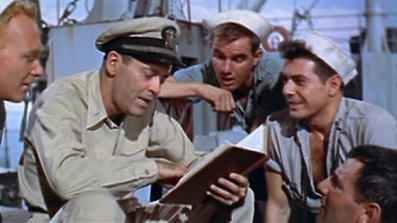
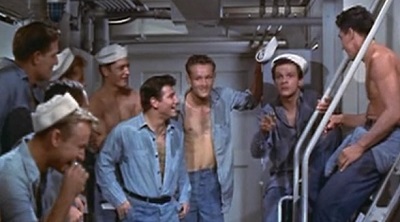
The film is about Roberts’ (Henry Fonda’s) efforts to get into combat in WWII, efforts that are squashed by his cargo ship captain, played by James Cagney. The crew love Roberts for his rebelliousness and his sympathy for their needs. The story is meant to be both moving and comic, but succeeds at neither thanks to Ford’s odd direction. Had I not known that this legend was at the helm, I would have guessed a newbie was having trouble distinguishing between stage and screen. Yes, Mister Roberts was a play, but that doesn’t explain why the crew in the film are practically shouting, or why their hamming reaches such preposterous levels that you have the feeling they’re always gathering to sing a song.
crew2
When they don’t, you feel vaguely uncomfortable, like when a stand-up comedian’s punchline falls flat. What’s even more puzzling is that you can almost see “exit left” printed on the screen because when figures leave the group, the others act as if they’re no longer in earshot. The transitions throughout the film feel forced, with odd shots of ocean and ship that neither advance the narrative, nor contribute to the mood, and the score seems slightly off the entire time.

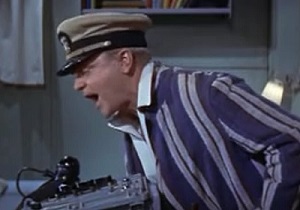
The choice to have James Cagney, who plays the villain of the film, act as if he’s starring in a camp masterpiece was also ill advised. Look, I love my camp. Brainsmasher: A Love Story is one of my favorite movies. But a film doesn’t work when half your cast is taking themselves seriously, and the other acting as if they’re auditioning for a Mystery Science Theater special. Cagney has talent, but you wouldn’t know it from this film. I kept wishing he’d disappear from the screen so that I could stop being embarrassed for him. A character can be ludicrous but still menacing, but Cagney’s bluster in Mister Roberts is merely a caricature of his earlier, meatier roles.
James Cagney as the cruel captain

James Cagney as the cruel captain

And try to forget the depiction of the islanders as soon as you see it. For a moment when I watched them approach the cargo ship in canoes, I thought, Battle!!!

Fordsislanders
I have the feeling that’s what Ford thought too, as it’s one of the few shots that worked in spite of its genre confusion and absurdity. Unfortunately, he moves from there to regular stereotypes:

islanderscloseupFord
Unfortunately, these scenes didn’t have the charms of camp portrayals, such as one of my favorites, the underappreciated parody Joe vs. the Volcano, in which the islanders are all obsessed with orange soda.

Joevsvolcano
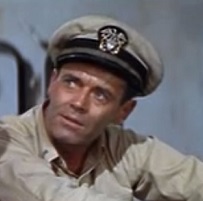
But when Fonda is on the screen, you forget how bad Mister Roberts is. Ford made many mistakes, but his stubbornness in demanding Fonda over the studio’s preferences, Marlon Brando and William Holden, almost outweighs all of his poor choices. In a better movie, this performance could have won Fonda the Oscar, just as he won the Tony for it on the stage.
Fonda
He plays Roberts with such understated dignity, humor, and pathos. Watch his easy leadership of the crew, his posture demonstrating how naturally he takes charge. Witness his subtle deflation once he sacrifices his own ambitions for the sake of that crew. I have never seen Fonda so good in anything. How hard it must have been for him, to have the role that meant so much to him undermined by his own director.

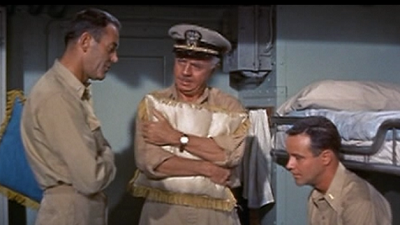
Luckily, there are multiple scenes with Fonda, Lemmon, and Powell.
Henry Fonda, William Powell, and Jack Lemmon

A perfect combination: Henry Fonda, William Powell, and Jack Lemmon

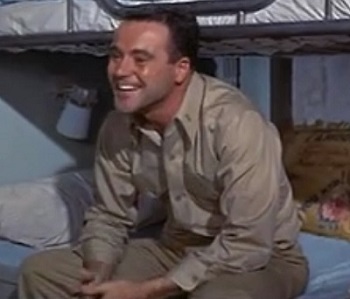
With the crew absent and only a room as background, the three show you what a film this could have been. Lemmon’s performance won him the Oscar. He’s riveting as a cowardly, lazy, sex-crazed ensign who has the potential to be so much more.
Lemmon
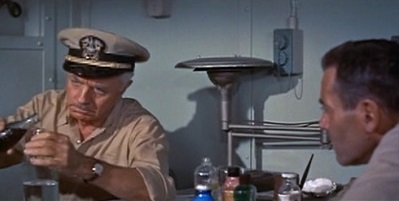
And how do you beat the joy of watching Powell create fake whiskey with utter seriousness, or recount the fake injuries of his crew when they’re avoiding work?
powellandfondawhiskey
As Doc, Powell plays the wise older man with utter perfection. While the film might not have deserved him, it’s truly a wonderful last Hollywood role, and the three have amazing chemistry.

To what extent Ford is to blame for the film’s flaws and not his co-director, Mervyn LeRoy (who was also assisted by Joshua Logan, the play’s cowriter and director), is impossible to exactly determine. But unless he ONLY directed the scenes with Powell, Lemmon, and Fonda, Ford was right to be embarrassed by it.

It’s a good thing he followed it up with one of his masterpieces.

Don’t forget to check out the other John Ford entries in the blogathon!  

Share
Posted in: 1950s films, Action & Sports Films, Blogathons, Comedies (film), Drama (film) Tagged: Henry Fonda, Jack Lemmon, Joe vs. the Volcano, John Ford, Mister Roberts, William Powell

Sherlock Holmes Meets Paris Hilton: The Mad Miss Manton (1938)

03/16/2014 by leah@carygrantwonteatyou.com 12 Comments

This post is part of Movies Silently’s Sleuthathon. Check out other entries on her site!

Imagine pitching this story idea: a Paris Hilton type with a pack of tiny dogs solves a crime New York cops can’t. It sounds like a Beyond Balderdash card, doesn’t it? That couldn’t possibly be a real movie plot. Luckily for us, it is. The Mad Miss Manton stars Henry Fonda and Barbara Stanwyck, but as you might guess, it’s not of the same caliber as their later pairing.  The mystery is ridiculous, the plot convoluted, and the character development all over the place. But who cares? Just let the film be what it wants to be: crazy fun.

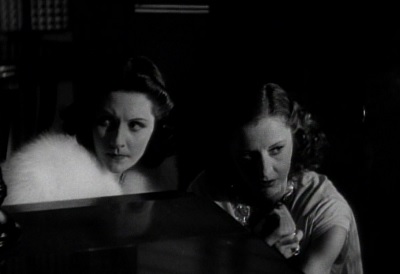
The Mad Miss Manton

The Mad Miss Manton

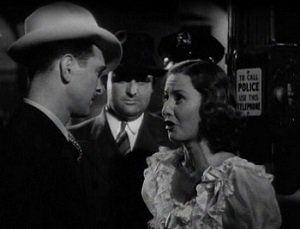
Melsa Manton is a society girl known for “pranks” she claims are in the name of charity. She and her bevy of like-minded friends are suspected of constant mischief, and when Manton finds a body that disappears before help arrives, the police and newspaper editor Peter Ames (Henry Fonda) cry foul. Manton sets out to solve the crime to redeem the reputation of her crew, and along the way, Ames falls in love with her. As you might expect, this loopy story leads to some sticky problems for the filmmakers, but never fear: Philip Epstein is the primary writer, so some of those problems end up being hysterical to watch, including….

The Heroine with the Vanishing Trait—and Pets
Barbara Stanwyck is my favorite actress. She can portray a character who is terrified (Sorry, Wrong Number), sinister (The Strange Love of Martha Ivers), funny (Ball of Fire), or heartbroken (Stella Dallas). But there’s one thing this tough Brooklyn-born actress could not do, and that’s act like a flake. The problem is, without that trait, the beginning of the film is incomprehensible, even in screwball land. You simply can’t buy this woman with a bunch of precious dogs, prancing around the city on pranks or building mansions for her pooches, as Paris Hilton did.

To make the “madness” of Manton plausible, you would need an actress who could play naïve, who could be as trusting as Carole Lombard’s character in My Man Godfrey or Goldie Hawn’s in Seems Like Old Times. Only an actress like that could have pulled off a heroine who is not lacking in intelligence, but is lacking in cynicism. At first, therefore, I thought Stanwyck miscast.

Clearly, I underestimated the audacity of Epstein and his uncredited cowriters as they developed Wilson Collison’s story. Fewer than 10 minutes into the film, Epstein conveniently erases the airhead tendencies that he created in the opening scenes. Now, it seems, Manton is simply misunderstood (forget the film’s title). From the moment she’s on the case, Stanwyck is in familiar territory, fast-acting and thinking, with the assurance she’ll bring to her reporters in Meet John Doe and Christmas in Connecticut.  To illustrate this change in Manton’s character, the screenwriters eliminate all of her dogs. Poof! No Fifis in her apartment. No Fidos tracking her along her crime-solving path.

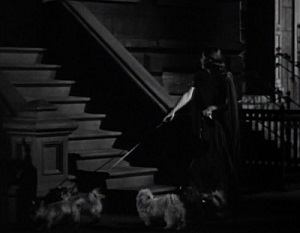
The dogs in one of their last appearances

The dogs in one of their last appearances

I think I fell for this movie when they vanished. It reminded me of the kind of bravado later soap opera writers would emulate in developing their narratives, with conveniently erased back stories and children growing up at Chia Pet speed.

A Bewildering Plot
The Mad Miss Manton is only 80 minutes long, yet I could have sworn it ended twice before it actually did. I felt a little like I used to reading Agatha Christie novels, when she conveniently left out information I needed to solve the crime myself. Who are all these suspects? Why do some of them appear on the screen for a few minutes, then reappear twenty minutes later, without my understanding anything new about them? There are multiple crime scenes, attempts on Manton’s life, ranting scenes by the police lieutenant, a hospital visit, an effort to lure in the killer, and much clue following. And, of course, multiple clips of the suspects that are meant to be illuminating/mysterious. But every time the chaos begins to overwhelm viewers, Manton’s friends rush in and save the film, which brings me to….

An Amazing Crew
I love the “Park Avenue pranksters,” the group of women whose help Manton enlists to solve the crime. My favorite is Pat (Whitney Bourne), who keeps stopping to snack at the crime scenes, à la Shawn Spencer.

Who can beat a troop of friends, armed with flashlights and ermine, creeping through the window of a house the cops have inconveniently locked?

“I found a blood stain,” says one woman, perching on the floor.

“Oh, how can it be blood? It’s blue,” replies Manton.

“Maybe they shot Mrs. Astor,” retorts her friend.

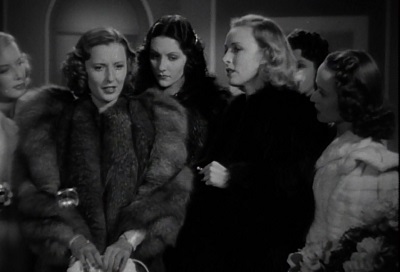
Manton and her "pranksters"

Manton and her “pranksters”

Most of these accomplices are clever, and all are fun and fabulous company. They seem to live an endless string of parties and sleepovers. Unlike Blair Waldorf’s Gossip Girl minions, however, these women are sweet-natured without sacrificing their blistering wit, as when they mock their ringleader for starting to like Ames:

“You know psychiatrists say hate’s just a step away from love,” says one.

“Yeah, but it’s the lull in between that drives you crazy,” replies another.

The film suffers every time the crew leaves the screen.

Distracting Minor Characters
I did not feel the same delight in encountering Manton’s maid, Hilda (Hattie McDaniel). While her sassy replies to her employer are sometimes amusing, it’s difficult to view McDaniel in a maid costume without picturing Mammy from Gone with the Wind, the part she’d win an Oscar for a year later. While this is not the type of servile performance the actress would later be asked to defend, the role is not as progressive (and therefore her part less funny) than we might have hoped.

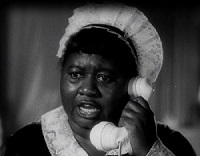
Hilda (Hattie McDaniel)

Hilda (Hattie McDaniel)

The police lieutenant (Sam Levene) sometimes distracts from the story as well. Like one of the suspects (Penny Singleton), Levene is stolen straight from After the Thin Man (which tells you how seriously the director, Leigh Jason, and his writers take the crime itself).

Unfortunately, Levene can’t turn off the beleaguered, badgering tone he used in the earlier film. While his attitude toward Manton initially adds to the humor, his grumbling soon becomes tiresome. Nick Charles could be just as withholding with clues as Manton, but never was treated with such disrespect. Wouldn’t the lieutenant’s opinion of her alter when he discovered her sleuthing skills, even with their class and gender differences?

The lieutenant (Levene) dismissing Manton

The lieutenant (Levene) dismissing Manton

Henry Fonda in Screwball Mode
The only actor who surprised me in this film was Henry Fonda. I’ll admit that I’ve never been a fan; I’d usually rather see someone else in his place: John Garfield in The Grapes of Wrath, Joel McCrea in The Lady Eve.  But Fonda is exuberant in The Mad Miss Manton, so at home with the one liners and silly antics that I kept checking the credits to make sure it was the same man. (Interestingly, Fonda himself disliked the part.) He’s surprisingly confident and attractive as Peter Ames, the editor in love with Manton, and it’s hilarious to watch him trying to romance her, while admitting that he’s enough of a pragmatist to appreciate that she’s rolling in it.

Manton (Stanwyck) and Ames (Fonda)

Ames (Fonda) and Manton (Stanwyck)

The relationship begins in hostility. He’s written an editorial dismissing Manton’s supposedly nonexistent body discovery as one of her group’s “escapades.” She slaps him with her hand and a libel suit on their first meeting. Of course, they start to fall in love from there.

The two take turns outwitting one another in His Girl Friday style (though at a less frantic pace). After Manton agrees to pretend they’re engaged to dupe a suspect, Ames comes to her apartment with champagne to celebrate. “Well, if I want to marry a fortune hunter,” she answers, “I can go to Europe and marry a professional one.”

“I’m determined to make you happy if I have to drag your name through the breach-of-promise courts to do it,” he answers.

It’s startling how suggestive the film is. The two are in her bedroom as she smokes in her nightgown and he gets flustered. She ties him up regularly, and once she even takes off his pants. The love/hate battle between them is exhilarating, and while much of the credit goes to Stanwyck, for once she has an equal sparring partner in Fonda.

As you can tell from my review, this is a far from perfect film. But I would encourage you to embrace it just the same: the disappearing dogs, the ever-changing heroine, the unlikely romance, the bizarre crew, even the occasional joke about communism.  It’s a bit “mad,” but it’s a lot of fun.

Share
Posted in: 1930s films, Blogathons, Film Noir/Crime/Thriller & Mystery, Romantic Comedies (film) Tagged: Barbara Stanwyck, blogathon, Henry Fonda, Paris Hilton, screwball comedy, The Madd Miss Manton

Recent Posts

  • 100 Years Later, Still Scary: Dr. Caligari
  • Escaping Out of the Past (1947)
  • A Weeper for Those Who Love Jerks
  • Thank You, Academy, for Not Infuriating Me
  • Challengers (2024) Is a Bad Movie

Subscribe to Blog via Email

Enter your email address to subscribe to this blog and receive notifications of new posts by email.

Categories

  • 1920s films
  • 1930s films
  • 1940s films
  • 1950s films
  • 1960s films
  • 1970s films
  • 1980s films
  • 1990-current films
  • 2020s films
  • Action & Sports Films
  • Anti-Romance films
  • Blogathons
  • Childfree
  • Comedies (film)
  • Drama (film)
  • Feminism
  • Femme fatales
  • Film Noir/Crime/Thriller & Mystery
  • Gloriously Silly Scenes
  • Horror
  • Humor
  • Mae West Moments
  • Musicals and dancing films
  • Oscars
  • Random
  • Romance (films)
  • Romantic Comedies (film)
  • The Moment I Fell for
  • Turn My Sister into Classic Movie Fan
  • TV & Pop Culture
  • Uncategorized
Share
Classic Movie Blog Hub Member

Recent Comments

  • leah@carygrantwonteatyou.com on Meg Ryan’s Fate Foretold in Joe Versus the Volcano
  • Ryan on Meg Ryan’s Fate Foretold in Joe Versus the Volcano
  • leah@carygrantwonteatyou.com on 100 Years Later, Still Scary: Dr. Caligari
  • The Classic Movie Muse on 100 Years Later, Still Scary: Dr. Caligari
  • leah@carygrantwonteatyou.com on 100 Years Later, Still Scary: Dr. Caligari

Archives

  • November 2025
  • September 2025
  • May 2025
  • March 2025
  • January 2025
  • November 2024
  • August 2024
  • July 2024
  • May 2024
  • March 2024
  • February 2024
  • December 2023
  • November 2023
  • October 2023
  • September 2023
  • August 2023
  • July 2023
  • May 2023
  • April 2023
  • March 2023
  • January 2023
  • December 2022
  • November 2022
  • September 2022
  • July 2022
  • May 2022
  • April 2022
  • March 2022
  • February 2022
  • October 2021
  • September 2021
  • April 2021
  • March 2021
  • February 2021
  • December 2020
  • October 2020
  • September 2020
  • July 2020
  • May 2020
  • April 2020
  • March 2020
  • February 2020
  • December 2019
  • October 2019
  • September 2019
  • June 2019
  • May 2019
  • April 2019
  • February 2019
  • January 2019
  • November 2018
  • September 2018
  • July 2018
  • June 2018
  • May 2018
  • April 2018
  • March 2018
  • February 2018
  • January 2018
  • November 2017
  • September 2017
  • August 2017
  • July 2017
  • June 2017
  • May 2017
  • April 2017
  • March 2017
  • February 2017
  • January 2017
  • December 2016
  • November 2016
  • October 2016
  • August 2016
  • July 2016
  • June 2016
  • May 2016
  • April 2016
  • March 2016
  • February 2016
  • January 2016
  • December 2015
  • November 2015
  • October 2015
  • September 2015
  • August 2015
  • July 2015
  • June 2015
  • May 2015
  • April 2015
  • March 2015
  • February 2015
  • January 2015
  • December 2014
  • November 2014
  • October 2014
  • September 2014
  • August 2014
  • July 2014
  • June 2014
  • May 2014
  • April 2014
  • March 2014
  • February 2014
  • January 2014

Meta

  • Log in
  • Entries feed
  • Comments feed
  • WordPress.org

Copyright © 2025 Cary Grant Won't Eat You.

Church WordPress Theme by themehall.com