Cary Grant Won't Eat You

Classic movies for phobics

  • About
  • eBooks
  • Previous Blogathons
Classic movies for phobics

classic film

ILL, How Do I Love Thee?: A Classic Movie Fan’s Tribute

02/23/2019 by leah@carygrantwonteatyou.com 4 Comments

For years I’ve been grumbling, waiting for streaming access to classics I hear about from other blogs: Letter from an Unknown Woman, The Great Lie, A Foreign Affair. Without a Netflix DVD cache or TCM, the classic movie fan is left with few options, and my brief affair with the Warner Archive had given me little love. Then it occurred to me, like a (clichéd) beacon of light in the night: YOU HAVE ACCESS TO INTERLIBRARY LOAN.

How do I love thee, ILL? Let me count the ways.

  1. You don’t tarry. Within a week, all three films were at my library’s front desk. The student helping me didn’t notice my bated breath or strong desire to do the worm in celebration. Used to her fellow students’ desperate and grumpy research requests, she was unaware of the yummy chocolate cake she was handing over to me. Her loss.
  2. You have so much to offer. Greedy after receiving all three films, I thought I’d dare for my elusive, longed-for white whale of a book. I’d just emailed Grace Collins of True Stories of Tinseltown about our upcoming podcast chat on Mae West and Cary Grant when my long-stamped-out desire resurfaced: Goodness Had Nothing to Do with It. I needed it–obviously–for research. Amazon was charging boatloads of cash for Mae’s autobiography, but was it possible I could get my hands on it for free? YES!!!
  3. You give me so MANY moments to savor. Here is one of hundreds of funny interchanges from Mae’s bio: She’s just put on opening night for her first play in New London, CT in 1926. The house manager is grumbling about the ticket purchases: “The title’s scaring them away. Nobody in this town will buy tickets for a show with the title SEX….We don’t talk about sex hereabouts, and we don’t put it on signs.” Only 85 people show for the first performance, and Mae is feeling blue that the first play she wrote and starred in looks like a bomb. But at the next day’s matinee, she sees lines of men from the naval base “two and three deep,” and the manager is scrambling for extra seats for his theater. “And you said it was a bad title,” observes Mae. And he replies, “I forgot about the sailors.”
  4. You let me savor each moment. On Monday morning, I’d been reading my usual dose of terrifying headlines on CNN. I was feeling blue, and knew I had to banish that mood if I had any chance of cheering my 9 am students, who had been staring at me for days with a peculiar type of hostility they’d developed from years of New England winters—the “how-dare-you-deny-me-another-snow-day, woman” look I knew so well. Naturally, I looked to Mae for mood elevation, and found her defense against the newspaper baron, William Randolph Hearst, who–in the midst of delivering his own era’s brand of terrifying headlines–had written this, “Is it not time Congress did something about Mae West?” Thanks to my generous love, ILL, I got to read Mae’s response: “All I have ever wanted to do is entertain people, make them laugh so hard they forget they’d like to cry.” Such an important reminder to me about the need for humor, dear Mae; you bolstered me the rest of the week. And by Friday? I was enjoying Jean Arthur’s and Marlene Dietrich’s charismatic performances in The Foreign Affair. Oh ILL, how I love thee…..

Share
Posted in: 1930s films, 1940s films, Comedies (film), Drama (film), Humor, Mae West Moments Tagged: A Foreign Affair, classic film, Goodness Had Nothing to Do with It, ILL, Letter from an Unknown Woman, libraries, Mae West, The Great Lie

Sexual Predators in Film: Weinstein, 1937

11/10/2017 by leah@carygrantwonteatyou.com 8 Comments


All this talk of Harvey Weinstein and now Louis C.K. has me thinking about Stage Door (1937), that fascinating film featuring a dormitory of smart-talking women clamoring for parts on the stage, and suffering the sexist overtures of a very slimy producer along the way. The film was produced the same year the words “casting couch” were first published in Variety, according to Matthew Dessem. How the film got made is clear: it’s a feminist anthem against sexual predation, yes, but it’s carefully camouflaged as one of the funniest comedies of its era. Critics praised the witty, fabulous dialogue, ignoring or underplaying the blatant warning directed at female aspirants to stage or screen.

The story begins with Jean Maitland (Ginger Rogers) trying to oust roommate Linda Shaw (Gail Patrick). Jean’s a sarcastic gal from the wrong side of the tracks, too proud and ethical to give into seductions in exchange for parts or furs. Her roommate, however, is an opportunist, and has given up her reputation in exchange for gifts from her wealthy keeper, sables and sapphires she rubs in Jean’s face.
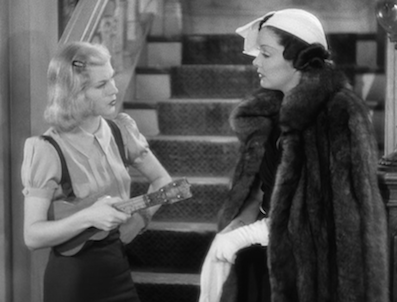

The two separate to achieve peace, but Jean isn’t long for a solitary room; enter her new roommate, heiress Terry (Katharine Hepburn), who wants to star on the stage too. She thinks her peers haven’t made it big yet because they lack ambition. Her slow recognition of her own privilege will become the axis around which the plot revolves. Initially mocked by the dorm residents who resent her for slumming, she does make one friend, Kay Hamilton (Andrea Leeds), the acknowledged talent of the bunch.
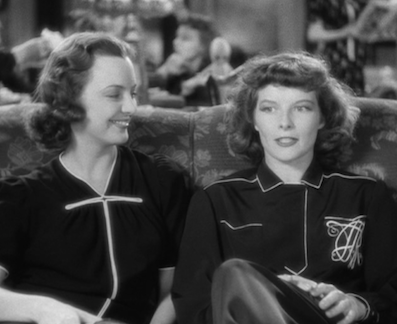

Sympathy and admiration for Kay will lead Terry to understand that her poverty-stricken companions aren’t slackers, but cynics battered by experience. They face obstacles she doesn’t, and have no safety net if they fall.

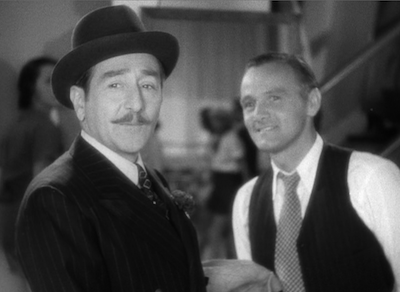
While Katharine Hepburn’s Terry is learning how the hungry half lives, Jean encounters Linda’s lover, Anthony Powell (Adolphe Menjou), who eyes her in an audition. The fact that finding prey is his goal in being a producer is clear, as when he says to a dancing school director, “I very likely won’t produce anything unless I can find an angel. You haven’t seen any flying around, have you?” After an uncomfortable amount of leering at a dancing pair, he asks about “the little blonde.” His pal obligingly offers the information, of course, and soon Jean has unwittingly taken a job given to her so that Powell has access to her charms. We can see in all of these moves a clear pattern: he’s after/has sex with the girl, she gets the role. Jean’s response when she sees Powell and Linda at the club where she’s been hired says everything:
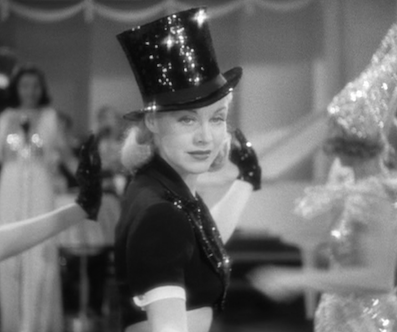

Jean’s barbs at Powell (and at his choice of a mistress) have no effect.
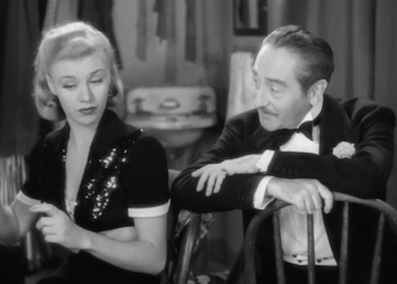

But then Jean decides it’s time to teach her former roommate Linda a lesson, steal her guy. Jean doesn’t plan to have sex with him, but what’ll it hurt her to drink a little champagne, have a meal or two that isn’t stew?

But the bigger reason for dating an undesirable man is evident: If Jean doesn’t play nice, what happens to her job? Her dancing partner, Annie, suggests as much multiple times. When Jean complains about his creepiness, saying she needs a “tin overcoat” as protection, her partner responds, “You should be glad he looked at you at all.”  Jean doesn’t need her partner’s pestering; she knows full well that “…if I don’t go out with him, I’ll probably lose my job, and so will Ann, and I’ll be right back where I started from.”

Of course, Powell has plans of his own: ply Jean with alcohol, tell her a sob story about his life, talk about her name in lights and himself as the reason, and get what he wants. If she isn’t exactly sober enough to consent, what does he care? Creepily, his butler knows just how to disappear. As Linda warns her (to protect her meal ticket), the butler is “deaf,” so she “really won’t have to bother to scream for help.”

Luckily, Jean gets too sad-drunk on the first trip to his penthouse to make his “seduction” fun. He decides she isn’t worth the trouble, but she (too buzzed to catch the drift of their last talk) thinks she’s beginning to like the guy. The next night, when Terry is having an actual business meeting with him in the penthouse (as Weinstein’s actresses thought), Jean charges in.
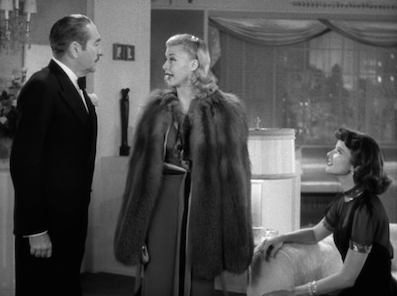

Terry fakes drunkenness and sexiness to keep Jean away from the predator, and it works.
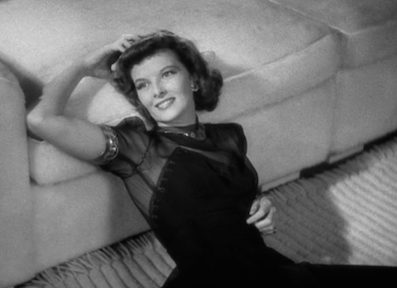

Jean realizes he’s as worthless, creepy, and unfaithful as she initially thought, and leaves. The audience is grateful for Jean’s escape, having seen the disaster Powell leaves in his wake: poor Linda has nothing but trinkets in exchange for sexual favors–gifts not even sizable enough to get her out of that dorm. (How thin is her arrogance!) We know how short Jean’s casting-couch career would be after her favors, given that roving eye. The actress in the story with true talent (Kay) who doesn’t succumb to (and apparently was never offered) the producer’s embraces is literally starving as he puts off her auditions for his dalliances, and will soon reach an even sadder fate.

I kept thinking of Terry when the Weinstein revelations came out, not just because she was brave in the story, but because she could be. Of course, Terry too is the object of male manipulation. The only reason she’s up for a part is her father’s secret meddling (He’s finagled her starring role so that she’ll fail and realize she should come home and marry a rich boy like a good little girl. Nice support, huh?) Although she does have a disgustingly condescending father, Terry is safe. That money gives her power of her own, and she can afford to confront the Anthony Powells of this world. It’s really the lesson of the Weinstein story, isn’t it? Predators go after those with no power, so those with it have to be the ones to stand up. And not just men, but female stars, the Meryl Streeps, who have status of their own and can be immune from predators’ hushing machinations. Several media outlets have justifiably called out the male actors and directors who did nothing about Weinstein, and the employees, like that pal in Stage Door, who abetted the behavior. But I’m disappointed too in the prominent women, those who weren’t personally affected, but could have done something…and didn’t. (Streep claims she didn’t know; even if she didn’t, others with star power did.)

At first I thought that the sexual predator storyline and feminist response to it were from Edna Ferber, a friend of Hepburn’s and the original play’s cowriter. Ferber may have been inspired by memories from childhood, I reasoned. According to Janet Burstein, Ferber learned about men’s less pleasant side in her youth, when everyday wants meant she “had to run a gauntlet of anti-Semitic abuse from adult male loungers, perched on the iron railing at the corner of Main Street, who spat, called her names, and mocked her in Yiddish accents.” That disgust on Jean’s face when she spots the way Powell looks at her? Yeah, that’s written by an author who knows. But the play Ferber cowrote was completely redone for the screen by Morrie Ryskind and Anthony Veiller. And according to some sources, the movie’s verisimilitude has less to do with the screenwriters than with Gregory La Cava, who sought the stories of and the funny dialogue of the women he directed, and encouraged improvisation. But then again, the stories of such men were everywhere, then and now, and needed no writer to reveal the behavior. Anyone watching and listening–as La Cava apparently did–could hear and expose them.

I hope one day this film–and La Cava–get more credit for the kind of heroic feminism we see so rarely on the screen or in life. Eighty years ago, this film exposed the terrible repercussions of sexual predation, and instead of suggesting that victims should be blamed for not standing up–as even current headlines do–put the responsibility squarely on the man at fault. More, it gave a path for correction, by showing who could do something to fight back, and revealing the privilege that might blind him/her to what was really going on. How many films in the decades since have done the same?
Share
Posted in: 1930s films, Comedies (film), Drama (film), Feminism Tagged: classic film, films about sexual predators, Ginger Rogers, Harvey Weinstein, Katharine Hepburn, Louis C.K., Stage Door, the casting couch

Happy Films: You Were Never Lovelier (1942)

05/22/2016 by leah@carygrantwonteatyou.com 12 Comments

YouWereNeverLovelier
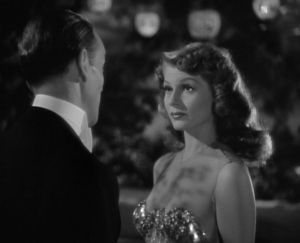
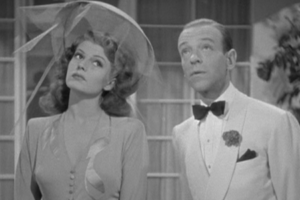
When asked to pick a film that I’d equate with ice cream for a sweet-inspired blogathon, I recalled the Rita Hayworth-Fred Astaire confection, You Were Never Lovelier. The plot is so silly: a sexist father, Eduardo Acuña (Adolphe Menjou), creates an imaginary secret admirer for his daughter, Maria (Rita Hayworth). He thinks he can handpick her suitor and pretend the boy is writing the love notes he himself is penning. But Maria mistakes a dancer, Robert (Fred Astaire), for her admirer, and much confusion ensues. It’s hard to explain why a story like this could win over its audience, especially since Maria is ridiculously susceptible, Robert directionless, and the film’s portrayal of Argentinians fantastical. And yet….What’s the primary feeling while watching? Utter delight. Try to watch it without grinning, rewinding, and pressing play again.

Why, you might ask?

Well, here’s our hero, Robert (Fred Astaire), dancing on a desk to protest Acuña’s refusal to consider him for his nightclub:

https://carygrantwonteatyou.com/wp-content/uploads/2016/05/AstaireYouWereNeverLovelier-sc.mp4

There’s the very funny meet cute between Robert and Maria, an encounter that doesn’t go well thanks to some snarky remarks by the former, who doesn’t know who she is.

MeetCute-YouWereNeverLovelier
And there’s the heavenly dancing. Within one scene Rita Hayworth and Fred Astaire make you forget the implausibility of the story because these are two of the most expressive dancers ever. From their first dance in, you’re entranced by their characters’ romance. How could you not be convinced, after watching them together?

https://carygrantwonteatyou.com/wp-content/uploads/2016/05/RitaandFred.mp4

The sweet, Oscar-nominated score is lovely, and the songs are catchy. “I’m Old-Fashioned” always makes me smile. Listen to Ella Fitzgerald’s version, or even better, watch a much longer clip than I’ve posted here at TCM, with Hayworth lip syncing it (sung by Nan Wynn) to Astaire’s Robert.

And that’s just one scene. I envy all of you who haven’t seen this film. You’re in for a treat.

This post is part of the Classic Movie Ice Cream Social, hosted by Fritzi of Movies Silently: a celebration of those movies and recipes that make us smile.

Share
Posted in: 1940s films, Blogathons, Comedies (film), Musicals and dancing films, Romantic Comedies (film) Tagged: best dancing movies, classic film, feel-good film, Fred Astaire, musicals, Rita Hayworth, You Were Never Lovelier

5 Classic Movie Resolutions

01/03/2016 by leah@carygrantwonteatyou.com 6 Comments

My regular resolutions are never met (or are so ambiguous I can’t tell if they have been), so this year I’m setting some for this blog. Who knows? I may even honor them. Here goes:

  1. More noir. I have so many great sources for recs that I’m not sure why I don’t watch or review more noir than I do. Perhaps since I eat Chandler, Hammett, and MacDonald books like candy, I reserve my film time for lighter fare. But given all the fascinating connections between recent TV shows & noir I’ve noticed just this year, I’m neglecting far too many writing opportunities.
  2. Lesser-known classics. I rely heavily on Amazon Instantly. This choice is idiotic considering the limited scope of their fare and my extensive access to free sources, including Sister Celluloid.
  3. More blogathons, including, hopefully, one I host.
  4. Fun with series. Obviously, the Mae West Moments will continue because…Mae West! Given how much I’ve enjoyed my time with West, I’m dreaming up more series.
  5. Jeff Rapsis Time. I’ve viewed silents It and The Last Command with live music, but when someone as talented as Rapsis is creating musical scores near me, why am I not attending silents more often?

So that’s it! My hopefully manageable goals for classic film viewing & writing in 2016. What are yours?

Share
Posted in: Random Tagged: blogging goals, classic film, New Year's, resolutions

5 Classic Film Costume Ideas–& What They’ll Be Mistaken for

10/27/2015 by leah@carygrantwonteatyou.com 2 Comments

Inspired a fashion blogger’s posts on Halloween options, I started thinking about potential costumes from classic film. I have recs for those of you stuck for ideas. Sure, your peers who don’t know the classics will mistake the character you’re playing, but if the costume is sharp, fun, or clever, who cares? Here are five suggestions:

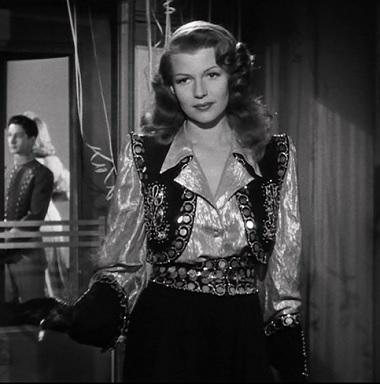
Gilda‘s Carnivàle Outfit

RitaCarnivaleoutfit-Gilda
The heroine’s (Rita Hayworth’s) stylish get-up has two major advantages:

  1. It’s fabulous.
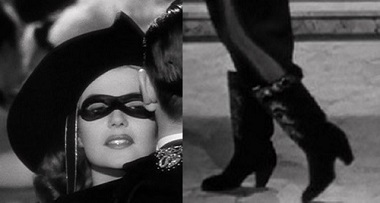
  2. It has wonderful accessories:

GildaCarnivaleaccessories
You’ll Likely Be Mistaken for:
Zorro’s love interest

Jezebel‘s Red Dress

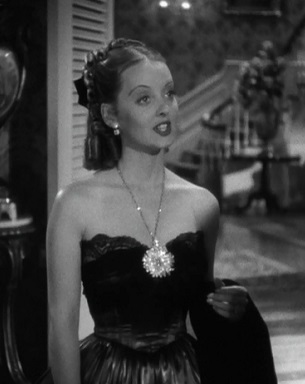
Jezebel-BetteDavis
Who hasn’t wanted to wear the dress that stops everyone short? And what gown in film had more impact than the one that branded Julie (Bette Davis) a fallen woman in front of her whole society? Plus, the dress is gorgeous.

You’ll Likely Be Mistaken for: A devil without her pitchfork, a bad angel sans wings, or just a gal who wants an excuse to wear an Oscars dress

The Disastrous Dress from Rebecca

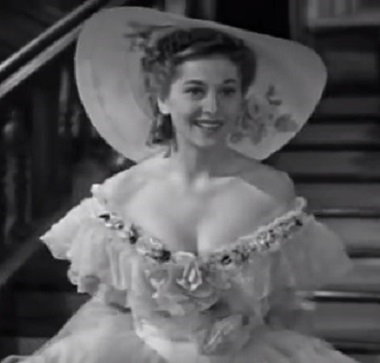
RebeccaJoanFontaine
The gown is a bit frilly, but putting on Rebecca’s character for the creepiest night of the year? Yeah, you could get into that. Of course, you could play it meek too, acting as the narrator, since both pick the same dress for the masquerade. Up to you. Some crinoline, a hat, some flowery details–you’ll have it.

You’ll Likely Be Mistaken for: Scarlett O’Hara (It’s a poofy dress. Who else could you be?)

Phyllis Dietrichson from Double Indemnity

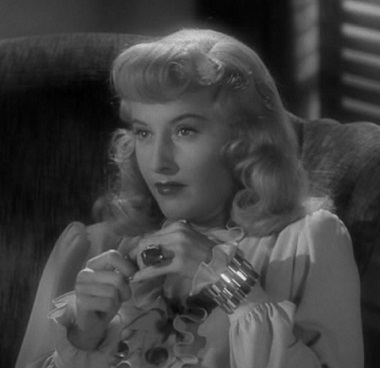
PhyllisDoubleIndemnity-Stanywck1
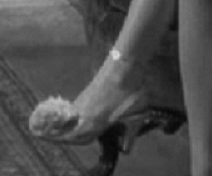
This is the budget option. As any smart Halloween shopper will tell you, you should skip the all-in-one packages in the costume store, and take a tour down the accessory aisle. Anyone can discover a sweater set or fussy dress at home or in the vintage shop. And it isn’t hard to find a wretchedly, embarrassingly bad blonde wig for less than twenty bucks, or some gloriously tacky jewelry. You might even have some from last year’s festivities. Just don’t forget those crazy feminine shoes–and, of course, the anklet:

PhyllisankletDoubleIndemnity
The best part? If you wear a wig–any wig–on Halloween, you really can’t go wrong.

You’ll Likely Be Mistaken for: George Washington or his wife Martha in modern gear (as was Barbara Stanwyck).

Shanghai Lily

ShanghaiExpress
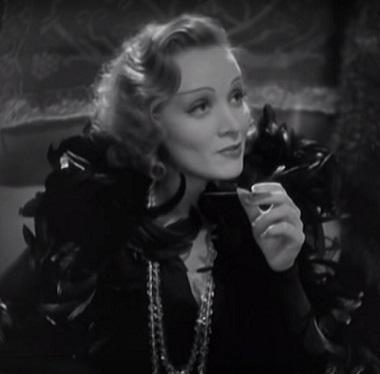
If you don’t gush over the fashions in Shanghai Express, head straight to the optometrist. Prostitutes in ’30s Shanghai had quite the budget, if Lily (Marlene Dietrich) is any indication. She’s costumed to the hilt in boas, feathered caps, furs, long gloves, and silk. For any woman who wants glamour in her life, Lily’s style is salivation material.

You’ll Likely Be Mistaken for: A generic femme fatale (close!)

There you have it. Five options for those seeking Halloween inspiration. What are favorites of yours?

Share
Posted in: 1930s films, 1940s films, Comedies (film), Drama (film), Humor, Random Tagged: classic film, costume ideas, Halloween

Recent Posts

  • 100 Years Later, Still Scary: Dr. Caligari
  • Escaping Out of the Past (1947)
  • A Weeper for Those Who Love Jerks
  • Thank You, Academy, for Not Infuriating Me
  • Challengers (2024) Is a Bad Movie

Subscribe to Blog via Email

Enter your email address to subscribe to this blog and receive notifications of new posts by email.

Categories

  • 1920s films
  • 1930s films
  • 1940s films
  • 1950s films
  • 1960s films
  • 1970s films
  • 1980s films
  • 1990-current films
  • 2020s films
  • Action & Sports Films
  • Anti-Romance films
  • Blogathons
  • Childfree
  • Comedies (film)
  • Drama (film)
  • Feminism
  • Femme fatales
  • Film Noir/Crime/Thriller & Mystery
  • Gloriously Silly Scenes
  • Horror
  • Humor
  • Mae West Moments
  • Musicals and dancing films
  • Oscars
  • Random
  • Romance (films)
  • Romantic Comedies (film)
  • The Moment I Fell for
  • Turn My Sister into Classic Movie Fan
  • TV & Pop Culture
  • Uncategorized
Share
Classic Movie Blog Hub Member

Recent Comments

  • leah@carygrantwonteatyou.com on Meg Ryan’s Fate Foretold in Joe Versus the Volcano
  • Ryan on Meg Ryan’s Fate Foretold in Joe Versus the Volcano
  • leah@carygrantwonteatyou.com on 100 Years Later, Still Scary: Dr. Caligari
  • The Classic Movie Muse on 100 Years Later, Still Scary: Dr. Caligari
  • leah@carygrantwonteatyou.com on 100 Years Later, Still Scary: Dr. Caligari

Archives

  • November 2025
  • September 2025
  • May 2025
  • March 2025
  • January 2025
  • November 2024
  • August 2024
  • July 2024
  • May 2024
  • March 2024
  • February 2024
  • December 2023
  • November 2023
  • October 2023
  • September 2023
  • August 2023
  • July 2023
  • May 2023
  • April 2023
  • March 2023
  • January 2023
  • December 2022
  • November 2022
  • September 2022
  • July 2022
  • May 2022
  • April 2022
  • March 2022
  • February 2022
  • October 2021
  • September 2021
  • April 2021
  • March 2021
  • February 2021
  • December 2020
  • October 2020
  • September 2020
  • July 2020
  • May 2020
  • April 2020
  • March 2020
  • February 2020
  • December 2019
  • October 2019
  • September 2019
  • June 2019
  • May 2019
  • April 2019
  • February 2019
  • January 2019
  • November 2018
  • September 2018
  • July 2018
  • June 2018
  • May 2018
  • April 2018
  • March 2018
  • February 2018
  • January 2018
  • November 2017
  • September 2017
  • August 2017
  • July 2017
  • June 2017
  • May 2017
  • April 2017
  • March 2017
  • February 2017
  • January 2017
  • December 2016
  • November 2016
  • October 2016
  • August 2016
  • July 2016
  • June 2016
  • May 2016
  • April 2016
  • March 2016
  • February 2016
  • January 2016
  • December 2015
  • November 2015
  • October 2015
  • September 2015
  • August 2015
  • July 2015
  • June 2015
  • May 2015
  • April 2015
  • March 2015
  • February 2015
  • January 2015
  • December 2014
  • November 2014
  • October 2014
  • September 2014
  • August 2014
  • July 2014
  • June 2014
  • May 2014
  • April 2014
  • March 2014
  • February 2014
  • January 2014

Meta

  • Log in
  • Entries feed
  • Comments feed
  • WordPress.org

Copyright © 2025 Cary Grant Won't Eat You.

Church WordPress Theme by themehall.com