Cary Grant Won't Eat You

Classic movies for phobics

  • About
  • eBooks
  • Previous Blogathons
Classic movies for phobics

Billy Wilder

Jack Lemmon & Restraint
03/31/2017 by leah@carygrantwonteatyou.com 8 Comments


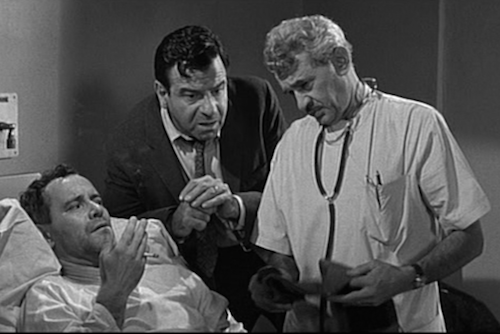
Of course I’ve been dying to see The Fortune Cookie (1966). Who wouldn’t want to view the first pairing of Jack Lemmon and Walter Matthau, the two whose seamless chemistry led to almost 30 years of hilarious cinematic repartee?

Matthau won his only (!) Oscar for the role of Willie Gingrich, an ambulance chaser who capitalizes when his brother-in-law, sports cameraman Harry Hinkle (Lemmon), gets injured by a football star running a play. Look at the people Gingrich can sue! The TV station! the Cleveland Browns! Of course, Hinkle was barely hurt, but an old injury might appear new, and thus enriching. If only Gingrich can get his brother-in-law to go along, he’ll be a millionaire! Of course, there are obstacles: his brother-in-law’s stupid scruples, for example, are holding up the path to gold.
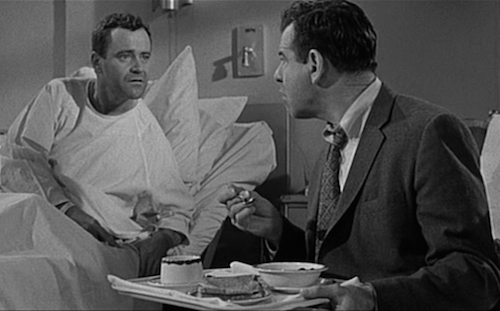

Luckily, Gingrich has an ace up his sleeve: Hinkle never got over his ex-wife, Sandy (Judi West), and she’s an anxious for the dough as Gingrich is.

Gingrich is a magical character, a monstrous anti-hero whose avarice is fascinating to witness. He’s Saul Goodman with an even darker sense of humor. I particularly love when he calls Sandy, saying he’s glad to have her as part of the “organization” conning the Browns (not to mention fooling her ex with fake affection). His children interrupt the call, prompting Gingrich to yell out (with a straight face), “Why don’t you kids go play on the freeway?”

Gingrich’s reaction to love getting in the way of profit is typical of him:
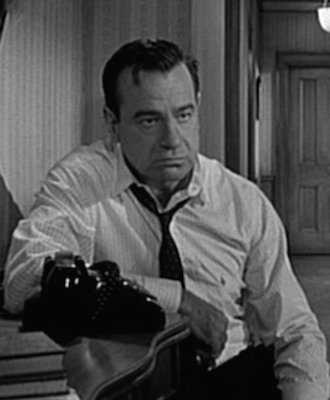

His hope to avoid his kids is displayed from the start of the film; his face dims when they’re present, but glows when opportunity arises. He’s only animated when they skate away:
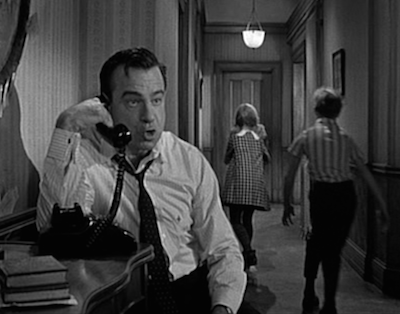

With Gingrich on the screen, you can’t look away, and he’s in nearly every scene. Why he was considered “supporting” and Lemmon the star is one of those mysteries of Oscar nominations no one outside of the industry ever understands.

In terms of plot, not much else happens. Hinkle agrees to fake a grave injury to win back his wife, who pretends better motives for her return in order to get at the money. ‘Boom Boom’ Jackson (Ron Rich), the player who hit Hinkle, slowly falls to pieces about what he thinks he’s done, to Gingrich’s delight (verisimilitude!) and Hinkle’s growing horror. What happens by the end of the movie, most viewers could predict, but given that Billy Wilder is the director and cowriter (with I.A.L. Diamond), there are wonderful twists along the way.

What’s notable about Lemmon’s performance is its generosity. Lemmon can play, often did play, a ham. His first Oscar, over a decade before, was for his scene-stealing, exuberant character in Mister Roberts. Yet here he is, ceding every scene to Matthau, and letting the latter’s role glitter just enough for his supporting Oscar. A less confident, thoughtful, or serious actor would have made Hinkle showier. But not Lemmon. When Hinkle finally stands up to Gingrich, we do see the dam of the character’s (and Lemmon’s) restraint burst, but only briefly, and even then, the goofiness pales in comparison to Matthau’s darkly funny turn as Gingrich. And as we all know, Lemmon only pales when he feels like it. Hinkle’s character is a subdued, passive one, and Lemmon never forgets it.

When I decided to join the Lemmon blogathon hosted by Crítica Retrô and Wide Screen World, I wondered which Lemmon I would see in The Fortune Cookie: the desperate and dark type he captures in Glenglarry Glen Ross, but this time played for humor? The sarcasm he spins in The Out of Towners? The nearly shrill silliness of his role in Some Like It Hot? How many actors has Lemmon been, just as a comedian?

Given how fun his banter typically is with Matthau, I expected to see the two out-goofing one another here. But I find it charming to discover something else: a realism to their dynamic, a sort of half-tolerant contempt that rings true for two characters joined by a marriage rather than by love or blood. A willingness (in real life) for one artist to help out another—in this case, Lemmon aiding Matthau with his one and only Oscar win. Their dynamic is definitely less fun than at the height of their powers in the wonderful Grumpy Old Men. Yet there’s something sublimely sweet about where it all started, and–though I didn’t think it possible–that makes me love Lemmon all the more.

For wonderful tributes and analyses of Lemmon’s work, check out the Jack Lemmon blogathon hosted by Le at Crítica Retrô and Rich of Wide Screen World.

Share
Posted in: 1960s films, Blogathons, Comedies (film) Tagged: ambulance chaser movie, Billy Wilder, characters like Saul Goodman, first film with Matthau and Lemmon, Jack Lemmon, review, The Fortune Cookie (1966), Walter Matthau

The Spirit of St. Louis (1957): Enthralling & Infuriating

10/23/2015 by leah@carygrantwonteatyou.com 10 Comments

Lindberghtakeofffilm2
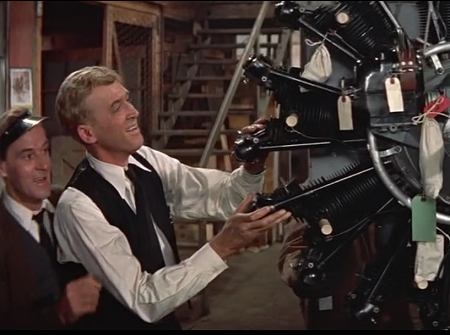
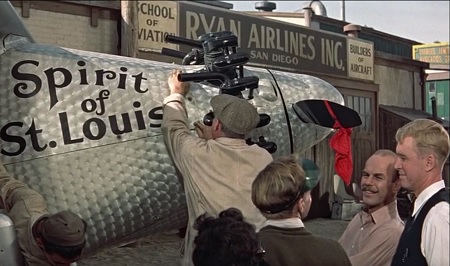
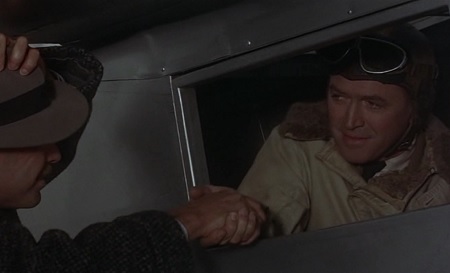
The first half of The Spirit of St. Louis, Billy Wilder’s ode to Charles Lindbergh, is engrossing. It’s even that rarest of traits in a biopic: fairly accurate. The scenes of his airmail days capture the impossible bravery of America’s early pilots and the primitive conditions under which they flew. Wilder conveys each stage of Lindbergh’s struggle beautifully: The search for funding and a plane for the epic NY-Paris flight, the near-universal doubts about his fitness for the attempt, the rush of finally finding a team to build that plane, as eager to prove themselves as he was.

RyanAirlines4
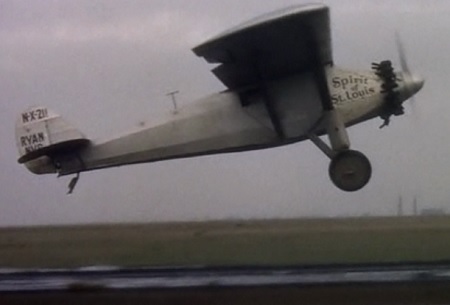
Until just after that terrifying take-off, I couldn’t believe the film hadn’t earned more praise than it had.

SpiritofStLouis6
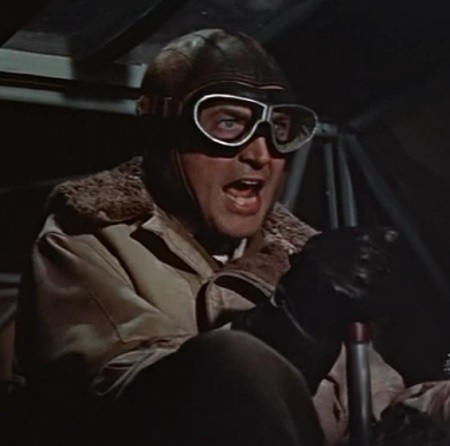
That’s why the clunky transition into the flight–Lindbergh (Jimmy Stewart) gabbing with a fly–shocked me enough to stop the film, ponder what had gone wrong.

Lindbergh-anttalkfilm2
It wasn’t the cheesiness of the fly talk; after all, Raymond Chandler had managed to make a similar conversation in The Little Sister downright poetic. It was that everything about the first twenty minutes of the famous flight confirmed my fears: Wilder would definitely fail to make 30+ hours of sleep deprivation interesting, and his attempts to do so would not only grossly misrepresent his subject’s character, but Lindbergh’s whole purpose for making the journey.

Given, Wilder had quite an obstacle: How do you convey hours of reflection without awkward voiceovers? How do you enlighten viewers about the brilliant, reserved, limelight-averse, notoriously elusive Lindy with so little narrative space? That’s why Stewart was chosen, I thought. Wilder must have hoped the actor’s folksy geniality would while away the minutes, make us forget that the star was twice Lindy’s age, and about 100 times as charming. (If you doubt this comparison, check out Bill Bryson’s hilarious depiction of Lindbergh’s social awkwardness in One Summer: America, 1927.) The autobiography on which the film was based illuminates just how much Wilder miscalculated, and just how his still very worth viewing first half could have been redeemed in the second.

The Flashbacks

SpirtofStLouisflashbacks
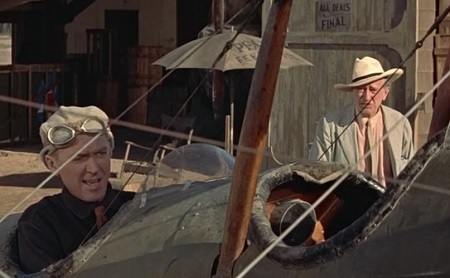
The Pulitzer Prize-winning book moves from flight to memory throughout, as the film does, but the latter’s flashbacks have a homespun, aw-shucks feel to them, with Lindbergh as a kind of lovable oaf who survives only due to luck. In one flashback, he buys a plane he can’t fly, utterly unconcerned about his lack of skill. The scene plays for comic relief, but painfully reinforces everything that Lindbergh stood against: recklessness.

Lindbergh was daring, yes, but cautious and calculating. When the flashbacks begin to appear in the book, he uses them not to illustrate character or give the reader a lovable feeling toward him. No, they explain his success. Here’s a moment of danger, and here’s the experience that prepared him for it: earlier escapes, his training as an instructor, his previous discoveries of flaws with his planes. His whole mission was to disprove that air travel was suicidal daredevilry because otherwise why pave runways? Why install lights for landings? Why allot money for research and development?

When Stewart actually pored half the canteen of water on his face—twice! —I nearly shouted at the screen. The real man was apportioning his own water in dribbles. Had anyone involved with the writing of the film read the book? “Lucky” Lindy put more thought into one move above or below the clouds than the writers did into his entire characterization. (Wendell Mayes co-wrote the screenplay with Wilder, and Charles Lederer was given adapting credit.)

Was Lindbergh lucky? Of course. But that isn’t the primary reason he succeeded. His competitors for the NY-Paris flight–those few who survived–were hundreds of miles off course, with safety features and luxuries he lacked. Lindbergh landed on his intended airfield early based on dead reckoning—no radio, no sextant, no help. How disappointing that the filmmakers would buy the “Lucky Lindy” headlines, and miss the far more interesting man.

The Moments of Danger

JimmyStewartLindberghscared
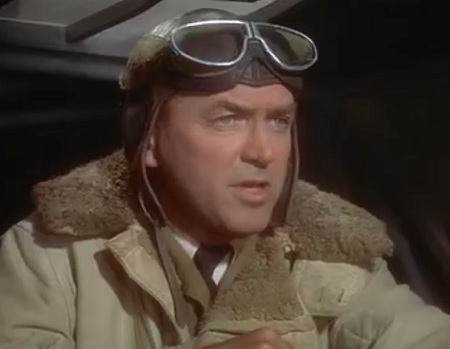
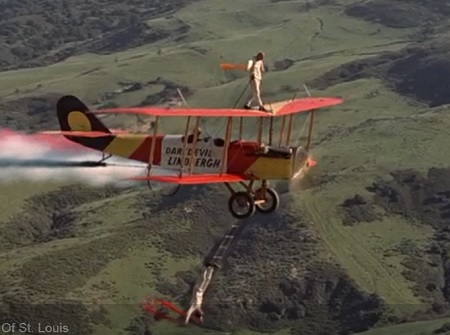
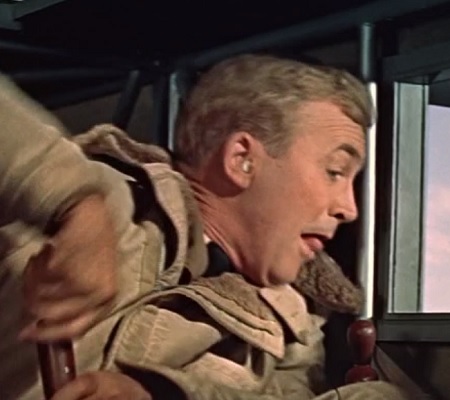
Lindbergh almost died innumerable times on that flight across the ocean, but Jimmy Stewart’s wide-eyed panic in no way captures Lindbergh’s icy calm. Interestingly, the pilot forced himself to calculate how to handle various frightening scenarios not out of panic, but to stay awake. He discovered that pleasant thoughts soothed, and thus led him to sleep. Plans to land on Arctic waters kept him alert—and alive. If Lindbergh really were as shot through with anxiety as the film implies, how could he have been a professional parachuter, as he was at the start of his career? A wing walker? (Tellingly, Lindbergh even dismisses the dangers of this part of his history, analyzing how safe both jobs could be with the right team.)

Lindberghaswingwalker

Oh, Jimmy…
I love Jimmy Stewart. Maybe if it were just the age, or the accent, or the personality. But it was everything: The talking aloud. The boisterous shouts. There’s a deafening, tone-deaf, overacting feel to nearly every word in the second half of the film.

JimmyStewartoveractingLindbergh
Lindbergh was not Jefferson Smith or George Bailey. Effusiveness, goofiness—how widely these traits miss the quiet, introspective, highly scientific man that Lindbergh apparently was. I suspect this hamming was under protest: Stewart’s own distinguished flying record in WWII suggests he was far too acquainted with pilots to misstep this badly without directorial intervention.

Perhaps I wouldn’t have been so disappointed in the depiction of the flight, had the film not been so brilliant in the first half. But I kept thinking about what could have been: What if the film had ended at takeoff? Why try to put onscreen so much of a reflective book? Like The Great Gatsby, another notoriously hard to film text, the ideas are paramount here: Lindbergh’s meditations about God, about power, about nature and loss and risk.

Michael Powell and Emeric Pressburger could have attempted an arty take on Lindbergh’s thinking. But Wilder, the storytelling genius, should have stuck to action, and let us end with that lovely image that he conveyed so perfectly: of Lindbergh weighing the current against forecasted weather, his chance to beat the competitors versus his sleeplessness, the muddiness of the airfield versus its length, and then deciding to go, and with a few laconic words to the panicked faces around him, pushing off into the sky.

SpiritofStLouisTakeoff-film
This post is part of the Classic Movie Blog Association’s fall blogathon. Go here for fantastic entries on films highlighting planes, trains, and automobiles. You can also find an eBook version of the blogathon with many of the group’s entries, including mine, at Smashwords (for free) or Amazon for. 99. All funds for the latter go to the National Film Preservation Foundation.

Share
Posted in: 1950s films, Action & Sports Films, Blogathons, Drama (film) Tagged: Billy Wilder, Charles Lindbergh, Film, Jimmy Stewart, Ryan Airlines, Spirit of St. Louis

Some Like It Hot: Only for Men?

01/18/2015 by leah@carygrantwonteatyou.com 19 Comments

I know that the field of comedy has always been dominated by men. It’s no surprise that when humorous films are ranked, those most amusing to men lead the pack. But I still find it disturbing that the film the AFI considers the funniest of all time is one that gives me just a few laughs in its two hours of running time.

I’m willing to admit that I might be missing something in Some Like It Hot; after all, many women whose judgment I respect are fans of it, and I am an enthusiastic viewer of most of Billy Wilder’s work. But for what it’s worth, I’d like to vent a bit about why (for mainly gender-related reasons) I find this film that sounds so promising—two male musicians acting like women in order to travel with an all-female band—so annoying.

Daphne/Jerry (Jack Lemmon’s character): By Turns Annoying & Creepy
The script doesn’t help, but Lemmon is largely to blame for a very unfunny portrayal of a man turned on by his fellow female band members. His suggestive comments range from grating to disturbing, and his hyena laugh is Jim Carrey-annoying.

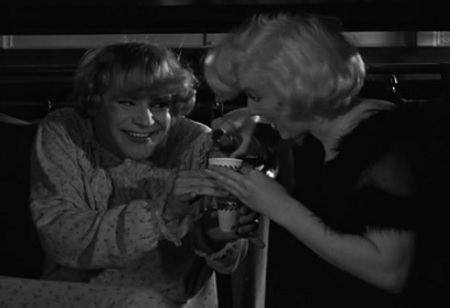
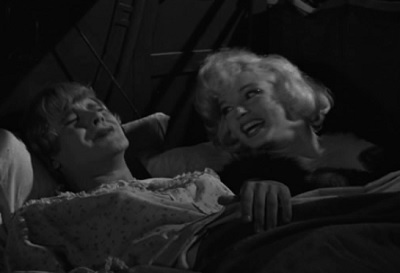
Take this scene: Jerry is in bed in his cross-dressing gear (i.e., as Daphne), when Sugar Kane (Marilyn Monroe) visits his train berth to thank him for a favor.

After the two get some drinks, Jerry says, “This may even turn out to be a surprise party.”
“What’s a surprise?” she answers.
“Not yet.”
“When?”
“Better have a drink first.”
“That’ll put hair on your chest.”
“No fair guessing.”

He then protests other women crashing his party, as it’ll ruin his surprise. I tried not to examine the logic of this scene too closely, but unfortunately, Lemmon’s delivery added to my initial reaction. Does this face look like seduction to you?

LemmonandMonroe-trainberth
If there were any hint of self-deprecation here, any understatement, the scene might have played as lighthearted, with a hint of, I don’t know, possible participation from Monroe. But with Lemmon’s high-pitched, broad delivery and leer, I felt uncomfortable, not amused. Look, this isn’t It’s Always Sunny in Philadelphia, in which the humor is based on the immorality of its leads. We’re supposed to empathize with this man, not wish to warn Sugar Kane there’s a pervert on the loose.

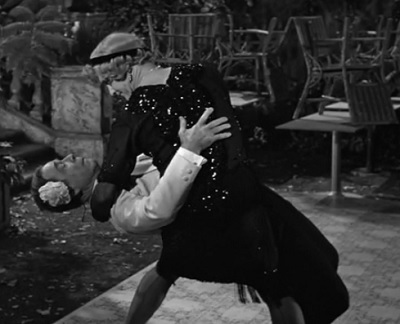
Once Lemmon is being courted by a man and his energy dissipates into snarly comments and stiff movements, he’s quite amusing. I particularly enjoyed when he starts to really get into his gender ambiguity as he dances.

LemmontangoingSomeLikeItHot
I just wish we could have had more of that and less of his flirtatious mood with Sugar and the other band members.

Joe/Josephine (Tony Curtis) a Bore—Until He Becomes a Pseudo-Millionaire
I’m not a fan of Tony Curtis’s. With the exception of Sweet Smell of Success, I tend to dislike his films, finding him too smugly pleased with himself, too much the “Matthew McConaughey of his generation,” as my sister puts it. While his low-key portrayal in Some Like It Hot is a welcome break from Lemmon’s energy, he takes his lethargy too far. It seems watching Lemmon’s hypercaffeinated performance caused Curtis to nap his way through the script.

But once Curtis (as Joe) ditches the dress and takes on a different costume, he is quite amusing. He has dressed himself in what he deems sophisticated clothing, complete with a cap and metal buttons. He wants to convince Sugar he’s from old money.

CurtisandMonroe
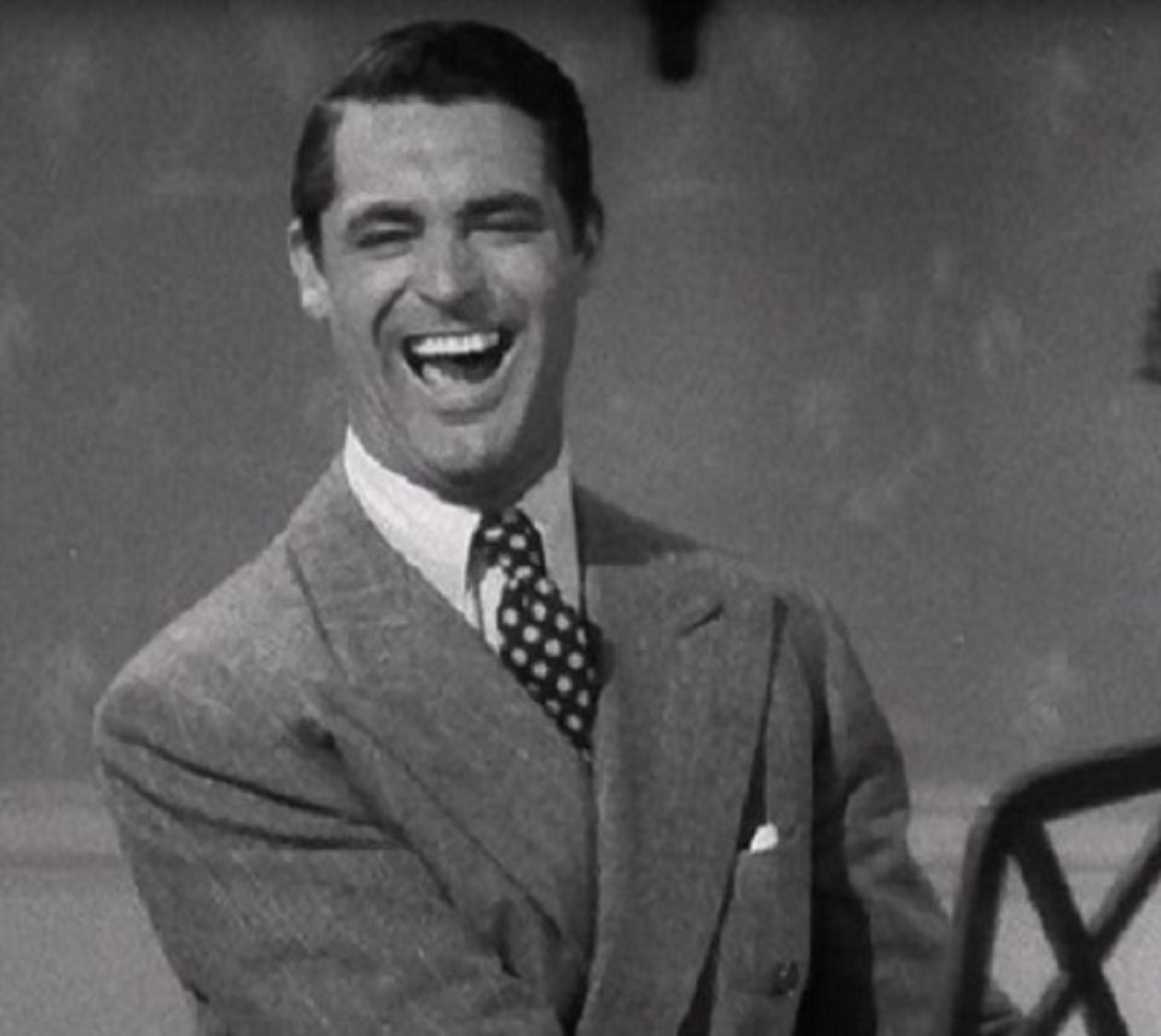
When he speaks, it’s with Cary Grant’s accent. I like the layers of jokes here, even if they’re anachronistic given the movie’s 1929 timeline: Joe is so unfamiliar with well-born men that he mimics a movie star’s imitation of one. (Admittedly, this wasn’t a bad choice: Grant was so convincing in his own portrayal of a blue blood that he probably convinced 90 percent of us.)

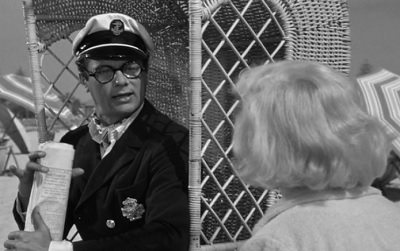
As the Shell millionaire he’s aping, Joe can be quite funny. I like when he mistakes a stuffed swordfish for a member of the “herring family.” Curtis is far more animated in these scenes, and the script so much stronger than in the rest of the movie. Joe’s description of his love’s death is funny, and his details about his family’s attempts at a cure for his heartache—a French maid, a troupe of Balinese dancers—are hilarious.

Male Fantasy Scenes Played as Realistic
I don’t know about you, but when I’m traveling with a bunch of female friends, I tend to relax in lingerie like this:

Marilynlingerie
I prefer to cuddle up to my companions, especially ones I’ve just met, to get as much skin-on-skin contact as possible.

MarilyncuddlingwithLemmon
And on the beach, I like to spend my time tossing a ball to my pals in a provocative fashion.

If this kind of scenario is played as fantasy, I find it funny. But when I’m supposed to take it as a given, with the humor to be found elsewhere, I’m so busy rolling my eyes that I miss the action. Look, I understand that Hollywood wants to show some skin, especially in a film featuring Marilyn Monroe. And I’ll admit I’m jaded from one too many sorority house/girls’ locker room scenes of a similar nature. Admittedly, I have seen much worse in other movies; at least all of the women in the band aren’t dressed like this (just the most attractive ones, as they always eschew comfort for sexiness, right?)

If they’re played as campy, how funny scenes like these can be! But if they aren’t, I tend to look up the screenwriters and confirm my suspicion—yep, written by men, probably ones who’ve spent too much time on adult-only channels/sites. Am I the only one who thinks humor works best when it’s based on actual human behavior, not teen boys’ daydreams?

Missed Opportunities in the Script
Cross dressing is almost always funny in film, and Curtis and Lemmon are so unattractive as women, and so obviously male, that it makes the gullibility of those around them funny in itself. Initially, their disgust at the casual chauvinism of the other hotel guests is entertaining too, as when Daphne gets pinched and Josephine is propositioned by the bellboy. Pity that there’s no accompanying recognition of their own chauvinism, as without it, we’re left mainly with tired gags about breasts, high heels, etc. While occasionally both of the men (and the script) give a fun twist to their adoption of female clothing and mannerisms, in most scenes, I didn’t see anything new.

Of course, I know that this territory is much better canvassed today than in 1959, when it would have been far more scandalous. Still, the stars’ parents would have found the film tame; it’s impossible to be shocked by men in tights and Marilyn’s walk when earlier (pre-Code) movies portrayed women sleeping to the top and cheating on their husbands to get even—without judgment. Let’s not forget that Mae West had drag queens in her 1927 play, and planned to feature them in her next before the censors stepped in.

I know there are times when repetition of references, as we often see in Some Like It Hot, is funny. I still laugh every time I hear the name Mr. Bigglesworth. But those references only continue to be amusing if they were particularly funny—and ideally fresh—to begin with. I was disappointed to find that a writer/director who in an earlier film (with Charles Brackett) defined craziness as giving an engagement gift of a “roller skate…covered with Thousand Island dressing” would (with I.A.L. Diamond) resort to lines as flat as these: “I’ve got a funny sensation in my toes, like someone was barbequing them over a slow flame.”/ “Let’s throw another log on the fire.”

One Reason to Watch: Sugar Kane
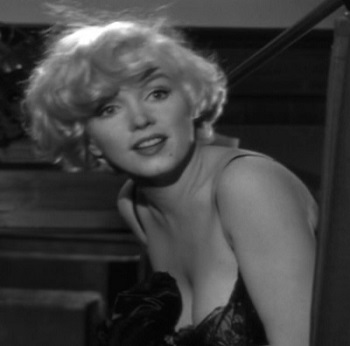
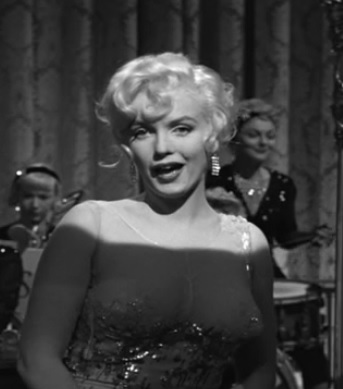
Monroe is mesmerizing as Sugar Kane. She is, of course, unbelievably attractive in the movie.

Marilynsinging
And she manages to turn what could have been a brainless blonde stereotype into something believable, even touching. I particularly enjoyed her effort to convince Joe-as-Shell-millionaire that she has a sophisticated background. While he comes across as conniving and silly in his con, her performance is moving and honest and funny in spite of her lies. While she fabricates a Bryn Mawr education, she conceals nothing else, and her openness makes her deceptions so obvious they might as well not be deceptions at all.

It might seem that I hated this movie. I didn’t. In fact, I enjoyed the first 25 minutes or so, after which I just kept hoping it would improve in the interludes between Monroe’s perfect delivery of her lines. But the film’s undeserved reputation infuriates me. I can’t help wondering if I were a woman new to classic comedies and started with this one, would I have kept watching?

This post is part of the Contrary to Popular Opinion Blogathon, where we set the consensus on its head by defending a maligned film, performer or director or toppling a beloved one! Check out the other entries.

contrary-blogathon-7

Share
Posted in: 1950s films, Blogathons, Comedies (film), Feminism Tagged: Billy Wilder, It's Always Sunny, Mae West, Marilyn Monroe, Matthew McConaughey, Mr. Bigglesworth, Some Like It Hot, Tony Curtis

Recent Posts

  • 100 Years Later, Still Scary: Dr. Caligari
  • Escaping Out of the Past (1947)
  • A Weeper for Those Who Love Jerks
  • Thank You, Academy, for Not Infuriating Me
  • Challengers (2024) Is a Bad Movie

Subscribe to Blog via Email

Enter your email address to subscribe to this blog and receive notifications of new posts by email.

Categories

  • 1920s films
  • 1930s films
  • 1940s films
  • 1950s films
  • 1960s films
  • 1970s films
  • 1980s films
  • 1990-current films
  • 2020s films
  • Action & Sports Films
  • Anti-Romance films
  • Blogathons
  • Childfree
  • Comedies (film)
  • Drama (film)
  • Feminism
  • Femme fatales
  • Film Noir/Crime/Thriller & Mystery
  • Gloriously Silly Scenes
  • Horror
  • Humor
  • Mae West Moments
  • Musicals and dancing films
  • Oscars
  • Random
  • Romance (films)
  • Romantic Comedies (film)
  • The Moment I Fell for
  • Turn My Sister into Classic Movie Fan
  • TV & Pop Culture
  • Uncategorized
Share
Classic Movie Blog Hub Member

Recent Comments

  • leah@carygrantwonteatyou.com on Meg Ryan’s Fate Foretold in Joe Versus the Volcano
  • Ryan on Meg Ryan’s Fate Foretold in Joe Versus the Volcano
  • leah@carygrantwonteatyou.com on 100 Years Later, Still Scary: Dr. Caligari
  • The Classic Movie Muse on 100 Years Later, Still Scary: Dr. Caligari
  • leah@carygrantwonteatyou.com on 100 Years Later, Still Scary: Dr. Caligari

Archives

  • November 2025
  • September 2025
  • May 2025
  • March 2025
  • January 2025
  • November 2024
  • August 2024
  • July 2024
  • May 2024
  • March 2024
  • February 2024
  • December 2023
  • November 2023
  • October 2023
  • September 2023
  • August 2023
  • July 2023
  • May 2023
  • April 2023
  • March 2023
  • January 2023
  • December 2022
  • November 2022
  • September 2022
  • July 2022
  • May 2022
  • April 2022
  • March 2022
  • February 2022
  • October 2021
  • September 2021
  • April 2021
  • March 2021
  • February 2021
  • December 2020
  • October 2020
  • September 2020
  • July 2020
  • May 2020
  • April 2020
  • March 2020
  • February 2020
  • December 2019
  • October 2019
  • September 2019
  • June 2019
  • May 2019
  • April 2019
  • February 2019
  • January 2019
  • November 2018
  • September 2018
  • July 2018
  • June 2018
  • May 2018
  • April 2018
  • March 2018
  • February 2018
  • January 2018
  • November 2017
  • September 2017
  • August 2017
  • July 2017
  • June 2017
  • May 2017
  • April 2017
  • March 2017
  • February 2017
  • January 2017
  • December 2016
  • November 2016
  • October 2016
  • August 2016
  • July 2016
  • June 2016
  • May 2016
  • April 2016
  • March 2016
  • February 2016
  • January 2016
  • December 2015
  • November 2015
  • October 2015
  • September 2015
  • August 2015
  • July 2015
  • June 2015
  • May 2015
  • April 2015
  • March 2015
  • February 2015
  • January 2015
  • December 2014
  • November 2014
  • October 2014
  • September 2014
  • August 2014
  • July 2014
  • June 2014
  • May 2014
  • April 2014
  • March 2014
  • February 2014
  • January 2014

Meta

  • Log in
  • Entries feed
  • Comments feed
  • WordPress.org

Copyright © 2025 Cary Grant Won't Eat You.

Church WordPress Theme by themehall.com