Cary Grant Won't Eat You

Classic movies for phobics

  • About
  • eBooks
  • Previous Blogathons
Classic movies for phobics

Blogathons

State of the Union: the Wish Fulfillment Edition

05/12/2014 by leah@carygrantwonteatyou.com 11 Comments

This post is part of The Great Katharine Hepburn blogathon. Be sure to check out the other entries!

The political satire in 1948’s State of the Union feels disturbingly fresh. Replace a phrase or two, and presidential nominee Grant Matthews’ (Spencer Tracy’s) speeches on the “working man” could fit into the Occupy Wall Street movement.

The film’s title, however, refers to not only what’s rotten in the state of the nation, but in the marriage between Grant (Tracy) and Mary Matthews (Katharine Hepburn).
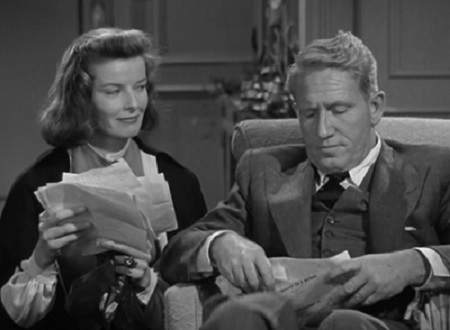
Mary and Grant Matthews

Mary and Grant Matthews

Sexy newspaper publisher Kay Thorndyke (Angela Lansbury) has seduced Grant with the aim of pitting him against her dead father’s political rivals.
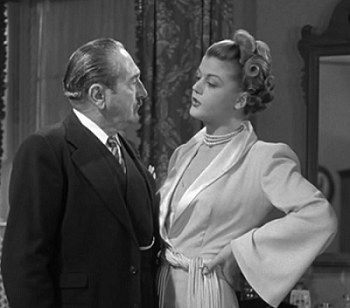
Kay and fellow schemer (Menjou)

Kay and fellow schemer (Adolphe Menjou)

Mary (Hepburn) agrees to pretend her marriage is strong for the sake of the campaign, as she believes her husband a “great man,” which, if he ever were, he ceases to be by the film’s close. The movie traces his idealism crumbling under the necessity of playing the political game, thanks, in no small part, to Kay’s machinations.

The dialogue is as sharp and cynical as you would expect in a Frank Capra film. My favorite comment is when Mary snaps that the slimy politician under Kay’s supervision (Adolphe Menjou) should be happy about what’s left of her own naiveté: “You politicians have remained professionals only because the voters have remained amateurs.”

The central problem of the film is how unsympathetic her husband Grant is. A self-made man with his “little guy” days far behind him, he pompously lectures businessmen and union leaders about how that little guy should be treated. Capra treats him as if he’s one of his innocents among the corrupt, like Mr. Deeds or Jefferson Smith, and it doesn’t work–Grant begins as a heel, and ends as a worse one.

And it’s hard to forget he’s betrayed a wife so cool she calmly knits while he’s doing acrobatics with his plane, handing campaign manager (Van Johnson) her bag to puke in.
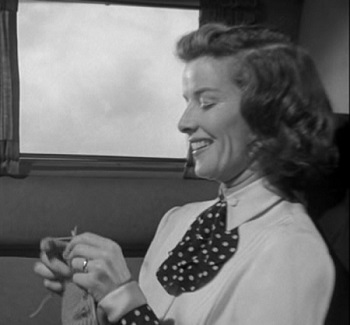
Mary during dangerous aerial acrobatics

Mary during dangerous aerial acrobatics

Luckily, we can ignore Grant and his speechifying and pay attention to the true delight of the film: Mary and Kay facing off against one another—Mary because she loves her husband, and Kay because she fears Grant will be swayed by his wife’s morals and thus lose the election.
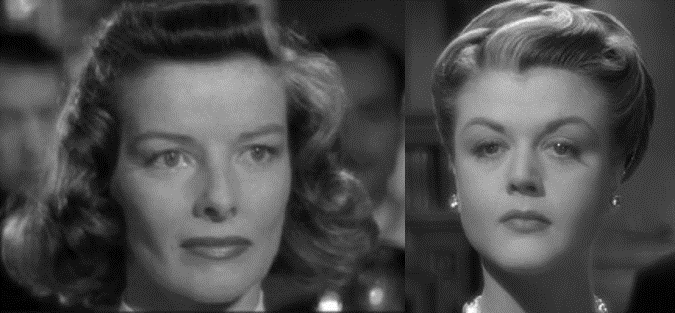
The two real stars

The two real stars

Just listen to how they talk about each other:

Kay: “That woman’s got to [Grant]. She’s been feeding him that to-thine-own-self-be-true diet.”

Mary: “If this weren’t my house, I could tell her someplace she has to go to…” or “…I think Kay’d be more comfortable in a kennel.”

When Mary has to invite Kay to her house to cover up the affair, she tries to avoid doing what she apparently did once before: getting plastered and throwing Kay out. This is the moment in the film when I wanted to shake Capra. That’s the scene you left out???

We do get treated to seeing Mary drunk in defiance of orders from Kay and crew.
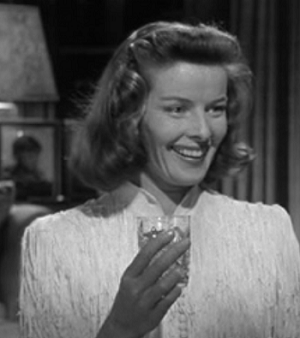
Mary rebeling

Mary rebelling

But I kept wishing for a The Women-style face off; the heroines are so powerful and interesting that in comparison, the men in the film (with the exception of Johnson and Mary’s butler) seem a waste of screen time. Luckily, the women are so fun to watch that they revive and redeem the film.

At one point Grant’s barber shares his wife’s conviction that a woman should be president. “That’s silly,” responds Mary. “No woman could ever run for president. She’d have to admit she was over 35.”

Though the quip is funny, no line coming out of Hepburn’s mouth was ever less convincing. Those who know anything about Hepburn realize she had confidence to spare, felt comfortable aging in front of the camera, and would have run for any office if she’d felt like it. Mary clearly has Hepburn’s spunk, and after all, a woman had run for president more than 70 years before this film, another woman with considerable moxie.

Would Mary have won? Of course not. But what speeches she would have written!

And for Capra not to give Kay more time in the film is criminal. Watch her command her editors to publish filth about all of the Republican candidates so that their united hatred for one another will make them choose her man (Grant) at the convention. That icy stare you recognize from The Manchurian Candidate (1962)? Yeah, this is a woman who could make it to the White House today for sure. She’s a predatory villain as thrilling to watch as Claire Underwood (Robin Wright) in House of Cards.
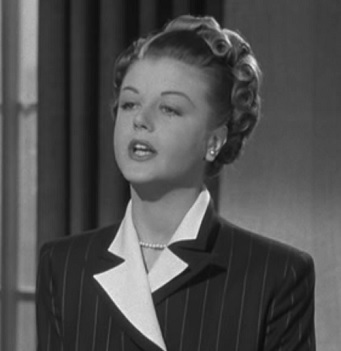
Kay commanding the troops

Kay commanding the troops

It’s probably enough that a film in 1948 starred such strong actresses playing powerful roles. I shouldn’t wish for what could have been, these two really facing off against each other, maybe even running against each other for office.

But what a film that would have been.

Share
Posted in: 1940s films, Blogathons, Drama (film), Feminism Tagged: Angela Lansbury, feminists, Katharine Hepburn, political satire, Spencer Tracy

5 Reasons Why English Majors Will Love Ball of Fire

05/01/2014 by leah@carygrantwonteatyou.com 27 Comments

This entry is part of the Romantic Comedy blogathon cohosted by Backlots and Carole and Co.

In trying to get friends to give old movies a chance, I often start with Ball of Fire, mainly because I know many English majors/graduate students, few of whom predict what delights are waiting for them in this 1941 classic. Here are just five of the reasons why everyone who waxes poetic about Shakespeare or Austen needs to spend a little time with Gary Cooper and Barbara Stanwyck:

1. The Plot: A Mobster/Moll Romantic Comedy about Language

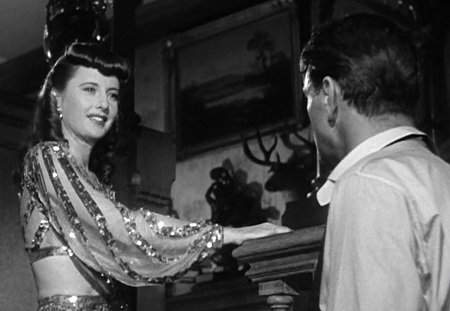
Professor Bertram Potts (Cooper), on the hunt for colorful subjects to aid him with his encyclopedia entry on slang, enlists a sexy torch singer, Sugarpuss O’Shea (Stanwyck).

O'Shea (Stanwyck) flirting with the professors

O’Shea (Stanwyck) flirting with Potts

Sound ridiculous? It is, wonderfully so.

In the “meet cute” moment, O’Shea has just learned that her mobster boyfriend (Dana Andrews) is in trouble with the law. Fearing the knock on her dressing room door is the DA with a subpoena, she’s hostile to Potts, and when she discovers his mission to study her, dismisses him:

O’Shea: “Shove in your clutch.”

Potts: “Exactly the kind of thing I want”….

O’Shea: “OK, scrow, scram, scraw.”

Potts: “A complete conjugation!”

The opening sequence of Potts’ investigation, in which we learn the sources of such terms as “slap happy” and discover just how old the term “jerk” must be, is equally amusing to those of us who delight in wordplay, as is the nerdy professor’s ignorance of such words as “boogie.”

And that’s just the first half hour.

2. A Clever Take on Snow White and the Seven Dwarves

Fables, folk tales, fairy tales. We English majors love to read them, interpret them, reinvent them. (Angela Carter’s dark The Bloody Chamber traumatized me in an introductory lit course.) Famed writing team Charles Brackett and Billy Wilder turn the tale on its head, making Snow White a seductress and the dwarves a team of innocent professors (six bachelors and a widower) who are writing an encyclopedia together, with Prince Potts acting as the eighth member.

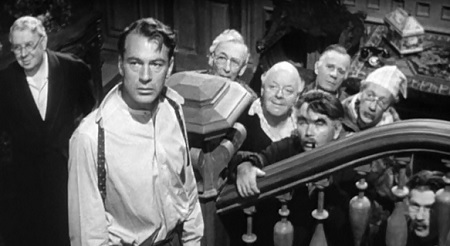
O’Shea seeks shelter from the police at their house, claiming she needs to stay to help with Potts’ research. The proper Potts doesn’t understand why she needs a sleepover, but his elderly companions, used to only the “singularly uninspiring underpinnings” of their housekeeper, outweigh his objections. They have fallen for O’Shea, and their charming antics to gain her attention—wearing new outfits, making sure their pants get ironed, having her teach them the conga—make you wonder just how unfair it is that the prince is the one who wins Snow White’s affection.

Potts (Cooper) and the dwarves reacting to O'Shea's flirtation

Potts (Cooper) and the dwarves reacting to O’Shea

O’Shea has no plans to seduce Potts, but when things get “hotter” for her boyfriend and she’s told “to stay in the icebox like a good little salad,” she gives the impressionable Potts a kiss. And, as in the fairy tale, things escalate from there.

3. The Witty Dialogue/One Liners

What English major isn’t a sucker for good dialogue? With Wilder & Brackett as writers and Howard Hawks as the director, witty banter and frequent double entendres are a matter of course.

Early in the film, Miss Bragg, the housekeeper, badgers Professor Oddly for gobbling up the strawberry jam after writing an encyclopedia entry on strawberries. She then expresses horror at Professor Magenbruch’s studies.

“I’m just starting my article on sex, Miss Bragg,” he answers. “Any objections?”

“No,” she concedes. “I trust you have more control of yourself than Professor Oddly.”

And the one liners! Some favorites:

O’Shea: “Say, who decorated this place, the mug that shot Lincoln?”

Potts: “Make no mistake, I shall regret the absence of your keen mind; unfortunately, it is inseparable from an extremely disturbing body.”

O’Shea (describing her throat): “It’s as red as The Daily Worker and just as sore.”

Miss Bragg (speaking of O’Shea): “That is the kind of woman that makes whole civilizations topple!”

I always wonder why so many Gilmore Girls and Aaron Sorkin fans won’t give 30s and 40s comedies a try. Ball of Fire not only employs the banter they love so well, but avoids the trap of making EVERY character eloquent (a Sorkin flaw). The contrast between O’Shea’s wisecracking and Potts’ slow earnestness is one of the delights of the film, and given that Cooper typically played a Clint Eastwood type, his professorial wordiness is particularly amusing. As the Self-Styled Siren put it, “Who besides Billy Wilder would look at Gary Cooper, the most laconic speaker in Hollywood, and think, ‘Linguistics!’”

4. Wonderful Characters (and Performances)

With eight professors, a nightclub singer, a mobster and his minions, the DA and his team, and Potts’ other research subjects, a viewer would be unreasonable to expect much character development in any but the main players. Romantic comedies rarely get beyond stereotypes anyway. But most of the characters in Ball of Fire are unique and memorable, from the prim widower with the sexless interpretation of romance, to the genial Professor Magenbruch, who can’t stop thinking about his need to research for the sex entry. Even Joe Lilac’s two minions are funny in their villainy. And at the center of the film, we have Sugarpuss O’Shea, played by Stanwyck in an Oscar-nominated performance.

Stanwyck’s job as Snow White is to charm, and she takes to it naturally. She’s laid back and confident, and as cool as her companions are geeky. (I kept thinking of an Elizabeth Bennett landing in the middle of The Big Bang Theory.) Most of all, O’Shea’s a great deal of fun, whether leading her band in a quiet version of “Boogie” at the start of the story, or teaching the professors to conga. She doesn’t want to harm any of the professors with her deception, but she is so used to looking out for herself that their brand of vulnerability is foreign to her.

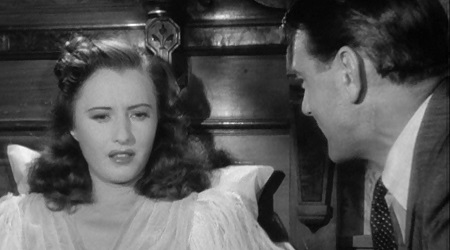
O’Shea too is soon smitten, so unfamiliar with sincerity that it floors her even as her comfort with her sexuality undoes her companions. Her guilt at duping such lovable men is palpable.

O'Shea, discovering Potts' love for her

O’Shea, discovering Potts’ love for her

Stanwyck lost the Oscar to Joan Fontaine in Suspicion that year. Fontaine’s was a strong performance, but I think Stanwyck’s dazzling turn should have guaranteed her win. Though some of the credit for her fully rounded performance definitely goes to the writers, Stanwyck is so believable in the midst of this crazy plot that she grounds the film. A once reluctant watcher of black and white flicks, I became a classic movie enthusiast and lifelong Stanwyck fan after watching this movie. I suspect I’m not the only one.

5. The Grammarian Winning the Girl?

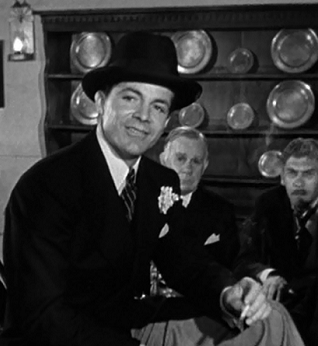
English majors—especially males—don’t get a lot of cred in the romantic lead department, especially when up against mobsters like Joe Lilac.

Dana Andrews playing the suave Joe Lilac

Suave Lilac (Dana Andrews), Potts’ rival

At least women can get the “sexy librarian” rep. Occasionally, poets can win some attention in film (and I know such gifts helped my friends on Valentine’s Day). But grammarians? Teachers of the comma splice? Among an unglamorous profession, grammar professors are the nadir when it comes to sexy reps, right down there with nuclear physicists.

Potts, trying to box based on a book's lessons

Potts, trying to box based on a book’s lessons

“You see, this is the first time anybody moved in on my brain,” says O’Shea after entering Potts’ home, and you know when she later glows at the possibility of becoming “Mrs. Lilac” just how unlikely the brain is to triumph.

But slowly, Potts makes inroads. O’Shea even reads a grammar book in her spare time, and there’s a whole discussion about the repetitiveness of her phrase “on account of because” in the midst of a romantic interlude. Only Wilder and Brackett could not only make this scene romantic, but convincing. Due to the caliber of their writing and Stanwyck’s performance, we trust that this cynical nightclub singer really does get so flushed in company with “corny” Potts that she needs to take the movie’s equivalent of a cold shower (a towel to the neck).

And this triumph, my English major friends, is a rare treat to witness. Good luck finding a modern film so generous in its treatment of grammarians. When you find one, be sure to let me know. In the meantime, I’ll take another serving of Ball of Fire.

Check out the other romantic comedy entries in the blogathon!

Share
Posted in: 1940s films, Blogathons, Humor, Romantic Comedies (film) Tagged: Ball of Fire, Barbara Stanwyck, Dana Andrews, English majors, Gary Cooper

The Sadistic Spouse: Charles Boyer in Gaslight

04/23/2014 by leah@carygrantwonteatyou.com 22 Comments

This post is part of the Great Villain Blogathon cohosted by Speakeasy, Shadows and Satin, and Silver Screenings. Check out other entries on one of their sites!

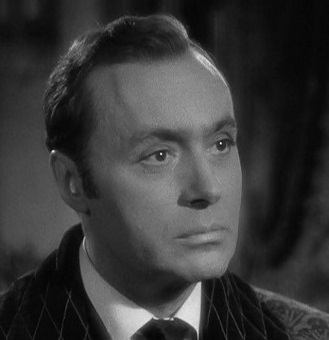
When it comes to villains, Gregory Anton in Gaslight lacks the theatricality of The Joker or Lecter. He wants the presence of Harry Lime or the narcissism of Ellen Harland. He doesn’t chill the viewer as do Maleficent and Mrs. Danvers. On the surface, therefore, Gregory might not seem a villain worthy of comment. As played by Charles Boyer, the role is so two-dimensional as to approach camp. You can almost hear Boyer saying to himself, “Time for the faux-loving face—wait, too long on that one, stern face time.”

Boyer's stern face

Boyer’s stern face

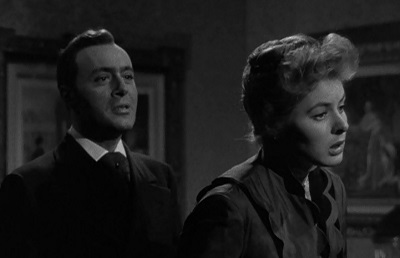
Yes, Gregory seems as commonplace a villain as his name would suggest. But in terms of his effect on his victim, Gregory is a master among villains. Having convinced his new wife, Paula (Ingrid Bergman), to move back to the house where her aunt was murdered, he creates a series of sounds and sights he pretends not to notice. He expresses concern at Paula’s supposedly imaginary observations; he chides her for forgetfulness when items disappear (due to his own actions). She believes him because she loves him. The term “gaslighting,” which originated with this story, refers to Gregory’s sinister brand of psychological abuse: trying to convince his wife she’s going insane. While the motives of his actions are not immediately apparent, he clearly feels no remorse for his cruelty.

Convincing his wife she's crazy

Gregory, celebrating his victory over his wife

So often, we side with the criminal in a plot like this one: with a wife this gullible, it’s easy to go for the laugh rather than the shiver. It would be common too to dismiss Paula as stupid, to fail to sympathize due to her blindness and fragility. But the nineteenth-century timeline of the story counters our usual impulses, making us uneasy and fearful from the start. (Just what were those stories about men committing their wives to asylums on questionable grounds again?) And Paula is not just any victim: She is a victim played by Ingrid Bergman.

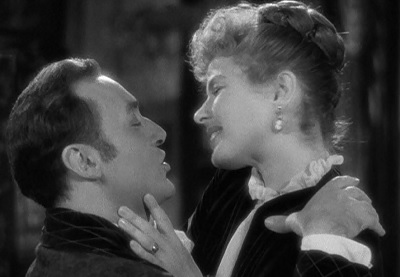
Bergman beautifully illustrates the extent of her heroine’s downfall at Gregory’s hands. She is incandescent as a woman in love before his plot takes off.

Gregory's pretense of love

Paula in love

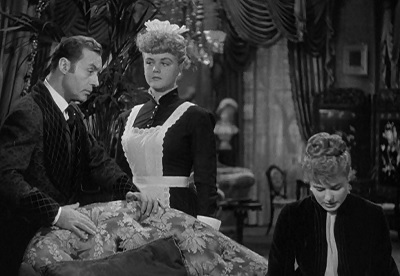
Her fears about her sanity, which first dim, and then blot out any semblance of happiness or reason, are terrifying to watch. Just when she thinks she can trust in his love for her and have faith in herself again, Gregory cuts off her giddiness with a chilling expression, claims she’s unwell, forgetful, unworthy, childish. Her jealousy of a cruel maid (Angela Lansbury) he flirts with in her own home is nothing, he suggests, but a sign of her sickness.

Using the maid to torture his wife

Using the maid to torture his wife

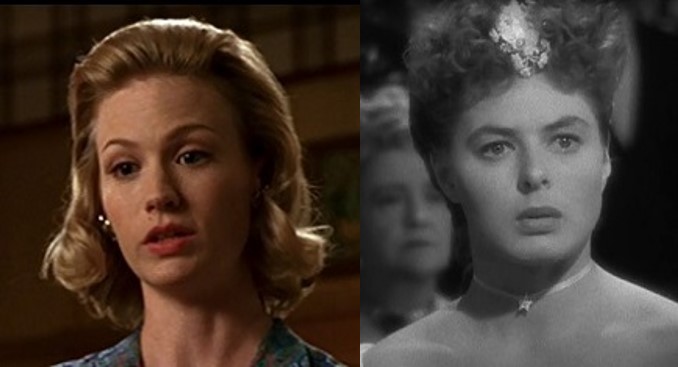
Think of Betty Draper in the first season of Mad Men, then quadruple the vulnerability, make Don evil rather than sick, take away his love, and remove any right Betty has to defend herself against his duplicity, and you have poor Paula in Gaslight.

Season 1 Betty Draper a powerhouse compared to Paula

Season 1 Betty Draper a powerhouse compared to Paula

Paula’s weakness is her love for her husband; without it to prey upon, Gregory would have no chance of winning this psychological battle against her. And it’s just this level of cruelty she can’t accept. Of course she finds her own forgetfulness more believable. Not content with the damage he’s done, Gregory shuts her away from others, guaranteeing she spends most of her time obsessing over whether she’s mad–hardly a healthy pastime. How long, we wonder, CAN Paula stay sane, trapped in a loveless marriage, a frightening house, and fears she can no longer control? While there’s hope in the form of a suspicious detective (Joseph Cotten), even if Paula escapes, can anyone recover from this kind of treatment?

Despite a largely passive performance, Bergman is stunning to watch in Gaslight. I can think of no actress but Meryl Streep who could accomplish so much with just expressions, who could deliver enough pain and fear to carry the film and beat out Barbara Stanwyck, Bette Davis, Claudette Colbert, and Greer Garson for the Oscar.

Bergman as situation worsens

Paula as her situation worsens

Just a few years after Gaslight, Bergman would fall for Roberto Rossellini and become involved in an affair with him so scandalous Congress and many of her American fans would condemn her. But she would make a Hollywood comeback less than a decade later, and her union with the famous director would result in a daughter, Isabella, who, in a curious twist, would make a splash of her own as a victim in another famous film, Blue Velvet. Who could forget torch singer Dorothy Vallens, the target of creepy villain Frank Booth (Dennis Hopper)?

Like mother, like daughter

Like mother, like daughter

 Be sure to check out the other villains in the blogathon!

Share
Posted in: 1940s films, Anti-Romance films, Blogathons, Drama (film), Film Noir/Crime/Thriller & Mystery, TV & Pop Culture Tagged: Betty Draper, Charles Boyer, Gaslight, Ingrid Bergman, Mad Men, marriage, villain

Sherlock Holmes Meets Paris Hilton: The Mad Miss Manton (1938)

03/16/2014 by leah@carygrantwonteatyou.com 12 Comments

This post is part of Movies Silently’s Sleuthathon. Check out other entries on her site!

Imagine pitching this story idea: a Paris Hilton type with a pack of tiny dogs solves a crime New York cops can’t. It sounds like a Beyond Balderdash card, doesn’t it? That couldn’t possibly be a real movie plot. Luckily for us, it is. The Mad Miss Manton stars Henry Fonda and Barbara Stanwyck, but as you might guess, it’s not of the same caliber as their later pairing.  The mystery is ridiculous, the plot convoluted, and the character development all over the place. But who cares? Just let the film be what it wants to be: crazy fun.

The Mad Miss Manton

The Mad Miss Manton

Melsa Manton is a society girl known for “pranks” she claims are in the name of charity. She and her bevy of like-minded friends are suspected of constant mischief, and when Manton finds a body that disappears before help arrives, the police and newspaper editor Peter Ames (Henry Fonda) cry foul. Manton sets out to solve the crime to redeem the reputation of her crew, and along the way, Ames falls in love with her. As you might expect, this loopy story leads to some sticky problems for the filmmakers, but never fear: Philip Epstein is the primary writer, so some of those problems end up being hysterical to watch, including….

The Heroine with the Vanishing Trait—and Pets
Barbara Stanwyck is my favorite actress. She can portray a character who is terrified (Sorry, Wrong Number), sinister (The Strange Love of Martha Ivers), funny (Ball of Fire), or heartbroken (Stella Dallas). But there’s one thing this tough Brooklyn-born actress could not do, and that’s act like a flake. The problem is, without that trait, the beginning of the film is incomprehensible, even in screwball land. You simply can’t buy this woman with a bunch of precious dogs, prancing around the city on pranks or building mansions for her pooches, as Paris Hilton did.

To make the “madness” of Manton plausible, you would need an actress who could play naïve, who could be as trusting as Carole Lombard’s character in My Man Godfrey or Goldie Hawn’s in Seems Like Old Times. Only an actress like that could have pulled off a heroine who is not lacking in intelligence, but is lacking in cynicism. At first, therefore, I thought Stanwyck miscast.

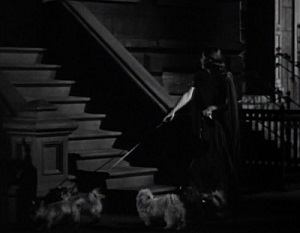
Clearly, I underestimated the audacity of Epstein and his uncredited cowriters as they developed Wilson Collison’s story. Fewer than 10 minutes into the film, Epstein conveniently erases the airhead tendencies that he created in the opening scenes. Now, it seems, Manton is simply misunderstood (forget the film’s title). From the moment she’s on the case, Stanwyck is in familiar territory, fast-acting and thinking, with the assurance she’ll bring to her reporters in Meet John Doe and Christmas in Connecticut.  To illustrate this change in Manton’s character, the screenwriters eliminate all of her dogs. Poof! No Fifis in her apartment. No Fidos tracking her along her crime-solving path.

The dogs in one of their last appearances

The dogs in one of their last appearances

I think I fell for this movie when they vanished. It reminded me of the kind of bravado later soap opera writers would emulate in developing their narratives, with conveniently erased back stories and children growing up at Chia Pet speed.

A Bewildering Plot
The Mad Miss Manton is only 80 minutes long, yet I could have sworn it ended twice before it actually did. I felt a little like I used to reading Agatha Christie novels, when she conveniently left out information I needed to solve the crime myself. Who are all these suspects? Why do some of them appear on the screen for a few minutes, then reappear twenty minutes later, without my understanding anything new about them? There are multiple crime scenes, attempts on Manton’s life, ranting scenes by the police lieutenant, a hospital visit, an effort to lure in the killer, and much clue following. And, of course, multiple clips of the suspects that are meant to be illuminating/mysterious. But every time the chaos begins to overwhelm viewers, Manton’s friends rush in and save the film, which brings me to….

An Amazing Crew
I love the “Park Avenue pranksters,” the group of women whose help Manton enlists to solve the crime. My favorite is Pat (Whitney Bourne), who keeps stopping to snack at the crime scenes, à la Shawn Spencer.

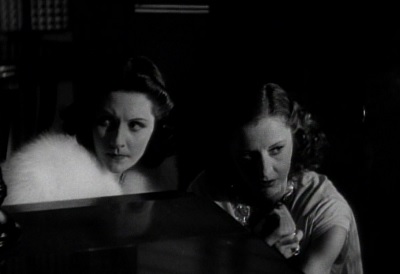
Who can beat a troop of friends, armed with flashlights and ermine, creeping through the window of a house the cops have inconveniently locked?

“I found a blood stain,” says one woman, perching on the floor.

“Oh, how can it be blood? It’s blue,” replies Manton.

“Maybe they shot Mrs. Astor,” retorts her friend.

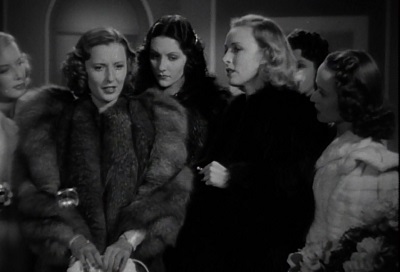
Manton and her "pranksters"

Manton and her “pranksters”

Most of these accomplices are clever, and all are fun and fabulous company. They seem to live an endless string of parties and sleepovers. Unlike Blair Waldorf’s Gossip Girl minions, however, these women are sweet-natured without sacrificing their blistering wit, as when they mock their ringleader for starting to like Ames:

“You know psychiatrists say hate’s just a step away from love,” says one.

“Yeah, but it’s the lull in between that drives you crazy,” replies another.

The film suffers every time the crew leaves the screen.

Distracting Minor Characters
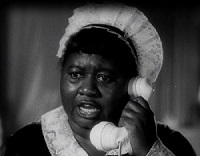
I did not feel the same delight in encountering Manton’s maid, Hilda (Hattie McDaniel). While her sassy replies to her employer are sometimes amusing, it’s difficult to view McDaniel in a maid costume without picturing Mammy from Gone with the Wind, the part she’d win an Oscar for a year later. While this is not the type of servile performance the actress would later be asked to defend, the role is not as progressive (and therefore her part less funny) than we might have hoped.

Hilda (Hattie McDaniel)

Hilda (Hattie McDaniel)

The police lieutenant (Sam Levene) sometimes distracts from the story as well. Like one of the suspects (Penny Singleton), Levene is stolen straight from After the Thin Man (which tells you how seriously the director, Leigh Jason, and his writers take the crime itself).

Unfortunately, Levene can’t turn off the beleaguered, badgering tone he used in the earlier film. While his attitude toward Manton initially adds to the humor, his grumbling soon becomes tiresome. Nick Charles could be just as withholding with clues as Manton, but never was treated with such disrespect. Wouldn’t the lieutenant’s opinion of her alter when he discovered her sleuthing skills, even with their class and gender differences?

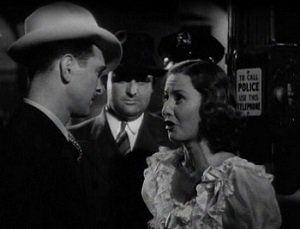
The lieutenant (Levene) dismissing Manton

The lieutenant (Levene) dismissing Manton

Henry Fonda in Screwball Mode
The only actor who surprised me in this film was Henry Fonda. I’ll admit that I’ve never been a fan; I’d usually rather see someone else in his place: John Garfield in The Grapes of Wrath, Joel McCrea in The Lady Eve.  But Fonda is exuberant in The Mad Miss Manton, so at home with the one liners and silly antics that I kept checking the credits to make sure it was the same man. (Interestingly, Fonda himself disliked the part.) He’s surprisingly confident and attractive as Peter Ames, the editor in love with Manton, and it’s hilarious to watch him trying to romance her, while admitting that he’s enough of a pragmatist to appreciate that she’s rolling in it.

Manton (Stanwyck) and Ames (Fonda)

Ames (Fonda) and Manton (Stanwyck)

The relationship begins in hostility. He’s written an editorial dismissing Manton’s supposedly nonexistent body discovery as one of her group’s “escapades.” She slaps him with her hand and a libel suit on their first meeting. Of course, they start to fall in love from there.

The two take turns outwitting one another in His Girl Friday style (though at a less frantic pace). After Manton agrees to pretend they’re engaged to dupe a suspect, Ames comes to her apartment with champagne to celebrate. “Well, if I want to marry a fortune hunter,” she answers, “I can go to Europe and marry a professional one.”

“I’m determined to make you happy if I have to drag your name through the breach-of-promise courts to do it,” he answers.

It’s startling how suggestive the film is. The two are in her bedroom as she smokes in her nightgown and he gets flustered. She ties him up regularly, and once she even takes off his pants. The love/hate battle between them is exhilarating, and while much of the credit goes to Stanwyck, for once she has an equal sparring partner in Fonda.

As you can tell from my review, this is a far from perfect film. But I would encourage you to embrace it just the same: the disappearing dogs, the ever-changing heroine, the unlikely romance, the bizarre crew, even the occasional joke about communism.  It’s a bit “mad,” but it’s a lot of fun.

Share
Posted in: 1930s films, Blogathons, Film Noir/Crime/Thriller & Mystery, Romantic Comedies (film) Tagged: Barbara Stanwyck, blogathon, Henry Fonda, Paris Hilton, screwball comedy, The Madd Miss Manton
« Previous 1 2 3 4 5 6

Recent Posts

  • 100 Years Later, Still Scary: Dr. Caligari
  • Escaping Out of the Past (1947)
  • A Weeper for Those Who Love Jerks
  • Thank You, Academy, for Not Infuriating Me
  • Challengers (2024) Is a Bad Movie

Subscribe to Blog via Email

Enter your email address to subscribe to this blog and receive notifications of new posts by email.

Categories

  • 1920s films
  • 1930s films
  • 1940s films
  • 1950s films
  • 1960s films
  • 1970s films
  • 1980s films
  • 1990-current films
  • 2020s films
  • Action & Sports Films
  • Anti-Romance films
  • Blogathons
  • Childfree
  • Comedies (film)
  • Drama (film)
  • Feminism
  • Femme fatales
  • Film Noir/Crime/Thriller & Mystery
  • Gloriously Silly Scenes
  • Horror
  • Humor
  • Mae West Moments
  • Musicals and dancing films
  • Oscars
  • Random
  • Romance (films)
  • Romantic Comedies (film)
  • The Moment I Fell for
  • Turn My Sister into Classic Movie Fan
  • TV & Pop Culture
  • Uncategorized
Share
Classic Movie Blog Hub Member

Recent Comments

  • leah@carygrantwonteatyou.com on Meg Ryan’s Fate Foretold in Joe Versus the Volcano
  • Ryan on Meg Ryan’s Fate Foretold in Joe Versus the Volcano
  • leah@carygrantwonteatyou.com on 100 Years Later, Still Scary: Dr. Caligari
  • The Classic Movie Muse on 100 Years Later, Still Scary: Dr. Caligari
  • leah@carygrantwonteatyou.com on 100 Years Later, Still Scary: Dr. Caligari

Archives

  • November 2025
  • September 2025
  • May 2025
  • March 2025
  • January 2025
  • November 2024
  • August 2024
  • July 2024
  • May 2024
  • March 2024
  • February 2024
  • December 2023
  • November 2023
  • October 2023
  • September 2023
  • August 2023
  • July 2023
  • May 2023
  • April 2023
  • March 2023
  • January 2023
  • December 2022
  • November 2022
  • September 2022
  • July 2022
  • May 2022
  • April 2022
  • March 2022
  • February 2022
  • October 2021
  • September 2021
  • April 2021
  • March 2021
  • February 2021
  • December 2020
  • October 2020
  • September 2020
  • July 2020
  • May 2020
  • April 2020
  • March 2020
  • February 2020
  • December 2019
  • October 2019
  • September 2019
  • June 2019
  • May 2019
  • April 2019
  • February 2019
  • January 2019
  • November 2018
  • September 2018
  • July 2018
  • June 2018
  • May 2018
  • April 2018
  • March 2018
  • February 2018
  • January 2018
  • November 2017
  • September 2017
  • August 2017
  • July 2017
  • June 2017
  • May 2017
  • April 2017
  • March 2017
  • February 2017
  • January 2017
  • December 2016
  • November 2016
  • October 2016
  • August 2016
  • July 2016
  • June 2016
  • May 2016
  • April 2016
  • March 2016
  • February 2016
  • January 2016
  • December 2015
  • November 2015
  • October 2015
  • September 2015
  • August 2015
  • July 2015
  • June 2015
  • May 2015
  • April 2015
  • March 2015
  • February 2015
  • January 2015
  • December 2014
  • November 2014
  • October 2014
  • September 2014
  • August 2014
  • July 2014
  • June 2014
  • May 2014
  • April 2014
  • March 2014
  • February 2014
  • January 2014

Meta

  • Log in
  • Entries feed
  • Comments feed
  • WordPress.org

Copyright © 2025 Cary Grant Won't Eat You.

Church WordPress Theme by themehall.com