Cary Grant Won't Eat You

Classic movies for phobics

  • About
  • eBooks
  • Previous Blogathons
Classic movies for phobics

Blogathons

The Artist at Play: Man with a Movie Camera (1929)

03/09/2015 by leah@carygrantwonteatyou.com 14 Comments

This post is part of the blogathon hosted by Movies Silently and sponsored by Flicker Alley. Thanks to both for such a great event! Click here to see the wonderful entries of the other participants:
Camera-Man2
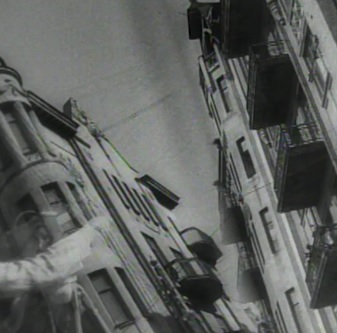
Wizardry. It’s the word that jumps at you while viewing Man with a Movie Camera, the celebrated documentary depicting 24 hours in a Russian city. Unlike the famous magician of Oz, director Dziga Vertov invites his viewers to experience all that his camera—and by extension, all that film—can do. Announcing at the start of his movie that there will be no scenarios, intertitles, or actors, Vertov set out to separate the genre from its roots in theater. The result could have been a movie so meta it became unwatchable to any but film scholars; after all, the director even demonstrates how he obtains shots, even exhibits the film editing process. But this masterpiece is not only revolutionary; it’s also engrossing. Here are just a few reasons why:

It’s a Bird…It’s a Plane…It’s Vertov Behind the Camera
There’s a dizzying speed to the film, images flashing by at such a clip that some contemporary viewers and critics protested. Predictably, some of this speed captures industry, as when the director hurries an assembly line production to Tasmanian Devil haste to capture its unremitting flow. The director thrills at images of transportation, with clips of trains, buses, motorcycles, often with himself in dangerous positions to capture the motion. The thrilling score—I watched the Alloy version—underscores the frantic mood.

Vertov occasionally slows his pace, even stopping to profile still shots, the film editing process, and those same shots in action in a particularly lovely tribute to the power of moving images.

StillShots
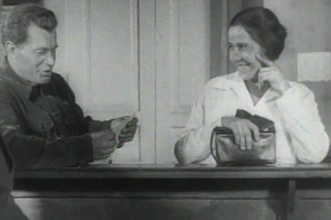
But it’s in rapidity that Vertov reveals his mastery of form and meaning. He even underscores the brevity of life in a short sequence. We see a couple getting a marriage license.
MarriageCertificate
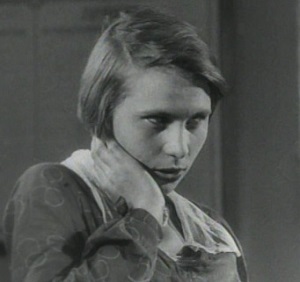
Directly after, another couple is signing divorce papers; the director zooms in on the estranged wife’s grim expression.
Divorce
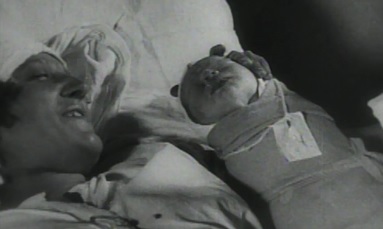
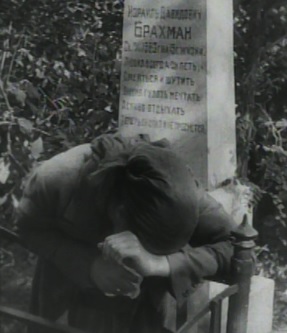
A mourner appears in a cemetery. A funeral passes our eyes. A baby is being born.
Baby
The director moves back and forth between the scenes to reinforce the connections. This circle of life takes a total of three minutes.
Loss
Realism…with Mannequins

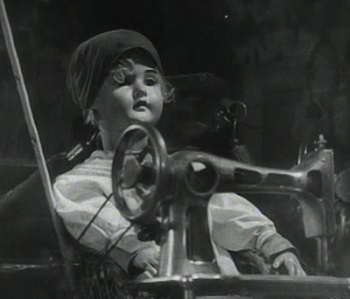
The film begins in a movie theater, priming the audience for a show. We see a Russian city, morning beginning. A woman sleeps in her room; a child does the same on a bench where he’s spent the night. There are scenes you expect next: the bustle of a city beginning, the drudgery of work. And some of those scenes, you get, and each is powerful, particularly portrayals of the mines. But it’s the surprises that keep you watching. Why does the director dwell on creepy shots like this one?
CreepyMannequin2
What’s the obsession with washing scenes? (What number of shaving, tooth brushing, and hair cleansing rituals were shot over the years he made this movie to end up with so many in the final product?)

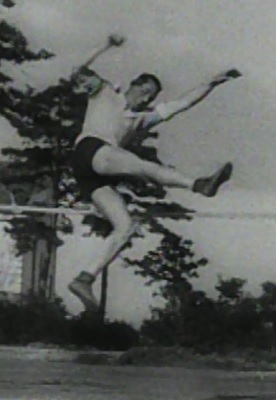
Documentaries can be gloomy, and for a director who attacked fiction and took so seriously his aims to capture truth, Vertov has a surprisingly light touch. You’re struck by the artist’s obsession with grace, revealed through a montage of pole vaulters, high jumpers, dancers, and basketball players.
HighJumper
He revels in a kid’s magic show, in women’s bodies at the beach. He attempted an international art form through his completely novel take on a documentary, achieving the realeast of real. And he delivers: You can’t help but feel fascinated by similarities evident between Russian culture and ours, between 1929 and today.

But like this pioneer’s artistic descendants, practitioners of cinéma vérité and literary journalism, Vertov believed revealing subjectivity was part of delivering truth. He not only affects his subjects by the intrusion of his camera, but our perception of them by which shots he includes, and which he doesn’t. As essayist Joan Didion would explain many decades later, “However dutifully we record what we see around us, the common denominator of all we see is always, transparently, shamelessly, the implacable ‘I.’”
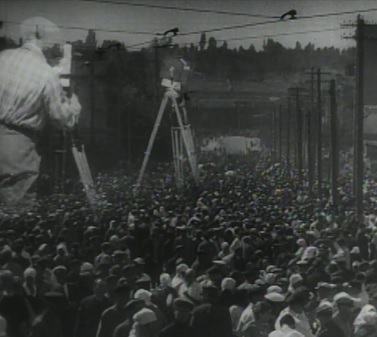
CameraManAbove
Part of the delight of Man with a Movie Camera is watching subjects’ reactions to his (then novel) camera: the woman who blocks her face with a purse to avoid it, the tiny girl who can’t keep her eyes away.

But the director’s vision is so unique and his quirkiness so evident throughout that you never forget that another artist would have chosen other faces, other moments, would have startled his subjects in other ways, and for other reasons.

Look, Mom! No Hands!
The highly touted innovations with camera work in the film are remarkable in and of themselves. (Who knew so many of these techniques were used so early?) They also serve a purpose, not only illustrating Vertov’s sense of time dissolving, but recapturing for modern audiences the thrill of being at the beginning of a new art form.
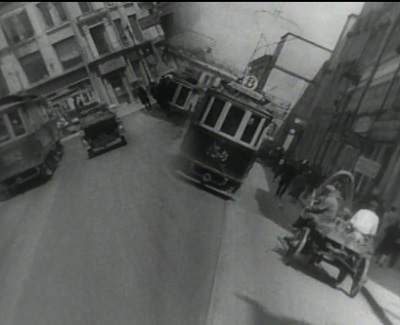
Camera-Man
They made me think of the Impressionists, freed from the tyranny of having to capture exactly what they saw. The scenes featuring the filmmaker at work are so amusing. Here’s the photographer riding on a moving car! Watch him risk his life to portray that train! I kept thinking of a little kid showing off on his bike, holding his hands aloft for the first time. And just as I thought it, I saw this image:
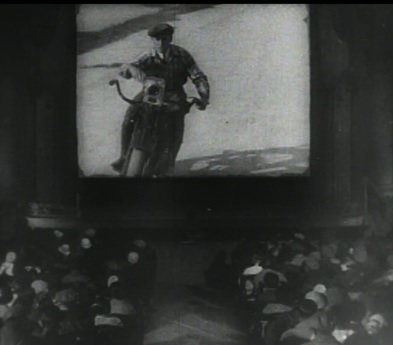
Motorcycle
Because the director’s having fun, so are we.
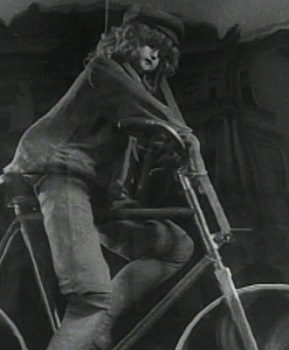
CreepyMannequin
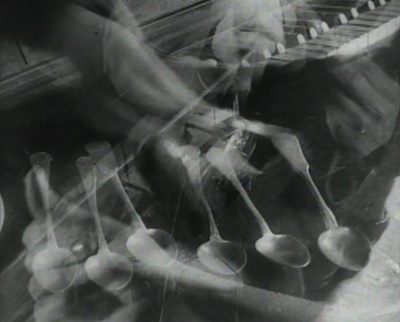
Because the action is exhilarating, we are giddy. Who but a kid-like grown up could have come up with an animated movie camera in action, or with this delightfully silly image?
Camera-Man4
Surely, Vertov would be leading the creative team at Pixar today.

Sight and Sound rated this movie eighth, and gave it the honor of best documentary of all time. I am not surprised by either ranking given the vision and experimentation of this film. But that’s not why I’m glad that I’ve seen it. What an experience, to witness so much of life covered, in so little time, and so beautifully. What a joy it is, to a witness the work of a genius with a sense of fun.

Thanks to Kimberly Bastin at Flicker Alley for a screener of the film!

Share
Posted in: 1920s films, Blogathons, Comedies (film), Drama (film), Uncategorized Tagged: Man with a Movie Camera, Sight and Sound bests, silent film, Vertov

Why the John Goodman Oscar Snubs?

02/09/2015 by leah@carygrantwonteatyou.com 16 Comments

BigLebowski-Walter-Goodman
This post is part of the 31 Days of Oscar blogathon. I’m taking part in the Oscar Snubs segment, hosted by Once Upon a Screen! There are so many amazing posts. Check them out here. Also see Paula’s Cinema Club & Outspoken & Freckled for the other great Oscar topics.

I’m rarely puzzled by an actor failing to win an Oscar. The competition is steep, the Academy biases evident, and the campaigning too embarrassing for some well-respected professionals to attempt. But for an actor not to be nominated when he regularly appears in critically acclaimed movies (and presumably played a role in their success) is surprising. With over two decades of fine performances to his name, John Goodman has yet to receive a single Oscar nod.

He is a regular in Coen brothers’ films, and thus would presumably take on the shimmer of those critical darlings. How’s this for a partial list of acting credits?: Inside Llewyn Davis (2013), O Brother, Where Art Thou? (2000), The Big Lebowski (1998), The Hudsucker Proxy (1994) (voice only), Barton Fink (1991), and Raising Arizona (1987).

For two years in a row, Goodman acted in the Oscar-winning film: Argo (2012) and The Artist (2011). In 2011, in fact, he performed in two Oscar-nominated films, playing the doorman in Extremely Loud & Incredibly Close as well as the executive in The Artist. While his roles in the other two might not have been significant enough for Academy Award consideration, his performance in Argo certainly was.

John Goodman-Argo
Goodman won a Golden Globe for playing Dan Conner on Roseanne (1988-97) and an Emmy for his guest performance in Studio 60 on the Sunset Strip. He’s won other honors, including, of course, for comedy, but the most prestigious have been ensemble awards. His only Golden Globe-nominated film performance was for Barton Fink.

I have to ask: Why?

Is His Acting Not Good Enough?
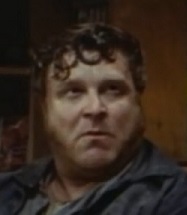
The easiest answer is that he’s simply not skilled enough to win. I guess that’s possible, even though I find it tough to believe any other actor could have so memorably captured Walter Sobchak in The Big Lebowski, or the oddest hotel guest ever in Barton Fink. Even in small roles his impact is felt. I can’t stop laughing when I think about his performance as an escaped convict in Raising Arizona, especially when he gets into his never-leave-a-man-behind diatribe.

RaisingArizona-Goodman-1
And with all of Hollywood to choose from, why would the gifted Coen brothers continue to cast Goodman if they didn’t find him talented? While the directing duo features the same actors in many of their films, I think only Joel Coen’s wife makes more showings than Goodman. (John Turturro, also beloved by the brothers, has been in four of their movies to Goodman’s six.)

Are His Roles Not Sufficiently Challenging?
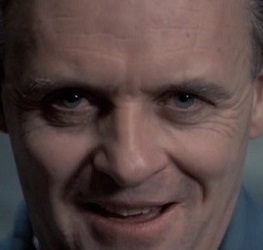
Goodman fits well into a number of stereotypical roles, especially the kind of good ol’ boy he plays in Alpha House. He clearly plays these with ease. But he enjoys eccentric characters too, as so many of his Coen brothers movies prove. The Academy seems to love larger-than-life characters. Anthony Hopkins and Daniel Day-Lewis have been honored for roles that bear no resemblance to actual human beings. Does anyone believe there was ever a man like those Day-Lewis played in Gangs of New York or There Will Be Blood? In what world is Hannibal Lecter anything but a caricature?

Lecter
Goodman’s oddball and sometimes sinister characters, in contrast, are typically very believable, especially Walter in The Big Lebowski. Is it easy to make a person who is comically bizarre come off as realistic?

RaisingArizona
I don’t think it is, nor do I believe the much-loved Day-Lewis has pulled off this feat nearly as often as Goodman has (admittedly, the latter’s role in O Brother also never gets beyond myth).

In terms of understated performances, which I typically think more deserving of honors, Goodman isn’t always given enough play time for the kind of nuanced and subtle acting we saw in Roseanne, and he doesn’t seem to demand meatier roles when he could. I’d like to see him attempt these types of parts more than he does. If only such understated roles were honored, Goodman being bypassed by the Academy would make sense given the number of his quirky parts. But that’s not the case. Oscars would otherwise never have been given to Day-Lewis for There Will Be Blood or Hopkins for The Silence of the Lambs.

Is It the Usual Reason—No Love for Comedians?
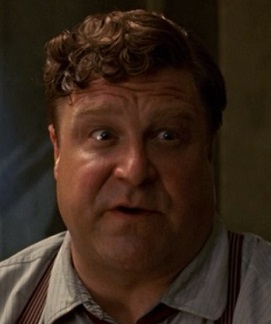
Those of you who’ve read my blog for a while know that I regularly take the Academy to task for their lack of appreciation for comedic performances and scripts (Harold Ramis, Steve Martin, Ralph Fiennes). While Goodman has often starred in dramas, even his more serious roles are usually punctuated with humor. And with a face as expressive as this one, why would he neglect the opportunity to make us laugh?

BartonFink-Goodman
The Academy’s dismissal of comedy could explain how often Goodman is never even discussed—much less chosen—when it comes to nominations.

Could It Be the TV Curse?
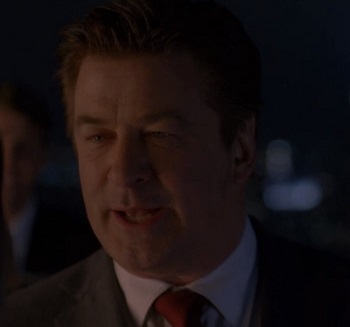
In the new golden age of TV, actors can move from big screen to television and back again without losing their star status—as long as that show is on cable. Network television still retains its low status. (Doubt me? Check out which shows win most Emmys for drama.) Whatever his other accomplishments, Goodman will always be known as Roseanne’s Dan Conner. He starred too long on a hit show—and performed too well—for it to be otherwise. While we see the rare exception—J.K. Simmons’s Oscar nomination this year, for example—most network television stars never get much credit once they turn to film. I can’t explain this trend nearly as fluently as Jack Donaghy (Alec Baldwin) does in 30 Rock.

Jackexplains30Rock
Jack is advising Tracy Jordan (Tracy Morgan) on how to tank his acting career. In the NBC TV show’s typical self-referential fashion, Baldwin is actually describing his own life:

“Do TV. No one will ever take you seriously again. Doesn’t matter how big a movie star you are, even if you have the kind of career where you walked away from a blockbuster franchise or worked with Meryl Streep or Anthony Hopkins. Made important movies about things like civil rights or Pearl Harbor. Stole films with supporting roles and then turned around and blew them away on Broadway. None of that will matter once you do television. You can win every award in sight, be the biggest thing on the small screen, and you’ll still get laughed out of the Vanity Fair Oscar party by Greg Kinnear….You wanted to hit rock bottom again? Go on network television.”

Could this trend explain Goodman’s snubs?

Is He Discounted Due to His Choices—and Costars?
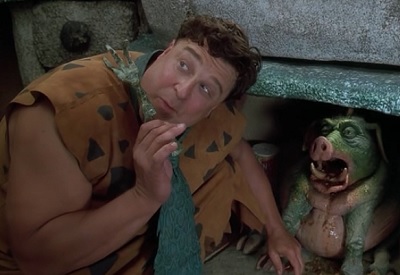
Perhaps no number of outstanding performances can make the Academy forget this role:

JohnGoodman-Flintstones
Or the fact that he starred with Roseanne Barr, who never has gained any traction outside of TV and unfortunately earned even a presidential slam thanks to this performance:

RoseanneBarr
That the show they shared was remarkably ahead of its time, wise and real in a way few sitcoms then or since have been, doesn’t seem to make any difference.

Of course, there’s no way to know for sure why the Academy passes on this lovable character actor. My belief? The omission maybe has a bit to do with the TV curse or his former costar. But mainly, he’s ignored for the same reason Jeff Bridges was for The Big Lebowski and for many other roles that preceded it: Goodman simply makes it look too easy.

Please check out the other 31 Days of Oscar entries! (I will, by the way, return to classic movie fare on Thursday:))

Share
Posted in: 1980s films, 1990-current films, Blogathons, Comedies (film), Drama (film), Oscars, TV & Pop Culture, Uncategorized Tagged: Argo, John Goodman, Oscars, Roseanne, snubs, The BIg Lebowski

Fabulous Fights: Ginger Rogers & Gail Patrick in Stage Door (1937)

01/31/2015 by leah@carygrantwonteatyou.com 19 Comments

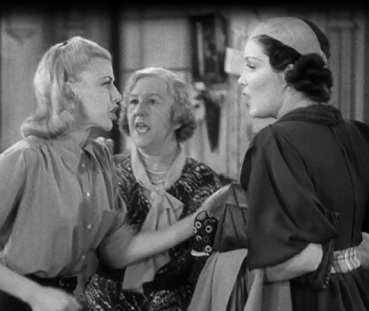
PatrickRogers-shove
This post is part of Backlots’ 4th Annual Dueling Divas Blogathon. Check out the other entries!

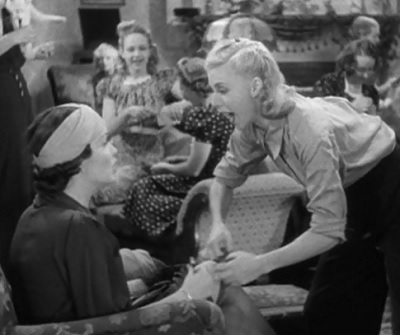
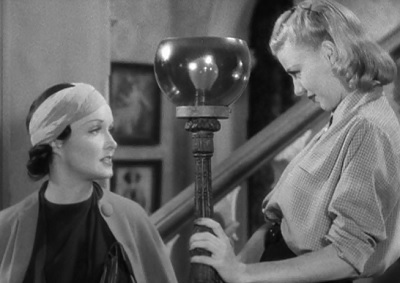
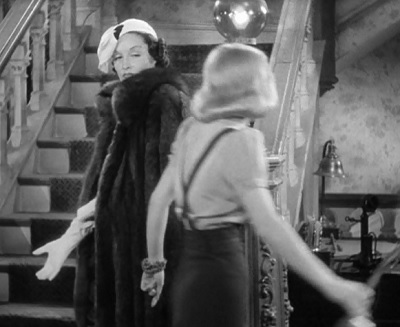
If you haven’t seen Jean (Ginger Rogers) squabble with Linda (Gail Patrick) in Stage Door, I envy you. It’s just such a pleasure. Three minutes into the movie, they are already at it: Jean thinks Linda has stolen her stockings—again—and she’ll forcibly remove them if she has to.

PatrickRogers-stockings-2
The two are roommates in the Footlights Club, a residence for aspiring stage performers, and their uncomfortably close quarters obviously are doing nothing for either’s temper. Linda denies the theft, calling Jean a “hoyden” and “guttersnipe.” Jean, sensitive to cracks about her class, says she’ll “slap [Linda’s] ears flat against the back of her head.” It takes the manager to prevent blows.

It’s the end of their relationship as roommates, but just the beginning of our enjoyment of their rivalry.

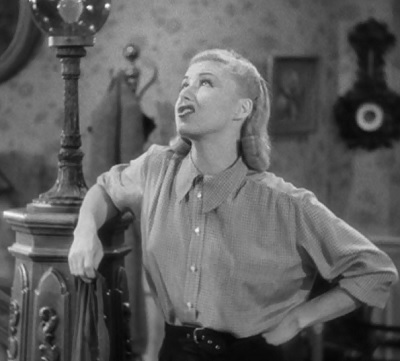
GingersRogersyellingupstairs
Jean particularly enjoys mocking Linda about her age and her lover, Anthony Powell (Adolphe Menjou).

“If you were a little more considerate of your elders,” Linda smirks to Jean, “maybe Mr. Powell would send his car for you someday….Course he would probably take one look at you and send you right back again. But then you’d have to expect that.”

“Oh, is that so?” Jean answers, imitating Linda’s superior tone.

“Do you know I think I could fix you up with Mr. Powell’s chauffeur?” Linda adds. “The chauffeur has a very nice car too.”

“Yes, but I understand that Mr. Powell’s chauffeur doesn’t go as far in his car as Mr. Powell does.”

“Even a chauffeur has to have an incentive,” says Linda.

“Well, you should know,” Jean snaps.

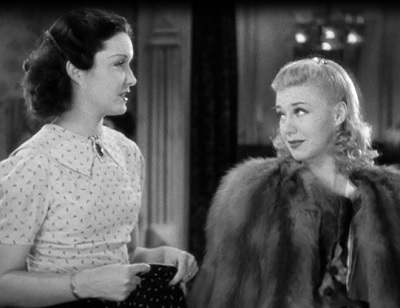
StageDoor-PatrickandRogers
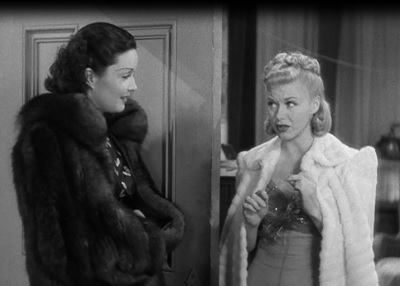
Although she judges Linda for sleeping with Powell, Jean still envies her for the rich food and garb her actions afford her. “Say, I think it’s very unselfish for those little animals to give up their lives to keep other animals warm,” she says, admiring Linda’s furs.

GingerRogersGailPatrickcoat
“You know they’re very smart little animals,” Linda answers. “They never give up their lives for the wrong people.”

“Well,” says Jean, “you understand the rodent family much better than I do.”

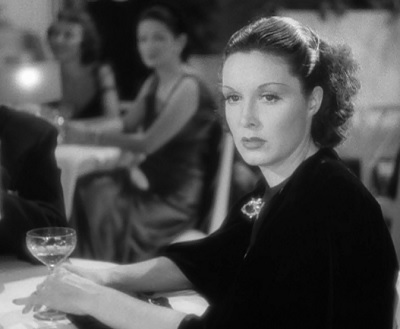
Unfortunately for Linda, Mr. Powell takes a liking to Jean, and hires her for a gig at his nightclub. Sitting next to her boyfriend, Linda realizes just whom he’s hired…

LindaSeesJean-GailPatrick
And Jean isn’t much happier to see her former roommate…

JeanseesLinda-GingerRogers
A few minutes later, Jean jabs at Linda with her cane, and the latter calls her “riffraff.”

Powell is curious about—but not put off by—Jean’s disinterest in him. “You don’t like me, do you?” he asks her.

“Oh, how could I help but like a man who takes his mother out to a nightclub,” coos Jean. “That was your mother you were sitting with?”

Jean decides to date him, even though he initially made her want to “run home and put on a tin overcoat.” How could she resist such revenge while getting a taste of the finer things in life?

AdviceGailPatrickGingerRogers
Linda tries to be philosophical about her lover’s betrayal, warning Jean it just better be temporary. “It’s one thing to borrow a friend’s friend,” she explains. “It’s another thing to hold him….”

Linda even gives her former roommate some advice, which, of course, is intended to poison their first date. “May I come in?” she begins, entering her room.

“Oh sure, I guess you’ll be safe,” Jean says, “the exterminators won’t be here till tomorrow.”

“How did they miss you on their last visit?” Linda quips.

StageDoor-GailPatrickGingerRogers
“Must be galling to you older women to lose your meal ticket to younger riffraff,” gloats Jean.

“Just a leave of absence, dearie,” explains Linda, “and in the meantime, I have my lovely sable coat and my star sapphire to keep me company.”

“It’s lovely, but I’m afraid you paid too much for it.”

The dialogue gives you a taste of these two together, but I can’t capture the chemistry, or the sparkling delivery—Ginger Rogers, with her snappy sarcasm, at her tough-gal best. Gail Patrick, with the flawless cool customer routine she perfected the year before in My Man Godfrey. The two together are magnetic.

The best part? There’s another rivalry in the film too—between Rogers and Katharine Hepburn, which is almost as fun.

For more dueling divas, check out the other entries in the blogathon!

Share
Posted in: 1930s films, Blogathons, Comedies (film), Feminism, Humor Tagged: Divas, fights, Gail Patrick, Ginger Rogers, Stage Door, women

Some Like It Hot: Only for Men?

01/18/2015 by leah@carygrantwonteatyou.com 19 Comments

I know that the field of comedy has always been dominated by men. It’s no surprise that when humorous films are ranked, those most amusing to men lead the pack. But I still find it disturbing that the film the AFI considers the funniest of all time is one that gives me just a few laughs in its two hours of running time.

I’m willing to admit that I might be missing something in Some Like It Hot; after all, many women whose judgment I respect are fans of it, and I am an enthusiastic viewer of most of Billy Wilder’s work. But for what it’s worth, I’d like to vent a bit about why (for mainly gender-related reasons) I find this film that sounds so promising—two male musicians acting like women in order to travel with an all-female band—so annoying.

Daphne/Jerry (Jack Lemmon’s character): By Turns Annoying & Creepy
The script doesn’t help, but Lemmon is largely to blame for a very unfunny portrayal of a man turned on by his fellow female band members. His suggestive comments range from grating to disturbing, and his hyena laugh is Jim Carrey-annoying.

Take this scene: Jerry is in bed in his cross-dressing gear (i.e., as Daphne), when Sugar Kane (Marilyn Monroe) visits his train berth to thank him for a favor.

After the two get some drinks, Jerry says, “This may even turn out to be a surprise party.”
“What’s a surprise?” she answers.
“Not yet.”
“When?”
“Better have a drink first.”
“That’ll put hair on your chest.”
“No fair guessing.”

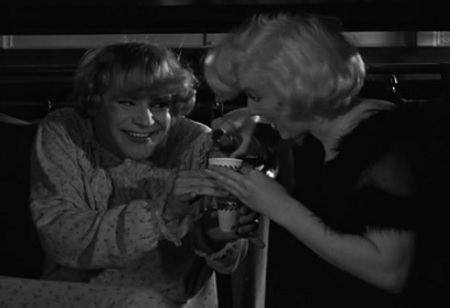
He then protests other women crashing his party, as it’ll ruin his surprise. I tried not to examine the logic of this scene too closely, but unfortunately, Lemmon’s delivery added to my initial reaction. Does this face look like seduction to you?

LemmonandMonroe-trainberth
If there were any hint of self-deprecation here, any understatement, the scene might have played as lighthearted, with a hint of, I don’t know, possible participation from Monroe. But with Lemmon’s high-pitched, broad delivery and leer, I felt uncomfortable, not amused. Look, this isn’t It’s Always Sunny in Philadelphia, in which the humor is based on the immorality of its leads. We’re supposed to empathize with this man, not wish to warn Sugar Kane there’s a pervert on the loose.

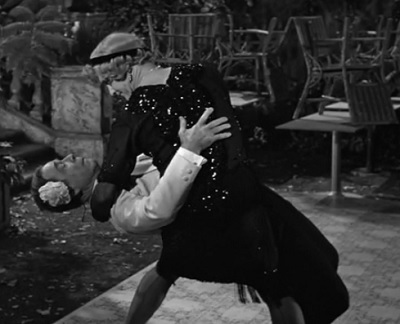
Once Lemmon is being courted by a man and his energy dissipates into snarly comments and stiff movements, he’s quite amusing. I particularly enjoyed when he starts to really get into his gender ambiguity as he dances.

LemmontangoingSomeLikeItHot
I just wish we could have had more of that and less of his flirtatious mood with Sugar and the other band members.

Joe/Josephine (Tony Curtis) a Bore—Until He Becomes a Pseudo-Millionaire
I’m not a fan of Tony Curtis’s. With the exception of Sweet Smell of Success, I tend to dislike his films, finding him too smugly pleased with himself, too much the “Matthew McConaughey of his generation,” as my sister puts it. While his low-key portrayal in Some Like It Hot is a welcome break from Lemmon’s energy, he takes his lethargy too far. It seems watching Lemmon’s hypercaffeinated performance caused Curtis to nap his way through the script.

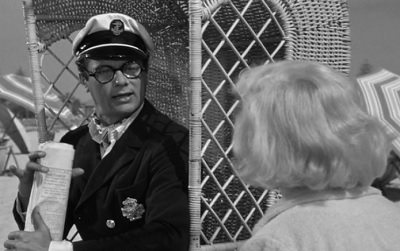
But once Curtis (as Joe) ditches the dress and takes on a different costume, he is quite amusing. He has dressed himself in what he deems sophisticated clothing, complete with a cap and metal buttons. He wants to convince Sugar he’s from old money.

CurtisandMonroe
When he speaks, it’s with Cary Grant’s accent. I like the layers of jokes here, even if they’re anachronistic given the movie’s 1929 timeline: Joe is so unfamiliar with well-born men that he mimics a movie star’s imitation of one. (Admittedly, this wasn’t a bad choice: Grant was so convincing in his own portrayal of a blue blood that he probably convinced 90 percent of us.)

As the Shell millionaire he’s aping, Joe can be quite funny. I like when he mistakes a stuffed swordfish for a member of the “herring family.” Curtis is far more animated in these scenes, and the script so much stronger than in the rest of the movie. Joe’s description of his love’s death is funny, and his details about his family’s attempts at a cure for his heartache—a French maid, a troupe of Balinese dancers—are hilarious.

Male Fantasy Scenes Played as Realistic
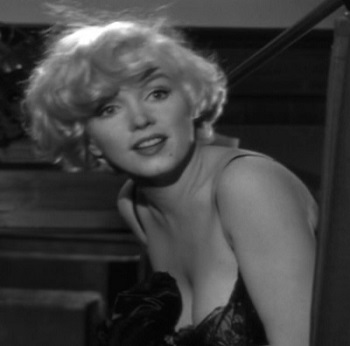
I don’t know about you, but when I’m traveling with a bunch of female friends, I tend to relax in lingerie like this:

Marilynlingerie
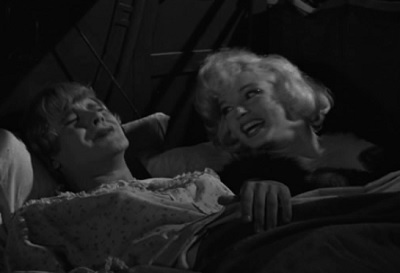
I prefer to cuddle up to my companions, especially ones I’ve just met, to get as much skin-on-skin contact as possible.

MarilyncuddlingwithLemmon
And on the beach, I like to spend my time tossing a ball to my pals in a provocative fashion.

If this kind of scenario is played as fantasy, I find it funny. But when I’m supposed to take it as a given, with the humor to be found elsewhere, I’m so busy rolling my eyes that I miss the action. Look, I understand that Hollywood wants to show some skin, especially in a film featuring Marilyn Monroe. And I’ll admit I’m jaded from one too many sorority house/girls’ locker room scenes of a similar nature. Admittedly, I have seen much worse in other movies; at least all of the women in the band aren’t dressed like this (just the most attractive ones, as they always eschew comfort for sexiness, right?)

If they’re played as campy, how funny scenes like these can be! But if they aren’t, I tend to look up the screenwriters and confirm my suspicion—yep, written by men, probably ones who’ve spent too much time on adult-only channels/sites. Am I the only one who thinks humor works best when it’s based on actual human behavior, not teen boys’ daydreams?

Missed Opportunities in the Script
Cross dressing is almost always funny in film, and Curtis and Lemmon are so unattractive as women, and so obviously male, that it makes the gullibility of those around them funny in itself. Initially, their disgust at the casual chauvinism of the other hotel guests is entertaining too, as when Daphne gets pinched and Josephine is propositioned by the bellboy. Pity that there’s no accompanying recognition of their own chauvinism, as without it, we’re left mainly with tired gags about breasts, high heels, etc. While occasionally both of the men (and the script) give a fun twist to their adoption of female clothing and mannerisms, in most scenes, I didn’t see anything new.

Of course, I know that this territory is much better canvassed today than in 1959, when it would have been far more scandalous. Still, the stars’ parents would have found the film tame; it’s impossible to be shocked by men in tights and Marilyn’s walk when earlier (pre-Code) movies portrayed women sleeping to the top and cheating on their husbands to get even—without judgment. Let’s not forget that Mae West had drag queens in her 1927 play, and planned to feature them in her next before the censors stepped in.

I know there are times when repetition of references, as we often see in Some Like It Hot, is funny. I still laugh every time I hear the name Mr. Bigglesworth. But those references only continue to be amusing if they were particularly funny—and ideally fresh—to begin with. I was disappointed to find that a writer/director who in an earlier film (with Charles Brackett) defined craziness as giving an engagement gift of a “roller skate…covered with Thousand Island dressing” would (with I.A.L. Diamond) resort to lines as flat as these: “I’ve got a funny sensation in my toes, like someone was barbequing them over a slow flame.”/ “Let’s throw another log on the fire.”

One Reason to Watch: Sugar Kane
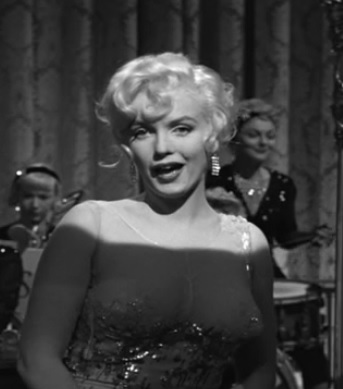
Monroe is mesmerizing as Sugar Kane. She is, of course, unbelievably attractive in the movie.

Marilynsinging
And she manages to turn what could have been a brainless blonde stereotype into something believable, even touching. I particularly enjoyed her effort to convince Joe-as-Shell-millionaire that she has a sophisticated background. While he comes across as conniving and silly in his con, her performance is moving and honest and funny in spite of her lies. While she fabricates a Bryn Mawr education, she conceals nothing else, and her openness makes her deceptions so obvious they might as well not be deceptions at all.

It might seem that I hated this movie. I didn’t. In fact, I enjoyed the first 25 minutes or so, after which I just kept hoping it would improve in the interludes between Monroe’s perfect delivery of her lines. But the film’s undeserved reputation infuriates me. I can’t help wondering if I were a woman new to classic comedies and started with this one, would I have kept watching?

This post is part of the Contrary to Popular Opinion Blogathon, where we set the consensus on its head by defending a maligned film, performer or director or toppling a beloved one! Check out the other entries.

contrary-blogathon-7

Share
Posted in: 1950s films, Blogathons, Comedies (film), Feminism Tagged: Billy Wilder, It's Always Sunny, Mae West, Marilyn Monroe, Matthew McConaughey, Mr. Bigglesworth, Some Like It Hot, Tony Curtis

Disney’s Tangled: Better as a Silent Film?

11/11/2014 by leah@carygrantwonteatyou.com 8 Comments

MotherKnowsBest-Tangled
This post is part of the The Fairy Tale Blogathon hosted by Movies Silently. Check out the other entries!

I was hesitant to give Tangled a chance. I’ve always been bored by Rapunzel, who had little to recommend her but strong hair. Sure, she had beauty—yawn—and a pretty voice (What heroine doesn’t?) But she always seemed so idiotic to me. She had two tasks in her life—let down her hair, and conceal the prince’s visits, and she botched one of them, setting her love up for the witch’s wrath. And however her looks might have grown in all that tower time, isolation surely didn’t do much for the fair one’s people skills.

Disney’s 2010 version was much more entertaining than I thought it would be. Rapunzel is savvier and spunkier than in the original tale. And Tangled has some amusing theories on what she did all day, and how her upbringing by a witch might have affected her. Some wonderful side characters add to the energy, and the witch is a hoot. But there are some disappointments too.

First, the improvements on the fairy tale:

A Heroine Who Isn’t a Snooze
I’ve always pictured Rapunzel as a less interesting version of Lady Bertram, napping until the prince arrived and slowly making her way to the window, yawning as she helped him climb. Disney’s version (voiced by Mandy Moore) is full of projects: reading, painting murals, baking, doing papier-mâché and otherwise trying to fill the hours. She is obsessed with the lights unleashed on her birthday, actually lanterns from the queen and king to call her (their daughter) back from the witch, who stole Rapunzel to retain the Fountain-of-Youth properties of her magical long hair.

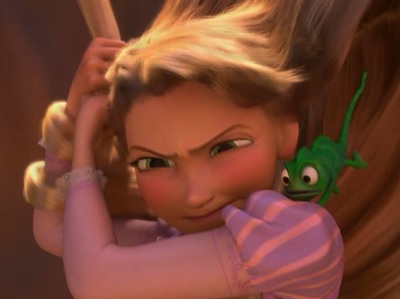
The unbelievable strength of Rapunzel’s hair in the fairy tale always puzzled me, so I was relieved to find the hair was magical, and Disney made it much more fun by turning it into an all-in-one lever-rope-weapon.

Rapunzel-Tangled
Rapunzel is also pretty handy with a frying pan, which she wields to defend herself against the thief (a prince replacement) who escapes into her tower. She bribes him to help her to the lighting ceremony, after which she plans to return meekly to her mother (aka, the witch). (I was concerned about the amount of head-pan contact though, convinced she’d kill/maim him sooner or later; the pan surely must have been made of weaker stuff than my iron skillet.)

An Equal Partnership
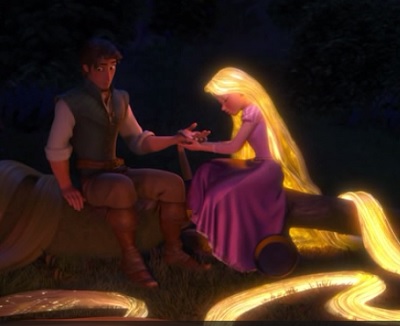
In most ways, the thief (Flynn Rider, voiced by Zachary Levi) is an everyday Disney hero, handsome and arrogant, proud of his “smolder” look. His backstory—an orphan craving riches—explains both his law-breaking ways and duplicitous behavior toward his partners. While he will obviously be reformed by the love of such a sweet, naïve girl, à la Lady and the Tramp, she will pick up his daring and inventiveness, needed qualities for a girl who is dangerously set in her ways thanks to eighteen years in a tower. Of course, she does have one advantage over him, with that magic, glowing hair.

FlynnandRapunzel-hair
I can’t say I was terribly interested, moved by, or invested in their union, but thought his altruism near the end was a nice touch. But no worries—I didn’t have to care much about them. Not with the mama witch to keep me interested.

A Worthy Villain
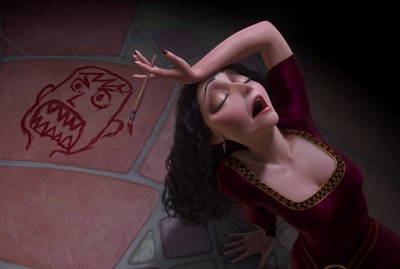
Now, I’m not going to claim this witch is as fearsome or powerful as Cruella de Vil. But it’s fascinating to watch Mother Gothel, perfectly voiced by Donna Murphy, manipulate her supposed daughter Rapunzel. This mother has Bette Davis flair as she pronounces the evils outside that Rapunzel must avoid. My favorite of the dangers she lists: men with pointy teeth.

MenwithPointyTeeth-MotherGothel
“Skip the drama,” she advises in song. “Stay with Mama.” Murphy’s performance is simultaneously disturbing and hilarious.

Mother Gothel transitions from worldly dangers to a litany of Rapunzel’s weaknesses: her clumsiness, her naïveté, etc., which will supposedly make her easily fall prey to others.

Of course, Mother Gothel pretends love, not fear of loss, is what prompts her tower hiding of Rapunzel.

LoveYou-MotherGothelandRapunzel
(And, of course, she does love her obsessively—at least, that magical hair.)

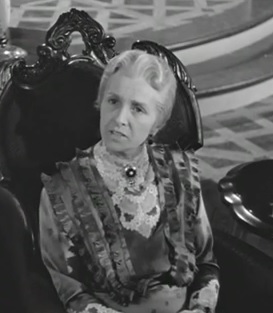
In terms of models, Mother Gothel is a twin of the monstrous parents in Like Water for Chocolate and Now, Voyager, mothers who think a daughter should exist solely to serve, and enjoy doing so.

NowVoyager-GladysCooper
Mother Gothel likes to point out her maternal virtues, such as providing such great paints and soup!

I’d always considered the father of the original tale weak for giving his child to the witch’s care (to avoid paying for stealing food for his pregnant wife with his life). But I’d never reflected on just how cruel it was to leave his child in such hands. The ill effects are briefly seen when Rapunzel escapes, as she veers between bursts of joy and energy…

Joyous-Tangled

…and periods of debilitating guilt:

Miserable-Tangled
While this back-and-forth moodiness is funny to watch due to Disney’s deft portrayal, I kept thinking of Davis’s twitchy, insecurity-infused performance in Now, Voyager, and just how much therapy it would cost Rapunzel before she attained the exuberance and lightheartedness she displayed in the very next scene. Truly, a witch who just threatens physical harm would be sweet by comparison.

Amazing Allies
I used to like the sidekicks in Disney flicks, but after one too many Sebastian types (of The Little Mermaid fame), I was relieved to find the most prominent sidekicks largely silent, including an Owl-like chameleon, Pascal, whose expressions and gestures provide sage advice (in tribute to his name, of course).

PascalTangled
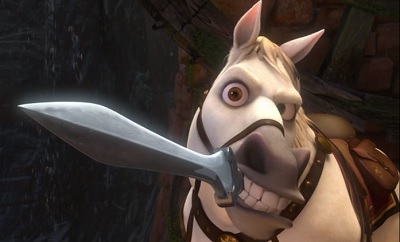
And there’s the glorious Maximus, a horse with amazing hunting skills and loyalty, who provides 90 percent of the comic relief of the film. As part of the royal guard, he tracks Flynn with Inspector Javert-like persistence after Flynn steals a crown from the palace.

Maximus-Tangled

Maximus falls for Rapunzel and reluctantly aids her beau, a reluctance that’s a joy to witness.

In fact, I was so enthralled by these animated allies that I found myself wishing the whole movie were silent, not just because these allies were the primary reward of watching the movie, but for the following additional reasons:

Utterly Forgettable Songs
Murphy (Mother Gothel) gets one good tune, and she’s a talented enough actress and singer to almost make the other songs worth hearing—almost. But with bland song after bland song, and the highly generic focus on dreams (seriously?), I was ready to return to the silent antics of Maximus. (If you can’t beat Kermit piping the lovely “Rainbow Connection” or the 1001 less compelling dreaming songs since, lay off of ’em.)

Scenery More Interesting than the Plot
A girl spends a lifetime in a tower, much of it reading, and the height of her ambition on escaping is to……see some lights. Umm, what? Couldn’t Disney have made her an artist—a writer or a painter (the murals!)? Or maybe an intellectual even? Surely Mother Gothel would have loved to provide the kinds of books that would turn Rapunzel into a scholar, as those might make her content to live a life of the mind, happy with her retreat. Turn the tower ivory, Mother Gothel! Come on! I’m not exactly talking about creativity here; I’m pronouncing the biggest cliché about towers ever. I know I’m supposed to believe Rapunzel has some spiritual connection with the lights, somehow understanding they’re for her, but if that’s the case, why didn’t Mother Gothel change the date of her birthday? The woman seems far too intelligent to have made such a dumb mistake.

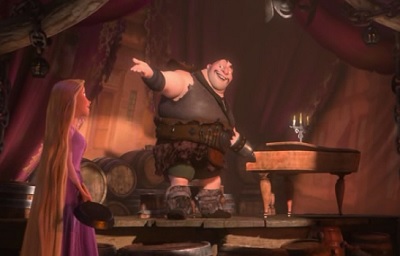
The first big moment after Rapunzel’s re-entry to the world involves turning a bunch of thugs to her side because she asks if they have dreams, and they proceed to share them.

DreamingThugs-Tangled
If I’d been in the theater, I’d have been tempted to throw popcorn at the screen. Even if this is a strange alternate universe where dreams aren’t discussed ad nauseam, neither this character, nor her own ambition, is at all inspiring. To see lights is not exactly the kind of dream to get criminals past their reluctance to open up. If the movie had played off her dream as comically stupid, what someone dozing in a tower would come up with, I’d have been all for it. But sigh. They played it as motivating.

In contrast to such clichéd scenes, all the details of the landscape sucked me in, especially the flood. In trying to get boys to watch the film, Disney really succeeded with the action shots.

Flood-TangledActionShot-Tangled
How interesting it would have been, in contrast to that silly song about grass when the heroine hits the ground and the unnecessary (if occasionally amusing) scene with the tough types, to just witness Rapunzel quietly taking in the wonders around her, jumping at everyday noises, stumbling a bit at the unaccustomed exercise. What humor and pathos would have been possible! Disney gets this for a second, as Rapunzel is paralyzed after her tower retreat, unable to make the 12-inch drop to the ground.

FootfromGround2-Tangled
That moment was worth the next hour.

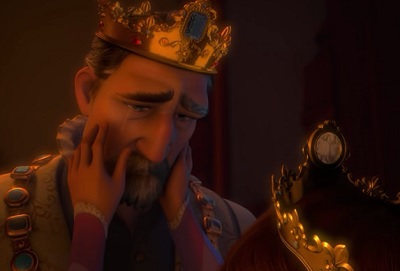
In fact, the only truly moving scene in the film is the silent clip of the king and queen, hesitant to practice this lantern ritual yet again, to allow themselves to still hope.

KingandQueen-Tangled
I wish that Disney hadn’t been so cowed by Pixar successes into such a conventional retreat from what’s compelling about this movie. They give Rapunzel a Barbie-sized waist. They back off from the interesting mother-daughter dynamic.

MotherGothelandRapunzel-insecurity
They don’t realize Maximus is the star. They have this supposedly feminist heroine spend her time on indisputably female-associated crafts instead of developing some kind of true ambition. And at the end of the movie she’s—surprise! A bride.

Disney had the potential for some Fantasia creativity, with silence used to beautiful effect, and the glimpses of the story’s potential still make this a fun movie. But how great it could have been.

Don’t forget to check out the other entries in the blogathon!

Share
Posted in: 1920s films, 1990-current films, Blogathons, Comedies (film), Drama (film) Tagged: animated movies, Disney, Now Voyager, overbearing mothers, Rapunzel, Tangled

The Moment I Fell For: Alice Brady

10/31/2014 by leah@carygrantwonteatyou.com 14 Comments

This is part of the Classic Movie Blog Association’s Forgotten Stars blogathon. Check out the other entries!

AliceBrady-top
When you type Alice Brady into a Google search, a flood of entries appear—but not for the talented actress who won over My Man Godfrey audiences in her role as the flighty head of the Bullock clan. Instead, the character of Alice (Ann B. Davis) from the Brady Bunch pops up. I enjoy my 70s kitsch as much as the next gal, but I find it troubling that the lasting fame of Brady, an actress who already was granted too few years (she died at 46), should be shortchanged as a result of everyone’s favorite cheesy housekeeper. Here are a few reasons why Alice Brady needs to be remembered:

She Could Outdazzle Ginger Rogers
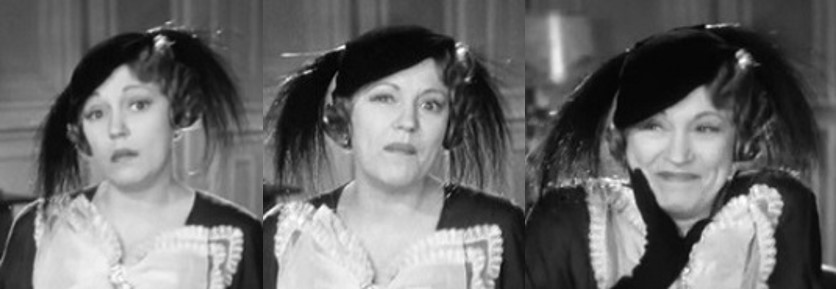
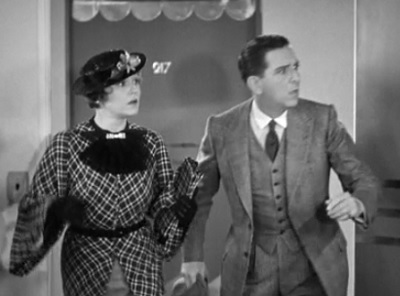
In The Gay Divorcee Aunt Hortense (Alice Brady) hires her former fiancé Egbert (Edward Everett Horton) to help her niece (Ginger Rogers) attain a divorce. While I am amused by Mimi’s (Rogers’s) attempts to divorce her husband and her suitor’s (Fred Astaire) confusion over the hijinks that ensue, their romance is completely outdone by the duo of Horton and Brady, who vie each other for who can be the most foolish. Hortense interprets any of Egbert’s idiotic actions—agreeing with her that geometrists are synonymous with geologists, wearing a finger puppet while conducting business—as signs of his continued love for her. When leaving his office, Hortense becomes weepy, saying, “You know, divorces make me so sentimental. Don’t you wish it was ours?”

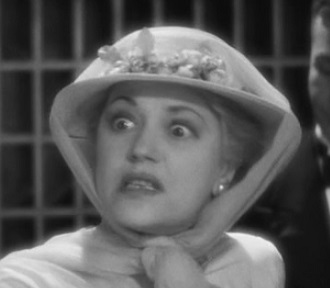
This exchange would have been funny with almost any actress. But this is Alice Brady. A few images should give you the idea of just how fun this moment—and their whole romance—is, and just why from that moment forward, I sought out Brady films. Just check out how expressive she can be in one short scene, and this without the delightfully funny trill of her amazing voice:

AliceBradyGayDivorceecom
As a fervent Astaire-Rogers fan, I’m usually annoyed by the subplots that take away from dance number time. But in this case, I was eager to see Hortense again, even becoming impatient with the dancing. Who wouldn’t smile to see the amazing Horton and Brady together?

Egbert andhortense-BradyandHorton
She Could Do Everything—Drama, Comedy; Film, Stage
Despite her producer dad’s strong objections, Brady, born in 1892, followed the family business by becoming a Broadway actress, and spent her youth alternating between screen and stage, mainly in dramatic roles, including as Lavinia in the first performance of Mourning Becomes Electra.

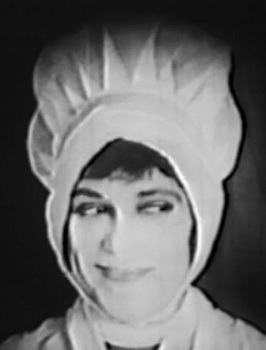
While I’ve only tracked down one of her many silents, Betsy Ross (1917), its absurd, overdramatic plot is worth viewing if only for this great line: “Thee is too spicy for a Quakeress, Betsy! I fear for thee.” Does any word suit this wonderful actress more?

Brady as Ross

Brady as Ross

Brady left the screen for a decade, focusing on the stage as Hollywood revolutionized its production. She returned in the sound era with perfect comic timing and delivery, no doubt honed in Broadway roles in such comedies as The Pirates of Penzance.

AliceBradyIndignant
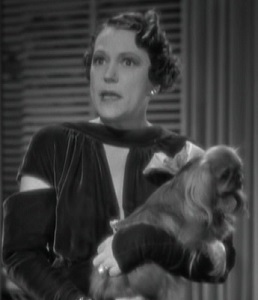
In typical Oscar fashion, the Academy nominated her for the romantic comedy My Man Godfrey, but only granted her the award when she starred in a drama. She played an Irish mother (Molly O’Leary, owner of the famous arsonist cow) beset by her children’s squabbles in In Old Chicago. What’s fascinating about the film is how understated her performance is, even for the stereotypical tough Irish mom she’s playing. For a woman who verged toward the theatrical in her comic roles, it’s interesting to find her often going for a quiet harrumph rather than a shout.

She Could Spar with William Powell
She’s good in the O’Leary role, but it pales in comparison to her comic gems. I’m not even a fan of My Man Godfrey, which feels a bit preachy to me and relies on too many sets of Carole Lombard hysterics. But I could watch her hangover scene with William Powell all day long.

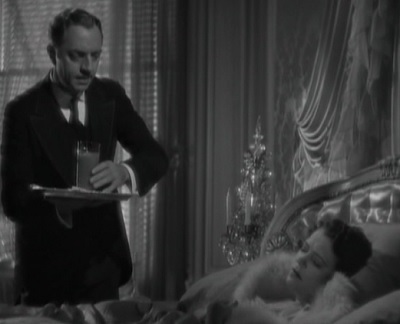
PowellandBrady
Her near-comatose presence is so funny given her later zaniness, as is her conviction that pixies are haunting her. When her new butler (Powell) tells her the tomato juice he’s serving is pixie remover, her flat delivery is priceless:

“Oh, then you see them too,” she drones.

“They’re old friends,” he responds.

“Yes, but you mustn’t step on them,” she explains calmly. “I don’t like them. But I don’t like to see them stepped on.”

She may not be remembered as much as she should be, but we classic film buffs would be the poorer without this “spicy” actress.

AliceBradyGoldDiggers
Random Facts:
A man claimed her Oscar at the Academy Awards when she was too sick to be present; apparently, no one ever had a clue who he was, including Brady.

Brady tried to get massages as a deduction on her income tax, claiming looks essential to her role as an actress, but, as her New York Times obituary writer wryly noted, “The government remained unmoved.”

Share
Posted in: 1930s films, Blogathons, Comedies (film), The Moment I Fell for Tagged: Alice Brady, Classic Film Blog Association, In Old Chicago, My Man Godfrey, The Gay Divorcee

My Favorite Canadian: Michael J. Fox

10/09/2014 by leah@carygrantwonteatyou.com 16 Comments

This post is part of the O Canada Blogathon hosted by Ruth of Silver Screenings and Kristina of Speakeasy.

I remember being vaguely horrified when I discovered Michael J. Fox was Canadian. He was OURS. How could he possibly be anything other than American? His role as Alex P. Keaton was so iconic: the conservative, hippie-parent-horrifying, greed-is-good believing teen who embodied and parodied Reagan-era culture.  Although I’d rather hang out with his sister Mallory (Justine Bateman), I knew Family Ties revolved around Fox’s pitch-perfect, Emmy-winning performance as Alex.

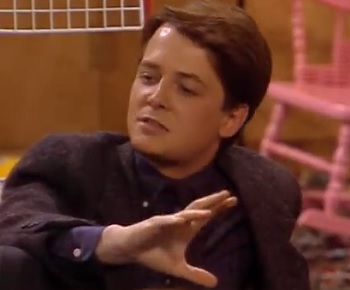
Keaton (Fox) explaining the horror of taxes to preschoolers

Alex P. (Fox) explaining the horror of taxes to preschoolers

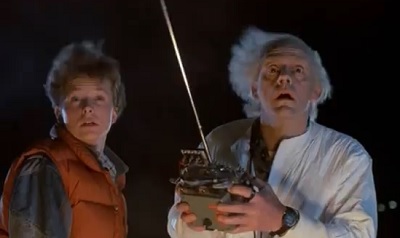
I was such a huge fan of Family Ties that when Fox followed the show with big-screen stardom in Back to the Future, what I felt was pride.

BacktotheFuture
No wonder then that in those years before I’d ever been out of my own country or met any Canadians, I felt so disappointed to lose any hold on him. I mean, I’d gone to see Doc Hollywood–in the theater. I’d suffered through The Secret of My Success for him. It wasn’t really a crush with me.  (Even if I ever had one, I think those suspenders in Back to the Future would have ruined it.)  I just admired him so much.  His gestures, expressions, movements–always so true, so uniquely his, and so damn funny. And oh, the lines. No one can deliver a line more effectively than Michael J. Fox. I could listen to him ask, “Are you telling me that you built a time machine… out of a DeLorean?” on repeat. No wonder the guy can’t seem to walk in front of a camera without being nominated for an award.

When Parkinson’s forced Fox to leave Spin City, his costars couldn’t stop crying long enough to finish his final episode. They didn’t know yet that he’d find a second career in his illness as a guest star, even as the headliner of his own show. And most of all, as the representative for the disease that had claimed him. They didn’t know he’d write a memoir. Call it Lucky Man. Tell other actors on Inside the Actor’s Studio suffering from the same afflictions that he had it easy, with his advantages, that they were those who had courage and guts; they were the ones he admired. That he’d remain tireless and fearless in his pursuit of a cure, and keep on wowing his countless fans.

It took a while, but I finally lost my dismay at Fox’s being Canadian. Instead, I now feel gratitude toward his homeland: for sharing this fine of an actor, this caliber of a human being with the rest of us. And now if you’ll excuse me, I need to re-watch Alex P. recommending amoral business principles to children.

Be sure to check out the other entries in the blogathon! And I promise to return to classic film next week. I just couldn’t resist celebrating Fox.

Share
Posted in: 1980s films, Blogathons, Humor, TV & Pop Culture Tagged: Alex P. Keaton, Back to the Future, Canadian, Family Ties, Michael J. Fox, Spin City

The Red Shoes, Pied Piper to Aspiring Ballerinas

08/03/2014 by leah@carygrantwonteatyou.com 14 Comments

This post is part of A Shroud of Thoughts’ The British Invaders Blogathon. Check out all the great entries! 

Vickyandshoemaker
Why did this film about the terrible choices a woman must make for her art inspire generations of ballerinas? Every little girl raised on Hans Christian Anderson knows that Karen, the red shoe-shod girl, doesn’t fare well: as punishment for her vanity in choosing red shoes for her confirmation (and similar sins), Karen can’t stop the shoes from dancing, can’t take them off, can’t go to church, can’t even prevent her detached legs from dancing when they’re cut off and replaced with wooden ones. Only when she truly feels remorse does she find peace—in death.

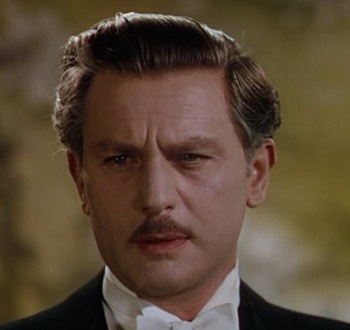
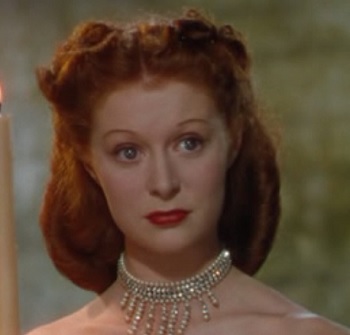
Surely then, a film about these shoes won’t bode well for the heroine, Vicky Page (Moira Shearer), as indeed, proves to be the case. The aspiring ballerina’s fierce impresario, Boris Lermontov (Anton Walbrook), expects unwavering commitment to dance. Vicky arrests his attention and is allowed into his troupe mainly because she seems to possess it:

“Why do you want to dance?” Lermontov asks when he meets her.

WhyDanceLermontov
“Why do you want to live?” Vicky answers.

VickyWhyDance
“I don’t know exactly why, but I must,” he admits.

“That’s my answer too,” Vicky answers.

His prima ballerina’s nuptials lead the fiery director to boot her out, and usher Vicky in. He’s not interested in any dancer “imbecile enough to get married.” “You cannot have it both ways,” he explains to his choreographer. “A dancer who relies upon the doubtful comforts of human love will never be a great dancer, never.” Vicky is soon in training for Lermontov’s new ballet, which is based on the Hans Christian Anderson tale, with a company skeptical about her abilities and self-doubt growing under everyone’s exacting standards.

She relaxes when The Red Shoes becomes a spectacular smash, but conflict soon arises in the form of the ballet’s young composer, Julian Craster (Marius Goring), who has fallen for Vicky, and she for him. At this point, we viewers are still happy: she’s gotten her role, as has Julian, whom we’re also rooting for; she’s a hit, as is he; they’re in love, and have earned the respect and affection of the rest of the troupe. But then Lermontov finds out, and she has to choose: greatness with him, or mediocrity with Julian (only minor roles, minor ballets for her). And like every woman before her, this choice between love and ambition will not be an easy one, and she will be tortured either way.

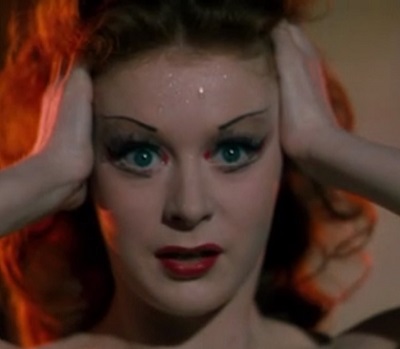
VickytorturedRedShoes
Why then, did this tragic film result in so many enthusiastic young ballerinas? I have a few theories on that, having been in ballet from ages 5-12 myself, and seen this movie when I was gobbling up Noel Streatfeild’s Ballet Shoes series.

For Young Girls, It Wouldn’t Have Been a Tough Choice
Julian is a likeable guy (for most of the film). He’s ambitious, cocky, devoted to his art, smart. He stands up for himself when he’s cheated; he’s supportive, sweet, and appreciative of Vicky as an artist, as he demonstrates during their loveliest moment together, when he envisions a time when a child will ask him as an old man where he was most happy, and he’ll answer this moment with Vicky: “‘What?’ [the girl] will say. ‘Do you mean the famous dancer?’ I will nod. ‘Yes, my dear, I do….We were, I remember, very much in love.’”

But let’s be frank here: Aside from the romantic streak, these are the types of traits women long on the dating scene may appreciate, but are not the type to win over pre-pubescent girls. This is not the kind of face girls’ dreams are made of:

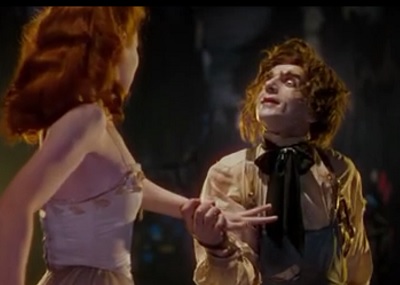
JulianTheRedShoes
Without the conflict, no tragedy. And after all, even those girls who dream of perfect love and great achievement know a ballerina’s career is short. Their gossiping friends in the dance company will tell them so (if they’ve made it that far). And if they’re still beginning, well, they will learn as much after a day with some dance flicks: The Turning Point, Center Stage. Is it so impossible for the young dreamer to think she’ll simply fall in love later, as the actress (Moira Shearer) herself did in her mid-twenties after her greatest dancing successes?

The Caliber of the Dancing
The pet peeve of dancing enthusiasts is when films substitute allegedly good actors for good dancers—because Jennifer Beals, my friends, sure did have acting chops. Perhaps I would understand this choice if any of the actors and actresses selected were talented.

Take, for example, Center Stage (2000), which played it both ways, inserting a few actors among real-life ballet dancers to elevate the film’s quality. While the result is good dancing, but an array of poor acting performances, the worst among the bunch are Zoe Saldana and Susan May Pratt, who were chosen for their supposed dramatic skills; the latter can’t even manage graceful walking. People, no dancer has ever regretted watching a Fred Astaire film, and the man was at best a passable actor. No dancer says, “I would have enjoyed that movie if he could act,” even if an occasional person among the general audience does.

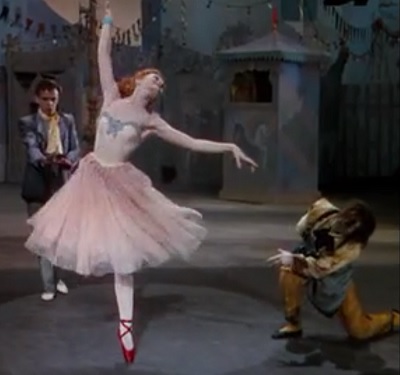
The Red Shoes, like the Rogers-Astaire films before it, did something more than highlight amateur beginners. It featured world-renowned ballet dancers and choreographers. Léonide Massine, who plays the choreographer (Ljubov) in the film, was a choreographer of nearly the status as George Balanchine. He created and acted the part of the shoemaker in the ballet. The replaced prima ballerina, Boronskaja (Ludmilla Tcherina), was in real life a prima ballerina in France.

And Moira Shearer? She danced for both Balanchine and Massine as a principal in the Sadler’s Wells (later the Royal Ballet), along with, you guessed it, that little-known ballerina Margot Fonteyn, whose costar in the company choreographed and played the male lead in the ballet within the film, Robert Helpmann.

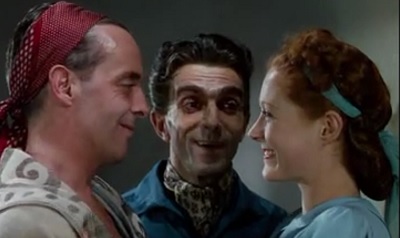
Helpmann, Shearer, and Massine.

Helpmann, Shearer, and Massine

Choosing such ballet luminaries didn’t hurt directors/writers Emeric Pressburger and Michael Powell’s movie; they were even lucky enough to find in these stars acting skills as well (which we rather expect in our greatest ballet dancers).

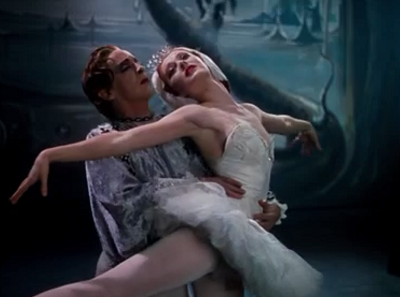
The Red Shoes’ most famous ballet itself is stunning, surreal, inventive and truly impossible to put into words, capturing the darkness of the fairy tale and all of its creepy, moralistic, vaguely misogynistic undertones, and giving Shearer the chance to demonstrate just why she was considered by some to be Fonteyn’s equal. It probably didn’t hurt that the film was scored by the Royal Philharmonic Orchestra.

The Realism
The movie is known for its surreal use of color and special effects and for a riveting performance by Walbrook as Lermontov.

surrealTheRedShoes
It’s recognized now as ridiculously ahead of its time; one shivers to think what an American studio would have done with the same material in 1948: the starlets they would have chosen, the bizarre beauty they would have stamped out.

But by any standards, this film captures ballet as it is lived as well: the punishing practices, the demand for perfection, the colorful personalities, the scary choreographers and directors. I didn’t even make it into the company in my school, but I was terrified of the man who was our head. I’ll never forget his sharp eyes on me when I missed a move in The Nutcracker, nor his poise, which was every bit as still and intimidating as Lermontov’s. And this was a director of a small company in a minor city.

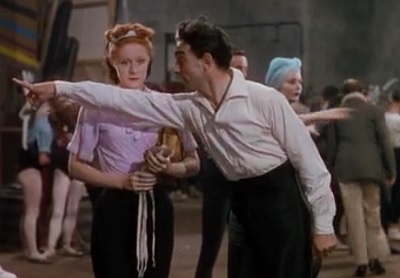
Vicky (Shearer) rebuffed by Ljubov (Massine), Vicky's (Shearer's) movie and real-life choreographer.

Vicky (Shearer) rebuffed by Ljubov (Massine)

The film, however, captures more than the tribulations of a dancer’s life. It conveys too the joy of the right move, of building toward something creative together, of earning not just the admiration of a crowd, but of those whose judgment you know to value.

Vicky (Shearer) with her fellow lead (Helpmann) and choreographer (Massine); all three were involved with Sadler's Wells ballets.

Colleagues in film and on the stage: Helpmann, Massine, and Shearer

And it portrays the thrill of those impossibly lovely gestures, pirouettes, and leaps too, which no other experience can quite replicate.

Shearer believed the film injured her classical dance career because critics assumed she was riding on her fame from it rather than technical talent. If that’s true, I want to thank her for the sacrifice (admittedly too late). For it meant many young aspiring ballerinas like me, who would never go very far in dance, would understand in watching and re-watching The Red Shoes just what had made those hours in the studio worth it for us. Yes, it was literally a pain to practice (I feel a cramp in the arch of my foot just remembering those pointe shoes). And it hurt even more when it was time to let ballet go. But look! Just watch Vicky.

VickydancingTheRedShoes
Why wouldn’t you want to be a part of that, even for a little while?

Share
Posted in: 1940s films, Blogathons, Drama (film), Musicals and dancing films, Romance (films) Tagged: ballet, dancing, Moira Shearer, The Red Shoes, tragedy

A Strange Mess: Mister Roberts

07/10/2014 by leah@carygrantwonteatyou.com 15 Comments

This is a contribution to the John Ford blogathon sponsored by Christianne Benedict at Krell Laboratories and Bemused and Nonplussed. Check out all the marvelous entries!

Punching his leading man. Drinking on the set. Quitting the production after being hospitalized. The tales of John Ford’s behavior on Mister Roberts aren’t pretty, and neither is the film. While some of its flaws can be blamed on its having multiple directors, the failures of Mister Roberts are largely a result of Ford’s decisions. The film is a bizarre mishmash of styles, moods, and genres, full of pointless shots and ludicrous acting. The fact that it was a success rather than a flop is likely due to the stellar performances of three of its stars, Henry Fonda, William Powell, and Jack Lemmon; if you love these three actors, as I do, watch the movie. The scenes between the three of them are compelling. If you don’t, avoid it, for the film is not quite bad enough to be camp, but comes awfully close.

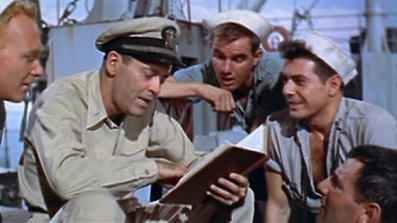
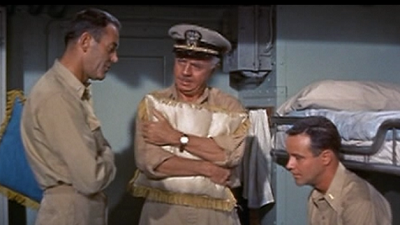
Robertsandcrew
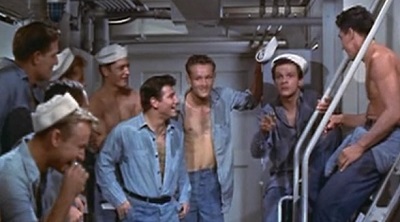
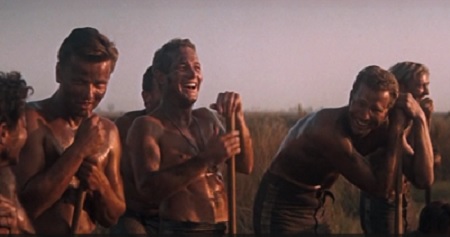
The film is about Roberts’ (Henry Fonda’s) efforts to get into combat in WWII, efforts that are squashed by his cargo ship captain, played by James Cagney. The crew love Roberts for his rebelliousness and his sympathy for their needs. The story is meant to be both moving and comic, but succeeds at neither thanks to Ford’s odd direction. Had I not known that this legend was at the helm, I would have guessed a newbie was having trouble distinguishing between stage and screen. Yes, Mister Roberts was a play, but that doesn’t explain why the crew in the film are practically shouting, or why their hamming reaches such preposterous levels that you have the feeling they’re always gathering to sing a song.

crew2
When they don’t, you feel vaguely uncomfortable, like when a stand-up comedian’s punchline falls flat. What’s even more puzzling is that you can almost see “exit left” printed on the screen because when figures leave the group, the others act as if they’re no longer in earshot. The transitions throughout the film feel forced, with odd shots of ocean and ship that neither advance the narrative, nor contribute to the mood, and the score seems slightly off the entire time.

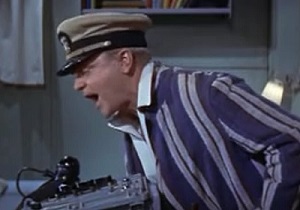
The choice to have James Cagney, who plays the villain of the film, act as if he’s starring in a camp masterpiece was also ill advised. Look, I love my camp. Brainsmasher: A Love Story is one of my favorite movies. But a film doesn’t work when half your cast is taking themselves seriously, and the other acting as if they’re auditioning for a Mystery Science Theater special. Cagney has talent, but you wouldn’t know it from this film. I kept wishing he’d disappear from the screen so that I could stop being embarrassed for him. A character can be ludicrous but still menacing, but Cagney’s bluster in Mister Roberts is merely a caricature of his earlier, meatier roles.

James Cagney as the cruel captain

James Cagney as the cruel captain

And try to forget the depiction of the islanders as soon as you see it. For a moment when I watched them approach the cargo ship in canoes, I thought, Battle!!!

Fordsislanders
I have the feeling that’s what Ford thought too, as it’s one of the few shots that worked in spite of its genre confusion and absurdity. Unfortunately, he moves from there to regular stereotypes:

islanderscloseupFord
Unfortunately, these scenes didn’t have the charms of camp portrayals, such as one of my favorites, the underappreciated parody Joe vs. the Volcano, in which the islanders are all obsessed with orange soda.

Joevsvolcano
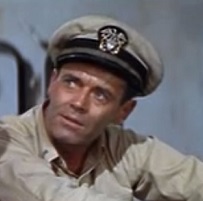
But when Fonda is on the screen, you forget how bad Mister Roberts is. Ford made many mistakes, but his stubbornness in demanding Fonda over the studio’s preferences, Marlon Brando and William Holden, almost outweighs all of his poor choices. In a better movie, this performance could have won Fonda the Oscar, just as he won the Tony for it on the stage.

Fonda
He plays Roberts with such understated dignity, humor, and pathos. Watch his easy leadership of the crew, his posture demonstrating how naturally he takes charge. Witness his subtle deflation once he sacrifices his own ambitions for the sake of that crew. I have never seen Fonda so good in anything. How hard it must have been for him, to have the role that meant so much to him undermined by his own director.

Luckily, there are multiple scenes with Fonda, Lemmon, and Powell.

Henry Fonda, William Powell, and Jack Lemmon

A perfect combination: Henry Fonda, William Powell, and Jack Lemmon

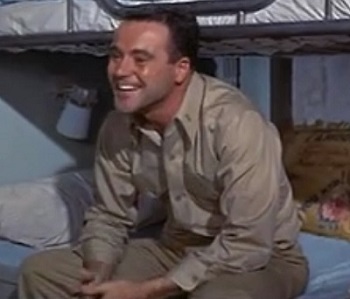
With the crew absent and only a room as background, the three show you what a film this could have been. Lemmon’s performance won him the Oscar. He’s riveting as a cowardly, lazy, sex-crazed ensign who has the potential to be so much more.

Lemmon
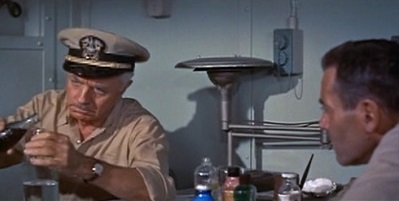
And how do you beat the joy of watching Powell create fake whiskey with utter seriousness, or recount the fake injuries of his crew when they’re avoiding work?

powellandfondawhiskey
As Doc, Powell plays the wise older man with utter perfection. While the film might not have deserved him, it’s truly a wonderful last Hollywood role, and the three have amazing chemistry.

To what extent Ford is to blame for the film’s flaws and not his co-director, Mervyn LeRoy (who was also assisted by Joshua Logan, the play’s cowriter and director), is impossible to exactly determine. But unless he ONLY directed the scenes with Powell, Lemmon, and Fonda, Ford was right to be embarrassed by it.

It’s a good thing he followed it up with one of his masterpieces.

Don’t forget to check out the other John Ford entries in the blogathon!  

Share
Posted in: 1950s films, Action & Sports Films, Blogathons, Comedies (film), Drama (film) Tagged: Henry Fonda, Jack Lemmon, Joe vs. the Volcano, John Ford, Mister Roberts, William Powell

Cool Hand Luke: Newman’s Double?

06/21/2014 by leah@carygrantwonteatyou.com 18 Comments

This post is part of Silver Screenings‘ and The Rosebud Cinema’s 1967 in Film Blogathon. Check out the other entries on their sites!

roadnewman
It’s not surprising, given the film’s condemnation of authority and celebration of rebellion, that Cool Hand Luke came out in 1967 in the midst of Vietnam War protests. Its depiction of the man “without eyes” and his fellow sadists is truly terrifying, as are the ominous parallels between the “failure to communicate” line the film popularized, and our muddy status in the war. The threat that the hero’s (seemingly) unflappable spirit poses to the guards’ squashing of the prisoners is evident to them—and us—from the start of the film. This guy (Paul Newman as Luke) makes prison fun instead of soul killing; clearly, the authorities will be seeking a way to destroy him.

What strikes me most about the movie is not its strong writing, or Newman’s compelling acting, or even George Kennedy’s perfect performance as Luke’s fan. It’s just how iconic of a Newman film it is. First, there’s that playfulness of Luke’s—from the speeding up of the road crew work, to bluffing at poker, to eating 50 eggs on a dare. Sounds like a Newman role, right? Like Butch Cassidy, like Henry Gondorff in The Sting…And like the actor himself, who was known for pranks. See this hysterical comparison of his and George Clooney’s.

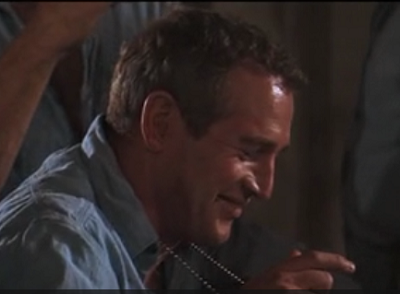
Newmanlaughing
Then there’s that complicated reaction to popularity. On the one hand, Luke relishes the attention; he likes to lead, rebel. He wants to inspire the men out of their lethargy, to make them fight for themselves. He’s found a way to introduce  joy into prison life, and he wants that influence to spread.

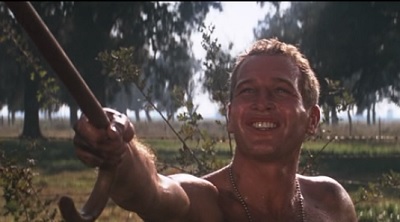
Newmannoeyes
But Luke’s resistance to idolization increases as his situation worsens. The more he’s thrown in the hold and beaten for being a “hard case,” the more he resists the simple hero worship of his companions, lashing out at the amount of pressure they’ve put on him: “Oh, come on! Stop beatin’ it. Get out there yourselves. Stop feeding on me!”

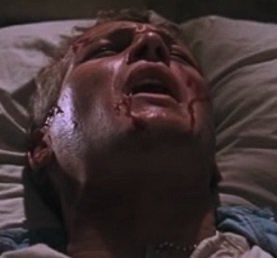
NewmanasLuke
In other words, inspiration he’ll provide. But if they’re content with just the stories about him and his cool demeanor, well, that’s something else entirely. How can he make a difference, if he’s the only ornery one who resists?

Again, the story makes me think of Newman the man, of the fame he used to spread the news about his philanthropies, including the moving Hole in the Wall Gang Camp. And, of course, there’s that healthy food that’s become—for some—more influential than his films.

I know Cool Hand Luke was just a part, that I should not conflate the man and the role. But it seems to me the two shared some traits, including a kind of impatience with the slow progress of the rest of us, our hesitation to do the right thing (I always thought this impatience was the reason for his flippant comment about his marital fidelity: “Why fool around with hamburger when you have steak at home?”)

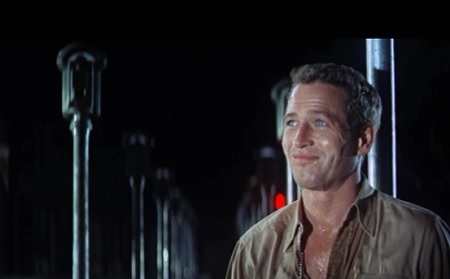
Sure, model me, Newman might say. Watch me if you must. (And doesn’t it always seem as if this stunningly handsome man resists our gaze, takes it as suffering he has to endure for his art? How compelling is a  star who seems too cool to notice his own looks?) Ask for my photograph if you feel like it, get my signature.

But get out there and do something yourself.

Newmanandmeters

Share
Posted in: 1960s films, Blogathons, Drama (film) Tagged: Cool Hand Luke, Paul Newman
« Previous 1 2 3 4 5 6 Next »

Recent Posts

  • 100 Years Later, Still Scary: Dr. Caligari
  • Escaping Out of the Past (1947)
  • A Weeper for Those Who Love Jerks
  • Thank You, Academy, for Not Infuriating Me
  • Challengers (2024) Is a Bad Movie

Subscribe to Blog via Email

Enter your email address to subscribe to this blog and receive notifications of new posts by email.

Categories

  • 1920s films
  • 1930s films
  • 1940s films
  • 1950s films
  • 1960s films
  • 1970s films
  • 1980s films
  • 1990-current films
  • 2020s films
  • Action & Sports Films
  • Anti-Romance films
  • Blogathons
  • Childfree
  • Comedies (film)
  • Drama (film)
  • Feminism
  • Femme fatales
  • Film Noir/Crime/Thriller & Mystery
  • Gloriously Silly Scenes
  • Horror
  • Humor
  • Mae West Moments
  • Musicals and dancing films
  • Oscars
  • Random
  • Romance (films)
  • Romantic Comedies (film)
  • The Moment I Fell for
  • Turn My Sister into Classic Movie Fan
  • TV & Pop Culture
  • Uncategorized
Share
Classic Movie Blog Hub Member

Recent Comments

  • leah@carygrantwonteatyou.com on Meg Ryan’s Fate Foretold in Joe Versus the Volcano
  • Ryan on Meg Ryan’s Fate Foretold in Joe Versus the Volcano
  • leah@carygrantwonteatyou.com on 100 Years Later, Still Scary: Dr. Caligari
  • The Classic Movie Muse on 100 Years Later, Still Scary: Dr. Caligari
  • leah@carygrantwonteatyou.com on 100 Years Later, Still Scary: Dr. Caligari

Archives

  • November 2025
  • September 2025
  • May 2025
  • March 2025
  • January 2025
  • November 2024
  • August 2024
  • July 2024
  • May 2024
  • March 2024
  • February 2024
  • December 2023
  • November 2023
  • October 2023
  • September 2023
  • August 2023
  • July 2023
  • May 2023
  • April 2023
  • March 2023
  • January 2023
  • December 2022
  • November 2022
  • September 2022
  • July 2022
  • May 2022
  • April 2022
  • March 2022
  • February 2022
  • October 2021
  • September 2021
  • April 2021
  • March 2021
  • February 2021
  • December 2020
  • October 2020
  • September 2020
  • July 2020
  • May 2020
  • April 2020
  • March 2020
  • February 2020
  • December 2019
  • October 2019
  • September 2019
  • June 2019
  • May 2019
  • April 2019
  • February 2019
  • January 2019
  • November 2018
  • September 2018
  • July 2018
  • June 2018
  • May 2018
  • April 2018
  • March 2018
  • February 2018
  • January 2018
  • November 2017
  • September 2017
  • August 2017
  • July 2017
  • June 2017
  • May 2017
  • April 2017
  • March 2017
  • February 2017
  • January 2017
  • December 2016
  • November 2016
  • October 2016
  • August 2016
  • July 2016
  • June 2016
  • May 2016
  • April 2016
  • March 2016
  • February 2016
  • January 2016
  • December 2015
  • November 2015
  • October 2015
  • September 2015
  • August 2015
  • July 2015
  • June 2015
  • May 2015
  • April 2015
  • March 2015
  • February 2015
  • January 2015
  • December 2014
  • November 2014
  • October 2014
  • September 2014
  • August 2014
  • July 2014
  • June 2014
  • May 2014
  • April 2014
  • March 2014
  • February 2014
  • January 2014

Meta

  • Log in
  • Entries feed
  • Comments feed
  • WordPress.org

Copyright © 2025 Cary Grant Won't Eat You.

Church WordPress Theme by themehall.com