Cary Grant Won't Eat You

Classic movies for phobics

  • About
  • eBooks
  • Previous Blogathons
Classic movies for phobics

1940s films

State of the Union: the Wish Fulfillment Edition

05/12/2014 by leah@carygrantwonteatyou.com 11 Comments

This post is part of The Great Katharine Hepburn blogathon. Be sure to check out the other entries!

The political satire in 1948’s State of the Union feels disturbingly fresh. Replace a phrase or two, and presidential nominee Grant Matthews’ (Spencer Tracy’s) speeches on the “working man” could fit into the Occupy Wall Street movement.

The film’s title, however, refers to not only what’s rotten in the state of the nation, but in the marriage between Grant (Tracy) and Mary Matthews (Katharine Hepburn).
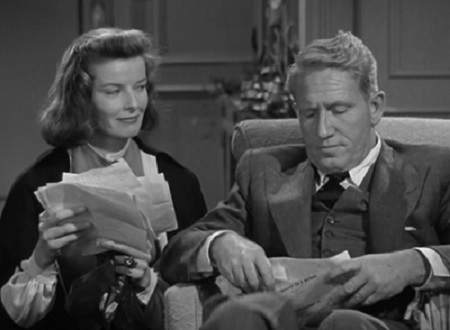
Mary and Grant Matthews

Mary and Grant Matthews

Sexy newspaper publisher Kay Thorndyke (Angela Lansbury) has seduced Grant with the aim of pitting him against her dead father’s political rivals.
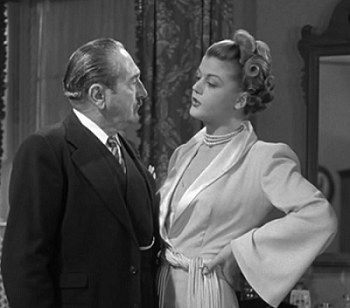
Kay and fellow schemer (Menjou)

Kay and fellow schemer (Adolphe Menjou)

Mary (Hepburn) agrees to pretend her marriage is strong for the sake of the campaign, as she believes her husband a “great man,” which, if he ever were, he ceases to be by the film’s close. The movie traces his idealism crumbling under the necessity of playing the political game, thanks, in no small part, to Kay’s machinations.

The dialogue is as sharp and cynical as you would expect in a Frank Capra film. My favorite comment is when Mary snaps that the slimy politician under Kay’s supervision (Adolphe Menjou) should be happy about what’s left of her own naiveté: “You politicians have remained professionals only because the voters have remained amateurs.”

The central problem of the film is how unsympathetic her husband Grant is. A self-made man with his “little guy” days far behind him, he pompously lectures businessmen and union leaders about how that little guy should be treated. Capra treats him as if he’s one of his innocents among the corrupt, like Mr. Deeds or Jefferson Smith, and it doesn’t work–Grant begins as a heel, and ends as a worse one.

And it’s hard to forget he’s betrayed a wife so cool she calmly knits while he’s doing acrobatics with his plane, handing campaign manager (Van Johnson) her bag to puke in.
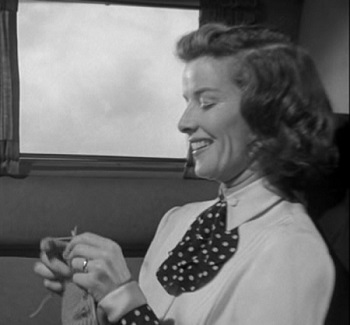
Mary during dangerous aerial acrobatics

Mary during dangerous aerial acrobatics

Luckily, we can ignore Grant and his speechifying and pay attention to the true delight of the film: Mary and Kay facing off against one another—Mary because she loves her husband, and Kay because she fears Grant will be swayed by his wife’s morals and thus lose the election.
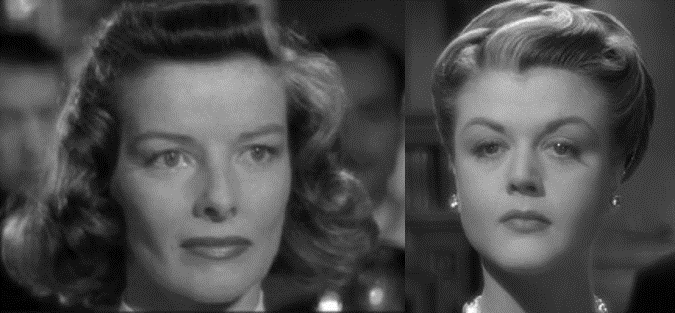
The two real stars

The two real stars

Just listen to how they talk about each other:

Kay: “That woman’s got to [Grant]. She’s been feeding him that to-thine-own-self-be-true diet.”

Mary: “If this weren’t my house, I could tell her someplace she has to go to…” or “…I think Kay’d be more comfortable in a kennel.”

When Mary has to invite Kay to her house to cover up the affair, she tries to avoid doing what she apparently did once before: getting plastered and throwing Kay out. This is the moment in the film when I wanted to shake Capra. That’s the scene you left out???

We do get treated to seeing Mary drunk in defiance of orders from Kay and crew.
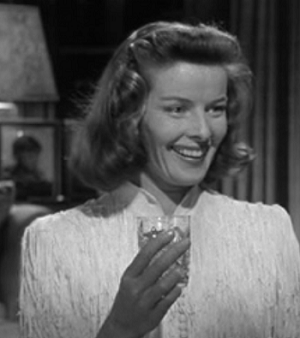
Mary rebeling

Mary rebelling

But I kept wishing for a The Women-style face off; the heroines are so powerful and interesting that in comparison, the men in the film (with the exception of Johnson and Mary’s butler) seem a waste of screen time. Luckily, the women are so fun to watch that they revive and redeem the film.

At one point Grant’s barber shares his wife’s conviction that a woman should be president. “That’s silly,” responds Mary. “No woman could ever run for president. She’d have to admit she was over 35.”

Though the quip is funny, no line coming out of Hepburn’s mouth was ever less convincing. Those who know anything about Hepburn realize she had confidence to spare, felt comfortable aging in front of the camera, and would have run for any office if she’d felt like it. Mary clearly has Hepburn’s spunk, and after all, a woman had run for president more than 70 years before this film, another woman with considerable moxie.

Would Mary have won? Of course not. But what speeches she would have written!

And for Capra not to give Kay more time in the film is criminal. Watch her command her editors to publish filth about all of the Republican candidates so that their united hatred for one another will make them choose her man (Grant) at the convention. That icy stare you recognize from The Manchurian Candidate (1962)? Yeah, this is a woman who could make it to the White House today for sure. She’s a predatory villain as thrilling to watch as Claire Underwood (Robin Wright) in House of Cards.
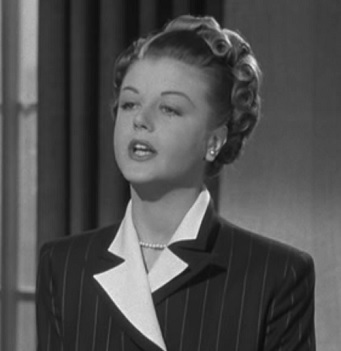
Kay commanding the troops

Kay commanding the troops

It’s probably enough that a film in 1948 starred such strong actresses playing powerful roles. I shouldn’t wish for what could have been, these two really facing off against each other, maybe even running against each other for office.

But what a film that would have been.

Share
Posted in: 1940s films, Blogathons, Drama (film), Feminism Tagged: Angela Lansbury, feminists, Katharine Hepburn, political satire, Spencer Tracy

Veep & Together Again: Hollywood & Female Leadership

05/08/2014 by leah@carygrantwonteatyou.com 10 Comments

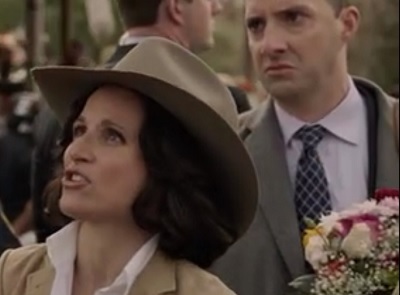
Sometimes the stars align, and you can convert hours of procrastination into productivity. At least, that’s what I’m telling myself about this week’s blog post, which is the result of a Veep marathon and viewing of two Irene Dunne films in a row. Call it a stretch or serendipity, but I keep observing similarities between the Julia Louis-Dreyfus-helmed TV show about a vice president and Together Again (1944), a film about a small-town mayor. Both keep returning to some of the same themes for humor, and both succeed.

Fairy Tale Romance? Not for Them
In Together Again, Irene Dunne (as Anne Crandall) plays a widow who takes over as mayor after her husband dies. The film begins with a shot of a statue created in her husband Jonathan’s honor. The unlikely Cupid of the film, Crandall’s father-in-law (Charles Coburn), is disgusted by this hero worship, which he considers against his son’s wishes. He tries to convince his daughter-in-law to find a man.

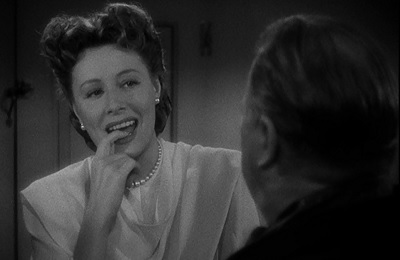
I can’t decide what’s more delightful: Crandall’s response, or her amusement in expressing it: “You can’t bear to see a woman living alone and liking it. No man can. Instinctively, it terrifies them. You’re a vanishing race and you know it. And the minute you lose your hold over us emotionally, wow. So naturally, your platform must be husbands are necessary. And they’re not really.”

Crandall mocking her father-in-law

His rebuttal, refreshingly, is not that singlehood is wrong; he just believes the state is not for her: “You talk like a free soul, but you’re the most manacled creature I’ve ever seen…Everything you do, everything you say, everything you breathe is the way Jonathan did it, said it, and breathed it. Why don’t you stop living his life and live your own?”

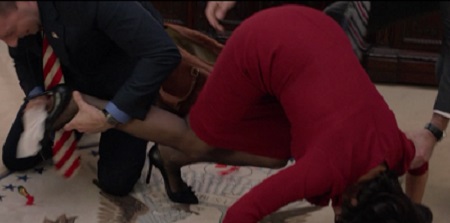
Veep’s heroine too is annoyed by others’ desire to fit her into a typical female role–in her case, as a happy wife and mother. At the start of Season 2, Julia Louis-Dreyfus attacks her former strategist (Gary Cole) for trying to force an image of the perfect family on her, which led to an uncomfortable river rafting trip with her daughter, her estranged husband, and his mistress. Their spat takes place in the Oval Office, and hilarity ensues when her lipstick marks up the sacred carpet.

Lipstick stain recovery effort

The Nonsense of Politics
Since Together Again is a romantic comedy, its primary interest, unlike Veep‘s, is not politics, but it has its moments, as in this great exchange between Randall and Mr. Witherspoon, who is in charge of the town’s sanitation and keeps leaving the south side blanketed in “a lot of old potato peelings.” His sorry excuses echo those that flood Veep:

Mr. Witherspoon: “It’s the manpower, your honor.”

Crandall: “Manpower, my eye. Use womanpower then.”

Mr. Witherspoon: “Women? To collect garbage?”

Crandall: “Why not? Women see more garbage in their lives than men do, don’t they? They might as well get paid for it.”

The scene highlights Randall’s power in the town. The joy of Veep, in contrast, is witnessing Meyer’s pathetic attempts to muster up the illusion of power she doesn’t have. And since we’re talking about D.C., the whole city is doing the same. After watching the jockeying for position among staffers, Congress members, and the administration, one wonders whether anything but ego is at stake for them. My favorite moment in the first season may be when the president’s lackey forbids the VP to adopt a dog because it’ll distract from the White House’s new pup: “Ma’am, you need to kill the dog. Not literally, but yeah, if it comes to it, yeah literally.”

Female Power: Is It All about the Hat?
Much of the plot of Together Again hinges on Crandall’s choice of a flirtatious hat over her usual professional attire when she goes to meet Corday (Charles Boyer), a sculptor in New York. The hat acts as a stand-in for the sexuality she’s been repressing as a widow. She’s bought it upon her father-in-law’s recommendation; he advised her when she departed their town to replace her functional one.

“When women starting wearing hats that look like hats,” he says, “they’re on the way out. At your age, you ought to be on the way in.”

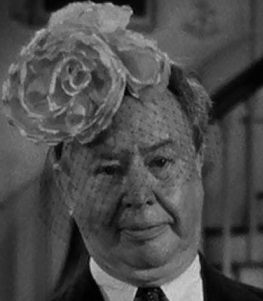
When Corday sees her in it, he assumes her a model rather than the mayor. Of course, no powerful woman could wear something so becoming, right? She hides the hat—and the nightclub raid she later gets involved in because of it—as soon as she returns home. But the hat keeps turning up again. My favorite moment is when her father-in-law walks in wearing it.

The father-in-law steals the show

Written seven decades later, HBO’s Veep focuses on a woman who is next in line to the president; it seems, on television at least, women have come a long way. But have they? Yes, the mayor of a tiny town is a far cry from the vice president of the United States, but perhaps not as far of a cry as we might wish. When Meyer asks why her presidential bid failed, her press secretary, Mike (Matt Walsh), responds, “You looked tired a lot and the hat….The hat hurt us. Your head looked weird in the hat; that’s all I’m gonna say.”

Convictions? What Convictions?
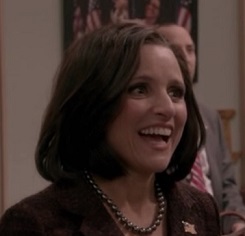
In Veep, it’s clear where Meyer’s convictions lie: she doesn’t have any. She puts an oil lobbyist on her clean jobs task force without hesitation. She tries to repress delight when a shipyard accident takes away her bad press. “Well, I think that worked out pretty good,” she says to her staff with a big smile.

Meyer-repressingjoy
(Of course, she tries to take it back when she discovers there were fatalities.) Self-interest trumps her idealism every time, which makes her a blast to watch.

**Spoiler ahead**

While Crandall’s political beliefs are only briefly sketched, her devotion to her dead husband and to the town he once led clearly dictates her behavior. She seems to be a very moral woman, bound by duty. Curiously, though, she seems content to leave the town she’s worked so hard to serve in the hands of her unscrupulous rival once she decides (as we know she will) to go after Corday.

The More, the Merrier
It’s refreshing to find in Veep a female led-show so entirely unconcerned with romance. But while her romantic interludes are brief and mildly funny, Meyer’s interactions with her staffers are fantastic. As a long-time Arrested Development fan, I was pleased to see Tony Hale (aka Buster) in another meaty role, treating Meyer’s various failures with compliments and tea and going to ridiculous lengths to satisfy her needs, as when he draws her chief of staff from her father’s bedside: “Something has happened to the vice president. I know your dad is dying and I’m really, really sorry, Amy, but I think Dana took Selina’s lipstick. It’s the one thing Selina asked for, and I don’t have it, and it’s ruining her night.”

I’ve left out much of the plot of Together Again in this review. The romance is fine, and Boyer a convincing lead. But it’s the Coburn-Dunne chemistry that kept me watching, especially when late in the film the two start riffing on youths’ views of aging. Coburn makes such a perfect Cupid that I can’t wait to see him play it in The More the Merrier.

Of course, there are other films and shows that tackle this same political ground. Parks and Recreation takes on the small-town concerns Crandall struggles with and makes them fresh and hilarious. But I could see little of Leslie Knope in Crandall or Meyer. Knope worships her town; Crandall belittles hers. And Meyer looks like a Knope foe: world-weary, cynical, and always out for herself.

Crandall and Meyer are alike, even if Meyer is looser ethically than her predecessor: both are hyper-aware of their public images and frustrated with the bureaucracy politics brings, but nevertheless, they manage to survive politics’ worst ravages, and in Crandall’s case, even find love along the way. And neither can resist a good hat.

Meyer and her assistant (played by Tony Hale)


Share
Posted in: 1940s films, Comedies (film), Feminism, Romantic Comedies (film), TV & Pop Culture Tagged: Charles Coburn, female leaders, female vice president, Irene Dunne, Julia Louis-Dreyfus, Veep

5 Reasons Why English Majors Will Love Ball of Fire

05/01/2014 by leah@carygrantwonteatyou.com 27 Comments

This entry is part of the Romantic Comedy blogathon cohosted by Backlots and Carole and Co.

In trying to get friends to give old movies a chance, I often start with Ball of Fire, mainly because I know many English majors/graduate students, few of whom predict what delights are waiting for them in this 1941 classic. Here are just five of the reasons why everyone who waxes poetic about Shakespeare or Austen needs to spend a little time with Gary Cooper and Barbara Stanwyck:

1. The Plot: A Mobster/Moll Romantic Comedy about Language

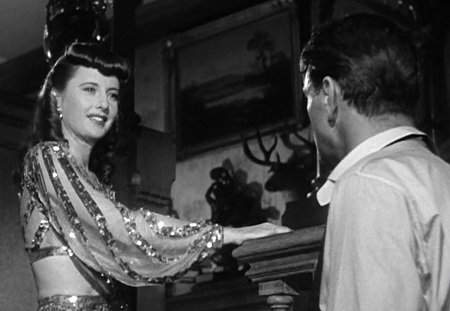
Professor Bertram Potts (Cooper), on the hunt for colorful subjects to aid him with his encyclopedia entry on slang, enlists a sexy torch singer, Sugarpuss O’Shea (Stanwyck).

O'Shea (Stanwyck) flirting with the professors

O’Shea (Stanwyck) flirting with Potts

Sound ridiculous? It is, wonderfully so.

In the “meet cute” moment, O’Shea has just learned that her mobster boyfriend (Dana Andrews) is in trouble with the law. Fearing the knock on her dressing room door is the DA with a subpoena, she’s hostile to Potts, and when she discovers his mission to study her, dismisses him:

O’Shea: “Shove in your clutch.”

Potts: “Exactly the kind of thing I want”….

O’Shea: “OK, scrow, scram, scraw.”

Potts: “A complete conjugation!”

The opening sequence of Potts’ investigation, in which we learn the sources of such terms as “slap happy” and discover just how old the term “jerk” must be, is equally amusing to those of us who delight in wordplay, as is the nerdy professor’s ignorance of such words as “boogie.”

And that’s just the first half hour.

2. A Clever Take on Snow White and the Seven Dwarves

Fables, folk tales, fairy tales. We English majors love to read them, interpret them, reinvent them. (Angela Carter’s dark The Bloody Chamber traumatized me in an introductory lit course.) Famed writing team Charles Brackett and Billy Wilder turn the tale on its head, making Snow White a seductress and the dwarves a team of innocent professors (six bachelors and a widower) who are writing an encyclopedia together, with Prince Potts acting as the eighth member.

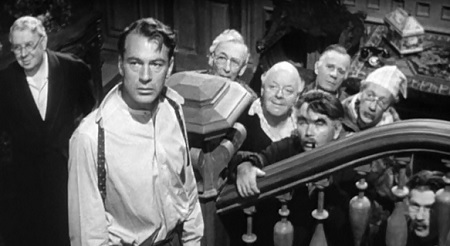
O’Shea seeks shelter from the police at their house, claiming she needs to stay to help with Potts’ research. The proper Potts doesn’t understand why she needs a sleepover, but his elderly companions, used to only the “singularly uninspiring underpinnings” of their housekeeper, outweigh his objections. They have fallen for O’Shea, and their charming antics to gain her attention—wearing new outfits, making sure their pants get ironed, having her teach them the conga—make you wonder just how unfair it is that the prince is the one who wins Snow White’s affection.

Potts (Cooper) and the dwarves reacting to O'Shea's flirtation

Potts (Cooper) and the dwarves reacting to O’Shea

O’Shea has no plans to seduce Potts, but when things get “hotter” for her boyfriend and she’s told “to stay in the icebox like a good little salad,” she gives the impressionable Potts a kiss. And, as in the fairy tale, things escalate from there.

3. The Witty Dialogue/One Liners

What English major isn’t a sucker for good dialogue? With Wilder & Brackett as writers and Howard Hawks as the director, witty banter and frequent double entendres are a matter of course.

Early in the film, Miss Bragg, the housekeeper, badgers Professor Oddly for gobbling up the strawberry jam after writing an encyclopedia entry on strawberries. She then expresses horror at Professor Magenbruch’s studies.

“I’m just starting my article on sex, Miss Bragg,” he answers. “Any objections?”

“No,” she concedes. “I trust you have more control of yourself than Professor Oddly.”

And the one liners! Some favorites:

O’Shea: “Say, who decorated this place, the mug that shot Lincoln?”

Potts: “Make no mistake, I shall regret the absence of your keen mind; unfortunately, it is inseparable from an extremely disturbing body.”

O’Shea (describing her throat): “It’s as red as The Daily Worker and just as sore.”

Miss Bragg (speaking of O’Shea): “That is the kind of woman that makes whole civilizations topple!”

I always wonder why so many Gilmore Girls and Aaron Sorkin fans won’t give 30s and 40s comedies a try. Ball of Fire not only employs the banter they love so well, but avoids the trap of making EVERY character eloquent (a Sorkin flaw). The contrast between O’Shea’s wisecracking and Potts’ slow earnestness is one of the delights of the film, and given that Cooper typically played a Clint Eastwood type, his professorial wordiness is particularly amusing. As the Self-Styled Siren put it, “Who besides Billy Wilder would look at Gary Cooper, the most laconic speaker in Hollywood, and think, ‘Linguistics!’”

4. Wonderful Characters (and Performances)

With eight professors, a nightclub singer, a mobster and his minions, the DA and his team, and Potts’ other research subjects, a viewer would be unreasonable to expect much character development in any but the main players. Romantic comedies rarely get beyond stereotypes anyway. But most of the characters in Ball of Fire are unique and memorable, from the prim widower with the sexless interpretation of romance, to the genial Professor Magenbruch, who can’t stop thinking about his need to research for the sex entry. Even Joe Lilac’s two minions are funny in their villainy. And at the center of the film, we have Sugarpuss O’Shea, played by Stanwyck in an Oscar-nominated performance.

Stanwyck’s job as Snow White is to charm, and she takes to it naturally. She’s laid back and confident, and as cool as her companions are geeky. (I kept thinking of an Elizabeth Bennett landing in the middle of The Big Bang Theory.) Most of all, O’Shea’s a great deal of fun, whether leading her band in a quiet version of “Boogie” at the start of the story, or teaching the professors to conga. She doesn’t want to harm any of the professors with her deception, but she is so used to looking out for herself that their brand of vulnerability is foreign to her.

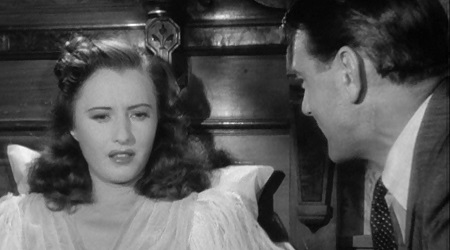
O’Shea too is soon smitten, so unfamiliar with sincerity that it floors her even as her comfort with her sexuality undoes her companions. Her guilt at duping such lovable men is palpable.

O'Shea, discovering Potts' love for her

O’Shea, discovering Potts’ love for her

Stanwyck lost the Oscar to Joan Fontaine in Suspicion that year. Fontaine’s was a strong performance, but I think Stanwyck’s dazzling turn should have guaranteed her win. Though some of the credit for her fully rounded performance definitely goes to the writers, Stanwyck is so believable in the midst of this crazy plot that she grounds the film. A once reluctant watcher of black and white flicks, I became a classic movie enthusiast and lifelong Stanwyck fan after watching this movie. I suspect I’m not the only one.

5. The Grammarian Winning the Girl?

English majors—especially males—don’t get a lot of cred in the romantic lead department, especially when up against mobsters like Joe Lilac.

Dana Andrews playing the suave Joe Lilac

Suave Lilac (Dana Andrews), Potts’ rival

At least women can get the “sexy librarian” rep. Occasionally, poets can win some attention in film (and I know such gifts helped my friends on Valentine’s Day). But grammarians? Teachers of the comma splice? Among an unglamorous profession, grammar professors are the nadir when it comes to sexy reps, right down there with nuclear physicists.

Potts, trying to box based on a book's lessons

Potts, trying to box based on a book’s lessons

“You see, this is the first time anybody moved in on my brain,” says O’Shea after entering Potts’ home, and you know when she later glows at the possibility of becoming “Mrs. Lilac” just how unlikely the brain is to triumph.

But slowly, Potts makes inroads. O’Shea even reads a grammar book in her spare time, and there’s a whole discussion about the repetitiveness of her phrase “on account of because” in the midst of a romantic interlude. Only Wilder and Brackett could not only make this scene romantic, but convincing. Due to the caliber of their writing and Stanwyck’s performance, we trust that this cynical nightclub singer really does get so flushed in company with “corny” Potts that she needs to take the movie’s equivalent of a cold shower (a towel to the neck).

And this triumph, my English major friends, is a rare treat to witness. Good luck finding a modern film so generous in its treatment of grammarians. When you find one, be sure to let me know. In the meantime, I’ll take another serving of Ball of Fire.

Check out the other romantic comedy entries in the blogathon!

Share
Posted in: 1940s films, Blogathons, Humor, Romantic Comedies (film) Tagged: Ball of Fire, Barbara Stanwyck, Dana Andrews, English majors, Gary Cooper

The Sadistic Spouse: Charles Boyer in Gaslight

04/23/2014 by leah@carygrantwonteatyou.com 22 Comments

This post is part of the Great Villain Blogathon cohosted by Speakeasy, Shadows and Satin, and Silver Screenings. Check out other entries on one of their sites!

When it comes to villains, Gregory Anton in Gaslight lacks the theatricality of The Joker or Lecter. He wants the presence of Harry Lime or the narcissism of Ellen Harland. He doesn’t chill the viewer as do Maleficent and Mrs. Danvers. On the surface, therefore, Gregory might not seem a villain worthy of comment. As played by Charles Boyer, the role is so two-dimensional as to approach camp. You can almost hear Boyer saying to himself, “Time for the faux-loving face—wait, too long on that one, stern face time.”

Boyer's stern face

Boyer’s stern face

Yes, Gregory seems as commonplace a villain as his name would suggest. But in terms of his effect on his victim, Gregory is a master among villains. Having convinced his new wife, Paula (Ingrid Bergman), to move back to the house where her aunt was murdered, he creates a series of sounds and sights he pretends not to notice. He expresses concern at Paula’s supposedly imaginary observations; he chides her for forgetfulness when items disappear (due to his own actions). She believes him because she loves him. The term “gaslighting,” which originated with this story, refers to Gregory’s sinister brand of psychological abuse: trying to convince his wife she’s going insane. While the motives of his actions are not immediately apparent, he clearly feels no remorse for his cruelty.

Convincing his wife she's crazy

Gregory, celebrating his victory over his wife

So often, we side with the criminal in a plot like this one: with a wife this gullible, it’s easy to go for the laugh rather than the shiver. It would be common too to dismiss Paula as stupid, to fail to sympathize due to her blindness and fragility. But the nineteenth-century timeline of the story counters our usual impulses, making us uneasy and fearful from the start. (Just what were those stories about men committing their wives to asylums on questionable grounds again?) And Paula is not just any victim: She is a victim played by Ingrid Bergman.

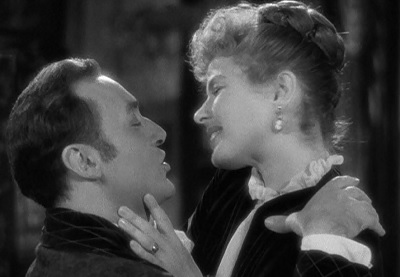
Bergman beautifully illustrates the extent of her heroine’s downfall at Gregory’s hands. She is incandescent as a woman in love before his plot takes off.

Gregory's pretense of love

Paula in love

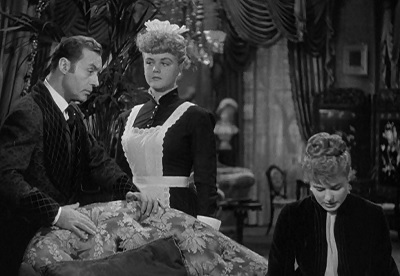
Her fears about her sanity, which first dim, and then blot out any semblance of happiness or reason, are terrifying to watch. Just when she thinks she can trust in his love for her and have faith in herself again, Gregory cuts off her giddiness with a chilling expression, claims she’s unwell, forgetful, unworthy, childish. Her jealousy of a cruel maid (Angela Lansbury) he flirts with in her own home is nothing, he suggests, but a sign of her sickness.

Using the maid to torture his wife

Using the maid to torture his wife

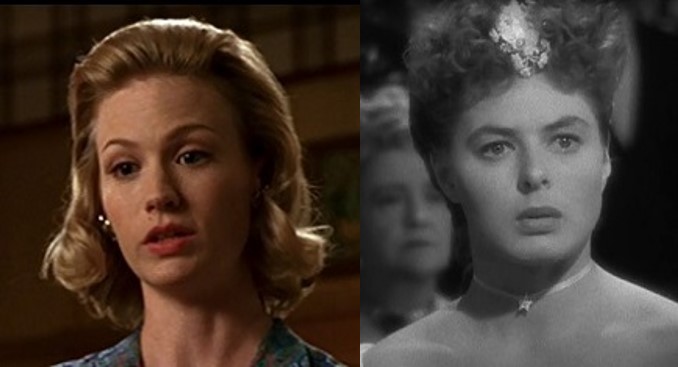
Think of Betty Draper in the first season of Mad Men, then quadruple the vulnerability, make Don evil rather than sick, take away his love, and remove any right Betty has to defend herself against his duplicity, and you have poor Paula in Gaslight.

Season 1 Betty Draper a powerhouse compared to Paula

Season 1 Betty Draper a powerhouse compared to Paula

Paula’s weakness is her love for her husband; without it to prey upon, Gregory would have no chance of winning this psychological battle against her. And it’s just this level of cruelty she can’t accept. Of course she finds her own forgetfulness more believable. Not content with the damage he’s done, Gregory shuts her away from others, guaranteeing she spends most of her time obsessing over whether she’s mad–hardly a healthy pastime. How long, we wonder, CAN Paula stay sane, trapped in a loveless marriage, a frightening house, and fears she can no longer control? While there’s hope in the form of a suspicious detective (Joseph Cotten), even if Paula escapes, can anyone recover from this kind of treatment?

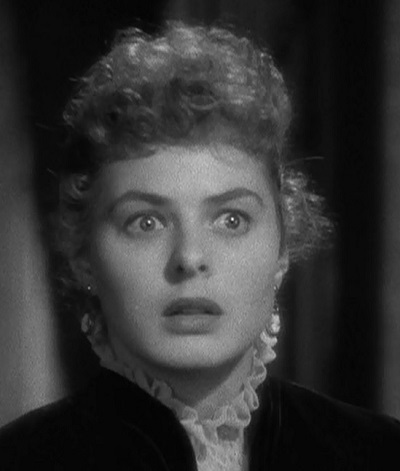
Despite a largely passive performance, Bergman is stunning to watch in Gaslight. I can think of no actress but Meryl Streep who could accomplish so much with just expressions, who could deliver enough pain and fear to carry the film and beat out Barbara Stanwyck, Bette Davis, Claudette Colbert, and Greer Garson for the Oscar.

Bergman as situation worsens

Paula as her situation worsens

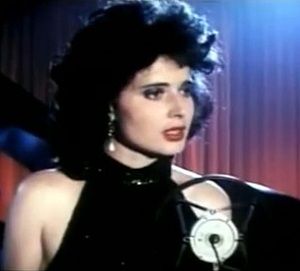
Just a few years after Gaslight, Bergman would fall for Roberto Rossellini and become involved in an affair with him so scandalous Congress and many of her American fans would condemn her. But she would make a Hollywood comeback less than a decade later, and her union with the famous director would result in a daughter, Isabella, who, in a curious twist, would make a splash of her own as a victim in another famous film, Blue Velvet. Who could forget torch singer Dorothy Vallens, the target of creepy villain Frank Booth (Dennis Hopper)?

Like mother, like daughter

Like mother, like daughter

 Be sure to check out the other villains in the blogathon!

Share
Posted in: 1940s films, Anti-Romance films, Blogathons, Drama (film), Film Noir/Crime/Thriller & Mystery, TV & Pop Culture Tagged: Betty Draper, Charles Boyer, Gaslight, Ingrid Bergman, Mad Men, marriage, villain

Nazis and Humor: The Shock of Lubitsch’s To Be or Not to Be (1942)

04/17/2014 by leah@carygrantwonteatyou.com 2 Comments

ToBeorNot2
Wrap your head around this fact: Two decades before Quentin Tarantino was born, Ernst Lubitsch directed a comedy about Nazis. Unlike Tarantino, whose own Nazi film was typically bloodthirsty, Lubitsch was best known for light fare, especially sophisticated sex farces so insightful and lacking in prudery that they remain startlingly modern and funny still today. Not surprisingly, Wes Anderson recently cited To Be or Not to Be, Lubitsch’s anti-Nazi comedy, as influential. Lubitsch and Anderson share a joy in puncturing human vanity and hypocrisy, a gift for efficiency in their visual symbolism, and an appreciation for moments of pathos within otherwise humorous films. They also are in love with silliness, and this film is full of it.

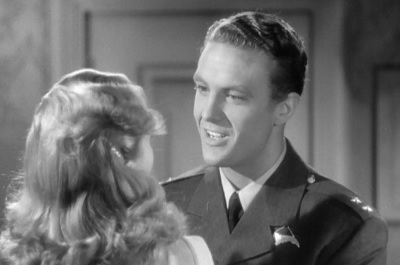
To Be or Not to Be is almost as frantic in pace as Anderson’s The Grand Budapest Hotel, so I’ll just explain the basics: An acting troupe in Warsaw pretends to be Nazis to undermine a plot against the Resistance. The troupe is led by Joseph Tura (Jack Benny), a man arrogant about his acting but insecure about his wife Maria’s (Carole Lombard’s) fidelity—and rightly so: She invites an aviator (a very young Robert Stack of Unsolved Mysteries fame) to her dressing room every time her husband begins the famous speech in Hamlet that gives the movie its name. (Joseph’s not initially aware of her flirtation, though he becomes obsessed with the flier’s rudeness in leaving during his soliloquy.)

Who knew Robert Stack could be funny?

Who knew Robert Stack could be funny?

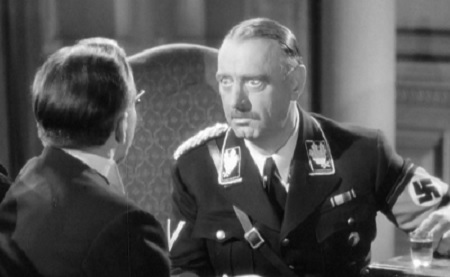
Like Joseph, the Nazis in the film are obsessed with the reactions of others to their words. When they joke about their leader’s vegetarianism or reputation, they fear their peers’ reprisals, and quickly state “Heil Hitler” to appear patriotic. The implication throughout the film is that the Nazis are much like the actors imitating them: full of insecurity and quick to express pronouncements they utter rather than feel.

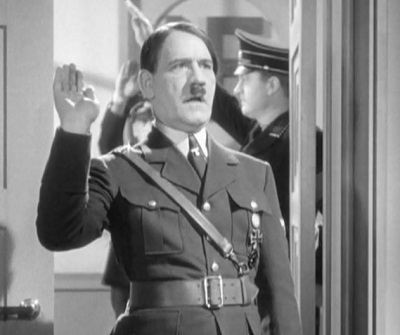
The movie begins with an actor from the troupe who is playing Hitler in a play that’s about to fold. He’s anxious to prove his plausibility in the role due to a blistering attack by his director. “I don’t know. It’s not convincing,” the director says, looking at the clothes and makeup meant to imitate the Führer. “To me, he’s just a man with a little mustache.”

“But so is Hitler,” the actor responds defensively.

An actor (Tom Dugan) saying "Heil myself" as Hitler in a doomed production.

An actor (Tom Dugan) saying “Heil myself” as Hitler in a doomed production.

As in most of Lubitsch’s films, the marital sexual farce is highly entertaining. In a typical moment, Maria’s assistant quips, “What a husband doesn’t know won’t hurt his wife.” But this farce goes beyond the main couple. The Nazis are not only fooled by these actors’ poor performances as Gestapo, but are also easily convinced that the beautiful Maria will be captivated by their power. They repeat “Heil Hitler” not only as a defense or conversation filler, but as a pickup line. Clearly, Lubitsch feels these Nazis are using their lethal reputation as a substitute for manhood. “And before the evening is over,” a Nazi spy says suggestively to Maria, “I’m sure you’ll say ‘Heil, Hitler.’” (I gasped when I heard this—Did I just hear a racy use of Hitler?) Sure enough, after he kisses her, Maria replies, “Heil Hitler” in a loaded, sexy tone in imitation of the man she’s duping.

Maria (Lombard) feigning attraction to a Nazi spy.

Maria (Lombard) feigning attraction to a Nazi spy.

Maria’s faux seduction mimics her earlier comforting of her needy spouse, though this time it’s for a worthier cause. But just as with Joseph, Maria’s cooing words mean little. She proves that it’s a man of action, not the Nazis or her narcissistic husband, who will likely win her bed in the end. When the RAF flier (Stack) gushes about the thrill of meeting an actress, Maria breathily replies, “Lieutenant, this is the first time I’ve ever met a man who could drop three tons of dynamite in two minutes.”

As for the Nazis, the actors do occasionally falter against them, mainly due to their inability to get over their egos. But there’s something gallant about these blundering Warsaw patriots, and one in particular, just as with M. Gustave of The Grand Budapest Hotel. This troupe of actors is goofy and flawed and outrageously vain. But as Lubitsch implies in the film, what act isn’t noble, against such enemies as these?

Share
Posted in: 1940s films, Comedies (film), Humor Tagged: Carole Lombard, Lubitsch, Nazis, satire, Wes Anderson

Beating the March Madness Blues with Knute

03/26/2014 by leah@carygrantwonteatyou.com 4 Comments

Little Mercer defeating the Big Bad Duke. That stunning Laettner shot you prayed wouldn’t go in. Davidson paying for busloads of its students to attend the Elite Eight. If you were born near corn and have since transplanted to either coast, I don’t care how thin your grasp of the finer rules (a pick and roll?) or how few Big 10 games you’ve managed to catch on your TV. Come March, homesickness arrives in the form of a basketball hitting a gym floor. So you fill out two brackets (one with viable predictions, another with your 13-seed team triumphing), frantically text childhood friends, and download a NCAA app, hoping to recapture some of the thrill that is watching the Madness in the Midwest.

In my case, the outsized crankiness ushered in with Selection Sunday, as I rambled to all in ear range about the cruelties of New England living: hockey on the big screens and game commentary drowned out by 80s tunes in sports bars, radio stations blaring Spring Training garbage. Why hadn’t I flown to watch the games in Chicago again, as my two sisters and friend once had? So I decided in breaks between shouting over Cinderella beauties alone in my living room (with an occasional pity join-in by my uninterested spouse), I would console myself with a sports film. Since I already have viewed my favorites (Hoosiers & Hoop Dreams) many times, and classic basketball flicks are scarce, I chose the movie starring our former president and the much-loved other Midwestern sport, Knute Rockne-All American (1940).

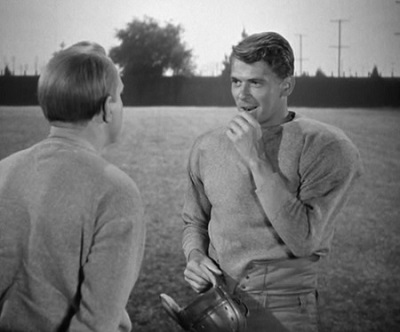
Pat O'Brien and Ronald Reagan in Knute Rockne-All American

Pat O’Brien and Ronald Reagan in Knute Rockne-All American

It’s hard to believe now that Notre Dame was ever an underdog, but if you’ve been to South Bend, you understand: a sleepy town you wouldn’t know was there but for the golden dome, breathtaking church, and lovely campus buildings. Of course, once Rockne (Pat O’Brien) started making a name for himself and the school, he was lured by the big-name programs, but like many loyal coaches who followed him (I’m looking at you, Shaka Smart), he stayed put.

Of course, the whole beginning of the bio-flick, I was waiting for George Gipp (Ronald Reagan), the stunning athlete who would set off Rockne’s career in his four seasons of play (1916-1920). Though I expected it, I was startled to see the ex-president so young, handsome, and fit.

Gipper was an intriguing person, hardworking in games, but nonchalant about practice, and more committed to baseball than football. Particularly surprising was his habit of shying from the limelight: He was known for dodging reporters. The film doesn’t explore another interesting trait: he liked to gamble, fooling out-of-towners who suspected he was just a naïve hick. And then he quietly would give much of the money to those in need.

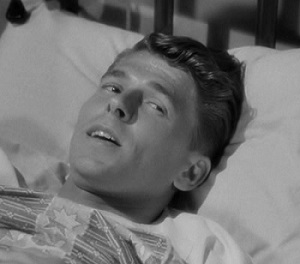
Reagan delivering Gipp's famous speech

Reagan delivering Gipp’s famous speech

His famous sickbed speech was thankfully muted in the film, without crass Hollywood dramatization, and Reagan delivered the lines well: “Rock, some day when the team is up against it, when breaks are beating the boys, ask them to go in there with all they’ve got, win just one for the Gipper. I don’t know where I’ll be then. But I’ll know about it, and I’ll be happy.”

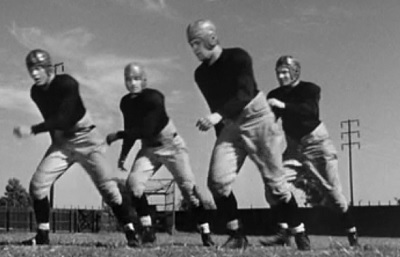
The rest of the movie is, as you would guess by its title, about Rockne rather than his illustrious player: the coach’s dedication to his team, the success of his program, and the sacrifices he made for his athletes. Rockne was renowned not only for popularizing the forward pass, but for his commitment to teamwork over individual talent. Sound familiar, NCAA basketball fans? In a funny scene, Rockne watches chorus girls and takes notes on their performance that will become the famous shift he teaches first his wife, and then his Four Horsemen (the gifted group who led the Fighting Irish to 28 wins and only 2 losses). How like a coach to appreciate the coordination of dancers. We always think of basketball in balletic terms too: seamless passes, graceful turns and fakes, fluid jumps to the rim.

The Four Horsemen mid-shift

The Four Horsemen mid-shift

What I enjoyed most about Knute Rockne-All American was the man himself, especially his unusual, clipped patterns of speech and motion, which Pat O’Brien captures perfectly without ever slipping into parody. (See footage of the real man here.) Rockne’s intelligence is established early on, when a famous chemist in his department tries to turn him into one. But it’s his enthusiasm for his boys that gets you, even when his wife has to go without vacation for 17 years as a result (probably true since his widow was involved with the film and unlikely to forget such a betrayal). When Rockne disappoints his team with a bad decision, the devastation of this loyal coach is painful to watch.

The most celebrated moment in the film is when Rockne repeats Gipp’s words to his players in the locker room during a losing game. The scene is surprisingly understated, even for its time: No close-ups to show tears in the eyes of athletes. No uplifting music except for the muffled marching band in the background. No shouting. It feels less like a moment to rile up the team than the coach’s need to honor a promise. Affected as I was by the speech, I couldn’t refrain my dismay at the ways that modest athlete’s name has been abused since. Reagan—or his PR machine—used the line for political gain repeated times; our most camera-happy chief of state is now referred to as “The Gipper.”

Rockne (O'Brien) delivering Gipp's words

Rockne (O’Brien) delivering Gipp’s words

Late in the film, college football is accused of the usual: passing failing students, subsidizing players, subverting the intentions of an education, etc., so Rockne goes to New York to defend his team and football as a whole to a committee of educators investigating the charges. How disturbingly prescient the claims were. But Rockne’s defense is powerful, as when he’s asked whether he changes his athletes’ grades:

“Any player who flunks in his class is no good to his coach, nor to the school he attends. And any coach who goes around trying to fix it for his athletes to become eligible scholastically when mentally they’re not is just a plain everyday fool.”

Shortly afterward, a professor on the committee expresses his skepticism about sports: “Where do these elaborate spectacles of sport fit into the scheme of education?” he says. “How would you grade an average athlete’s contribution to the national intelligence?”

Rockne has spent his life answering this question, and does so now with spirit:
“…To limit a college education to books, classrooms, and laboratories is to give to education too narrow a meaning for modern times….We’ve tried to build courage and initiative and tolerance and persistence, without which the most educated brain of man is not worth very much….Now I don’t know, I don’t know how you grade a boy for learning these things, professor…But wouldn’t it be a good idea not to grade anybody’s contribution to the national intelligence, until all the results are in, maybe five or ten years after graduation, when his record and character are not hung on the wall like a diploma, but inside the man himself?”

Rockne (O'Brien) defending football

Rockne (O’Brien) defending football

I nearly cheered. I wonder if everyone could listen to Rockne’s words with as little cynicism as I did. But year after year, college athletes are among my hardest-working students, and former high school players write that their teams made them less selfish, more mature, stronger leaders, better people. And maybe that explains my bafflement that the New Englanders around me fail to embrace March Madness as I do, maybe thinking of it as only another gambling opportunity, another set of games, just brackets whole or broken. Perhaps they are too disgusted by the power and dollar signs we now associate with the NCAA to watch its most famous tournament, or think because appearances by most of their own teams are rare that it isn’t worth their time.

But I found in Knute Rockne-All American a perfect supplement to my March Madness optimism, which, despite my blues at being away from home, returned with the first upset. There are so few reliable forms of inspiration in our lives, and even fewer that we can experience collectively. But for a short span of weeks, even just a night, we can witness heart and teamwork triumphing over power and ability; we can experience a little school we’ve never heard of and players we’ve never seen get on that floor and ignore the hoopla and the lights and what big money has wrought—and just play. We watch these games expecting to be inspired. And like Rockne’s once-underdog team, with every play, with every goal, whether they win or lose, they deliver.


Share
Posted in: 1940s films, Action & Sports Films, Drama (film) Tagged: college basketball, Film, humor, Knute Rockne, March Madness, NCAA, The Gipper

3 Classic Anti-Valentine’s Films for Sex and the City Fans

02/13/2014 by leah@carygrantwonteatyou.com 6 Comments

Single or attached, I’ve always loathed Valentine’s Day. When single, I’ve wondered why our couples-obsessed culture needs a day devoted to twosomes. When attached, I’ve pondered why I should celebrate en masse what’s supposed to be intimate. Therefore, my three recs today are for those who share my distaste for the day:

Female Bonding: Stage Door
For those who’d rather split a few bottles of wine with pals than brave pink-and-red-bedecked nightclubs this Friday, I recommend Stage Door, a film centered on women who live in an all-female boarding house as they try to make their big breaks on the stage.

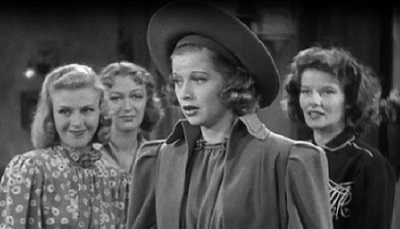
The heroines’ choice to remain single (and have casual boyfriends only) is celebrated rather than reviled by the film. If anything, the film mocks marriage. But don’t just view Stage Door (1937) for its politics; watch it to see the phenomenal cast interact: Ginger Rogers, Katharine Hepburn, Lucille Ball, Eve Arden. (The latter you may recognize as the principal in Grease; in her youth, she was always the smart-talking sidekick.)

Rogers, Arden, Ball, and Hepburn

Rogers, Arden, Ball, and Hepburn

The dialogue is so slick and cynical and quick that you’ll have a hard time keeping up with the one-liners, as when wealthy Terry’s (Katharine Hepburn’s) haughty tone annoys her impoverished fellow residents. Jean (Ginger Rogers) is not one to let an insult slide. When Terry snootily states, “Unfortunately, I learned to speak English correctly,” Jean fires back, “That won’t be of much use to you here. We all talk pig Latin.”

While the more famous classic movie about female friendships, The Women (1939), favors marriage with unfaithful partners over relationships with backbiting friends, this feminist flick celebrates the humor and loyalty between single women. In fact, I would argue that Stage Door’s women are in some ways more liberated than those in Sex and the City. Watch and see if you agree.

More of a feminist: Jean Maitland or Carrie Bradshaw? (Ginger Rogers & Sarah Jessica Parker)

More of a feminist: Jean or Carrie?


Revenge as Art:  Gilda
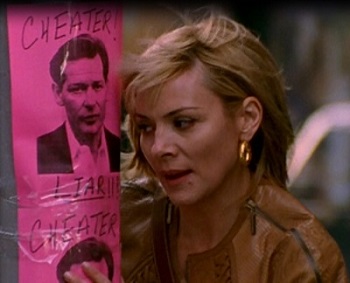
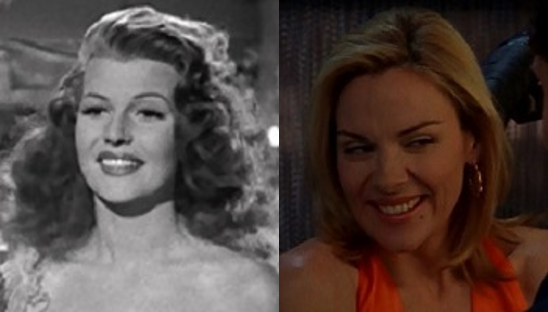
I enjoyed Samantha Jones’s (Kim Cattrall’s) revenge on boyfriend Richard Wright for his infidelity in Sex and the City: the dirty martini in his face, the papering of the city with posters describing his behavior.

Samantha in revenge mode

Samantha in revenge mode

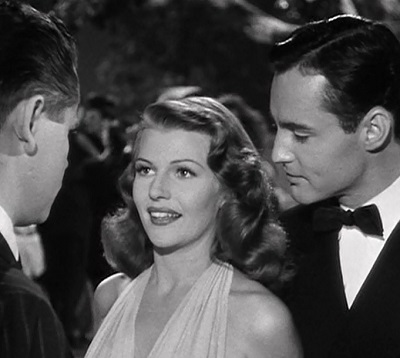
But this kind of takedown is kitten play compared to the work of Rita Hayworth in Gilda.

Gilda, who calls herself the "Bar Nothing," and her spiritual descendant, Samantha Jones

Gilda, the “Bar Nothing,” and her spiritual descendant, Sam

Like Samantha, Gilda (Hayworth) is in full command of her sexuality; it’s not difficult to discover why this WW II pinup was dubbed “The Love Goddess.” But her treatment of her ex, Johnny, is far more ruthless than her modern counterpart’s. First, she marries Johnny’s boss; then, she flaunts her affairs with other men to torment him further.

Gilda (Hayworth) torturing her ex

Gilda (Hayworth) torturing her ex

Gilda is so skillful a manipulator that you root for her to get what she wants, even if the ex she desires is no prize (and no mean manipulator himself).

Here’s an anti-Valentine’s Day conversation if ever there were one:

Gilda: “Would it interest you to know how much I hate you, Johnny?”
Johnny: “Very much.”
Gilda: “I hate you so much I would destroy myself to take you down with me.”

I think Samantha would be impressed.

Exploiting Men: Baby Face
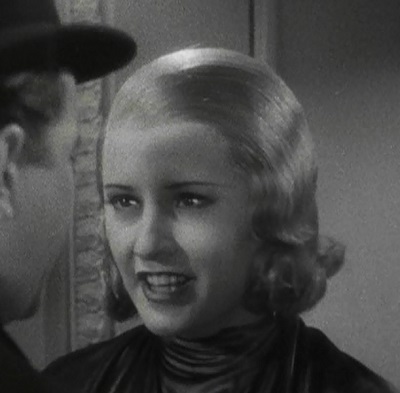
In an early episode of Sex and the City, “The Power of Female Sex,” Carrie’s fling has left a tip on her bedside table and she’s feeling ill at ease with the implications. The four friends discuss whether it’s ever acceptable to use your sexuality to get ahead. Barbara Stanwyck’s character in Baby Face (1933) has no such qualms: She leaves her hometown for NYC with the aim of doing just that.

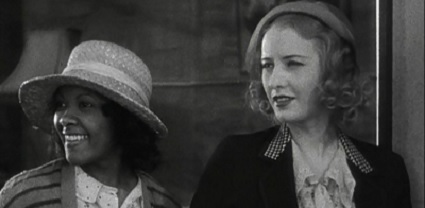
The shocks accumulate quickly as you watch Baby Face: Lily’s (Stanwyck’s) father has been prostituting her since she was fourteen. A grandfatherly figure in her dad’s speakeasy recommends she leave home to sexually exploit men for personal gain, quoting Nietzsche to back his case.  Once in New York, Lily takes quick steps to follow his advice, seducing the HR assistant in a bank to get a job, and then sleeping her way floor by floor to the top. (The camera helpfully pans up to highlight each floor as she ascends.)

Lily (Stanwyck) on the make

Lily (Stanwyck) on the make

You might expect the movie to make the heroine suffer for her behavior, given the date of this film, but she is unmoved by the heartbreak and eventual tragedy she leaves in her wake (among her victims is a smitten John Wayne). Men have used her all her life. Lily figures it’s her turn, and the film clearly sympathizes with her reasoning. She calmly goes about her business of seducing men, accumulating jewels and bonds, and sharing her successes with her best friend, Chico (Theresa Harris).

Chico and Lily admiring another woman’s wealth before Lily starts to advance

Chico and Lily scheming

Here’s a typical exchange with a discarded lover who stops by Lily’s apartment:

Ex-Lover: “It’s been brutal not seeing you.”
Lily: “Yeah, well you better get used to it.”

When he returns and offers marriage, Lily answers, “So you want to marry me, huh? Isn’t that beautiful. Get out of here….”

Lily's reaction to a marriage proposal from a discarded lover

Lily’s reaction to a marriage proposal from a discarded lover

This is a strange film with a number of flaws, but you won’t care; it’s too much fun to watch this predator in action. (Be sure to watch the pre-release version; it’s much better.)

What are your favorite anti-Valentine’s films?

Share
Posted in: 1930s films, 1940s films, Anti-Romance films, Comedies (film), Drama (film), Feminism, Film Noir/Crime/Thriller & Mystery, Humor, TV & Pop Culture Tagged: Carrie Bradshaw, Gilda, Samantha Jones, Sarah Jessica Parker, Sex and the City, Stage Door

Unhealthy Obsessions: Laura and Her

02/06/2014 by leah@carygrantwonteatyou.com 6 Comments

Her (2013) starts with an unoriginal premise: guy falls for an inappropriate thing, his society doesn’t judge him for it, and the audience is left to (a) reconsider their understanding of relationships and/or (b) fear a future in which falling for an operating system is acceptable.  (Substitute an android or doll for the operating system and you’ll find you’ve seen this film before.)

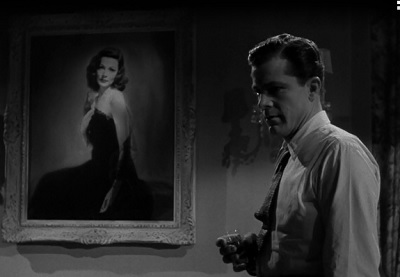
Her asks that you support this odd love, but the only time that has worked for me is with Laura (1944), in which detective Mark McPherson (Dana Andrews) becomes so enamored by others’ descriptions of and a portrait of a murder victim that he can barely function. The trick of the film is that it seduces the audience so completely that we cease to find this love creepy at all, something that never happened to me in the 126 minutes of Her.

Both Her and Laura benefit from the wise casting of their heroines. Scarlett Johansson’s voice is so sexy and Gene Tierney’s face so perfect that the audience’s first reaction is Of course! Who wouldn’t fall for her?

LauraTierney

It’s in the development of the hero that Laura succeeds and Her stumbles. There’s nothing wrong with Joaquin Phoenix’s open, touching performance. But the level of Theodore’s (Phoenix’s) romanticism is so extreme (he actually FEELS every word of the cheesy cards he writes for a living) and his enjoyment of his world so intense that you can’t help thinking this guy would fall for a Milk Dud.  We might like Theodore, but how could we possibly relate to him?

McPherson, on the other hand, is guarded in Laura, a much more common condition for those who’ve been burned by past relationships, as Her’s Theodore has been. When asked whether he’s ever been in love, McPherson quips, “A doll in Washington Heights once got a fox fur outta me.” As his passion for the murder victim, Laura (Tierney), increases, McPherson resists and denies it, trying to keep his professionalism intact. The audience can therefore empathize with his struggle, especially since some types of police work can demand obsession (mystery writer James Ellroy once claimed Laura was a favorite film of cops he knew).

DanaAndrews

Almost as problematic as the characterization of Her’s Theodore are the impressionistic scenes critics are applauding. Are they beautiful? Yes. But their lengthiness gave me too much time to think: Why would someone so outgoing primarily socialize with video games? Am I meant to believe people like those awful cards he writes? WHO SMILES THIS MUCH? Laura, at 88 minutes total, fits in the detective’s love AND the solution to the whodunit. It speeds along with such rapidity that the audience forgets that McPherson’s love is just as, if not more, disturbing than the affections of Laura’s former admirers.

It’s in depicting these former admirers/suspects that Laura really excels, especially with cynical Waldo Lydecker (Clifton Webb), whose one-liners keep the audience alternately laughing and cringing, often at the hero’s expense: “You’d better watch out, McPherson, or you’ll end up in a psychiatric ward. I don’t think they’ve ever had a patient who fell in love with a corpse.” Jonze’s film desperately needs a Lydecker, as its cloying mood soon becomes monotonous, and Amy Adams does nothing but bolster her friend’s feelings for the operating system. (Does Spike Jonze require screenwriter Charles Kaufman to avoid taking himself too seriously? Where is the light touch of Being John Malkovich?)

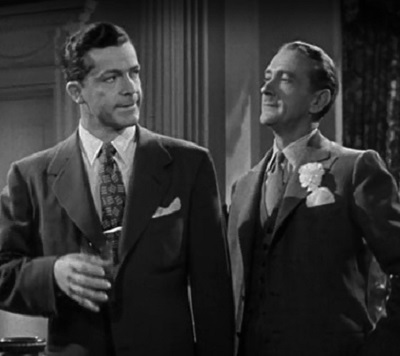
AndrewsandWebb

As it drifts along in its dreamy way, Her demands that you continue to contemplate its hero’s unhealthy love. Laura simply expects you to accept its. As a result, I felt drained by Her and intrigued by Laura. Unless you want sugar shock, I suggest you stick with the older film too.

Random thoughts:

The high-waisted pants on men have pained me in Laura and other 40s films. Could future fashion designers be so cruel as to bring back such an unflattering style and combine it with melon shades, as we see in Her? And if not, why did Jonze make me suffer through it? It takes a lot to make this man look unattractive:

JoaquinPhoenixJ

But Jonze certainly succeeded.

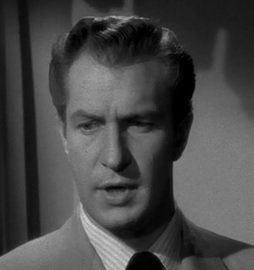
Vincent Price (the murder victim’s former fiancé) is such a wimp in Laura that it’s shocking to realize he scared whole generations of moviegoers and Michael Jackson fans.

VincentPrice

Apparently, fans of Philip Seymour Hoffman, Phoenix’s costar in The Master, also noticed Her’s dire need for sarcasm and did a fake promo for the film with Hoffman’s voice instead of Johansson’s. Listening to it was one of the few joys possible after hearing about Hoffman’s death (not PG rated, for you parents out there).

What are your thoughts on Laura and Her? (Please avoid bringing up anything in the second half of Laura, as I’d like to avoid spoilers.)

Share
Posted in: 1940s films, Drama (film), Femme fatales, Film Noir/Crime/Thriller & Mystery, Romance (films) Tagged: Gene Tierney, Her, Joaquin Phoenix, Laura, Vincent Price, Waldo Lydecker

Slacker Detectives: Psych and The Thin Man

01/30/2014 by leah@carygrantwonteatyou.com 1 Comment

Years ago, I tried without success to get my sisters into the TV show Psych.

“The mysteries are stupid,” they said.

“The mysteries aren’t the point,” I replied.

“You can’t ignore them!” they claimed.

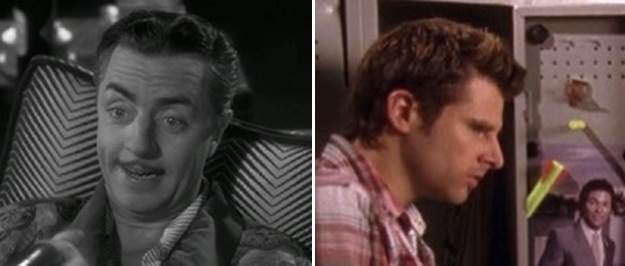
But I have, and I do, and so did the viewers of The Thin Man series starring William Powell and Myrna Loy, in which the detective always has to be forced onto a case because he’d rather be partying or vegging out. Sound familiar, Psych fans?

The witty repartee between the starring couple, Nick and Nora Charles, is what so many writers have tried to imitate since—not the mysteries’ quality, or the sometimes painfully melodramatic performances of the minor characters. Likewise, the interaction between the detective pair on Psych is so much the focus that commercials give no hint about the actual content of the episodes, as in the characters’ classic Hall & Oates  spoof.

Compare:

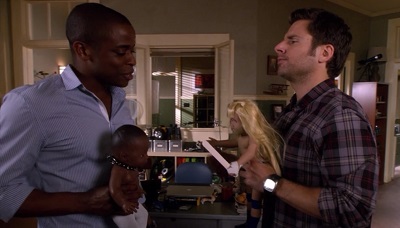
Psych episode (“Let’s Get Hairy,” Season 4, Episode 8): Partners Shawn and Gus are dressing dolls up as their favorite 1980s WWF wrestlers before a match rather than drumming up detecting business.

Gus and Shawn (Dulé Hill and James Roday) playing before the rumble.

Gus and Shawn (Dulé Hill and James Roday) playing before the rumble

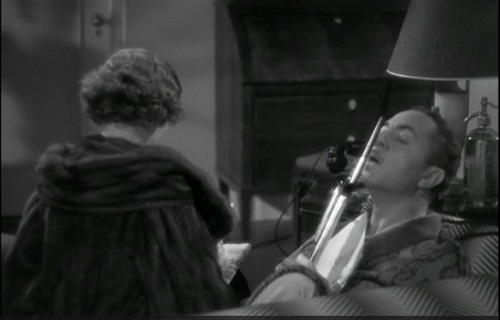
The first Thin Man:  Nora is trying to convince Nick into taking a case as he shoots balloons (and eventually a window) with a play gun she gave him for Christmas.

“Aw Nicky, take the case,” she says.

“You take it,” he answers. “I’m too busy.”

Nick and Nora (Powell and Loy) bantering in The Thin Man

Nick and Nora (Powell and Loy) bantering in The Thin Man

Pleasure before business? Check.
Adults acting like kids? Check.
Clever references? Check.
Perfect repartee? Check.

Nick proud of a bull’s eye; Shawn feeling suave thanks to his Miami Vice poster.

Nick proud of a bull’s eye; Shawn feeling suave thanks to his Miami Vice poster

I know some classic movie fans will find my comparison insulting to the more sophisticated films and the brilliant book that inspired them.  But such critics should give more credit to Psych’s dialogue, such as this exchange, which captures the show’s attitude toward the mysteries:

Shawn: “We came to investigate, catch bad guys and eat pie.”

Gus: “Not necessarily in that order.”

Shawn: “And it hasn’t been.”

Gus: “No.”

Shawn: “We started with the pie.”

Gus: “Always.” (Season 5, Episode 12, “Dual Spires”)

Even if you dislike Psych, don’t miss out on Nick and Nora.  Eighty years of fans. Five sequels (the last over a decade after the first). Scores of imitators. Observe the publication date on this NPR story discussing upcoming novellas of The Thin Man sequels. Sequels, mind you, which most of us try to forget, not commemorate decades later.

What are your thoughts on Psych and The Thin Man? Would you rather party with Nick and Nora, or Shawn and Gus? Did you like the first Thin Man best, or did the scene with Nick and the snoozers in the second make it your favorite? What other Nick and Shawn similarities have you noticed?


Share
Posted in: 1930s films, 1940s films, Comedies (film), Film Noir/Crime/Thriller & Mystery, Humor, TV & Pop Culture Tagged: Burton Guster, Nick & Nora Charles, Psych, Shawn and Gus, Shawn Spencer

Want to View a Hitchcock? Try Notorious.

01/23/2014 by leah@carygrantwonteatyou.com 1 Comment

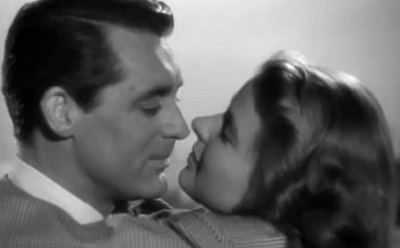
Vertigo was recently crowned the best film of all time, but the objectification of its heroine is hard to take on an empty stomach. Rear Window, also beloved by critics, is slow paced and clever rather than frightening, known for being groundbreaking in style. For the slow-burning suspense the master does so well, I’d begin with Notorious.

Grant and Bergman in Notorious

Grant and Bergman in Notorious

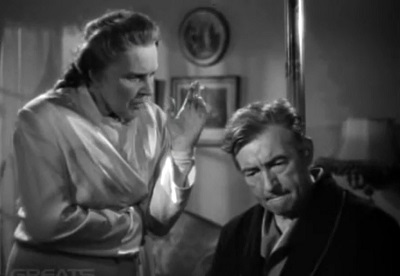
Technically, this is a film about a spy tracking down a Nazi plot. Actually, it’s about highly dysfunctional relationships, including the romance between stars Ingrid Bergman and Cary Grant, which you would find disturbing if the relationships between Bergman and the Nazi and the latter (Claude Rains) and his mother weren’t so much worse.

The spy (Rains) and his mother (Leopoldine Konstantin) making plans

The Nazi (Rains) and his mother (Leopoldine Konstantin) plotting

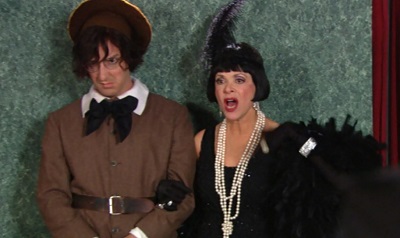
Bergman is in peril as the spy who marries the Nazi, and Grant’s hurt feelings get in the way of his assistance.  Watch it for the stars’ performances, your increasing fear about Bergman’s fate, and one of the creepiest mother-son relationships you’ll ever encounter. I haven’t been this horrified since I watched wholesome Angela Lansbury’s dangerous games with her son in The Manchurian Candidate (1962) or Lucille playing dress-up with hers in Arrested Development.

Buster (Tony Hale) and Lucille (Jessica Walter) in the “Motherboy XXX” episode

Buster (Tony Hale) and Lucille (Jessica Walter) in the “Motherboy XXX” episode

Share
Posted in: 1940s films, Film Noir/Crime/Thriller & Mystery, Romance (films) Tagged: Alfred Hitchcock, Arrested Development, Lucille Bluth, Motherboy
« Previous 1 2 3 4 5 6 7 8 9 10

Recent Posts

  • 100 Years Later, Still Scary: Dr. Caligari
  • Escaping Out of the Past (1947)
  • A Weeper for Those Who Love Jerks
  • Thank You, Academy, for Not Infuriating Me
  • Challengers (2024) Is a Bad Movie

Subscribe to Blog via Email

Enter your email address to subscribe to this blog and receive notifications of new posts by email.

Categories

  • 1920s films
  • 1930s films
  • 1940s films
  • 1950s films
  • 1960s films
  • 1970s films
  • 1980s films
  • 1990-current films
  • 2020s films
  • Action & Sports Films
  • Anti-Romance films
  • Blogathons
  • Childfree
  • Comedies (film)
  • Drama (film)
  • Feminism
  • Femme fatales
  • Film Noir/Crime/Thriller & Mystery
  • Gloriously Silly Scenes
  • Horror
  • Humor
  • Mae West Moments
  • Musicals and dancing films
  • Oscars
  • Random
  • Romance (films)
  • Romantic Comedies (film)
  • The Moment I Fell for
  • Turn My Sister into Classic Movie Fan
  • TV & Pop Culture
  • Uncategorized
Share
Classic Movie Blog Hub Member

Recent Comments

  • leah@carygrantwonteatyou.com on Meg Ryan’s Fate Foretold in Joe Versus the Volcano
  • Ryan on Meg Ryan’s Fate Foretold in Joe Versus the Volcano
  • leah@carygrantwonteatyou.com on 100 Years Later, Still Scary: Dr. Caligari
  • The Classic Movie Muse on 100 Years Later, Still Scary: Dr. Caligari
  • leah@carygrantwonteatyou.com on 100 Years Later, Still Scary: Dr. Caligari

Archives

  • November 2025
  • September 2025
  • May 2025
  • March 2025
  • January 2025
  • November 2024
  • August 2024
  • July 2024
  • May 2024
  • March 2024
  • February 2024
  • December 2023
  • November 2023
  • October 2023
  • September 2023
  • August 2023
  • July 2023
  • May 2023
  • April 2023
  • March 2023
  • January 2023
  • December 2022
  • November 2022
  • September 2022
  • July 2022
  • May 2022
  • April 2022
  • March 2022
  • February 2022
  • October 2021
  • September 2021
  • April 2021
  • March 2021
  • February 2021
  • December 2020
  • October 2020
  • September 2020
  • July 2020
  • May 2020
  • April 2020
  • March 2020
  • February 2020
  • December 2019
  • October 2019
  • September 2019
  • June 2019
  • May 2019
  • April 2019
  • February 2019
  • January 2019
  • November 2018
  • September 2018
  • July 2018
  • June 2018
  • May 2018
  • April 2018
  • March 2018
  • February 2018
  • January 2018
  • November 2017
  • September 2017
  • August 2017
  • July 2017
  • June 2017
  • May 2017
  • April 2017
  • March 2017
  • February 2017
  • January 2017
  • December 2016
  • November 2016
  • October 2016
  • August 2016
  • July 2016
  • June 2016
  • May 2016
  • April 2016
  • March 2016
  • February 2016
  • January 2016
  • December 2015
  • November 2015
  • October 2015
  • September 2015
  • August 2015
  • July 2015
  • June 2015
  • May 2015
  • April 2015
  • March 2015
  • February 2015
  • January 2015
  • December 2014
  • November 2014
  • October 2014
  • September 2014
  • August 2014
  • July 2014
  • June 2014
  • May 2014
  • April 2014
  • March 2014
  • February 2014
  • January 2014

Meta

  • Log in
  • Entries feed
  • Comments feed
  • WordPress.org

Copyright © 2025 Cary Grant Won't Eat You.

Church WordPress Theme by themehall.com