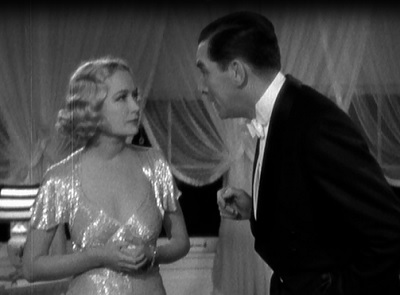
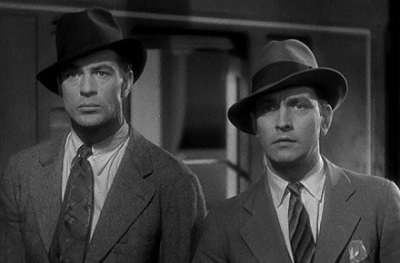
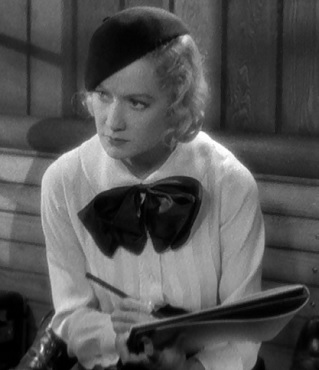
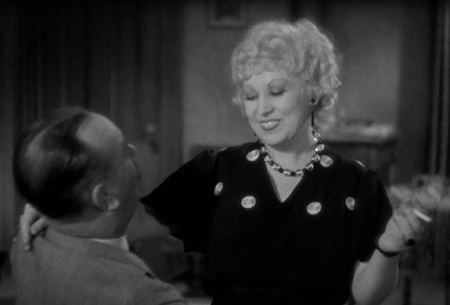
Cary Grant Won't Eat You

Classic movies for phobics

  • About
  • eBooks
  • Previous Blogathons
Classic movies for phobics

Author: leah@carygrantwonteatyou.com

A Cinematic Argument for Gun Control: The Ale & Quail Club

07/05/2015 by leah@carygrantwonteatyou.com Leave a Comment

Ale&QuailClub-PalmBeachStory
The Palm Beach Story (1942), Preston Sturges’ rom-com about love & money, features many screwball moments. But few would deny that the screwiest are with the trigger-happy Ale & Quail Club. I have heard many arguments over the years claiming we need tighter governance over gun ownership. But none have been more compelling than simply watching this hunting club in action.
Near the start of the film, Gerry (Claudette Colbert) is leaving her husband, Tom (Joel McCrea). Believing her extravagance is holding him back, she seeks a rich lover to–wait for it–help his business. She dodges Tom at the train station, and convinces a group of millionaires (the Ale & Quail Club) to buy her a ticket to Palm Beach. What she doesn’t know is just what kind of group she’s joined.

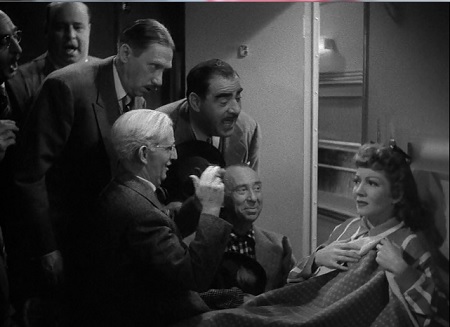
They dance with her; they sing to her, their intoxication becoming more evident by the moment. They serenade her with “Sweet Adeline,” to her evident annoyance:

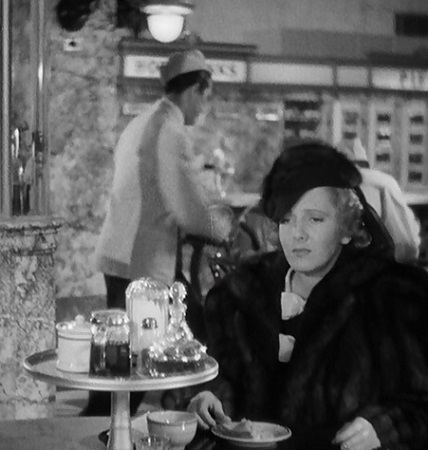
ReactiontoSerenadeClaudetteColbert
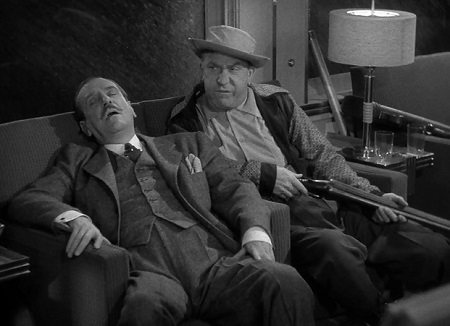
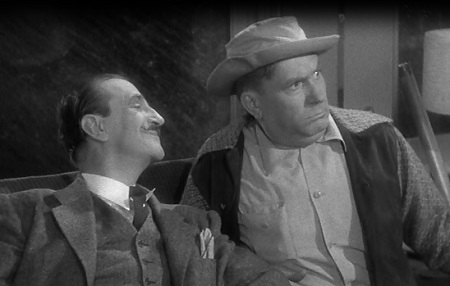
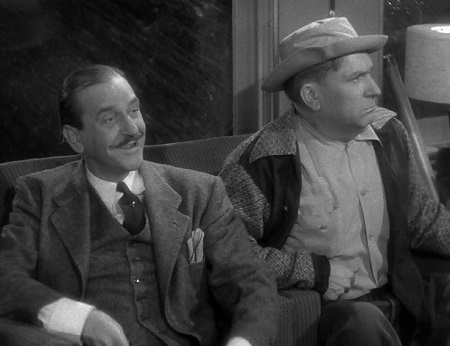
But not just hers. Two of the hunting club’s members haven’t joined the singing–one (William Demarest) because he detests such unmanly behavior, the other (Jack Norton) because his drunkenness has reached the pass-out point.

SweetAdelinereactionDemarestGordon
Demarest asks their private car’s steward, George (Ernest Anderson), to throw up crackers, and pretends to shoot them, saying, “Bang bang.”

BangBangDemarestGordon
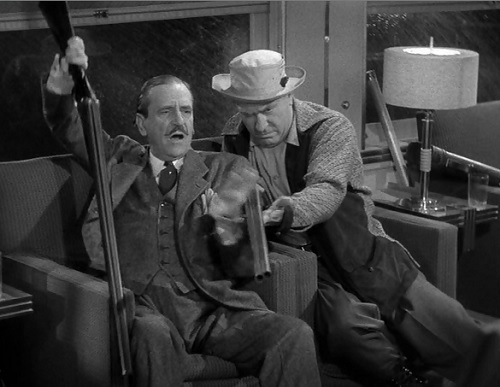
Naturally, his companion (Gordon) claims he’s missed, and the two make a $50 bet about who can make the best shot. Gordon, too drunk to be handling weapons, shatters the window.

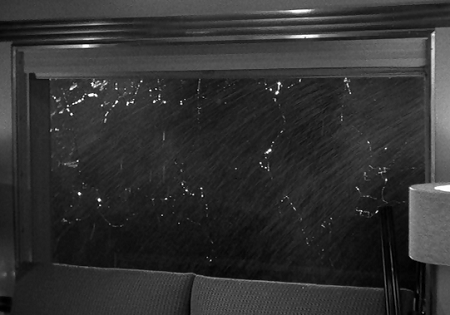
firstcasualtywindow
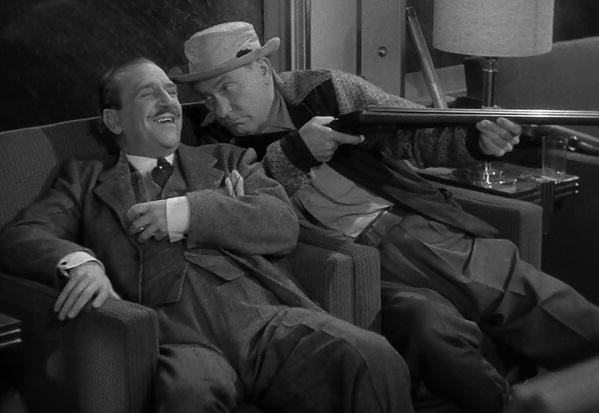
Demarest is shocked, and Gordon proud of his accomplishment.

ShockatSuccessDemarestandGordon
He claims the win.

JackGordonproudofwindowshot
“Wait a minute,” says Demarest. “you’re using real shells.”

“Well, what did you think I was using,” Gordon answers, “bird seed?”

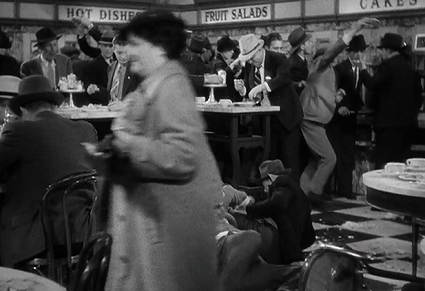
At this point, we might expect Demarest to cry foul. Instead, he loads his own weapon, and chaos ensues as they shoot up the car, with George ducking for safety. The singers in the other room, instead of trying to stop their friends, rush to join the party, calling, “Crap shooting.”

After they’ve completely busted up the car, one member realizes that Gerry, who was almost taken out when she checked to see what was happening, has disappeared.

she'sgone
Demarest suggests a posse.

PoseeledbyDemarest
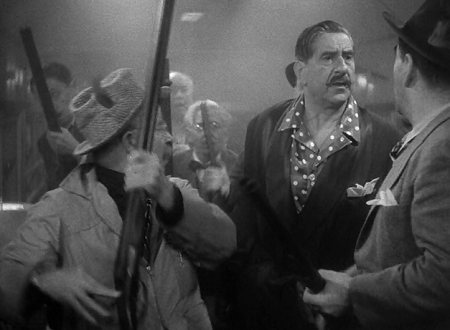
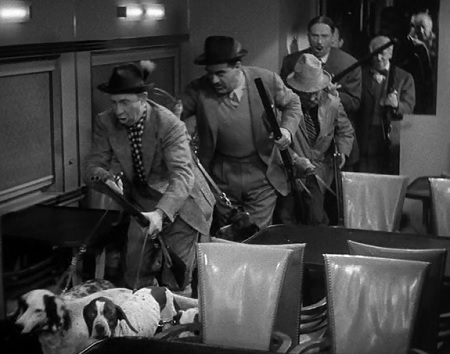
Gordon says they need their dogs, so the club gathers the canines from the other car, singing, “A Hunting We Will Go” as they stalk Gerry.

HuntingPartyAle&Quail
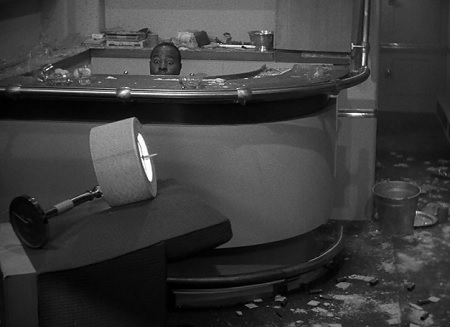
After they terrify multiple guests, the club is forced to return to their car. Naturally, they sing some more before the conductors discover what’s become of the car–and George.

George-PalmBeachStory
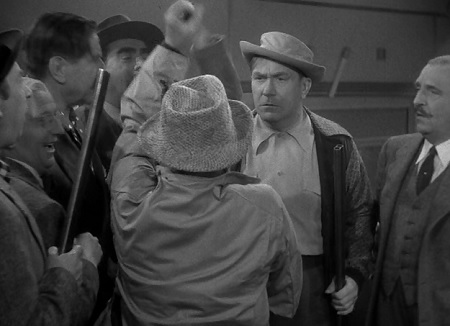
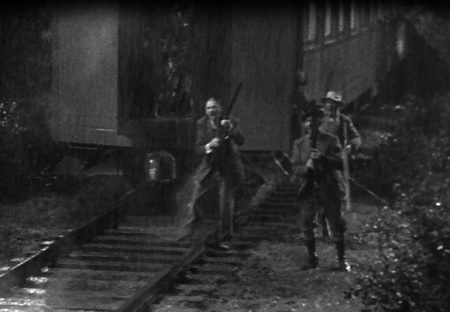
In our last view of the group, they try to protest their private car being disconnected from the train–with their weapons still in hand.

AleandQuailLastScene
If you haven’t seen it, this ridiculous scenario is, as you can imagine, hilarious. You’ll quickly remember all those Dick Cheney hunting jokes, perhaps the funny Parks and Recreation hunting trip.

But it’s also a terrifying scenario if you shift the light a little: a posse of men chasing after a woman, one black man hiding from the white men threatening him, loaded guns everywhere, a train full of potential victims, and not one person among the group sober. You will laugh–as I did–to see these goofy men, and their strange notion of partying. But you may also find yourself thinking, “You know, some of these guys would have failed a good background check….”

Share
Posted in: 1940s films, Comedies (film), Romantic Comedies (film) Tagged: Dick Cheney hunting jokes, Jack Gordon, Parks and Recreation hunting trip, Preston Sturges, Second Amendment, The Palm Beach Story, William Demarest

Mad Men Meets Sex and the City: The Best of Everything

06/28/2015 by leah@carygrantwonteatyou.com 16 Comments

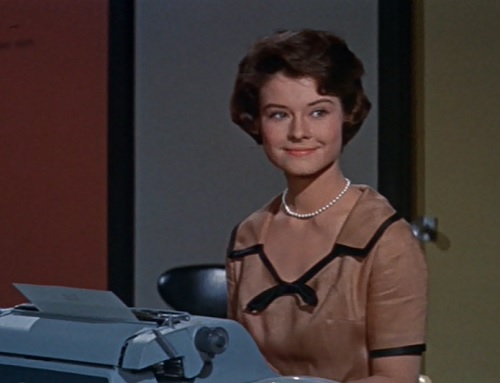
Baker-BestofEverything
This post is part of the Modern Era portion of the Classic Movie History Project Blogathon, sponsored by Aurora of Once Upon A Screen, Ruth of Silver Screenings and Fritzi of Movies, Silently. Previous days are covered here: Silent Era and Golden Age. Thanks to Flicker Alley for sponsoring and promoting this event.

Ever since Mad Men ended, I’ve been wondering about Peggy’s real-life equivalents, from the woman who coined “A Diamond Is Forever,” to those who paid a far greater cost for their romantic missteps than Peggy did. I’ve been curious about ’50s and ’60s movie versions of the career girl as well. Films covered single women in the city from the silent era on, but naturally, I viewed the movie based on the book Don Draper was reading at the start of the show, Rona Jaffe’s The Best of Everything.

Jaffe is an interesting figure in herself; her characters are based on her own experience in publishing, and her friends within it. She earnestly explained to Hugh Hefner (what a choice!) that her goal in writing the book was to normalize and destigmatize the experience of those girls who felt ashamed and alone in their mistakes: their dalliances with married men, the children they bore (or didn’t) as a result.

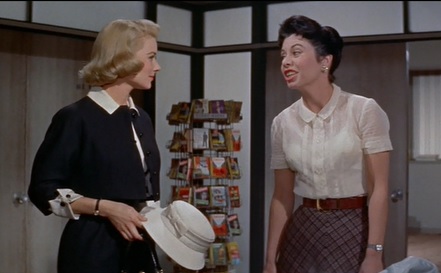
The controversial film version (1959) quickly lands us in the center of the action in a publishing company, and I was instantly hooked by the drama: the boss (Brian Aherne) who casually pinches his workers’ rears, the secretaries trying to balance social lives and unreasonable work demands, the crowded shared apartments and crammed lunch spots. (The film is given props for fashion, and deserves it. It’s a visual feast throughout.) Right away, we get a sense of what women had to put up with just to get paid, and not well.

First day on the job

First day on the job

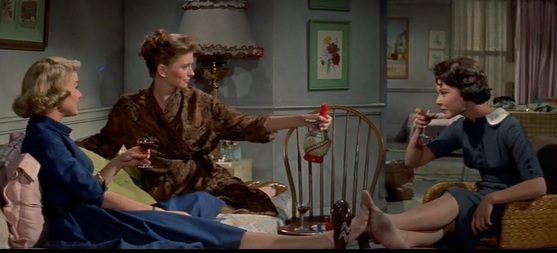
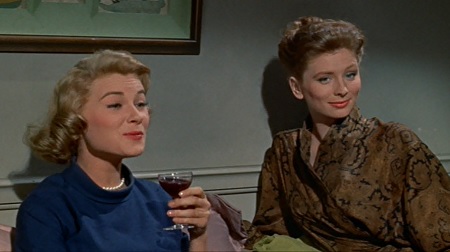
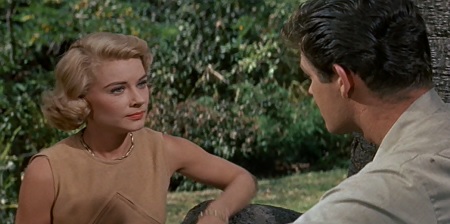
Newcomer to  the city Caroline (Hope Lange) rooms with coworkers Gregg (supermodel Suzy Parker) and April (Diane Baker) in a miniscule apartment, and the three instantly become tight friends despite having little in common: Gregg is the adventurous bombshell/aspiring actress, April the innocent, and Caroline, the sophisticate who is trying out work until her fiancé returns to the U.S. and marries her.

Single roommates in the city

Single roommates celebrating

Caroline and Gregg talk about lovers with April

Caroline and Gregg talk about lovers with April

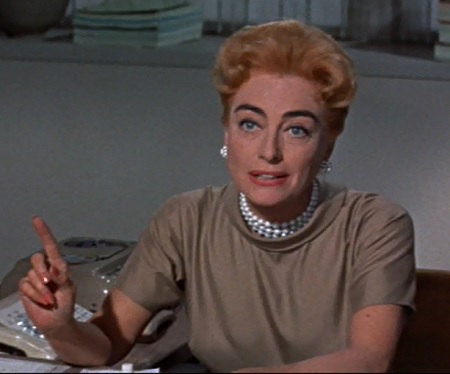
The three unite in hatred of Amanda Farrow, the harsh editor who has chosen success over marriage, and scorns the secretaries who didn’t have to go through as much as she did to advance.

JoanCrawford-Farrow
She has a smidgen of Miranda Priestly of The Devil Wears Prada in her, but there’s pathos and empathy to Farrow too. She may fail to support her many secretaries’ ambitions, but she tries to save them from her romantic fate, from awful men. And The Best of Everything is full of them.

The Sex and the City ladies might have faced a lot of freaks, but at least they had some personality; the men of The Best of Everything are as interchangeable as the vice presidents in American Psycho. A recent play of the book even used cardboard cutouts of men to emphasize the point.

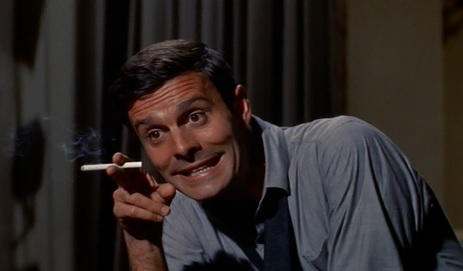
What’s puzzling is what these interesting women see in these duds. Effervescent April (Baker) falls for a guy who is so obviously a sleaze he might as well be wearing a signboard to announce it. Hope’s fiancé announces he’s married a rich girl instead of her—over the phone—and then expects her to sleep with him afterward. And get this: dazzling Gregg (Parker) falls so hard for a director (Louis Jourdan) that she goes into a crazy, stalking tailspin when he dumps her. (Yes, nothing inspires sexual obsession so much as heartthrob Gigi‘s Gaston. What??)

JourdanBestofEverything
Since the men are so patently lacking in any redeeming qualities but sleep inducement, the film’s attention to them rather than the workplace and roommate dynamics is disappointing, as the latter, when they’re the focus, are well developed and fascinating. Caroline advances quickly to the rung above secretary (a reader), but is accused by an alcoholic friend, Mike (Stephen Boyd), of faux ambition, just to avoid her romantic life (by the way, this is the love interest we’re rooting for).

Ambitions attacked

Ambitions attacked

Yet between the romantic interludes (and their sad repercussions) are intriguing signs of the second wave of feminism to come: Farrow (Crawford) leaves the marriage she impulsively makes with an old flame, returning to work, and we have the sense that she’s better for it. Caroline is promoted again. Abortion is presented as the fault of men who are careless with the hearts (and bodies) of naïve women—not the deserved end for loose ones. Female solidarity* prevails throughout, as when one of our heroines slaps a faithless boyfriend of the other. (*In one brief, funny exception, the secretaries all try to pass off work on one another.) The workplace even has moments of startling modernity, as with the hilariously painful bonding “picnic,” with its forced fun and workers getting drunk in self-defense. There’s enough worth watching in the film, in short, to get viewers through the unearned suds of these worthless romances.

Single women have fled to New York for all kinds of reasons, in all kinds of ages: post-Civil War belles, without men or funds; rural women leaving farms for factories; aspiring starlets, hoping for a berth at the glamour-girl dorm, The Barbizon Hotel (an upscale Footlights Club, a la Stage Door). These women certainly didn’t find the “best of everything.” But they still managed to live out enough of the excitement of the big city to keep other women coming, to keep dreamers hankering for if not the best of everything, the thrill of aspiring for it.

Share
Posted in: 1950s films, Blogathons, Drama (film), Feminism, Romance (films) Tagged: city, Joan Crawford, Mad Men, Sex and the City, single girls

Mae West as a Deadpan Plaintiff in I’m No Angel

06/26/2015 by leah@carygrantwonteatyou.com 11 Comments

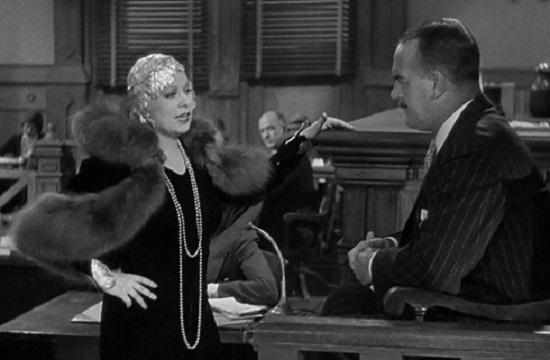
I'mNoAngel-CourtroomScene
This post is part of the The “…And Scene!” Blogathon. Check out the other entries here.

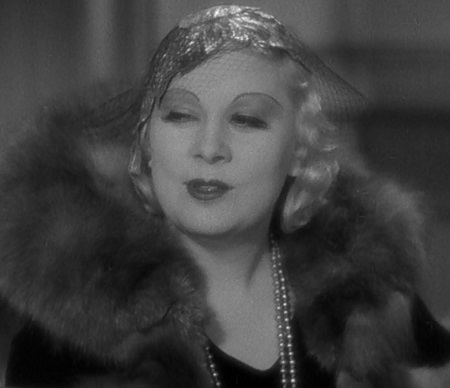
There are very few scenes in film as funny as when Mae West is talking about the number of men in her life, or, as she famously put it after the courtroom scene in I’m No Angel, the much more important amount of “life in your men.”

I’m a sucker for courtroom scenes in general, but most are thrilling, dramatic. I admit that a few are funny–From the Hip, Seems Like Old Times–but there’s nothing like Mae West on a roll, and every second of the courtroom scene of this glorious pre-Code wonder is the actress (and writer) at her best.

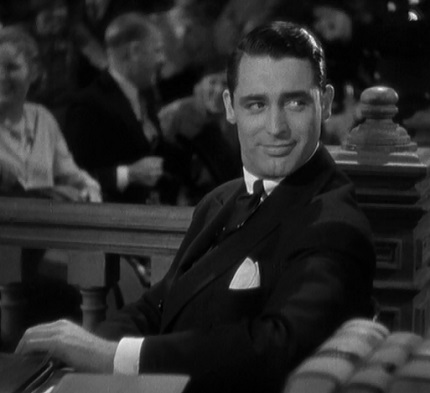
Tira, a circus performer, is suing her wealthy fiancé (Cary Grant) for breach of promise. He broke off their wedding because he saw another man in her place while she was out, not knowing it was a set-up by her boss, who didn’t want to lose her successful act to matrimony.

Unsurprisingly, the defense attorney immediately tries to besmirch Tira’s reputation, suggesting she gets around, that she has a “colorful past.”

In another movie, we might expect shame, embarrassment, hostility at such an attack. But this isn’t just any movie.

“Well, I gotta admit, I’ve been the love interest in more than one guy’s life,” Tira agrees. “I don’t see what my past has got to do with my present.”

“We shall show that to the satisfaction of the court, I believe,” the attorney primly responds. “Nevertheless, the fact remains that you’ve been on friendly terms with several men.”

“Alright, I’m the sweetheart of Sigma Psi. So what?”

The audience in the courtroom aren’t the only ones laughing at her quip. Even the defendant can’t resist.

CaryGrantI'mNoAngel
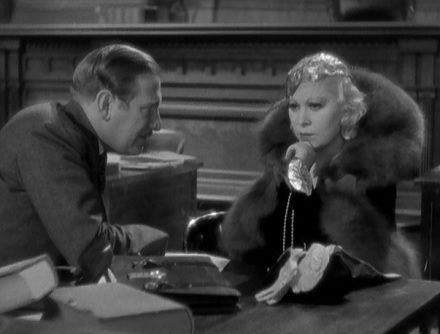
When she’s scolded by the judge for not answering the question, she coos at him in response. (He will later take her on a date.)

MaeWest-judge
The attorney presses on, undeterred, referencing a bunch of (obviously married) men by name, asking if she knows them.

“I do recall their faces,” she answers, “but them ain’t the names they gave me.”

Appalled, her own lawyer asks for a recess and chides her for admitting to such an active dating life.

Tira is unrepentant: “Why shouldn’t I know guys? I’ve been around. I travel from coast to coast. A dame like me can’t make trips like that without meeting some of the male population.”

He explains that she can’t win the case. She considers her options.

MaeWest-court-strategy
And then asks if she can question witnesses herself.

It’s at this point that West really hits her stride–literally. Because she gets to walk up and down past the jury box, practicing her famous strut repeatedly, flirting with everyone in the courtroom.

She treats her accusers with disdain, slamming their efforts to make her look bad, and saying, “OK, I’m through with you,” after she completes her questioning. Between witnesses, she asks the jury, “How ‘m I doin, hmmmmnnnn?”

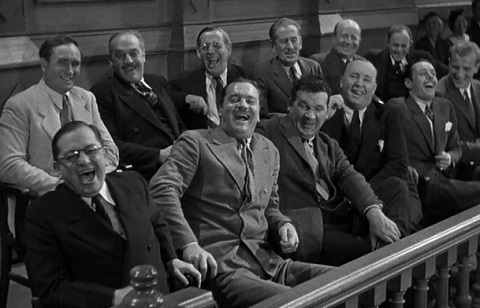
For once, jury duty has proven to be a blessing. Just look at their reactions to her performance:

I'mNoAngel-jury
As Tira concludes, her lover (Cary Grant) can’t handle it anymore and admits defeat. He’s fallen more in love with her than ever, as we have. Who cares if she’s the sweetheart of Sigma Psi? She’s Mae West, idiot. Catch her while you can. Case closed.

Share
Posted in: 1930s films, Blogathons, Mae West Moments, Romantic Comedies (film), Uncategorized Tagged: best courtroom scenes, Cary Grant, I'm No Angel, Mae West, Pre-Code

The Liebster Award

06/21/2015 by leah@carygrantwonteatyou.com 17 Comments

liebster-award-i
Thank you, Cinema Maven and Steve Bailey of MovieMovieBlogBlog, for nominating me for the Liebster award, and for being so patient with my horrible tardiness in giving responses! Everybody check out Cinema’s Maven’s responses to the questions she was asked, which are so funny and awesome. She also nominated 10 wonderful blogs I’m honored to see next to mine, as did Steve. Steve’s answers are also wonderful; I highly recommend reading #1 in his facts about himself. Hilarious.

For the award, my task is to nominate some folks for the award myself, answer questions, and ask my own. I don’t think I’ve yet honored these great bloggers. In no particular order:

Christina Wehner, K-Drama Today, A Person in the Dark, Critica Retro, Caftan Woman, MovieMovieBlogBlog, Carole & Co., Nitrateglow, Speakeasy, The Vintage Cameo, & Love Letters to Old Hollywood (I will try to remember to notify you as well, which I neglected to do on a similar occasion.)

To accept the award, answer my eleven questions, share eleven things about yourself, ask eleven of your own questions, and nominate up to eleven bloggers to answer them. If you don’t have the time right now, just know that I am a fan and wanted to give you a shout-out.

My Responses to Cinema Maven’s Great Questions

  1. You’re a casting agent. Tell me, what two stars who never acted together would you most like to see in a film? Barbara Stanwyck and Cary Grant in a comedy. It would have been perfection.
  2. What is your favorite line in a movie? “You know, junk food really doesn’t deserve the bad rap it gets. Take these fried pork rinds. This particular brand has 1 percent of the RDA—that’s Recommended Daily Allowance—of Riboflavin.” The Sure Thing.
  3. What is your favorite Alfred Hitchcock film, and briefly…why? Notorious. Perfect casting. The terrifying concept of living with your enemy—and being in his power. Plus, a creepy mother-in-law.
  4. Clark Gable or Cary Grant? Why? Cary Grant. He could do everything—and make it all look SO easy. I like Gable, but he was far less versatile (& no acrobatic skills).
  5. What movie should never EVER become a re-make? To Sir with Love.
  6. What classic film star would you like to interview? Full disclosure. They’d hold nothing back during your interview. Mae West. I wouldn’t want her to hold anything back.
  7. What movie or actor or actress ( pick one ) was absolutely, positively, unequivocally robbed of an Academy Award? For what film? Briefly, why should he/she/it have won? Barbara Stanwyck. For Ball of Fire. Also, for pretty much every movie she was in. Because there has never been another actress that natural on the screen, before or since.
  8. What classic film star, at the height of his or her fame, would you like to show up with you at your prom? Fred Astaire. Because he could make even me look like I could dance. 
  9. Which endings resonate MORE with you: movies with happy endings or movies with sad endings? ( Do NOT say, “that depends” ). Name the film. And why? I’m a sucker for a happy ending if it’s earned. The Shawshank Redemption is a good example.
  10. What actor or actress do you find too hyped up and over-rated OR what actor or actress do you find totally under the radar, and should be much more well-known? Tell us why. Anthony Hopkins—too theatrical. Johnny Depp—great taste, but not much talent (let the attacks begin).
  11. If you didn’t have classic films in your life, where else would your passion lie? What would your hobby be? My classic movie admiration reached its obsession stage when I started teaching writing and was too overwhelmed to read more than I already was. I suspect I’d go back to being the hardcore bookworm I am naturally.

My Responses to Steve Bailey’s Great Questions

1. “All-time favorite movie” is too tough. What is your favorite genre, and what is your all-time favorite movie in that genre? The screwball comedy. Ball of Fire.

2. “Theatrical” is too easy. What’s your all-time favorite TV-movie? I like the truly bad Lifetime ones. As a kid, I loved the If Tomorrow Comes TV miniseries (jewel thief love story–no lie). Surely Slugs was a TV movie? Also a favorite.

3. The Great Movie Genie is allowing you to permanently change the ending of one movie. Which one do you choose, and why? Four Weddings and a Funeral. Andie MacDowell’s unbelievably, comically flat delivery of the raining line, which nearly ruined an otherwise funny comedy. Also, it’s a dumb line.

4. You’re the latest heinie-kissing Hollywood exec, slavishly following trends. Which movie, good or bad, would you like to sequelize or remake? Clan of the Cave Bear was actually a fascinating book, and that movie was AWFUL. I’d like to see it done well. Never gonna happen.

5. Name the movie whose screening you’d like to co-host on TCM with Ben Mankiewicz. I’m No Angel. Who can’t talk about Mae West?

6. Describe your most memorable movie occasion — not necessarily your favorite film, but a movie you enjoyed with friends, one that evoked a particular memory, etc. Great question. Arsenic and Old Lace is attached to so many memories it deserves its own post. Also watching The Princess Bride with my younger sister. She knows every line.

7. What is your favorite line of movie dialogue? I answered this one above in #2 for Cinema Maven. Also, any  five minutes of The Thin Man. 

8. Why are movies special to you? I have many answers to this question, so I’ll just give one: Because I can feel pessimistic about everything around me, and walk out of a theater 2 hours later, inspired.

9. What do you enjoy most about blogging? Finding so many people who love what I do.

10. What is your favorite book about movies? Drama Queens by Autumn Stevens. Not great literature, but gossipy and so funny.

11. You have your favorite movie actor or actress to yourself for 24 hours to do with what you will. Name, please. Not my favorite actor, but Marlon Brando in 1951. I don’t think that requires an explanation.

11 Facts about Me

  1. Once when I returned a movie to Blockbuster, the woman at the counter said, “I won’t lie to you. That’s the worst fine I’ve ever seen.” That’s when I started buying movies.
  2. When my friends used to tan in high school and college, I’d hold up my pale, freckled arm so that they’d feel good about their progress.
  3. Cinema Maven, one of my very funny nominators, reminded me of my own cooking past. I tried to boil oatmeal once without any water. I guess that home ec class in middle school didn’t work.
  4. I used to excel at winning baked goods at the cake walk in school carnivals. I took great pride in this accomplishment.
  5. My parents used to send me to my room when it was messy, telling me I couldn’t leave until it was clean. I liked being in my room. I read there. I am a slob to this day. Let this be a lesson to parents out there.
  6. I have a gift for finding the coolest cat in the animal shelter, and not just for myself.
  7. The GPS changed my life. I spend much less of my time driving in circles now.
  8. I fear hail. It’s followed by tornadoes. The fact that I now live somewhere without them hasn’t changed my instinctual reaction.
  9. I am a hopeless klutz but can paddleboard. This means you all should try it.
  10. I’ve always attributed my good taste in friends to the caliber of people my sisters are. Unfortunately, my siblings hate classic films; nobody’s perfect.
  11. I think I have Fletch memorized.

Eleven Questions for My Nominees
1-5. What’s your favorite movie when you’re feeling:
*Blue?
*Angry?
*Nostalgic?
*Giddy?
*Undercaffeinated? Why (for any/all of the above)? Do they help you get over the mood, or intensify it?
6. What invention in your lifetime has affected you the most?
7. Which actor or actress (the performer/character he/she plays) would make the best superhero in your estimation? Why?
8. Which classic movie character would you ask romantic advice?
9. Which movie character (classic/current) would give you terrible advice about everything?
10. Which literary/movie character would you ask to help you with your least favorite errand?
11. Which actor/actress are you surprised you like? Why?

Share
Posted in: Uncategorized Tagged: blog recs, Cinema Maven, Liebster, Steve Bailey

Love It, Love It Not?: Waffling over Lubitsch’s Design for Living

06/13/2015 by leah@carygrantwonteatyou.com 2 Comments

DesignforLiving
I hoped to love Design for Living. After all, the director was Ernst Lubitsch, who had helmed such witty, cynical comedies about relationships, movies that usually feel as insightful and controversial now as they probably did back in the 20s and 30s. And many reviewers I respect had praised its humor and star.

But….

I found myself teetering back and forth throughout the film—This is wonderful! This is bad!—so, like a gal tearing apart a flower over a crush, I’m going to explain its effects the best way I can:

Love It #1: Subject Matter & Morality

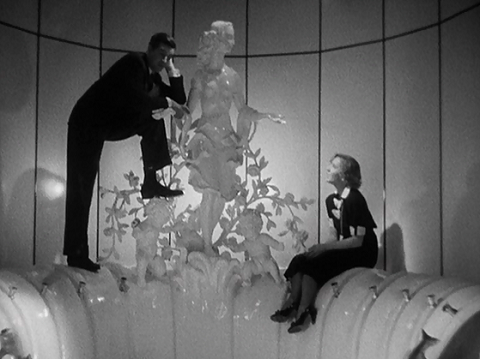
Gildasthreesome-DesignforLiving
Design for Living features a threesome—surely interesting coverage for a film of our time, much less in 1933. (An underrated film I watched in college, Threesome, got a lot of heat back in 1994 for its coverage, even though it was far less flip about the results of the tripling than Lubitsch’s.) I find stories about unusual relationships intriguing, and this is certainly one of them.

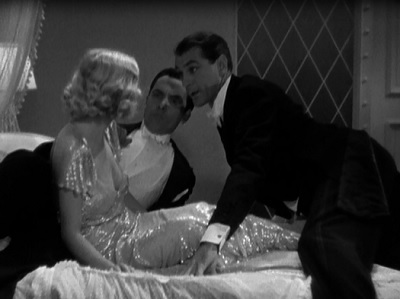
Knowing two roommates want her, Gilda tries to remain platonic with them. She attempts to preserve their friendship and guide their artistic successes (one is a playwright, the other a painter). Her catch phrase is “No sex.” Of course, she gives in to her own desire and theirs, repeatedly.

What’s interesting about the film is the utter lack of judgment about the heroine having sex with both men (in turn, rather than together), or later, wanting to leave her husband to resume the romance. Lubitsch’s touch is so incredibly light that we never blame Gilda (Miriam Hopkins) or her lovers, even though it would be easy to think of her actions, and theirs, as betrayal. Instead, we root for Gilda to stay with both men, as their happiness and hers seems most assured when their playful, sexually charged unit is intact.

Love It # 2: Its Opening
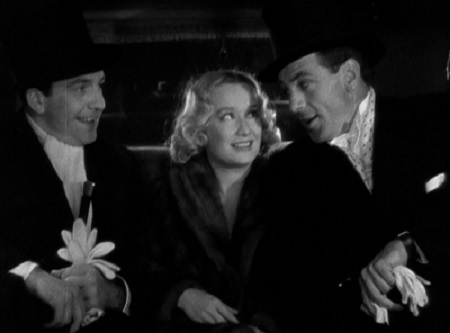
The plot begins with Gilda drawing a rather merciless caricature of two strangers in her train car, Tom (Fredric March) and George (Gary Cooper). Her humor and confidence are breathtaking. Her casual decision to put her legs up on their seat, her amused reaction to their annoyance at her picture, and their own exuberant attraction to her are a pleasure to watch. Although the development is almost too quick, their move from prickly insecurity to joy in each other’s company is funny, and such a convincing depiction of youthful spirits that it made me laugh.

Love It #3: Its Heroine
The film stars Miriam Hopkins, whom I’ve always thought I should like more than I do, which was confirmed by persuasive defenses of her work in a recent blogathon.

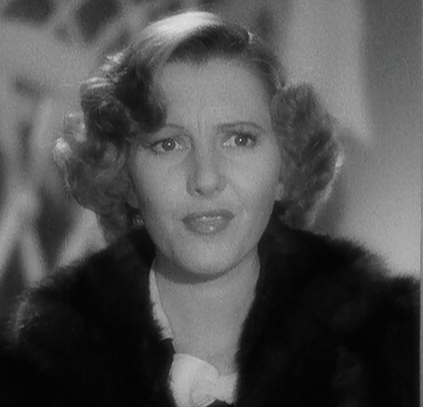
MiriamHopkinsDesignforLiving-2
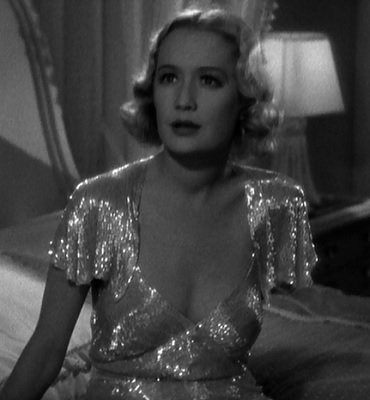
Although she can be dramatic in the film, my usual objection to her, that theatricality suits Gilda’s personality. After all, Gilda imagines herself the driving force behind multiple men’s artistic successes—not to mention their sexual satisfaction. I love that Gilda has utter confidence in her own role as a lover and commercial artist, but quickly sets about fixing the two men’s wobbly self-esteem. Her defense of a woman’s need to try out men like hats is hilarious, and amazingly ahead of its time. Her assurance and energy made me a fan of hers throughout, and always curious what she’d do next.

But….here’s the thing: Despite my enjoyment of these aspects of the film, I didn’t laugh that much, and had to wonder why, which brings me to…

Love It Not #1: Gary Cooper
Oh Gary. He just wasn’t formed for comedy. While his gawky, unnatural goofiness in Ball of Fire seemed to capture his academic persona, the same portrayal here rings very false. He is not convincing as a painter, as a lover, or as a spirited friend. I just wanted to hide my eyes or send him to acting class every time he was on the screen.

Love It Not #2: Edward Everett Horton as Deus Ex Machina
Whereas Cooper pains me in comedy, Horton delights me. But here, his role as Gilda’s boss and competing love interest was laughable—at best. The chemistry between Hopkins and Horton was so nonexistent that I felt like one of them was green screened in every time they were together.

HortonandHopkins

Threatened by...Horton?

Threatened by…Horton?

In addition, the mood between the three lovers is so light and Gilda’s own personality so ebullient that her desperate decision to throw herself at her boss to avoid Tom and George felt like the plot twist of a first-time playwright (which Noël Coward, the story’s creator, was not; apparently, the film barely resembled the play).

Speaking of poor playwrights….

Love It Not #3: These Three—Artists?
I can’t say I’m expecting realism in my comedies, but Hopkins’ drawing in the first few minutes of the story was so patently fake that it took my attention away from the film. (Why not an actress? Gilda definitely has that temperament.)

MiriamHopkins-DesignforLiving
But she’s Degas compared to Cooper, who may be the most unlikely painter ever to grace the screen, and Fredric March is not much more convincing as an author.

I get that a threesome seems Bohemian, and failed artistic aspirations are glamorous in the way poverty only can be in Hollywood portrayals, but come on. Making them artists felt like a cheap way for the writers and director to avoid the audience’s questioning of the characters’ behavior. (Those artists with their loose morals!) And the script is so thin that some truly adept performances were required. Unfortunately, not one of these casting choices fit the material fully. March reminded me so much of Gene Kelly that I could have believed in a little tap dancing. But he looked about as uncomfortable with that typewriter as Cooper did just being there.

In Conclusion….
So some loves, some nots. In the end, I’m glad I saw the film. The unabashed approval of this very untraditional relationship is breathtaking. There are some marvelous lines (my favorite, the “gentlemen’s agreement” to not hook up). The conclusion is a blast to watch. And Hopkins is riveting throughout. Just don’t expect that usual Lubitsch magic, and you’ll enjoy it.

Share
Posted in: 1930s films, Feminism, Romantic Comedies (film) Tagged: Design for Living, Ernst Lubitsch, Fredric March, Gary Cooper, Miriam Hopkins, Pre-Code, review, threesome

My Own “Awakener”: Mae West’s Writing

06/04/2015 by leah@carygrantwonteatyou.com 2 Comments

MaeWest-Awakener
As I was reading the bios of Kate Bolick’s awakeners in Spinster, writers whose independence had inspired her own, I inevitably began to consider my own awakeners. Which literary women had encouraged me to live by my own definition of womanhood?

I came up with many answers, but soon one figure nudged the others out: No costar could ever prevent being upstaged by Mae West. My brain was no different: what other woman could share my consciousness once the shimmying, voluptuous, smart-talking, smart-writing dame arrived?

Others might think of her as an actress first, but for me, it’s the writing that dominates. I grew up worshipping one-liners from Dave Barry and Jane Austen. How I love a quip that’s not only hilarious, but timeless, that captures something of human nature that’s real and honest. And West, well, we all know she had a way with the lines.

And what a pioneer she was! Her play, brazenly titled Sex, produced in 1926. Her arrival on the screen at 38, with an insistence on writing her own dialogue that ensured her place in movie history. And most of all, a sense of humor so unmatched that her words have become part of the American vernacular—whether all of us realize it or not.

I suspect Bolick never fell for West’s language, for if she had, she would have had no need for five writers to inspire her; one would have been more than sufficient. So in honor of Bolick, whose book celebrating singlehood I enjoyed, I will share two of my favorite West comments on matrimony for my monthly Mae West celebration:

First, the famous quip:

“Marriage is a fine institution, but I’m not ready for an institution.”

And second, that marvelous rejoinder from I’m No Angel:

Man: “I don’t suppose you believe in marriage, do you?”
Tira (West) “Only as a last resort.”

What I love is that a male character saying these words onscreen now would get big laughs—not to mention a female. (Of course, no one else could say them with the kind of oomph West did; she ignites the screen while current bombshells play with matches.)

And West not only says the words, she means them; she was every bit as unconventional as they imply. Of course, I know not to confuse fictional characters with their authors. Luckily, West gave me permission, stating about her racy creation, Diamond Lil, who bears a strong resemblance to Tira: “I’m her and she’s me and we’re each other.”

Like Bolick’s awakeners, West did have an encounter with matrimony, but since she was underage, denied cohabiting with the guy, and didn’t even admit to the union until it was discovered, I think we can agree that its impact on her was as negligible as she claims. (And of course, there’s also the accordion player from her vaudeville days some claim she married; she left him too.)

Which leaves us with her writing.

It would be easy to interpret West as simply of her time, as the pre-Code era certainly had some loose moral guidelines. But she acted the same AFTER the Code. Some might also suggest she was provocative for the sake of being rebellious. Or—perhaps even more dangerously—that she was condemning others’ choices in favor of her own. I’ve never thought of her that way, perhaps since her heroines are friendly with other women in her films, and only snarky when they oppose or judge her. And with a delivery that friendly and relaxed, who could take offense?

What West demands for each of her heroines is simply what we all should: the right to be who she is without regard to others’ morals and traditions. To be an individual, with all that implies.

As for West herself? Well, she never got to that last resort, instead cozying up with Paul Novak, a muscle-bound (and decades younger) man from her Vegas act. But it wasn’t a fling. The romance lasted until her death 26 years later; he’d never let her change her will in his favor, not wanting to think about her death. Early in their relationship, when Jayne Mansfield suggested she’d rescued Mickey Hargitay, another of West’s Chippendale-like chorus, from her employer, Novak responded by punching Mr. Universe.

West’s reaction was perfect: she implied they were at war over her affections. Kind of like her films–all the men longing just for her, she casually dating them all. Leave it to West to joke about her famous lack of monogamy while other women were pining for it. Leave it to her to confront a scandal with laughter, as she confronted everything.

I haven’t lived or loved like West. Who could? But oh, how her moxie inspires me.

Share
Posted in: 1930s films, 1940s films, Comedies (film), Feminism, Mae West Moments, Romantic Comedies (film) Tagged: awakener, Kate Bolick, Mae West, marriage, single, Spinster

The Man Who Knew Too Little: an Underrated Bill Murray Gem

05/28/2015 by leah@carygrantwonteatyou.com 2 Comments

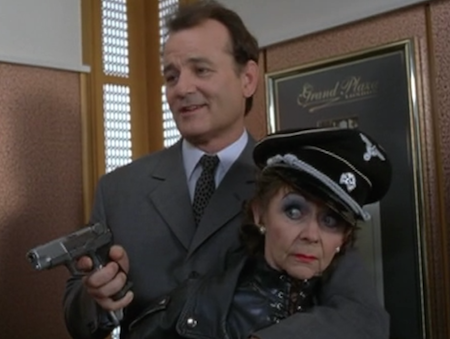
ManWhoKnewTooLittleMurray
The Man Who Knew Too Little (1997) received a 41% on Rotten Tomatoes. It was panned by critics as only moderately funny. Experts claimed it was undeserving of the talents of Bill Murray, relied on broad stereotypes, and centered around only one gag.

Most of these critiques are true. But the film is also hilarious.

To describe the movie as a parody of The Man Who Knew Too Much (the 1934 or ’56 version) would be a stretch. Call it instead a Hitchcockian parody, and you’ll have it. Hitchcock asked us all what becomes of a civilian when mistaken for a spy (North by Northwest), or thrown into a conspiracy once in contact with one (The Man Who Knew Too Much/The 39 Steps)? Director Jon Amiel and writer Robert Farrar extend the question: “and he is totally oblivious to what’s going on?”

A suspected spy arrives in London

A suspected spy arrives in London

Here’s the tissue-thin plot: Blockbuster employee Wallace Ritchie (Murray) shows up for a surprise visit to London. His brother (Peter Gallagher) sends him to a participant theater act called the Theatre of Life until after his business dinner. Ritchie answers the pay phone call that’s supposed to begin the show. But the call that comes in (a few minutes early) isn’t from the theater, but from the employers of Spencer, a hit man tasked with killing the defense minister’s mistress, Lori (Joanne Whalley). She knows too much about a conspiracy plot to reignite the Cold War and is blackmailing the minister with incriminating letters. Thus begins Ritchie’s confusion: he thinks he’s acting; the bad guys–and Lori–suspect he’s a spy undermining their plans.

Because there is essentially no storyline, Murray is let loose to be the playful, odd guy he seems to be in real life, at least according to encounters with strangers in clubs and in cabs. In fact, I’d argue that in some ways this film is more typical of Murray’s personality than any other: the man knows how to improv his way through life.

As Ritchie, Murray has a blast ripping on a number of tough guy acts–most notably, Clint Eastwood’s. Of course, he mimics “Here’s Johnny” from The Shining. He pauses before saving Lori to put on his sunglasses. He asks for retakes, explains his life of espionage to cops, applauds a corpse for the realism of his acting.

Impressed with a corpse's acting

Impressed with a dead killer’s supposed acting

In a favorite moment, Ritchie creeps out some muggers by sobbing, “I got a couple of kids,” and then, embarrassed by his poor performance, abruptly trying another approach: “You know it’s getting so that decent people can’t even go out on the street anymore without scum like you trying to step on whatever’s decent in this world. Well you know something? Your type are just gonna be the kind of crap that sticks to the bottom of a good man’s loafer.”

Murray faux-beseeching

Murray faux-beseeching

Imagine Murray’s fake crying (pictured above) and his enunciation of “a good man’s loafer,” and you’ll have a hint of just how hysterical this film can be.

The extent to which Ritchie remains deluded stretches belief, of course: he never catches on. But who is looking for realism in an unapologetically silly comedy? And, if we’re being honest, how plausible are Hitchcock spy stories and their ilk (Foul Play, Gotcha!, Frantic, The Tuxedo, etc.)? I think we can agree that all of us would live approximately 5 seconds if mistaken for a spy or harboring the secrets of one, a likelihood this parody clearly asks us to consider.

And truthfully, the film could be about anything. What matters is this: Murray is in almost every scene, and an hour and a half of Murray goofing off is about the best mood elevator I can imagine. I watch this ludicrous flick when I’m blue, scared, angry–and I never stop enjoying it. The critics gave it a 41 percent on Rotten Tomatoes; the audience gave it a 70. As usual, the critics are missing out on the fun to be had here; don’t make the same mistake.

Share
Posted in: 1990-current films, Comedies (film), Film Noir/Crime/Thriller & Mystery, Humor, TV & Pop Culture Tagged: Bill Murray, The Man Who Knew Too Little

Could Silent Films Woo Non-Classic Movie Fans?

05/22/2015 by leah@carygrantwonteatyou.com 6 Comments

ClaraBow-It
I recently caught It at a theater with live music, and am still buzzing from it. I liked the film before. With live music, it was a revelation. The talented composer, Jeff Rapsis, used the term “moving picture” rather than film to discuss silents. This term and my exposure to multimedia this year have me thinking: Could silents reach otherwise classic movie-averse folks like my sister?

Could Silents Silence Typical Classic Film Objections?
Resistance to classic film, especially black and whites, comes in the form of comparison: The production values are better now. The acting is better now. Directors have learned from their predecessors, so why go back? We classic film enthusiasts may scoff at these claims, offering as Exhibit A Michael Bay, but the fact remains that the films of the 30s-50s and today are considered similar enough to be directly compared. Yet silent film is a different art form than the movies we know, with different restrictions, different demands. We can no more compare the two than we could stage and television productions.

My mother has been studying art, and keeps referring to the departure from representational art once photography advanced. Movies took the opposite route: moving from figurative (silent) to representational (today). There are exceptions, of course–Terrence Malick comes to mind. But just as we can’t compare Vermeer to Picasso, we can’t go point for point with Metropolis and Star Wars. Avoiding comparisons is crucial since we’re all guilty of using the worst example from the opponent’s camp (i.e., Bay), and the best from our own. With no comparisons, with fewer best-of lists, perhaps there can be less quickness to judgment.

Could Instagram Pave the Way to Silents?
For a culture obsessed with Instagram, silents seem a natural. Incredible concision? Check. A story delivered with visuals rather than sound/many words? Check. Silent film directors didn’t have the luxury of lengthy speeches; they had to distill emotion to a few gestures, drama to a few actions. What could be more compelling to our tweet-obsessed, quick-pic world? And as for our love for cat videos, also sans words, could a Buster Keaton action shot resemble a cat video more? The silliness, the athleticism, the grace–all without special effects? His DNA was clearly more feline than human.

Will Our Media-Savvy Youth Prove Less Resistant to Classics?
This year my students produced radio and visual essays for a creative nonfiction class. They were nervous about unfamiliar technology, just as we older folks are. But they were never resistant to other art forms, as we can be. When I showed them silent film sequences, they didn’t complain. They took ideas from them. When a guest speaker demonstrated his digital memoir, which included silent film clips, they expressed admiration. One student started adding black and white footage to his profile. Another used images of classic film stars primping and mooning to illustrate her preparations for a date. And lest you think they were budding film directors, I should point out that most were science majors.

Perhaps this flexibility bodes well for classic movie fans. When I entered the theater to watch It, I noticed an older audience, as expected. But back in the corner was a line of twenty-somethings, looking vaguely hipsterish and far too serious. Afterward, they were grinning, just like I was. Is it silly of me, to find this hopeful?

Of course, anyone watching a silent with live music would more fully appreciate the art form as it was meant to be experienced. (For those of you with sisters like mine, who rant about classic film sucking, see if you can find a silent with a composer. My husband, who dragged me to Transformers 2, agreed to a romantic comedy once he heard the details.)

But even in a room, on the computer screen, perhaps a silent can reach our resistant friends if a 30s or 40s masterpiece does not. It’s worth a try.

*For anyone interested, my bet with Rachel is ongoing. She’s using her new job, home, and move as excuses for the delay in her fulfillment of the deal. I will keep you posted on developments.

Share
Posted in: 1920s films, Turn My Sister into Classic Movie Fan, Uncategorized Tagged: Buster Keaton, cat, classic film haters, Instagram, silent films live

The Nerdiest Scene Ever: Encyclopedia Writers Trumping Gangsters in Ball of Fire

05/16/2015 by leah@carygrantwonteatyou.com 28 Comments

This post is part of the My Favorite Classic Movie Blogathon in celebration of National Classic Movie Day (May 16th). Click here to view the schedule listing all the great posts.

CoopervsDuryea
Nerd alert: I used to sit in the basement, reading my parents’ World Books for fun. I think it started with A Tale of Two Cities. A few hours into the encyclopedia set’s entries on The French Revolution, and Sydney Carton was forgotten.

Now, of course, my addiction is Wikipedia, despite my warning students away from it with Colbert. The other day I attended a Renaissance Faire featuring a pirate show (yes, I know how ridiculous that is), just after reading about Blackbeard in The Smithsonian. The combination led me on a Wikipedia binge on female pirates.

Thus it should be no surprise that a film about professors writing an encyclopedia (and their unexpected romantic interlude with a gangster’s moll) would thrill me. I’ve already explained why Ball of Fire should be viewed by all English majors. Today I’m advocating it for history buffs as well, particularly due to one scene starring the professors, two gangsters, The Sword of Damocles, and the mirrors of Archimedes.

**Spoiler alert.**

For those who’ve never seen the film, here’s the basic plot: Sugarpuss (Barbara Stanwyck), girlfriend to gangster Joe Lilac (Dana Andrews), hides out from the D.A. in the home of the encyclopedia writers, pretending she’s there to help with Professor Potts’s (Gary Cooper’s) entry on slang. Potts falls for and proposes to her, and she (to her great shock) falls for him too. But when her scheming is exposed, Potts lets her leave with Lilac, who needs her “I do” to prevent her from testifying about his crimes.

Sugarpuss knows she’s earned Potts’s disgust, but refuses to marry Lilac, instead explaining her love for the professor. She describes his poor kissing technique, his “giraffe” fashion, and other traits that have somehow inspired her love for him.

Sugarpuss-Stanwyck
“I’ll never see him again,” she tells Lilac, “but I’m not gonna marry you, not if you tie a ton of cement around my neck and throw me into the East River, like you did all the others.”

To force her, Lilac sends two of his henchmen, Pastrami (Dan Duryea) and Anderson (Ralph Peters), to take the professors hostage.

GangstersBallofFire
When Potts discovers how much Sugarpuss loves him, he wants to yodel he’s so happy. His fellow professors share in this enthusiasm, even holding down Pastrami’s gun. The gangster retorts,”Better look out, it’s gonna spit.”

At this exciting juncture, their garbage man arrives with questions on a quiz, including one about the Sword of Damocles. Professor Jerome (Henry Travers–a.k.a., Clarence of It’s a Wonderful Life) explains the legend, realizing its pertinence to their situation: A sword is suspended above the head of Damocles by just a hair, just like the portrait above Pastrami.

SwordofDamoclesstrategy-BallofFire
Jerome’s quick-witted colleagues soon catch the reason for his storytelling. Suddenly, they have a strategy–and perhaps as importantly, hope.

ProfessorsSeeDamoclesBallofFire
After Potts shares another story–Archimedes burning the Roman fleet with well-aimed mirrors–Professor Gurkakoff (Oscar Homolka) moves his microscope so that it’s catching the sunlight, and directs it at the rope above the portrait.

Oscar Homolka-BallofFire
Potts then notices that Anderson is pitched precariously on a high chair.

Ralph Peters-BallofFire
He therefore refers one of his colleagues to a passage that gives him a mission once Pastrami is handled.

Topples-BallofFire
The approach is working. Two of the professors have spotted a carpet they’re ready to pull to topple Anderson, and the fire is burning through the rope above the picture.

Reflectors-Archimedes-BallofFire
Now all the professors need to do is distract the criminals’ attention from the fire. Potts insults the gangsters in a pseudo-intellectual style, beginning a nonsensical speech with “Your inferiority is a question of the bony structure of your skulls.”

Anderson is unaware how truthfully he speaks when he complains, “This mixed-up talk is giving me a headache.” Pastrami argues that guns, not smarts, make the world go round, and proves it by shooting their globe.

Pastrami-Dan Duryea-BallofFire
While this gun play has the whole room worried, it’s Pastrami’s decision to leave his chair that leads to panic. Professor Oddly proposes that Pastrami shoot a dime out of his hand, but only if he returns to his seat. Realizing the risk he’s taking, poor Oddly switches to a quarter, then a 50-cent piece. The tension in the room has obviously reached quite a pitch.

ProfessorsFearful-BallofFire
Oddly’s expression as he waits to lose his hand is priceless:

ProfOddlyRichardHaydn
Of course, Pastrami is knocked over first.

Portrait starts to fall.
And Anderson falls via the carpet move. Oddly faints–quite theatrically. And the professors rush off in a garbage truck to save Sugarpuss, with Potts studying boxing strategies to use against Lilac en route. With scenes as delightfully geeky and ridiculous as this one, it any wonder that this classic film remains my favorite?

Share
Posted in: 1940s films, Blogathons, Film Noir/Crime/Thriller & Mystery, Humor, Romantic Comedies (film) Tagged: Ball of Fire, Barbara Stanwyck, Colbert, enclopedia, films for English majors, films for history buffs, Gary Cooper

A Beauty After All: Katharine Hepburn

05/10/2015 by leah@carygrantwonteatyou.com 17 Comments

KatharineHepburn-beautyGoldenPond
This is an entry in the Great Katharine Hepburn blogathon. Check out the marvelous posts on her work.

“I’d rather look like Katharine Hepburn at 80,” Aunt Betty said, looking at the screen, “than myself at 30.” I looked at the old lady on the TV, then back at my aunt, confused. Maybe Betty was ripping on her own looks, as she often did. She couldn’t possibly be serious. As a fourteen-year-old who longed to resemble Helen Slater or Jamie Gertz, I found wanting to look thirty incomprehensible. Eighty?

My teenage definition of beauty

My teenage definition of beauty

My aunt smiled at my bafflement. “Just look at that bone structure,” she explained, pointing at Hepburn. “She’s beautiful.”

Bone structure? That wasn’t on my list of attractive characteristics. I examined Hepburn’s face closely to discover what my aunt saw in it, but those wrinkles distracted me. I felt uneasy, as I always did when adults said something I couldn’t understand. I changed the subject.

I didn’t forget it though. Every time I saw Hepburn, the comment returned. She had always looked old to me. Having seen her first in Guess Who’s Coming to Dinner? I could never view her earlier films without seeing the imprint of her older self. Besides, Hepburn was angular, not soft and feminine, like Helen Slater or my earlier womanly ideal, Lynda Carter.

I wasn’t alone, of course, in devaluing Hepburn’s looks. Her employer David O. Selznick had been famous for it. Others, of course, appreciated that bone structure, hence that line about her cheekbones: “The greatest calcium deposits since the White Cliffs of Dover.”

I think I was past thirty myself before I started to understand Betty’s words. Of course, my definition of beauty had expanded by then, but my changing assessment of the actress’s looks was always more complicated than answering pretty or not? First, I noticed Hepburn’s breathless confidence of movement.

GrantandHepburn-Holiday-a
Then there were the clothes that suited her, rather than following any passing fashions. And the parts she chose, roles that could inspire women like me, and like my aunt: athletes, business leaders, pioneers, advocates for women.

HepburnAdamsRib
She always imbued these characters with vulnerability as well as strength, helping viewers see powerful females as fully rounded human beings.

Hepburn’s real-life actions demonstrated the same moxie she expressed in film: fighting back after the box office poison label, establishing her own terms with The Philadelphia Story, and then using her new power to ensure good salaries for her Woman of the Year screenwriters.

In her private life, Hepburn managed to say what she wanted, avoid whom she wished, have a long-time affair with a married man without compromising her career. With her spirit, it’s not surprising that she continued to star as a romantic lead even in her forties.

Now I see in that erect posture of hers in her final years, those fierce expressions, her pride in a life well lived.

KatharineHepburn-LoveAffair
How many of us can follow our own standards consistently, passionately, for as many years as she did? No wonder my aunt found Katharine Hepburn so breathtaking at 80. I look at her later performances now, and see the same. Imprinted on Katharine’s Hepburn’s face, her carriage, and even her voice is the caliber of life she lived.

Look at her. Isn’t she beautiful?

KatharineHepburn-posturewFonda

Share
Posted in: 1930s films, 1940s films, 1950s films, 1980s films, Blogathons, Feminism, Humor, TV & Pop Culture Tagged: beautiful actresses, Katharine Hepburn, spirit
« Previous 1 2 3 4 5 … 15 16 17 18 19 20 21 22 23 24 25 26 27 Next »

Recent Posts

  • 100 Years Later, Still Scary: Dr. Caligari
  • Escaping Out of the Past (1947)
  • A Weeper for Those Who Love Jerks
  • Thank You, Academy, for Not Infuriating Me
  • Challengers (2024) Is a Bad Movie

Subscribe to Blog via Email

Enter your email address to subscribe to this blog and receive notifications of new posts by email.

Categories

  • 1920s films
  • 1930s films
  • 1940s films
  • 1950s films
  • 1960s films
  • 1970s films
  • 1980s films
  • 1990-current films
  • 2020s films
  • Action & Sports Films
  • Anti-Romance films
  • Blogathons
  • Childfree
  • Comedies (film)
  • Drama (film)
  • Feminism
  • Femme fatales
  • Film Noir/Crime/Thriller & Mystery
  • Gloriously Silly Scenes
  • Horror
  • Humor
  • Mae West Moments
  • Musicals and dancing films
  • Oscars
  • Random
  • Romance (films)
  • Romantic Comedies (film)
  • The Moment I Fell for
  • Turn My Sister into Classic Movie Fan
  • TV & Pop Culture
  • Uncategorized
Share
Classic Movie Blog Hub Member

Recent Comments

  • leah@carygrantwonteatyou.com on Meg Ryan’s Fate Foretold in Joe Versus the Volcano
  • Ryan on Meg Ryan’s Fate Foretold in Joe Versus the Volcano
  • leah@carygrantwonteatyou.com on 100 Years Later, Still Scary: Dr. Caligari
  • The Classic Movie Muse on 100 Years Later, Still Scary: Dr. Caligari
  • leah@carygrantwonteatyou.com on 100 Years Later, Still Scary: Dr. Caligari

Archives

  • November 2025
  • September 2025
  • May 2025
  • March 2025
  • January 2025
  • November 2024
  • August 2024
  • July 2024
  • May 2024
  • March 2024
  • February 2024
  • December 2023
  • November 2023
  • October 2023
  • September 2023
  • August 2023
  • July 2023
  • May 2023
  • April 2023
  • March 2023
  • January 2023
  • December 2022
  • November 2022
  • September 2022
  • July 2022
  • May 2022
  • April 2022
  • March 2022
  • February 2022
  • October 2021
  • September 2021
  • April 2021
  • March 2021
  • February 2021
  • December 2020
  • October 2020
  • September 2020
  • July 2020
  • May 2020
  • April 2020
  • March 2020
  • February 2020
  • December 2019
  • October 2019
  • September 2019
  • June 2019
  • May 2019
  • April 2019
  • February 2019
  • January 2019
  • November 2018
  • September 2018
  • July 2018
  • June 2018
  • May 2018
  • April 2018
  • March 2018
  • February 2018
  • January 2018
  • November 2017
  • September 2017
  • August 2017
  • July 2017
  • June 2017
  • May 2017
  • April 2017
  • March 2017
  • February 2017
  • January 2017
  • December 2016
  • November 2016
  • October 2016
  • August 2016
  • July 2016
  • June 2016
  • May 2016
  • April 2016
  • March 2016
  • February 2016
  • January 2016
  • December 2015
  • November 2015
  • October 2015
  • September 2015
  • August 2015
  • July 2015
  • June 2015
  • May 2015
  • April 2015
  • March 2015
  • February 2015
  • January 2015
  • December 2014
  • November 2014
  • October 2014
  • September 2014
  • August 2014
  • July 2014
  • June 2014
  • May 2014
  • April 2014
  • March 2014
  • February 2014
  • January 2014

Meta

  • Log in
  • Entries feed
  • Comments feed
  • WordPress.org

Copyright © 2025 Cary Grant Won't Eat You.

Church WordPress Theme by themehall.com