Cary Grant Won't Eat You

Classic movies for phobics

  • About
  • eBooks
  • Previous Blogathons
Classic movies for phobics

Month: March 2017

Jack Lemmon & Restraint
03/31/2017 by leah@carygrantwonteatyou.com 8 Comments


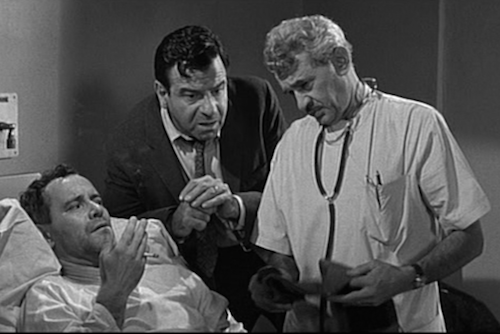
Of course I’ve been dying to see The Fortune Cookie (1966). Who wouldn’t want to view the first pairing of Jack Lemmon and Walter Matthau, the two whose seamless chemistry led to almost 30 years of hilarious cinematic repartee?

Matthau won his only (!) Oscar for the role of Willie Gingrich, an ambulance chaser who capitalizes when his brother-in-law, sports cameraman Harry Hinkle (Lemmon), gets injured by a football star running a play. Look at the people Gingrich can sue! The TV station! the Cleveland Browns! Of course, Hinkle was barely hurt, but an old injury might appear new, and thus enriching. If only Gingrich can get his brother-in-law to go along, he’ll be a millionaire! Of course, there are obstacles: his brother-in-law’s stupid scruples, for example, are holding up the path to gold.
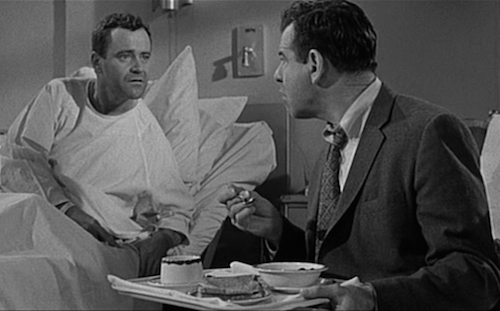

Luckily, Gingrich has an ace up his sleeve: Hinkle never got over his ex-wife, Sandy (Judi West), and she’s an anxious for the dough as Gingrich is.

Gingrich is a magical character, a monstrous anti-hero whose avarice is fascinating to witness. He’s Saul Goodman with an even darker sense of humor. I particularly love when he calls Sandy, saying he’s glad to have her as part of the “organization” conning the Browns (not to mention fooling her ex with fake affection). His children interrupt the call, prompting Gingrich to yell out (with a straight face), “Why don’t you kids go play on the freeway?”

Gingrich’s reaction to love getting in the way of profit is typical of him:
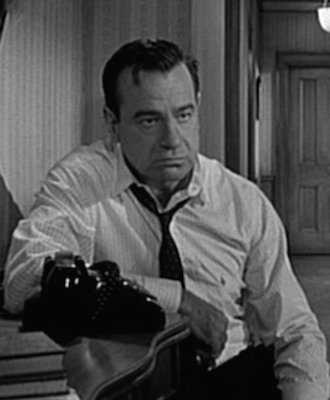

His hope to avoid his kids is displayed from the start of the film; his face dims when they’re present, but glows when opportunity arises. He’s only animated when they skate away:
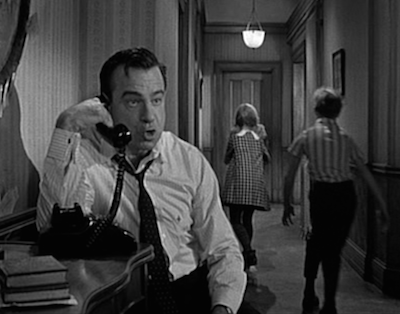

With Gingrich on the screen, you can’t look away, and he’s in nearly every scene. Why he was considered “supporting” and Lemmon the star is one of those mysteries of Oscar nominations no one outside of the industry ever understands.

In terms of plot, not much else happens. Hinkle agrees to fake a grave injury to win back his wife, who pretends better motives for her return in order to get at the money. ‘Boom Boom’ Jackson (Ron Rich), the player who hit Hinkle, slowly falls to pieces about what he thinks he’s done, to Gingrich’s delight (verisimilitude!) and Hinkle’s growing horror. What happens by the end of the movie, most viewers could predict, but given that Billy Wilder is the director and cowriter (with I.A.L. Diamond), there are wonderful twists along the way.

What’s notable about Lemmon’s performance is its generosity. Lemmon can play, often did play, a ham. His first Oscar, over a decade before, was for his scene-stealing, exuberant character in Mister Roberts. Yet here he is, ceding every scene to Matthau, and letting the latter’s role glitter just enough for his supporting Oscar. A less confident, thoughtful, or serious actor would have made Hinkle showier. But not Lemmon. When Hinkle finally stands up to Gingrich, we do see the dam of the character’s (and Lemmon’s) restraint burst, but only briefly, and even then, the goofiness pales in comparison to Matthau’s darkly funny turn as Gingrich. And as we all know, Lemmon only pales when he feels like it. Hinkle’s character is a subdued, passive one, and Lemmon never forgets it.

When I decided to join the Lemmon blogathon hosted by Crítica Retrô and Wide Screen World, I wondered which Lemmon I would see in The Fortune Cookie: the desperate and dark type he captures in Glenglarry Glen Ross, but this time played for humor? The sarcasm he spins in The Out of Towners? The nearly shrill silliness of his role in Some Like It Hot? How many actors has Lemmon been, just as a comedian?

Given how fun his banter typically is with Matthau, I expected to see the two out-goofing one another here. But I find it charming to discover something else: a realism to their dynamic, a sort of half-tolerant contempt that rings true for two characters joined by a marriage rather than by love or blood. A willingness (in real life) for one artist to help out another—in this case, Lemmon aiding Matthau with his one and only Oscar win. Their dynamic is definitely less fun than at the height of their powers in the wonderful Grumpy Old Men. Yet there’s something sublimely sweet about where it all started, and–though I didn’t think it possible–that makes me love Lemmon all the more.

For wonderful tributes and analyses of Lemmon’s work, check out the Jack Lemmon blogathon hosted by Le at Crítica Retrô and Rich of Wide Screen World.

Share
Posted in: 1960s films, Blogathons, Comedies (film) Tagged: ambulance chaser movie, Billy Wilder, characters like Saul Goodman, first film with Matthau and Lemmon, Jack Lemmon, review, The Fortune Cookie (1966), Walter Matthau

Airplane!: The Joy of Recognizing Classic Movie References

03/11/2017 by leah@carygrantwonteatyou.com 2 Comments

**Spoilers about George Gipp ahead**

The other day I was watching Airplane! with some friends. For the first time, I caught that the film includes a hilarious spoof of Knute Rockne’s “Win One for the Gipper” speech, that speech leaders of underdogs everywhere like to imitate. Popularized by Knute Rockne-All American (1940), the speech was given by the famous Notre Dame football coach when his team was losing against Army in 1928. In the speech he references his former player, George Gipp, the National Football Hall of Famer who died tragically in his mid-twenties. Pat O’Brien plays Rockne beautifully in the movie, capturing some of the cadence of his words, and using understated sadness where another would have gone for drama. Eight years after his famous player’s death, Rockne discusses Gipp’s last words with his losing team (in real life, and in the film):

“I’m going to tell you something I’ve kept to myself for years,” says Rockne (O’Brien). “None of you ever knew George Gipp (Ronald Reagan). It was long before your time. But you know what a tradition he is at Notre Dame… And the last thing he said to me: ‘Rock,’ he said ‘sometime, when the team is up against it — and the breaks are beating the boys — tell them to go out there with all they got and win just one for the Gipper…’ I don’t know where I’ll be then, Rock,’ he said – ‘but I’ll know about it – and I’ll be happy.'”

Of course, the team wins, and history is made.

Ronald Reagan’s deathbed scene in the film, of course, meant he was associated with the name George Gipp, as different as they were. Gipp, phenomenally talented as a football player, was very modest about his accomplishments. He was an interesting man, too: actually preferred another sport, spent time gambling with out-of-towners who thought South Bend hicks could never beat them (afterward secretly giving his winnings to charity). Always, Gipp displayed an allergy to limelight.

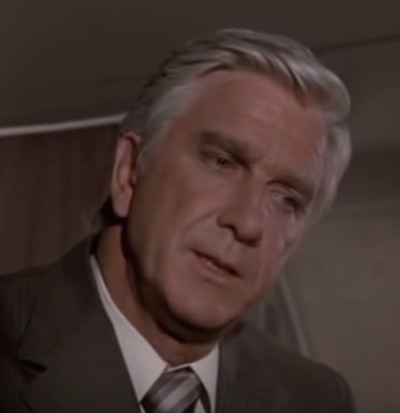
Once I learned Gipp’s true story, I became horrified that Reagan’s presidency had turned Gipp’s legacy into a promotion campaign. Of course, Airplane! (1980) would capitalize on the humor of this discrepancy. The movie came out before Ronald Reagan’s first White House term, but the politician had made two runs for the Republican nomination before getting it in 1980; there are digs on his acting in the film. And then the perfect parody: In a moment when Ted Striker (Robert Hays) is despairing about his poor chances of landing the plane, with death certain for all if he doesn’t, in comes Dr. Rumack-Don’t-Call-Me-Shirley (Leslie Nielsen) to give Striker a hilarious pep talk. Almost word for word, it’s Rockne’s speech. Nielsen even captures the coach’s understated style. To give a football speech in such a moment is very tacky–in even more ways that most viewers might suspect: Rockne died in a plane crash. Screenwriters Jim Abrahams, David Zucker, and Jerry Zucker capture inappropriate uses of Gipp’s name and of his coach’s tribute by using both inappropriately in their own film.

But I wasn’t thinking of any of those details as I watched. What I felt was a thrill, that delightful shock of recognition every classic film fan feels when she sees or hears a reference to an old favorite. And I didn’t think it was possible, but Airplane! is even funnier than I thought. How marvelous.

Share
Posted in: 1940s films, 1980s films, Action & Sports Films, Comedies (film), Drama (film), Humor, TV & Pop Culture Tagged: Airplane!, Film, George Gipp, Knute Rockne, Knute Rockne: All American, Leslie Nielsen, review, Ronald Reagan, Win One for the Gipper

Sexy Con Man: John Garfield

03/05/2017 by leah@carygrantwonteatyou.com 14 Comments


Even my classic-movie-hating sister, who is seldom willing to admit ANYTHING positive about my beloved black and whites, had to admit, there’s just something about John Garfield. Some sensuality, magnetism that escalates him far beyond his seemingly average looks. I mean, if the guy were standing still, I’d maybe compare him to Matt Damon: ordinary enough to slip from notice (as a man playing a superspy should be). But Garfield rarely stays still. And once he moves, his look intensifies, his fluid athleticism kicks into gear, and all that ordinariness is gone: this guy is crazy hot.

I realize his looks are far from the best thing about Garfield. This superb actor is among my favorites, can make me root even for the often disreputable characters he so thoroughly inhabits and humanizes. But it’s undeniable that if a guy plays a con man who can get any woman, he needs to either have Cary Grant’s looks, or be a guy like John Garfield, whose intensity and confidence make you ignore every other man, woman, dog, cat, and chair in the room.

Take Nobody Lives Forever (1946). When Nick approaches his mark, Gladys (Geraldine Fitzgerald), you feel a kind of pity, even though Nick is the hero: she doesn’t stand a chance. We know from the script she’s a lonely and bored widow. Her financial manager is giving her an unutterably boring description of his golf game. Here’s her expression before Nick arrives:


Nick approaches, and the effort not to swoon–how does she manage it? Notice the intensity of this expression:


And here’s how she looks after five minutes with him:


He walks away, and the formerly abstaining Gladys orders a brandy.

**some spoilers–but not how it all ends**

In most films, it’s hard not to despise the mark. Even if he/she is sweet, the level of stupidity is so pronounced you root for the con artist, as the screenwriter wants you to do. The fact that you’d never feel that way in real life is irrelevant: for the space of an hour or two, you’re all for cleverness over heart. Nobody Lives Forever is that rare film that makes you respect both con artist and mark because there’s a kind of maturity and world-weariness to Gladys, despite her blindness to Nick’s motives; clearly, her former husband’s long illness has taken away some of her illusions.

Nick’s recent war experience makes his change of heart believable, and her desire for him, even when she discovers his true character, seems not the reaction of a sap but of a woman who has had enough experience not to expect perfection in her man. Part of that is the role; part of that is Fitzgerald’s convincing performance. But most of it is Garfield. I mean, how the hell do you say goodbye to that man? Clearly, Gladys is not ready to; just check out that grip:


Since this is noir, of course, we don’t know how it’s all going to end. Nick has two frightening foes in his ex and a shaky co-conspirator. The ending is suspenseful, and involves large doses of Nick’s friend, Pop (the wonderful Walter Brennan), so I obviously won’t spoil it for you.

I will say as a huge fan of con artist movies that any cleverness is utterly absent. Nick makes up a career that would be so easy to disprove, with little effort to give it substance. There’s no satisfaction for my Ocean 11’s-, The Sting-loving gene, no big reveal or sleight of hand. But there is some of that sweetness I’ve come to love in Leverage, and like that highly satisfying TV show, the film gives us the toll such a life takes on its players (especially since these grifters aren’t the do-gooders of that small-screen team). Overall, I had a mixed reaction to the film as a story. But as a vehicle for Garfield, it’s wonderful. He’s so believable in the role, so intense and mesmerizing. And as always, so sexy.

This post is part of Phyllis Love’s Classic Movies’s John Garfield: The Original Rebel blogathon. Check out the wonderful entries!

Share
Posted in: 1940s films, Blogathons, Film Noir/Crime/Thriller & Mystery, Uncategorized Tagged: classic con movies, con artist films, Geraldine Fitzgerald, grifter falls for mark film, John Garfield, Leverage TV, Nobody Lives Forever, Ocean's 11, sexy leading men

Recent Posts

  • 100 Years Later, Still Scary: Dr. Caligari
  • Escaping Out of the Past (1947)
  • A Weeper for Those Who Love Jerks
  • Thank You, Academy, for Not Infuriating Me
  • Challengers (2024) Is a Bad Movie

Subscribe to Blog via Email

Enter your email address to subscribe to this blog and receive notifications of new posts by email.

Categories

  • 1920s films
  • 1930s films
  • 1940s films
  • 1950s films
  • 1960s films
  • 1970s films
  • 1980s films
  • 1990-current films
  • 2020s films
  • Action & Sports Films
  • Anti-Romance films
  • Blogathons
  • Childfree
  • Comedies (film)
  • Drama (film)
  • Feminism
  • Femme fatales
  • Film Noir/Crime/Thriller & Mystery
  • Gloriously Silly Scenes
  • Horror
  • Humor
  • Mae West Moments
  • Musicals and dancing films
  • Oscars
  • Random
  • Romance (films)
  • Romantic Comedies (film)
  • The Moment I Fell for
  • Turn My Sister into Classic Movie Fan
  • TV & Pop Culture
  • Uncategorized
Share
Classic Movie Blog Hub Member

Recent Comments

  • leah@carygrantwonteatyou.com on Meg Ryan’s Fate Foretold in Joe Versus the Volcano
  • Ryan on Meg Ryan’s Fate Foretold in Joe Versus the Volcano
  • leah@carygrantwonteatyou.com on 100 Years Later, Still Scary: Dr. Caligari
  • The Classic Movie Muse on 100 Years Later, Still Scary: Dr. Caligari
  • leah@carygrantwonteatyou.com on 100 Years Later, Still Scary: Dr. Caligari

Archives

  • November 2025
  • September 2025
  • May 2025
  • March 2025
  • January 2025
  • November 2024
  • August 2024
  • July 2024
  • May 2024
  • March 2024
  • February 2024
  • December 2023
  • November 2023
  • October 2023
  • September 2023
  • August 2023
  • July 2023
  • May 2023
  • April 2023
  • March 2023
  • January 2023
  • December 2022
  • November 2022
  • September 2022
  • July 2022
  • May 2022
  • April 2022
  • March 2022
  • February 2022
  • October 2021
  • September 2021
  • April 2021
  • March 2021
  • February 2021
  • December 2020
  • October 2020
  • September 2020
  • July 2020
  • May 2020
  • April 2020
  • March 2020
  • February 2020
  • December 2019
  • October 2019
  • September 2019
  • June 2019
  • May 2019
  • April 2019
  • February 2019
  • January 2019
  • November 2018
  • September 2018
  • July 2018
  • June 2018
  • May 2018
  • April 2018
  • March 2018
  • February 2018
  • January 2018
  • November 2017
  • September 2017
  • August 2017
  • July 2017
  • June 2017
  • May 2017
  • April 2017
  • March 2017
  • February 2017
  • January 2017
  • December 2016
  • November 2016
  • October 2016
  • August 2016
  • July 2016
  • June 2016
  • May 2016
  • April 2016
  • March 2016
  • February 2016
  • January 2016
  • December 2015
  • November 2015
  • October 2015
  • September 2015
  • August 2015
  • July 2015
  • June 2015
  • May 2015
  • April 2015
  • March 2015
  • February 2015
  • January 2015
  • December 2014
  • November 2014
  • October 2014
  • September 2014
  • August 2014
  • July 2014
  • June 2014
  • May 2014
  • April 2014
  • March 2014
  • February 2014
  • January 2014

Meta

  • Log in
  • Entries feed
  • Comments feed
  • WordPress.org

Copyright © 2025 Cary Grant Won't Eat You.

Church WordPress Theme by themehall.com