Cary Grant Won't Eat You

Classic movies for phobics

  • About
  • eBooks
  • Previous Blogathons
Classic movies for phobics

Month: December 2016

The Odd Stew of Designing Woman
12/16/2016 by leah@carygrantwonteatyou.com 14 Comments


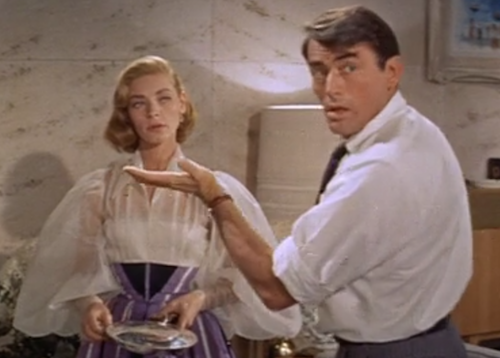
It’s surprising the screenplay for Designing Woman (1957) won George Wells an Oscar, given its strange stew of marital conflict, mob threats, brain damage, fashion, and acrobatic fight moves. But there is a cleverness to it, and some insights about marriage one doesn’t usually get in a comedy. So while not exactly an amazingly tasty stew, it’s curious enough in flavor to keep you watching, and the fourth-wall-breaking format leads to moments of humor throughout, especially through the thoughts of the ex-girlfriend.

Of course, being a fan of complex heroines, I hoped Designing Woman would have a double meaning, that Lauren Bacall’s fashion designer bride had sneaky moves up her perfectly tailored sleeves. Alas, no such luck. Marilla (Bacall) is a sophisticated businesswoman, but traditional when it comes to her sports reporter husband, Mike (Gregory Peck). The two have married after a very short affair, and much of the story hinges around his utterly unnecessary concealment of a former flame, Lori (Dolores Gray), and Marilla’s anxiety about it. The couple is so prickly over this conflict that they endanger Mike’s life as he hides from the mob. (Mike, it seems, is more truthful in reporting than in life, and has ticked off a boxing fixer with mob ties.)

So here are my thoughts on the memorable moments of this Vincente Minnelli-helmed comedy: the flavorful additions, the questionable spices, the discordant ingredient that nearly destroys the whole, and a wonderful final pinch of flavor.

The Flavorful Moments
Confession to the Ex
Mike’s former girlfriend, Lori (Dolores Gray), adds wonderful comedy to the plot, which has gotten a little too sweet in the opening meet-cute aftermath. Mike keeps not getting around to breaking his marriage to her, and she, sharing her reflections with us, reveals, “He was so pathetic I had to help him out.” She generously delivers the breakup news, and then adds a jab he completely misses: “I’d have probably done the same thing myself if I’d found the right man.”

After she relieves him from hurting her feelings, she observes him to be as “grateful as a Saint Bernard.” Her initial euphoria over her own maturity and strength soon dissolves: “But then I made a mistake. I asked him to tell me about her, and he made a bigger mistake, he told me.”
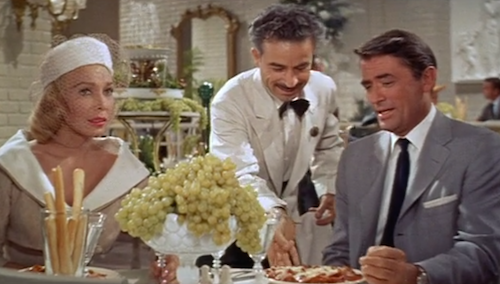

Rolling her eyes, she listens: “I heard all about her eyes, and her hair and her figure….I heard all about her fine sense of humor, and her clothes, and the cute way she had of tilting her head when she laughed….After a while I knew her like a sister.” And of course, she gets a thoroughly justified revenge with a strategic placement of his ravioli plate.

Party Scenes
The movie highlights the divisions between this high-class business leader and her working-class husband in various ways, most successfully with their apartments: his small and messy; hers refined, large, and including what he calls an “outside flunky.” Before he’s had time to look around his new place, all her friends arrive and rush her, barely registering his presence as he tries to excuse the embarrassingly short pants he’s wearing (his own being smeared with ravioli). Even when he leaves the room to change and returns, her distracted friends ignore him. And she is oblivious to his annoyance and embarrassment as she dons and then leaves behind his handsome form. The scene is perfectly orchestrated to reveal his disconnection and loneliness, and the way she’s suddenly made him feel alienated and extraneous in his own home and marriage.

In the aftermath, she’s dismissive of her career to soothe his ego, the embodiment of a bride worried about losing her new man. Luckily, she’s humbled herself enough to ease his insecurity (sigh, at least she doesn’t give up the career). The later party scene, with her rehearsal and his poker game colliding, is so cacophonous it’s actually hard to watch, but perfectly captures just how unalike their work lives are. Both of them are occasionally petty and jealous as they try to navigate in one another’s worlds, and yet come back together through their feelings for one another. The movie never suggests this union will be easy, and there’s something refreshing about that, and–unlike many romantic comedies–very honest.

The Fight Scene
The hilarious antics of the final fight scene make for good comedy. It’s well orchestrated, especially a brilliant final touch (see below). In a favorite moment, Mike observes that his wife doesn’t know how to help, as she can’t identify who is on Mike’s side, and who is not. I loved this reflection, as it echoes my reaction to every bad action sequence I’ve seen in the past decade. I so often can’t tell characters apart once the fists or legs start flying.

The Rotten
I don’t expect PC treatment of subject matter in my 50s films, but usually, I can cringe a bit at unfortunate touches and move on. Unfortunately, much of the comedy of Designing Woman hinges around making fun of a former boxer’s brain damage. Yes, you read that correctly. Maxie (Mickey Shaughnessy) is tasked with protecting Mike from the mob, but can never quite figure out what town he’s in, or what it is he’s supposed to do. Mike is by turns exasperated with him and condescending toward him. Marilla’s not much better, and sometimes worse. Mickey Shaughnessy’s performance is, unfortunately, often convincing, making his character’s brain damage poignant when the actor’s going for funny. The only way to enjoy this comedy is to block out whenever he’s on the screen, which is often.

The Brilliant Final Touch
Early in the film, in a typical bro kind of way, Mike objects to the effeminate dancing style of Marilla’s friend and colleague, musical director Randy (Jack Cole). You can just hear the homophobic chains in Mike’s mind churning as he watches those fluid, flamboyant movements, even before he imitates him to Marilla. But when the mob is beating up Mike and his friends, Randy appears and starts taking out half of them with his dance moves. I haven’t seen dance fighting this fun since Kevin Bacon’s in Footloose.

https://carygrantwonteatyou.com/wp-content/uploads/2016/12/DesigningWomanClips.mp4

It’s in this moment of brilliance that you know Minnelli’s at the helm, and you’re so glad. I only wish we’d  seen more such flourishes of his style because I could watch that clip over and over again. There, as elsewhere, I was more interested in the musical Marilla was designing for, than the marriage she was trying to save. The problem is, I think Minnelli was too. Luckily, there’s enough of the lovely costumes (and how Bacall wears them), enough of the self-absorption of those running the musical (who find the mob fight merely distracting) to intrigue and entertain. And of course, you can always rewatch Randy….

Hope you’ll enjoy the many other contributions to this Minnelli blogathon hosted by the marvelous Michaela of Love Letters to Old Hollywood.

Share
Posted in: 1950s films, Comedies (film), Musicals and dancing films, Romantic Comedies (film) Tagged: Designing Woman, Gregory Peck, Lauren Bacall, review, Vincente Minnelli films

Goin’ to Town: Feel-Good Classic

12/10/2016 by leah@carygrantwonteatyou.com Leave a Comment


How do you explain the joy of Mae West after a long hiatus? I’ve saved Goin’ to Town for a rough day, and it had the hoped-for effect. I may not get everything in my life right, but I have an instinct for good medicine: Mae had me grinning within seconds.

Cleo (West) first appears in an embrace with a guy we know isn’t the boyfriend obsessed with her. She’s, of course, some kind of dance hall singer. We see the boyfriend asking for her, and then the film cuts to the guy she’s kissing:

Lover: “Now I’d like to take you away from all this.”

Cleo: “All this? Oh, I get you. Yeah, for a long time I was ashamed of the way I live.”

Lover: “You mean to say you reformed?”

Cleo: “No, I got over bein’ ashamed.”

(Spoilers) West wasn’t exactly a fan of realistic plots, but this one is a doozy: Cleo’s boyfriend has promised her an oil ranch after they marry, and seemingly within minutes is dead, and the ranch hers. (“Well, that’ll help pay for my feelings.”) She falls for a British high-class type who runs her oil fields, and shoots off his hat and lassoes him to express her attraction (her definition of “coaxing”). He doesn’t think she’s classy enough, so she heads to Buenos Aires to buy her way into society and impress this snob.

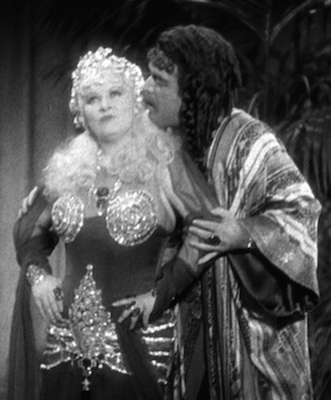
Entrée into society, in West’s world, includes winning a horse race and performing as an unlikely soprano in a Samson and Delilah opera. Her outfit in the latter, with sequins highlighting breasts and hips, is hilariously provocative, seeming to confirm her scandalous background rather than winning respect from the elite.


The elite, of course, are so worthless in this film—including her boring object of desire, Edward Carrington (Paul Cavanagh)—that Cleo’s fight for status, even going so far as a marriage of convenience to well-born Fletcher Colton (Monroe Owsley), makes little sense. Of course, even in this conventional, post-Code desire to set aside a colorful past, West subverts the screenplay formula: Cleo’s utterly unashamed of hers:

Socialite: “Speaking of relatives, Mrs. Colton, have your ancestors ever been traced?

Cleo: “Well, yes, but they were too smart, they couldn’t catch ’em.”

Critics, both West’s contemporaries and ours, attack the film’s silliness, her toned-down innuendos, the reduced number of her beaus. It’s not West at her peak, they say. Low on the list of West films, they report. Something’s lost, they carp. You know what? Get over it. The film’s fun, and her victorious final song a riot. While West’s magic in She Done Him Wrong might be enough to fuel a steam engine, I’ll take enough to fuel a car. It’s still West. It’s still entertaining. The plot moves at a crazy clip, so just when you fear a sad/dramatic plot twist is going to overtake the action, poof! It’s gone. And in the meantime, you get enough of her slow stroll, enough hilarious comments, and enough silliness to break through a day’s doldrums, and make  you smile again.

Share
Posted in: 1930s films, Comedies (film), Feminism, Mae West Moments Tagged: comedies, feel-good movie, Goin' to Town, Mae West, review

Recent Posts

  • 100 Years Later, Still Scary: Dr. Caligari
  • Escaping Out of the Past (1947)
  • A Weeper for Those Who Love Jerks
  • Thank You, Academy, for Not Infuriating Me
  • Challengers (2024) Is a Bad Movie

Subscribe to Blog via Email

Enter your email address to subscribe to this blog and receive notifications of new posts by email.

Categories

  • 1920s films
  • 1930s films
  • 1940s films
  • 1950s films
  • 1960s films
  • 1970s films
  • 1980s films
  • 1990-current films
  • 2020s films
  • Action & Sports Films
  • Anti-Romance films
  • Blogathons
  • Childfree
  • Comedies (film)
  • Drama (film)
  • Feminism
  • Femme fatales
  • Film Noir/Crime/Thriller & Mystery
  • Gloriously Silly Scenes
  • Horror
  • Humor
  • Mae West Moments
  • Musicals and dancing films
  • Oscars
  • Random
  • Romance (films)
  • Romantic Comedies (film)
  • The Moment I Fell for
  • Turn My Sister into Classic Movie Fan
  • TV & Pop Culture
  • Uncategorized
Share
Classic Movie Blog Hub Member

Recent Comments

  • leah@carygrantwonteatyou.com on Meg Ryan’s Fate Foretold in Joe Versus the Volcano
  • Ryan on Meg Ryan’s Fate Foretold in Joe Versus the Volcano
  • leah@carygrantwonteatyou.com on 100 Years Later, Still Scary: Dr. Caligari
  • The Classic Movie Muse on 100 Years Later, Still Scary: Dr. Caligari
  • leah@carygrantwonteatyou.com on 100 Years Later, Still Scary: Dr. Caligari

Archives

  • November 2025
  • September 2025
  • May 2025
  • March 2025
  • January 2025
  • November 2024
  • August 2024
  • July 2024
  • May 2024
  • March 2024
  • February 2024
  • December 2023
  • November 2023
  • October 2023
  • September 2023
  • August 2023
  • July 2023
  • May 2023
  • April 2023
  • March 2023
  • January 2023
  • December 2022
  • November 2022
  • September 2022
  • July 2022
  • May 2022
  • April 2022
  • March 2022
  • February 2022
  • October 2021
  • September 2021
  • April 2021
  • March 2021
  • February 2021
  • December 2020
  • October 2020
  • September 2020
  • July 2020
  • May 2020
  • April 2020
  • March 2020
  • February 2020
  • December 2019
  • October 2019
  • September 2019
  • June 2019
  • May 2019
  • April 2019
  • February 2019
  • January 2019
  • November 2018
  • September 2018
  • July 2018
  • June 2018
  • May 2018
  • April 2018
  • March 2018
  • February 2018
  • January 2018
  • November 2017
  • September 2017
  • August 2017
  • July 2017
  • June 2017
  • May 2017
  • April 2017
  • March 2017
  • February 2017
  • January 2017
  • December 2016
  • November 2016
  • October 2016
  • August 2016
  • July 2016
  • June 2016
  • May 2016
  • April 2016
  • March 2016
  • February 2016
  • January 2016
  • December 2015
  • November 2015
  • October 2015
  • September 2015
  • August 2015
  • July 2015
  • June 2015
  • May 2015
  • April 2015
  • March 2015
  • February 2015
  • January 2015
  • December 2014
  • November 2014
  • October 2014
  • September 2014
  • August 2014
  • July 2014
  • June 2014
  • May 2014
  • April 2014
  • March 2014
  • February 2014
  • January 2014

Meta

  • Log in
  • Entries feed
  • Comments feed
  • WordPress.org

Copyright © 2025 Cary Grant Won't Eat You.

Church WordPress Theme by themehall.com