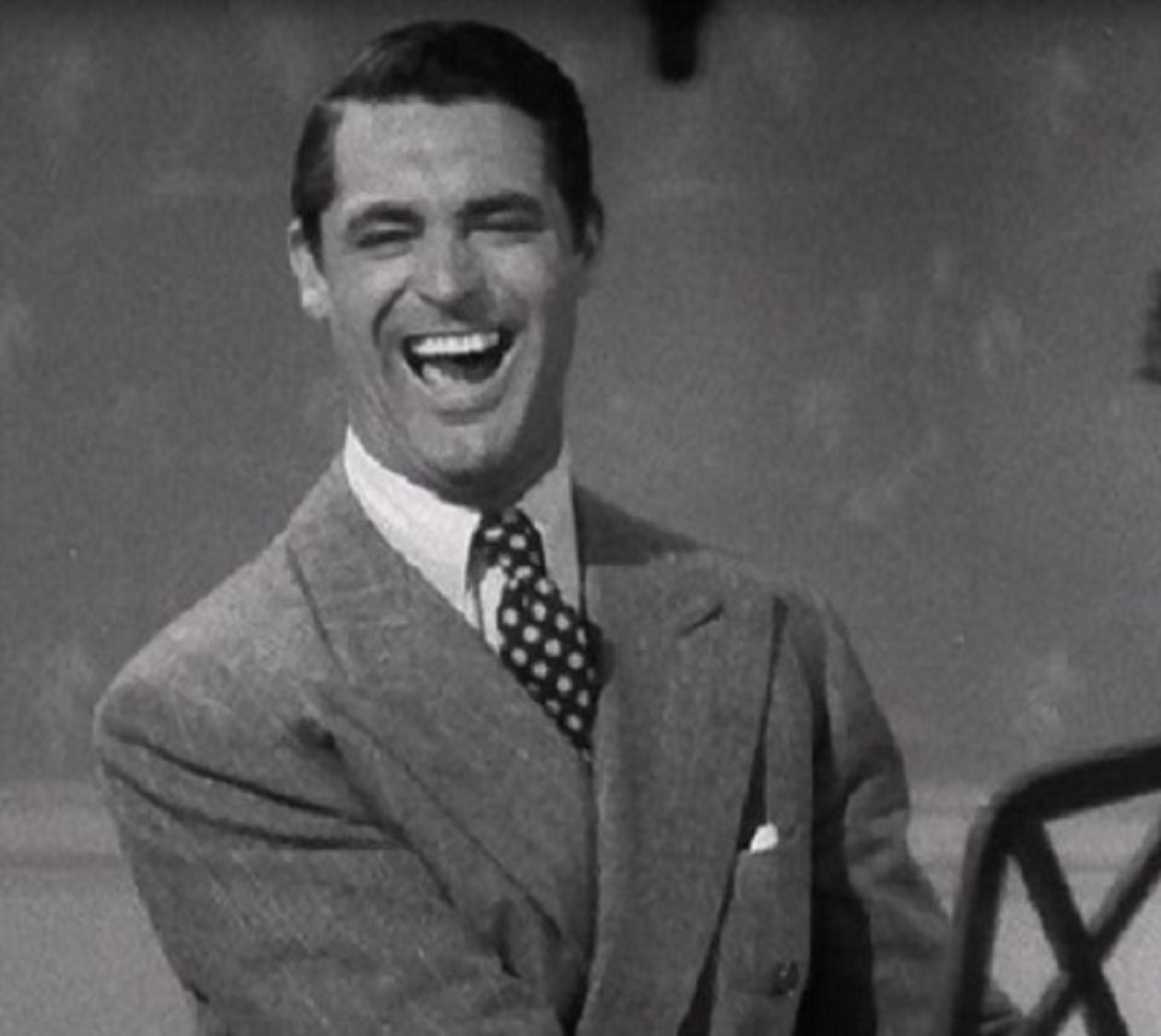
Cary Grant Won't Eat You

Classic movies for phobics

  • About
  • eBooks
  • Previous Blogathons
Classic movies for phobics

Month: May 2015

The Man Who Knew Too Little: an Underrated Bill Murray Gem
05/28/2015 by leah@carygrantwonteatyou.com 2 Comments

ManWhoKnewTooLittleMurray
The Man Who Knew Too Little (1997) received a 41% on Rotten Tomatoes. It was panned by critics as only moderately funny. Experts claimed it was undeserving of the talents of Bill Murray, relied on broad stereotypes, and centered around only one gag.

Most of these critiques are true. But the film is also hilarious.

To describe the movie as a parody of The Man Who Knew Too Much (the 1934 or ’56 version) would be a stretch. Call it instead a Hitchcockian parody, and you’ll have it. Hitchcock asked us all what becomes of a civilian when mistaken for a spy (North by Northwest), or thrown into a conspiracy once in contact with one (The Man Who Knew Too Much/The 39 Steps)? Director Jon Amiel and writer Robert Farrar extend the question: “and he is totally oblivious to what’s going on?”
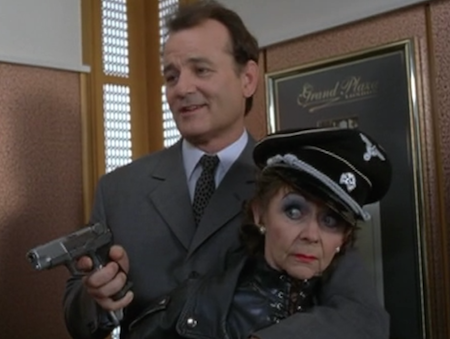
A suspected spy arrives in London

A suspected spy arrives in London

Here’s the tissue-thin plot: Blockbuster employee Wallace Ritchie (Murray) shows up for a surprise visit to London. His brother (Peter Gallagher) sends him to a participant theater act called the Theatre of Life until after his business dinner. Ritchie answers the pay phone call that’s supposed to begin the show. But the call that comes in (a few minutes early) isn’t from the theater, but from the employers of Spencer, a hit man tasked with killing the defense minister’s mistress, Lori (Joanne Whalley). She knows too much about a conspiracy plot to reignite the Cold War and is blackmailing the minister with incriminating letters. Thus begins Ritchie’s confusion: he thinks he’s acting; the bad guys–and Lori–suspect he’s a spy undermining their plans.

Because there is essentially no storyline, Murray is let loose to be the playful, odd guy he seems to be in real life, at least according to encounters with strangers in clubs and in cabs. In fact, I’d argue that in some ways this film is more typical of Murray’s personality than any other: the man knows how to improv his way through life.

As Ritchie, Murray has a blast ripping on a number of tough guy acts–most notably, Clint Eastwood’s. Of course, he mimics “Here’s Johnny” from The Shining. He pauses before saving Lori to put on his sunglasses. He asks for retakes, explains his life of espionage to cops, applauds a corpse for the realism of his acting.

Impressed with a corpse's acting

Impressed with a dead killer’s supposed acting

In a favorite moment, Ritchie creeps out some muggers by sobbing, “I got a couple of kids,” and then, embarrassed by his poor performance, abruptly trying another approach: “You know it’s getting so that decent people can’t even go out on the street anymore without scum like you trying to step on whatever’s decent in this world. Well you know something? Your type are just gonna be the kind of crap that sticks to the bottom of a good man’s loafer.”
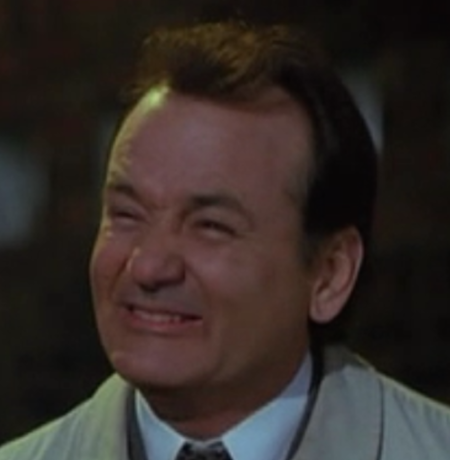
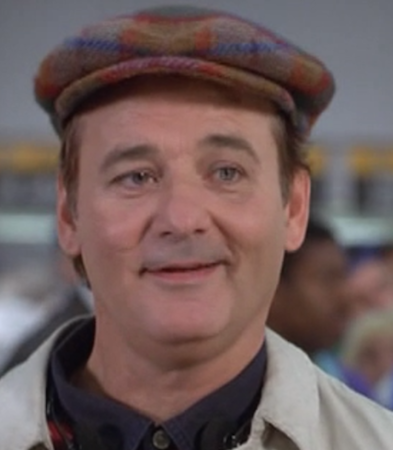
Murray faux-beseeching

Murray faux-beseeching

Imagine Murray’s fake crying (pictured above) and his enunciation of “a good man’s loafer,” and you’ll have a hint of just how hysterical this film can be.

The extent to which Ritchie remains deluded stretches belief, of course: he never catches on. But who is looking for realism in an unapologetically silly comedy? And, if we’re being honest, how plausible are Hitchcock spy stories and their ilk (Foul Play, Gotcha!, Frantic, The Tuxedo, etc.)? I think we can agree that all of us would live approximately 5 seconds if mistaken for a spy or harboring the secrets of one, a likelihood this parody clearly asks us to consider.

And truthfully, the film could be about anything. What matters is this: Murray is in almost every scene, and an hour and a half of Murray goofing off is about the best mood elevator I can imagine. I watch this ludicrous flick when I’m blue, scared, angry–and I never stop enjoying it. The critics gave it a 41 percent on Rotten Tomatoes; the audience gave it a 70. As usual, the critics are missing out on the fun to be had here; don’t make the same mistake.

Share
Posted in: 1990-current films, Comedies (film), Film Noir/Crime/Thriller & Mystery, Humor, TV & Pop Culture Tagged: Bill Murray, The Man Who Knew Too Little

Could Silent Films Woo Non-Classic Movie Fans?

05/22/2015 by leah@carygrantwonteatyou.com 6 Comments

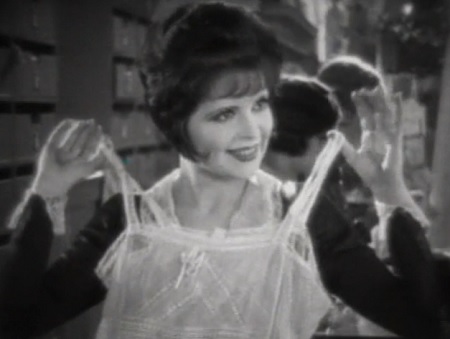
ClaraBow-It
I recently caught It at a theater with live music, and am still buzzing from it. I liked the film before. With live music, it was a revelation. The talented composer, Jeff Rapsis, used the term “moving picture” rather than film to discuss silents. This term and my exposure to multimedia this year have me thinking: Could silents reach otherwise classic movie-averse folks like my sister?

Could Silents Silence Typical Classic Film Objections?
Resistance to classic film, especially black and whites, comes in the form of comparison: The production values are better now. The acting is better now. Directors have learned from their predecessors, so why go back? We classic film enthusiasts may scoff at these claims, offering as Exhibit A Michael Bay, but the fact remains that the films of the 30s-50s and today are considered similar enough to be directly compared. Yet silent film is a different art form than the movies we know, with different restrictions, different demands. We can no more compare the two than we could stage and television productions.

My mother has been studying art, and keeps referring to the departure from representational art once photography advanced. Movies took the opposite route: moving from figurative (silent) to representational (today). There are exceptions, of course–Terrence Malick comes to mind. But just as we can’t compare Vermeer to Picasso, we can’t go point for point with Metropolis and Star Wars. Avoiding comparisons is crucial since we’re all guilty of using the worst example from the opponent’s camp (i.e., Bay), and the best from our own. With no comparisons, with fewer best-of lists, perhaps there can be less quickness to judgment.

Could Instagram Pave the Way to Silents?
For a culture obsessed with Instagram, silents seem a natural. Incredible concision? Check. A story delivered with visuals rather than sound/many words? Check. Silent film directors didn’t have the luxury of lengthy speeches; they had to distill emotion to a few gestures, drama to a few actions. What could be more compelling to our tweet-obsessed, quick-pic world? And as for our love for cat videos, also sans words, could a Buster Keaton action shot resemble a cat video more? The silliness, the athleticism, the grace–all without special effects? His DNA was clearly more feline than human.

Will Our Media-Savvy Youth Prove Less Resistant to Classics?
This year my students produced radio and visual essays for a creative nonfiction class. They were nervous about unfamiliar technology, just as we older folks are. But they were never resistant to other art forms, as we can be. When I showed them silent film sequences, they didn’t complain. They took ideas from them. When a guest speaker demonstrated his digital memoir, which included silent film clips, they expressed admiration. One student started adding black and white footage to his profile. Another used images of classic film stars primping and mooning to illustrate her preparations for a date. And lest you think they were budding film directors, I should point out that most were science majors.

Perhaps this flexibility bodes well for classic movie fans. When I entered the theater to watch It, I noticed an older audience, as expected. But back in the corner was a line of twenty-somethings, looking vaguely hipsterish and far too serious. Afterward, they were grinning, just like I was. Is it silly of me, to find this hopeful?

Of course, anyone watching a silent with live music would more fully appreciate the art form as it was meant to be experienced. (For those of you with sisters like mine, who rant about classic film sucking, see if you can find a silent with a composer. My husband, who dragged me to Transformers 2, agreed to a romantic comedy once he heard the details.)

But even in a room, on the computer screen, perhaps a silent can reach our resistant friends if a 30s or 40s masterpiece does not. It’s worth a try.

*For anyone interested, my bet with Rachel is ongoing. She’s using her new job, home, and move as excuses for the delay in her fulfillment of the deal. I will keep you posted on developments.

Share
Posted in: 1920s films, Turn My Sister into Classic Movie Fan, Uncategorized Tagged: Buster Keaton, cat, classic film haters, Instagram, silent films live

The Nerdiest Scene Ever: Encyclopedia Writers Trumping Gangsters in Ball of Fire

05/16/2015 by leah@carygrantwonteatyou.com 28 Comments

This post is part of the My Favorite Classic Movie Blogathon in celebration of National Classic Movie Day (May 16th). Click here to view the schedule listing all the great posts.

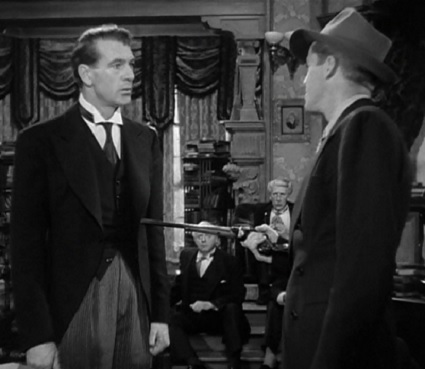
CoopervsDuryea
Nerd alert: I used to sit in the basement, reading my parents’ World Books for fun. I think it started with A Tale of Two Cities. A few hours into the encyclopedia set’s entries on The French Revolution, and Sydney Carton was forgotten.

Now, of course, my addiction is Wikipedia, despite my warning students away from it with Colbert. The other day I attended a Renaissance Faire featuring a pirate show (yes, I know how ridiculous that is), just after reading about Blackbeard in The Smithsonian. The combination led me on a Wikipedia binge on female pirates.

Thus it should be no surprise that a film about professors writing an encyclopedia (and their unexpected romantic interlude with a gangster’s moll) would thrill me. I’ve already explained why Ball of Fire should be viewed by all English majors. Today I’m advocating it for history buffs as well, particularly due to one scene starring the professors, two gangsters, The Sword of Damocles, and the mirrors of Archimedes.

**Spoiler alert.**

For those who’ve never seen the film, here’s the basic plot: Sugarpuss (Barbara Stanwyck), girlfriend to gangster Joe Lilac (Dana Andrews), hides out from the D.A. in the home of the encyclopedia writers, pretending she’s there to help with Professor Potts’s (Gary Cooper’s) entry on slang. Potts falls for and proposes to her, and she (to her great shock) falls for him too. But when her scheming is exposed, Potts lets her leave with Lilac, who needs her “I do” to prevent her from testifying about his crimes.

Sugarpuss knows she’s earned Potts’s disgust, but refuses to marry Lilac, instead explaining her love for the professor. She describes his poor kissing technique, his “giraffe” fashion, and other traits that have somehow inspired her love for him.

Sugarpuss-Stanwyck
“I’ll never see him again,” she tells Lilac, “but I’m not gonna marry you, not if you tie a ton of cement around my neck and throw me into the East River, like you did all the others.”

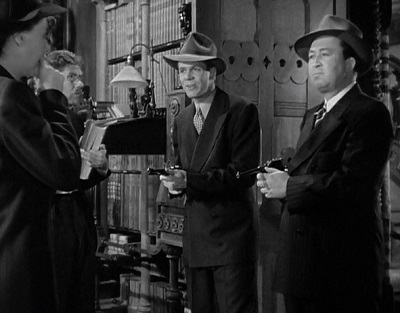
To force her, Lilac sends two of his henchmen, Pastrami (Dan Duryea) and Anderson (Ralph Peters), to take the professors hostage.

GangstersBallofFire
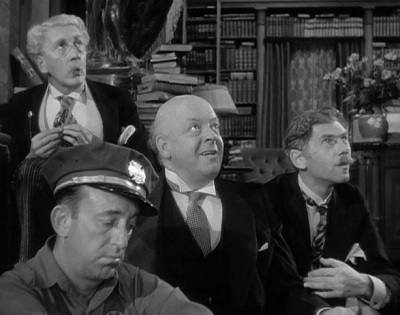
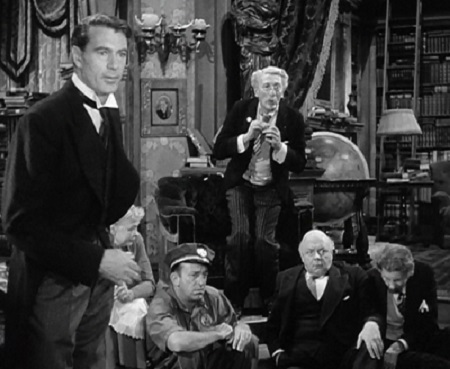
When Potts discovers how much Sugarpuss loves him, he wants to yodel he’s so happy. His fellow professors share in this enthusiasm, even holding down Pastrami’s gun. The gangster retorts,”Better look out, it’s gonna spit.”

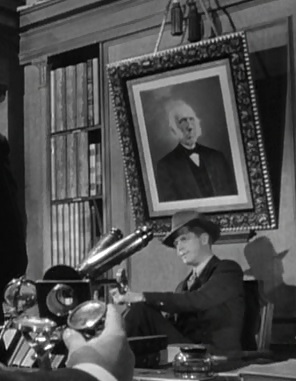
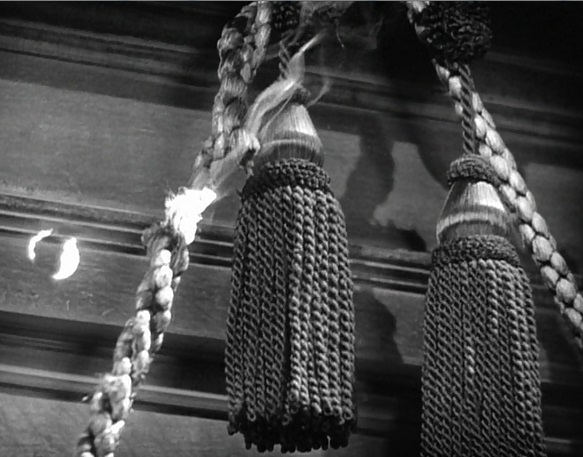
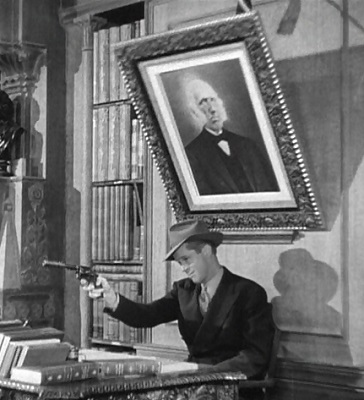
At this exciting juncture, their garbage man arrives with questions on a quiz, including one about the Sword of Damocles. Professor Jerome (Henry Travers–a.k.a., Clarence of It’s a Wonderful Life) explains the legend, realizing its pertinence to their situation: A sword is suspended above the head of Damocles by just a hair, just like the portrait above Pastrami.

SwordofDamoclesstrategy-BallofFire
Jerome’s quick-witted colleagues soon catch the reason for his storytelling. Suddenly, they have a strategy–and perhaps as importantly, hope.

ProfessorsSeeDamoclesBallofFire
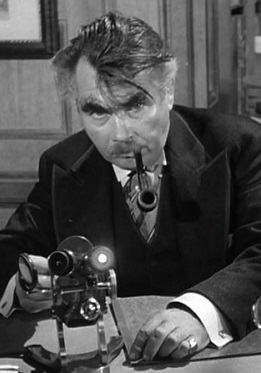
After Potts shares another story–Archimedes burning the Roman fleet with well-aimed mirrors–Professor Gurkakoff (Oscar Homolka) moves his microscope so that it’s catching the sunlight, and directs it at the rope above the portrait.

Oscar Homolka-BallofFire
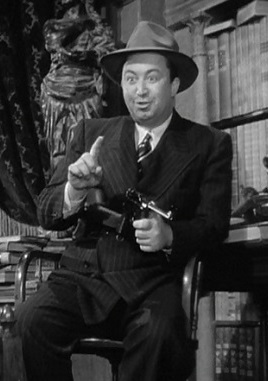
Potts then notices that Anderson is pitched precariously on a high chair.

Ralph Peters-BallofFire
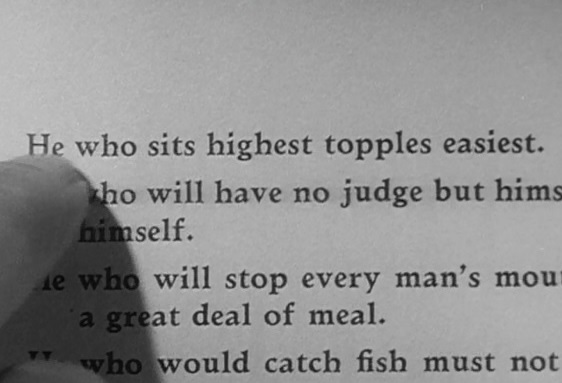
He therefore refers one of his colleagues to a passage that gives him a mission once Pastrami is handled.

Topples-BallofFire
The approach is working. Two of the professors have spotted a carpet they’re ready to pull to topple Anderson, and the fire is burning through the rope above the picture.

Reflectors-Archimedes-BallofFire
Now all the professors need to do is distract the criminals’ attention from the fire. Potts insults the gangsters in a pseudo-intellectual style, beginning a nonsensical speech with “Your inferiority is a question of the bony structure of your skulls.”

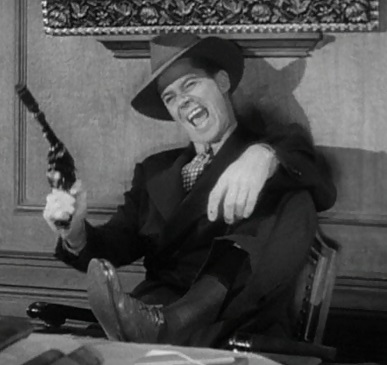
Anderson is unaware how truthfully he speaks when he complains, “This mixed-up talk is giving me a headache.” Pastrami argues that guns, not smarts, make the world go round, and proves it by shooting their globe.

Pastrami-Dan Duryea-BallofFire
While this gun play has the whole room worried, it’s Pastrami’s decision to leave his chair that leads to panic. Professor Oddly proposes that Pastrami shoot a dime out of his hand, but only if he returns to his seat. Realizing the risk he’s taking, poor Oddly switches to a quarter, then a 50-cent piece. The tension in the room has obviously reached quite a pitch.

ProfessorsFearful-BallofFire
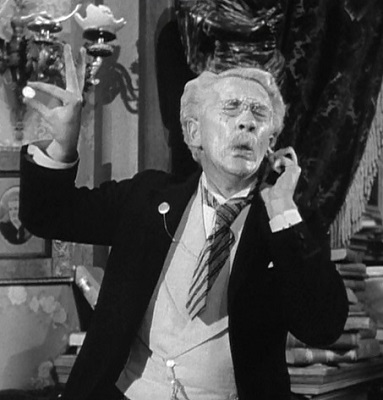
Oddly’s expression as he waits to lose his hand is priceless:

ProfOddlyRichardHaydn
Of course, Pastrami is knocked over first.

Portrait starts to fall.
And Anderson falls via the carpet move. Oddly faints–quite theatrically. And the professors rush off in a garbage truck to save Sugarpuss, with Potts studying boxing strategies to use against Lilac en route. With scenes as delightfully geeky and ridiculous as this one, it any wonder that this classic film remains my favorite?

Share
Posted in: 1940s films, Blogathons, Film Noir/Crime/Thriller & Mystery, Humor, Romantic Comedies (film) Tagged: Ball of Fire, Barbara Stanwyck, Colbert, enclopedia, films for English majors, films for history buffs, Gary Cooper

A Beauty After All: Katharine Hepburn

05/10/2015 by leah@carygrantwonteatyou.com 17 Comments

KatharineHepburn-beautyGoldenPond
This is an entry in the Great Katharine Hepburn blogathon. Check out the marvelous posts on her work.

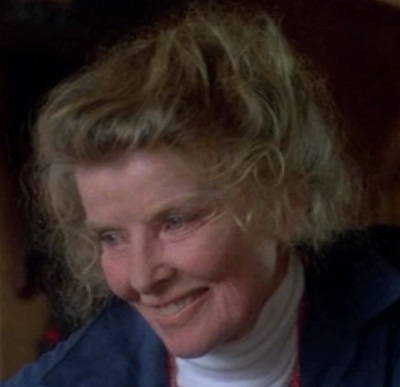
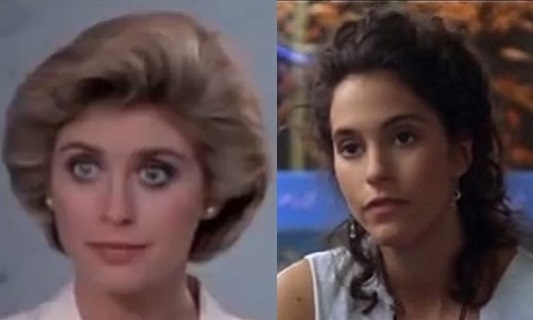
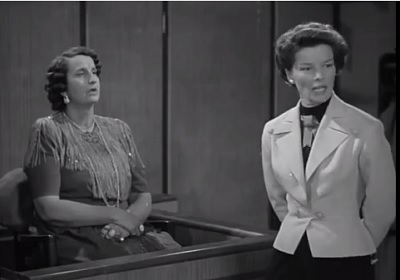
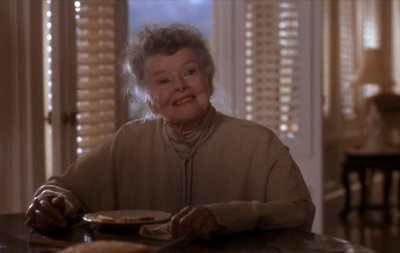
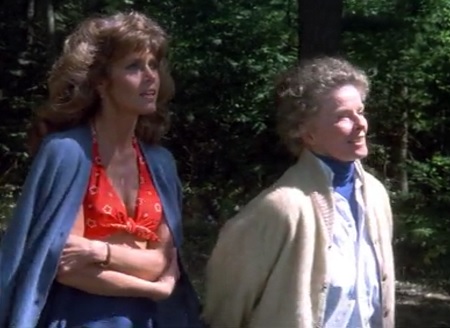
“I’d rather look like Katharine Hepburn at 80,” Aunt Betty said, looking at the screen, “than myself at 30.” I looked at the old lady on the TV, then back at my aunt, confused. Maybe Betty was ripping on her own looks, as she often did. She couldn’t possibly be serious. As a fourteen-year-old who longed to resemble Helen Slater or Jamie Gertz, I found wanting to look thirty incomprehensible. Eighty?

My teenage definition of beauty

My teenage definition of beauty

My aunt smiled at my bafflement. “Just look at that bone structure,” she explained, pointing at Hepburn. “She’s beautiful.”

Bone structure? That wasn’t on my list of attractive characteristics. I examined Hepburn’s face closely to discover what my aunt saw in it, but those wrinkles distracted me. I felt uneasy, as I always did when adults said something I couldn’t understand. I changed the subject.

I didn’t forget it though. Every time I saw Hepburn, the comment returned. She had always looked old to me. Having seen her first in Guess Who’s Coming to Dinner? I could never view her earlier films without seeing the imprint of her older self. Besides, Hepburn was angular, not soft and feminine, like Helen Slater or my earlier womanly ideal, Lynda Carter.

I wasn’t alone, of course, in devaluing Hepburn’s looks. Her employer David O. Selznick had been famous for it. Others, of course, appreciated that bone structure, hence that line about her cheekbones: “The greatest calcium deposits since the White Cliffs of Dover.”

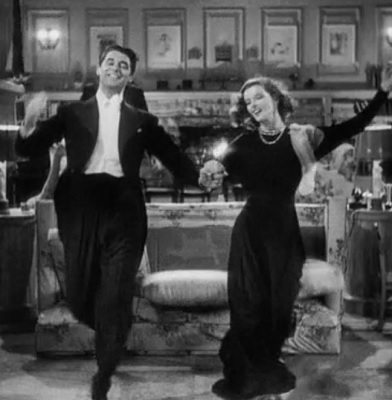
I think I was past thirty myself before I started to understand Betty’s words. Of course, my definition of beauty had expanded by then, but my changing assessment of the actress’s looks was always more complicated than answering pretty or not? First, I noticed Hepburn’s breathless confidence of movement.

GrantandHepburn-Holiday-a
Then there were the clothes that suited her, rather than following any passing fashions. And the parts she chose, roles that could inspire women like me, and like my aunt: athletes, business leaders, pioneers, advocates for women.

HepburnAdamsRib
She always imbued these characters with vulnerability as well as strength, helping viewers see powerful females as fully rounded human beings.

Hepburn’s real-life actions demonstrated the same moxie she expressed in film: fighting back after the box office poison label, establishing her own terms with The Philadelphia Story, and then using her new power to ensure good salaries for her Woman of the Year screenwriters.

In her private life, Hepburn managed to say what she wanted, avoid whom she wished, have a long-time affair with a married man without compromising her career. With her spirit, it’s not surprising that she continued to star as a romantic lead even in her forties.

Now I see in that erect posture of hers in her final years, those fierce expressions, her pride in a life well lived.

KatharineHepburn-LoveAffair
How many of us can follow our own standards consistently, passionately, for as many years as she did? No wonder my aunt found Katharine Hepburn so breathtaking at 80. I look at her later performances now, and see the same. Imprinted on Katharine’s Hepburn’s face, her carriage, and even her voice is the caliber of life she lived.

Look at her. Isn’t she beautiful?

KatharineHepburn-posturewFonda

Share
Posted in: 1930s films, 1940s films, 1950s films, 1980s films, Blogathons, Feminism, Humor, TV & Pop Culture Tagged: beautiful actresses, Katharine Hepburn, spirit

The Hottest Woman around in Her 40s: Mae West’s Age-Defying Career

05/06/2015 by leah@carygrantwonteatyou.com Leave a Comment

SchumerFeyArquetteDreyfus
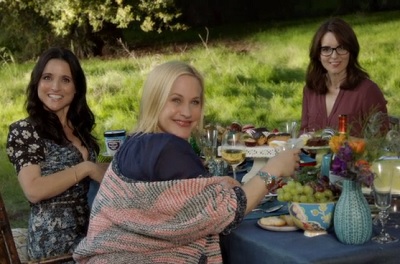
Amy Schumer’s hilarious skit about discrimination against middle-aged women in Hollywood has me wondering about Mae West. It’s true that modern films imply that women aren’t attractive enough past their 40s to be worthy of sex onscreen. But Mae West starred in Sextette in 1978; the film cast her as the object of all men’s desires in her eighties. While the movie was a box office failure, the simple fact is that no such film would be made today.

West’s role was hardly surprising, given that she was in her late 30s when her film career as a seductress began. She was, in addition, penning all of her own lines, and usually the whole screenplay. While many (Schumer among them) question why women haven’t made more progress in entertainment, few express the more disturbing possibility:  Have we backtracked?

Mae West was a pioneer, it’s true. But pioneers are usually followed by those who accomplish more. The frontrunner’s courageous example and more hospitable times and environments usually lead to at least some progress. Maybe we all should be examining West, to figure out what this extraordinary writer/actress got right, what she still has to teach us. And why not? Who doesn’t want a regular dose of West?

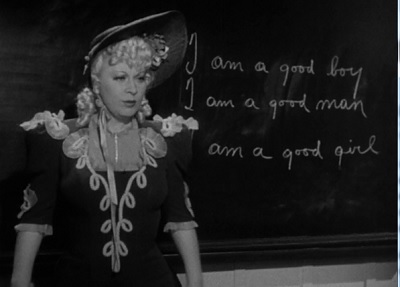
Since her host of brilliant one liners overpowers me, I’ll highlight just one each month to savor it properly, starting with this bit from My Little Chickadee, co-written by West and W.C. Fields (the following scene is obviously of her creation).

MaeWestchalkboardMyLittleChickadee
The town’s school teacher has fainted after dealing with a class of “unruly” boys. Newcomer Flower Belle (West) has taken over the class for the day, and is attracting all of the hormonal adolescents (in her late 40s, I might add). She checks out the teacher’s lessons on the chalkboard. “I am a good boy,” she reads slowly. “I am a good man. I am a good girl.” She turns to the students: “What is this?” she asks. “Propaganda?”

Share
Posted in: 1930s films, 1940s films, Feminism, Humor, Mae West Moments, Romantic Comedies (film), TV & Pop Culture Tagged: ageism, Amy Schumer, Hollywood, Julia Louis-Dreyfus, Mae West, Patricia Arquette, sexism, Tina Fey

Recent Posts

  • 100 Years Later, Still Scary: Dr. Caligari
  • Escaping Out of the Past (1947)
  • A Weeper for Those Who Love Jerks
  • Thank You, Academy, for Not Infuriating Me
  • Challengers (2024) Is a Bad Movie

Subscribe to Blog via Email

Enter your email address to subscribe to this blog and receive notifications of new posts by email.

Categories

  • 1920s films
  • 1930s films
  • 1940s films
  • 1950s films
  • 1960s films
  • 1970s films
  • 1980s films
  • 1990-current films
  • 2020s films
  • Action & Sports Films
  • Anti-Romance films
  • Blogathons
  • Childfree
  • Comedies (film)
  • Drama (film)
  • Feminism
  • Femme fatales
  • Film Noir/Crime/Thriller & Mystery
  • Gloriously Silly Scenes
  • Horror
  • Humor
  • Mae West Moments
  • Musicals and dancing films
  • Oscars
  • Random
  • Romance (films)
  • Romantic Comedies (film)
  • The Moment I Fell for
  • Turn My Sister into Classic Movie Fan
  • TV & Pop Culture
  • Uncategorized
Share
Classic Movie Blog Hub Member

Recent Comments

  • leah@carygrantwonteatyou.com on Meg Ryan’s Fate Foretold in Joe Versus the Volcano
  • Ryan on Meg Ryan’s Fate Foretold in Joe Versus the Volcano
  • leah@carygrantwonteatyou.com on 100 Years Later, Still Scary: Dr. Caligari
  • The Classic Movie Muse on 100 Years Later, Still Scary: Dr. Caligari
  • leah@carygrantwonteatyou.com on 100 Years Later, Still Scary: Dr. Caligari

Archives

  • November 2025
  • September 2025
  • May 2025
  • March 2025
  • January 2025
  • November 2024
  • August 2024
  • July 2024
  • May 2024
  • March 2024
  • February 2024
  • December 2023
  • November 2023
  • October 2023
  • September 2023
  • August 2023
  • July 2023
  • May 2023
  • April 2023
  • March 2023
  • January 2023
  • December 2022
  • November 2022
  • September 2022
  • July 2022
  • May 2022
  • April 2022
  • March 2022
  • February 2022
  • October 2021
  • September 2021
  • April 2021
  • March 2021
  • February 2021
  • December 2020
  • October 2020
  • September 2020
  • July 2020
  • May 2020
  • April 2020
  • March 2020
  • February 2020
  • December 2019
  • October 2019
  • September 2019
  • June 2019
  • May 2019
  • April 2019
  • February 2019
  • January 2019
  • November 2018
  • September 2018
  • July 2018
  • June 2018
  • May 2018
  • April 2018
  • March 2018
  • February 2018
  • January 2018
  • November 2017
  • September 2017
  • August 2017
  • July 2017
  • June 2017
  • May 2017
  • April 2017
  • March 2017
  • February 2017
  • January 2017
  • December 2016
  • November 2016
  • October 2016
  • August 2016
  • July 2016
  • June 2016
  • May 2016
  • April 2016
  • March 2016
  • February 2016
  • January 2016
  • December 2015
  • November 2015
  • October 2015
  • September 2015
  • August 2015
  • July 2015
  • June 2015
  • May 2015
  • April 2015
  • March 2015
  • February 2015
  • January 2015
  • December 2014
  • November 2014
  • October 2014
  • September 2014
  • August 2014
  • July 2014
  • June 2014
  • May 2014
  • April 2014
  • March 2014
  • February 2014
  • January 2014

Meta

  • Log in
  • Entries feed
  • Comments feed
  • WordPress.org

Copyright © 2025 Cary Grant Won't Eat You.

Church WordPress Theme by themehall.com