Cary Grant Won't Eat You

Classic movies for phobics

  • About
  • eBooks
  • Previous Blogathons
Classic movies for phobics

Month: April 2015

Go West Young Man: Mae West’s Censorship Satire

04/30/2015 by leah@carygrantwonteatyou.com 10 Comments

This post is part of The Fabulous Films of the 30s blogathon hosted by the Classic Movie Blog Association. Click here to see the many wonderful entries! For an eBook collection of blogathon entries, click eBook on the menu above.
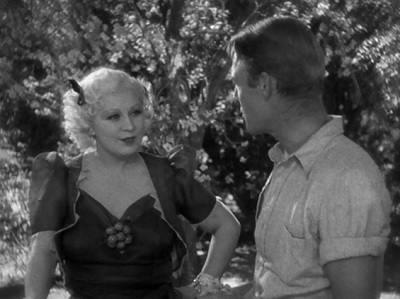
MaeWestandRandolphScott-GoWest
It’s easy to dismiss Go West Young Man (1936) as an inferior Mae West film. It doesn’t contain her best double entendres, and features much less screen time with her than in earlier pictures. The actress didn’t even originate the story; she adapted it from Lawrence Riley’s hit play, Personal Appearance. How could the film measure up to its hilarious predecessors, which West developed to highlight her own sexuality?

It doesn’t, but that’s part of the point—and the fun. The panning of Hollywood in the play must have appealed to West. But I think she saw something else in the story too: by converting the play to film, she could mock the Production Code itself. After all, West’s raunchy scripts and uninhibited performances from the early 30s have been cited as reasons for the Code’s enforcement. She must have laughed to discover the following opportunities to satirize her nemesis:

The Opening
We begin the story at a premiere of actress Mavis Arden’s (West’s) film, Drifting Lady. The camera darts back and forth between the screen and the crowd in the theater viewing it. All of the men in Drifting Lady are pining for Mavis’s character, a nightclub singer with multiple lovers.

Mavis plays the role in a comfortable, bawdy style, and then abruptly regrets her cheating ways and loses her man. An artificial chill settles over Drifting Lady when she does. This would never happen in a pre-Code West film, we viewers remind ourselves. West is supposed to get all of the guys, and celebrate every sexual conquest with a one liner.

Mavis’s acting has been natural (or at least, natural for West) up to this point. But when her lover is about to depart, the star holds out her arm in a stagey gesture and sputters sentimental bilge about April and blue skies and fond memories.
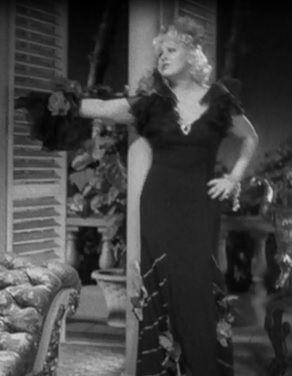
MaeWest-DriftingLadyGoWest
The actress adopts the same stagey line and tone when she talks to the crowd after her film.
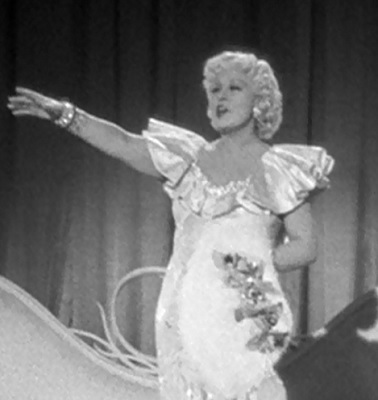
MaeWest-UnnaturalSpeechGoWest
She claims to be an “unaffected girl,” not the siren she plays in film. She then proceeds to share peculiar details about her life. Even if we hadn’t noticed Mavis’s fake tone, her press agent, Morgan (Warren William), rolling his eyes in the background would confirm our suspicions: she’s exactly like the character in the film. The studio might try to make her seem pristine, but we know she’s far from it. Don’t blame me, West’s deliberate hamming reminds us. This censorship nonsense isn’t my call.

Blaming the Studio
After Mavis leaves the stage, Morgan selects a few token men to greet her, all of them homely. When a spectator challenges the lack of handsome men, we learn that Mavis isn’t allowed to marry for five years, with Morgan acting as her watchdog. “Why make the job tough for her?” he adds.

We suddenly understand that strange speech after the film, when Mavis not only felt the need to pronounce her purity, but kept repeating her producer’s and studio’s names, AK of Superfine Pictures, Incorporated. She wasn’t sharing her everyday life with her audience; she was spelling out the terms of her contract. Clearly, this scene ridicules the studios’ tight control over stars’ personal lives. But it does much more: It satirizes limitations on believable behavior onscreen thanks to the Production Code. West, who had attracted censors from the start of her film career, must have relished each “incorporated” she uttered.

Marriage as a Substitute for Sex
West could no longer pen scenes of women seducing men without repercussions. In Go West Yong Man, she resolves this problem by referencing marriage when she means sex. By following the letter, but not the spirit of the Code, West emphasizes the ludicrous nature of censorship.
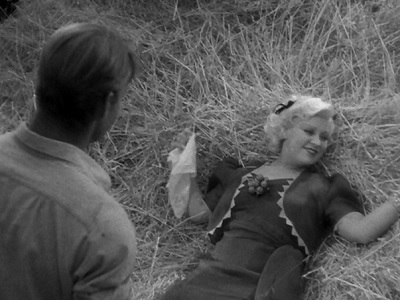
MaeWest-Rollinhay
The plot of the film is fairly simple. Morgan foils any romance Mavis attempts. (My favorite brush off: “We handle Ms. Arden’s admirers alphabetically; I’m just now getting into the Bs.”) She’s planning to join a former lover, a politician, after her film premiere. Morgan invites the press to her date, causing the lover to panic and giving Mavis the chance to express her true nature.

“Have you any particular platform?” the press asks her.

“The one I ain’t done,” she quips.

She soon departs, with the two planning to meet again in Harrisburg. En route, her car breaks down, and Mavis is stuck in a rural boardinghouse with her assistant and Morgan until it’s repaired. The delay annoys her until she spots a handsome young mechanic (Randolph Scott). Her suggestive look at his body and enthusiasm about his “sinewy muscles” say it all: We’re not talking about marriage, folks.

The Supporting Players
William is brilliant as Morgan. A New York Times reviewer described him as “the only player who has ever come close to stealing a picture from Mae West.” But he’s not alone. The boardinghouse proprietor is played by Alice Brady, and while the actress’s comedic chops aren’t fully exploited, the talents of those who play her employee Gladys (Isabel Jewell) and Aunt Kate (Elizabeth Patterson) are. The latter is an aging single woman, who makes knowing remarks about Mavis’s sexual attraction (i.e., “It”), her public relations, and her shade of hair, a color that did not appear in daylight in Aunt Kate’s youth.
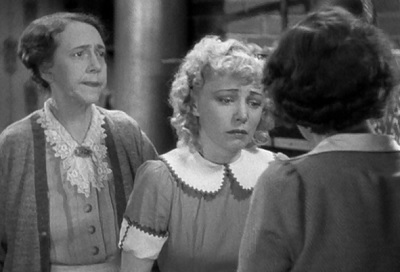
Patterson, Jewell, and Brady

Patterson, Jewell, and Brady

Gladys, an aspiring actress, attempts to impress Morgan by mimicking Marlene Dietrich. Morgan’s dismayed reactions are hilarious.
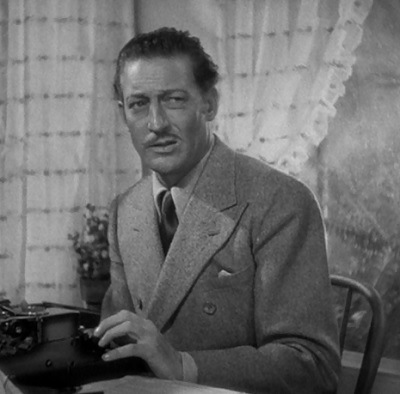
WarrenWilliamReaction-GoWest
While her Dietrich attempt flops, Gladys’s imitation of Mae West’s walk is something to behold. As the innocent in the film, Gladys illustrates the futility of censoring West’s words when that body does so much of the talking.

Unfortunately, the one black character in the film is a fool, or appears to be at first. Halfway through the movie, I became convinced he had just been smoking a lot of weed. It may be wishful thinking on my part, but could it be another snide jab at the censors, who would be unlikely to examine such a minor role closely?

Scenes with Mr. Oblivious
The funniest moments in the Go West Young Man are when Mavis tries to seduce the handsome mechanic, who completely misreads her blatant moves on him.
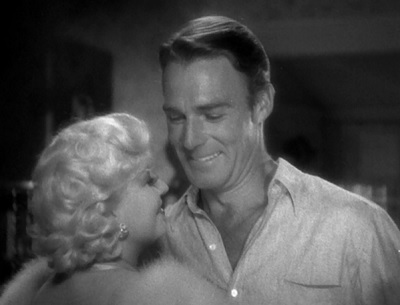
RandolphScott-MaeWest
Busy displaying his invention, he misses the meaning of such subtle lines as these:

  • “Modesty never gets you anything, I know.”
  • “I’d just love to see your model.”
  • “I can’t tell you the number of men I’ve helped to realize themselves.”

It’s amusing to see West’s attractions fail, given how many times we’ve seen the opposite. But what’s even funnier is to witness the man’s obtuseness. Clearly, he’s a surrogate for the censors, who must be fooling themselves (or be quite naïve) to misunderstand the meaning of West’s every look, every line.

Go West Young Man undermines the notion that sex can be discouraged by rules. The film may not have been one of West’s triumphs in terms of box office or critical acclaim, but it is a riveting look at a writer’s reactions to early Hollywood’s rule-bound universe.

Of course, the title makes little sense, referring to a famous historical line the film doesn’t address. I like to think of it as a reference to the star herself, with just one preposition (and comma) missing: “Go for West, young stud. You won’t regret it.”


Share
Posted in: 1930s films, Mae West Moments, Uncategorized Tagged: after pre-Code, censorship, satire

The Nicholas Cage Syndrome: Is Taste More Crucial than Talent?

04/24/2015 by leah@carygrantwonteatyou.com 6 Comments

KeiraKnightleyADangerous
I was outraged by the choice of Keira Knightley to play Elizabeth Bennett in Pride and Prejudice. “That woman,” I complained to my sister Rachel, “is known for her toned midriff, not her acting talent.” Although Knightley did a passable job in a decent film adaptation, I considered her subsequent Oscar nod an affront.
Rachel agreed with my assessment of the actress’s mediocrity, even if I couldn’t follow through with my plan to avoid her films. The problem was, Knightley kept selecting intriguing feminist roles, not the cheesy romantic leads her looks surely could have garnered her. The groundbreaking historical women she brought to life on the screen in The Duchess and A Dangerous Method led me to hours of fascinating research.

And then this year, an Oscar nod again, this time for an interesting biopic, The Imitation Game. When I grumbled about her second nomination, my sister disagreed. “I’ve changed my mind about her. Watch Begin Again. Two great films in one year. She has such good taste.”
And there it was, the trait so often ignored when we talk about acting: taste. Sometimes; as with Meryl Streep, Philip Seymour Hoffman, and Cary Grant; we get both: good films and incredible talent. But so often, we can’t select a movie based on the cast and assume we’ll enjoy it. Why? Because so many skilled performers have Nicholas Cage judgment.

Cage Syndrome: Good actor who stars only in trash

The Cage Syndrome: A good actor who repeatedly stars in trash.

Recall Halle Berry, still gilded from her Oscar win, choosing a bad Bond flick and Catwoman to cement her legacy. Or the previously reliable Morgan Freeman. His films since The Shawshank Redemption make me feel like a comet has crashed into my brain.

Is it possible that taste is more important than talent? I’m not saying that judgment trumps skill if the acting is bad enough to spoil the film. (I’m looking at you, Andie MacDowell.) But if the actor or actress is decent, might good taste matter more?

Let’s take another example: an actress even less versatile and skilled than Keira Knightley (who is admittedly rising in my estimation). Katie Holmes is better known for being the ex of Tom Cruise than for her acting. Her performances are largely forgettable, but her films are not. Even during her Dawson’s Creek years, Holmes displayed remarkable discrimination in her choices. The following are my favorites of her credits (the first and fifth I rewatch often):

  • Thank You for Smoking
  • Batman Begins
  • Pieces of April
  • The Gift
  • Wonder Boys
  • Go

KatieHolmes-ThankYouSmoking
By rarely starring and choosing movies that feature fine performers, Holmes has ensured I don’t need to rely on her skill to enjoy her films. Her mere presence in Woman in Gold is making me reconsider it despite lukewarm reviews. I trust her taste to impress as much as I trust Cage’s to disappoint. (I vowed during Snake Eyes never to watch his films again. Alas, I caved, remembering Raising Arizona, and even let my husband bring home Drive Angry, which did, in fact, make me angry.)

Of course, it’s hard to place the same kind of trust in the taste of classic film performers. Since studios held such tight reign over their stars, performers’ ability to select was limited. But now and then, you can, as in the interesting case of Norma Shearer.

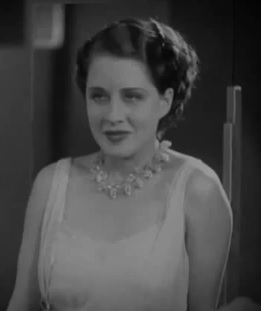
NormaShearerDivorcee1
She (conveniently) married the production head of MGM, therefore ensuring her pick of roles (to the envy of Joan Crawford, who must have enjoyed taking her husband away in The Women).

I’m not a big fan of Shearer’s acting, which I usually find too theatrical. That said, I always enjoy her films, even staid period dramas such as Marie Antoinette and antifeminist flicks such as The Women. But it’s her fight to play liberated women in the pre-Code era that makes me trust her judgment. A woman who would go to a photographer for sexy shots just so she’d be considered for parts like that of Jerry in The Divorcee? That’s an actress I can trust. And in pre-Code films, she relaxes the affectations and easy tears that occasionally mar her pictures. Shearer is never on my list of favorite film actresses, but just writing these words has made me long to see The Divorcee again.

Are there stars whose films you go to see in spite of the mediocrity of their acting? Which talented stars’ movies do you avoid due to the Cage syndrome? And what is up with Sandra Bullock’s love for Razzie-caliber roles?

Share
Posted in: 1980s films, 1990-current films, Comedies (film), Drama (film), Feminism, Humor, TV & Pop Culture Tagged: bad acting, good taste, Katie Holmes, Keira Knightley, Nicholas Cage, Norma Shearer, Sandra Bullock, syndrome

The Epitome Of Teen Queen Cruelty: The Heathers Of Heathers (1989)*

04/16/2015 by leah@carygrantwonteatyou.com 23 Comments

This post is part of the second annual Great Villain Blogathon, sponsored by Ruth of Silver Screenings, Karen of Shadows & Satin and Kristina of Speakeasy. Click here to read about other fascinating villains!

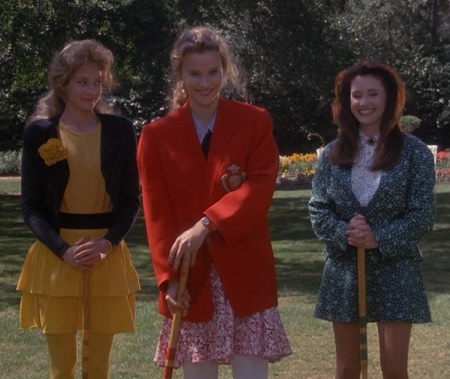
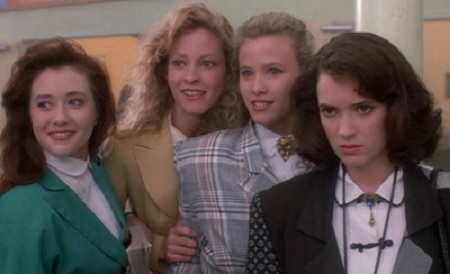
The Three Heathers: McNamara, Chandler (queen), and Duke

The Three Heathers: McNamara, Chandler (queen), and Duke

Before there were Mean Girls, there were Heathers, the heroines of the late-80s teen flick. If you haven’t seen it since high school, watch it again immediately on Netflix. It’s so much funnier than you remember, one of the sharpest satires about group behavior you will ever see. Mean Girls (2004), entertaining though it may be, is just a pale copy of it.

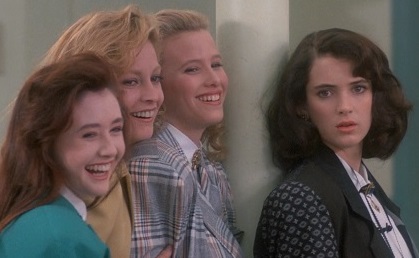
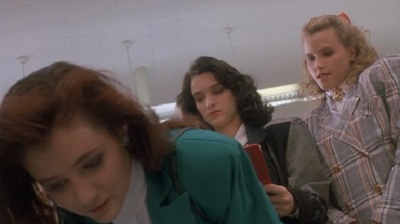
There are multiple villains in this black comedy, but the wicked trio are my favorites, a group of snotty popular girls, all named Heather. One outsider, Veronica (Winona Ryder), is allowed to share their company. She narrates their cruelty (and her own) in angsty teen fashion until J.D., a new crush (Christian Slater), urges her into revenge.

Heathers-movie2
Cliché as this group might be, the Heathers are so extreme in their behavior that they’re mesmerizing, with their lead, Heather Chandler (Kim Walker), the most interesting of the bunch.

HeatherChandler-1
To capture her fascination, I’m categorizing the queen Heather’s words, preferences, and actions below.

(Note: Some of the best lines are so profanity laced that I decided not to include them; the line ending in Mother Theresa is a favorite.)

Power Accessory
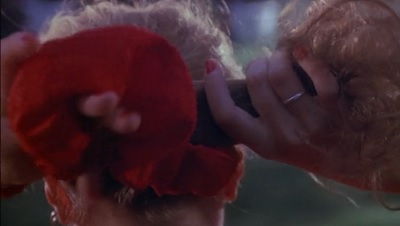
Heather’s red scrunchie is clearly one of the symbols of her dominance. It’s the first thing we see in the film.

RedScrunchie-Heathers

Her School Armor
These shoulder pads speak for themselves:

ShoulderPads-Heathers

Lunch-Time Polls & Other Bits of Wisdom

Lunchtimepoll-Heathers
Heather creates a regular poll** for her fellow popular kids. One of Veronica’s pathetic minor rebellions is to insist they seek answers from those Heather considers “the scum of the school” as well, those who in the queen’s estimation won’t help them brush up on their “conversational skills” before a college party.
Representative Poll: “Now check this out. You win five million dollars from Publisher’s Sweepstakes, and the same day that that big Ed guy gives you the check, aliens land on the earth and say they’re going to blow up the world in two days. What do you do?”

I just love the level of importance attached to this idiocy in the movie.

Signature Aphorism: “Real life sucks losers dry.”

Idea of Fun—and Urgency
The two Heather minions (Duke and McNamara) tell Veronica she’s needed right away in the café. When she arrives, their queen huffs, “Veronica, finally…I need you to forge a hot and horny, but realistically low-key note in Kurt’s handwriting and slip it onto Martha Dumptruck’s (Carrie Lynn’s) lunch tray.”

When Veronica protests that she doesn’t have anything against the poor target, Heather responds, “You don’t have anything for her either,” then suggests (with typical color) that this will give the girl fantasy material for when she’s alone. The Heathers’ excitement in anticipating the results of this cruel plot is evident:

Anticipating the results of their cruelty

Sense of Furniture
“Veronica needs something to write on. Heather (Duke), bend over.”

DohertyasDesk
Favorite Game
There’s really nothing like croquet for sociopaths; Heather Chandler has a loving ritual with her ball.

CroquetKissHeathers
Just after it, she hits Veronica’s head with it in a dream sequence.

Rydersheadcroquet
Her real-life game isn’t much more cordial. When her red ball knocks into Heather Duke’s green one, the latter asks, “So what are you going to do, Heather? Take the two shots or send me out?”

“Did you have a brain tumor for breakfast?” the queen snaps. “First, you ask if you can be red, knowing that I’m always red.” She then proceeds to knock the ball out of play.

After Heather Duke miraculously manages to rebound, Heather Chandler gets a chance to ruin her chances again, and does.

“Why?” says Heather Duke.

“Why not?” her frenemy responds.

Self-Reflection
“Does it bother you,” Veronica asks Heather #1, “that everyone thinks you’re a piranha?”

The queen scoffs in response that of course she doesn’t, desired as she is. “I’m worshipped at Westerburg,” she explains, “and I’m only a junior.”

“You wanted to be a member of the most powerful clique in school,” Heather reminds Veronica when the latter protests bullying. “If I wasn’t already the head of it, I’d want the same thing. Come on, Veronica. You used to have a sense of humor.”

Insults & Threats

HeatherChandler
Her entire demeanor belittles those around her, but Heather Chandler really has some classic lines. Here are a few examples of this sweetheart’s empathy at work:

“Grow up, Heather (Duke),” she says as her friend is puking. “Bulimia is so ’87.”

“You blow it tonight, girl,” Heather warns Veronica before their party at Remington University, “and it’s keggers with kids all next year.”

“What’s your damage?” (when Veronica refuses to sleep with an annoying college guy)

TheHeathers-brushoff
“You were nothing before you met me,” Heather snaps after Veronica embarrasses her by not putting out and getting sick at the university party. “You were playing Barbies with Betty Finn. You were a Bluebird. You were a Brownie. You were a Girl Scout cookie. I got you into a Remington party. What’s my thanks? It’s on the hallway carpet. I got paid in puke…Transfer to Washington. Transfer to Jefferson. No one at Westerburg’s going to let you play their reindeer games.”

“Is this turnout weak or what?” (response to a friend’s funeral in a dream appearance)

Other Heathers’ Honorable Mentions

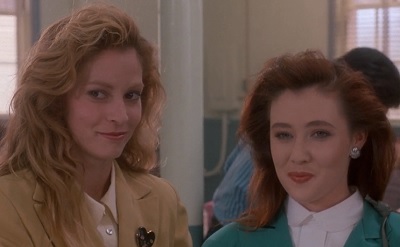
TheHeathers-Minions
**Spoilers ahead***

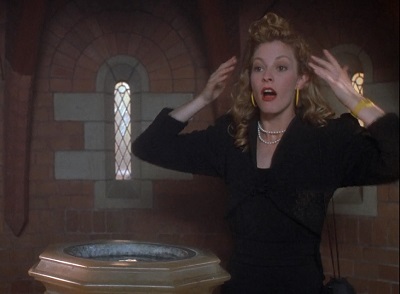
The minions have their moments as well. Here’s Heather McNamara (Lisanne Falk), fixing her hair with holy water after her friend’s funeral:

Heathers-funeralhairdo
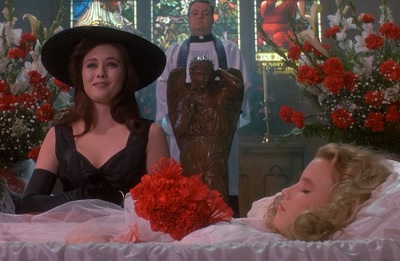
And Heather Duke (Shannen Doherty), celebrating Heather Chandler’s death:

Heathers-funeralofHeathers
If you’ve seen the movie, you’ll remember that Veronica accidentally kills the queen, which leads to the latter becoming a martyr in the school, more popular than ever. Afterward, J.D. exploits the school’s fever for suicide, killing two football players and passing the deaths off as self-inflicted with Veronica’s unwilling assistance. And that’s just the beginning.

Much of the humor of the story comes from others’ reactions to the bloodshed, including Heather Duke’s. She dons her predecessor’s queenly mantle, even wearing her power scrunchie. Here’s her response after hearing her clique’s bullying victim attempted to kill herself: “I mean, Heather and Kurt were a shock, but Martha Dumptruck? Get crucial. She dialed suicide hotlines in her diapers.”

Why, Veronica asks, must Heather Duke be such a jerk?

The replacement queen smirks, “Because I can be.”

The film suggests with the interchangeability of the Heathers that the death of a clique queen just leads to another who may be worse. As Veronica says of her friend’s newly acquired status, “I’ve cut off Heather Chandler’s head, and Heather Duke’s head is sprouting back in its place….”

In terms of filmmaking, this movie spawned creatures such as Mean Girls’ Regina George, queen of the Plastics. We might no longer call the teens in them “Swatch dogs and Diet Coke heads,” but clique comedies are alive and well in the Heathers’ wake, which will probably be true as long as high schools continue breeding ugly class structures. As J.D. says about geography, but could just as easily apply to time, “Seven schools in seven states, and the only thing different is my locker combination.”

*1988 international release
**Mean Girls
gave a nod to the film with a poll of its own. Did you catch it?

Share
Posted in: 1980s films, Blogathons, Comedies (film), Film Noir/Crime/Thriller & Mystery, TV & Pop Culture, Uncategorized Tagged: 80s, black comedy, Heathers, Mean Girls, Regina George, satire, Winona Ryder

Bette Davis & Sibling Bonds: The Sisters (1938)

04/09/2015 by leah@carygrantwonteatyou.com 4 Comments

TheSisters-1938
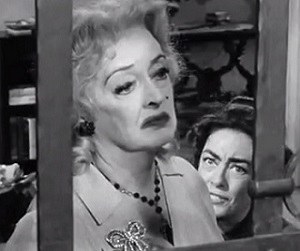
April 10th is National Siblings Day. If the holiday makes you cranky about being an only child, watch Whatever Happened to Baby Jane? That should cure you of longing for a sister.

WhateverHappenedtoBabyJane
Or spend some time with the creepy antihero of Scarface (1932). You’ll never want a brother again.

Scarface
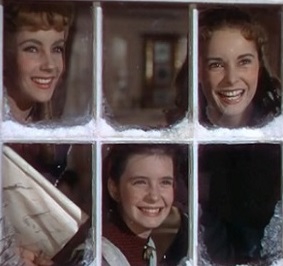
But if you insist on the delight of being a sibling, there’s always the classic sisterly bonding tale, Little Women. The March sisters will satisfy all your sentimental cravings.

LittleWomen
And if you want a more adult version of sisterly unity, check out The Sisters, a period drama set in 1904 in Silver Bow, Montana. Grace, Helen, and Louise Elliott all marry and experience varying degrees of unhappiness as a result. But the bond between them holds firm even when sorrow, tragedy, and distance separate them.

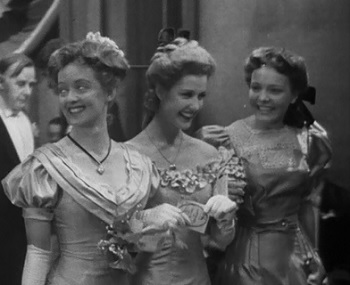
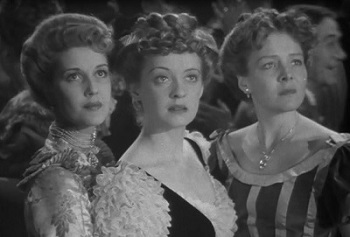
The story begins at a ball celebrating Teddy Roosevelt’s inauguration, where the three girls are in high demand.

Louise, Helen, and Grace

Louise, Helen, and Grace

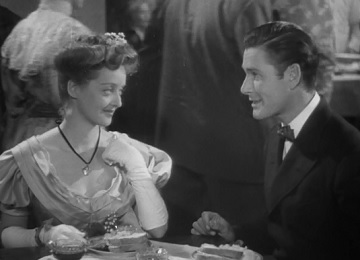
Helen (Anita Louise) is the loveliest, Grace (Jane Bryan) the steadiest, and Louise (Bette Davis) the most confident. Louise is on the verge of engagement to a banker’s son, Tom (Dick Foran), until she encounters Frank (Errol Flynn), a flashy visiting newspaper reporter.

BetteDavisandErrolFlynn
He has few prospects, and her parents don’t like him. He talks too much about freedom and drinking. But she’s in love, so she elopes with him to San Francisco. Her sisters, who seem to have a sixth sense about one another’s movements, anticipate her actions, and say goodbye before she can sneak away.

While Louise is busy grasping at contentment in San Francisco with her increasingly worthless husband, Grace marries Louise’s ex, Tom, and has a son. Meanwhile, Helen cozies up to her long-time admirer, Sam (Alan Hale), who is twice her age but can give her a life of glamour away from Silver Bow. At first, only Louise’s life is turning sour, with her mother adding the word “poor” to her name whenever she says it. Frank, a heavy drinker, avoids home and complains about his lack of freedom and talent, which makes him a general joy to be around. Finally, Louise gets a job so that they can pay the bills, giving him yet another reason to feel sorry for himself. Just before the famous 1906 earthquake, he flirts with the idea of leaving her.

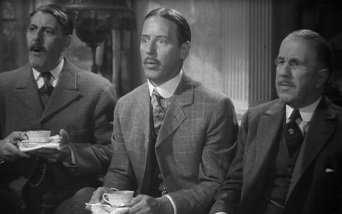
Helen, predictably, is faithless to her husband, whose health proves precarious. And when Grace discovers her husband isn’t as loyal as she thought, her sisters rush home to help her, scaring a group of philandering husbands into aiding their cause: outcasting the woman who seduced him.

MenConfrontedbySiblings
I won’t reveal what happens to each of their marriages, or the ending that promises happiness the audience has no reason to trust. I will say the movie is engrossing throughout, with comic relief from their parents (character actors Henry Travers and Beulah Bondi), convincing chemistry between Flynn and Davis, and lovely dresses by Orry George Kelly.

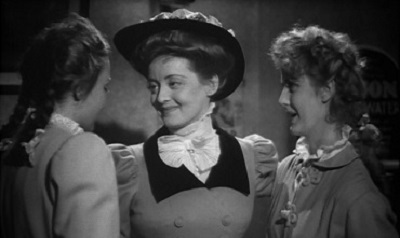
But what most intrigued me about the film occurred in the final minutes. Grace and Helen both sense that Louise is in need during the final inaugural ball of the film (this time for Taft), and each leaves her man to seek her. Together, the three sisters hold one another in a final, empowering image, their expressions declaring that whatever others will do—or won’t—these three will fiercely protect one another. And that is an image that will be on my mind on National Siblings Day.

BetteDavisandTheSisters

Share
Posted in: 1930s films, Drama (film), Romance (films), Uncategorized Tagged: Bette Davis, Errol Flynn, movies, National Siblings Day, sibling movies, Sisters

Pre-Code Fun: The Jewel Robbery (1932)

04/03/2015 by leah@carygrantwonteatyou.com 19 Comments

JewelRobbery-OpeningShot
This post is part of the Pre-Code blogathon hosted by Pre-Code and Shadows and Satin. Click here to see the other entries!

Jewel Robbery has much to recommend it: a debonair thief; a bored, beautiful housewife; marijuana cigarettes adding comic relief; and of course, a host of diamonds. Along the way, we witness a faux kidnapping, a baked police chief, and a rooftop escape. And, of course, we get to hear some killer lines.

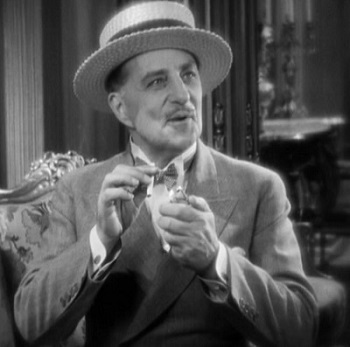
This is a pre-Code film—in other words, the kind of film you didn’t think your grandmother watched, but then, you didn’t know her all that well, did you? In the few years before censorship, there was a lot of scandalous footage on the screen, and much rooting for those engaged in immoral behavior. In this film, we are, of course, meant to root for the affair between the wife and thief, but I confess that this time I felt for the wronged husband, probably because the poor guy had so much stacked against him. First of all, Baron Franz (Henry Kolker) is not a looker:

Henry Kolker
He already has a friend, Paul, making assignations with his wife, Baroness Teri (Kay Francis), and then calling her a “coquette” when she doesn’t keep them. Luckily, most of his fellow politicians are too intimidated by Franz’s position to seduce her, but clearly, an undersecretary or two will slip through the cracks when a wife is as tired of her pampered, quiet life as Teri is. And then, of all weapons aimed against him, it just had to be with one:

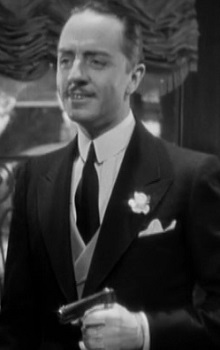
WilliamPowellthief
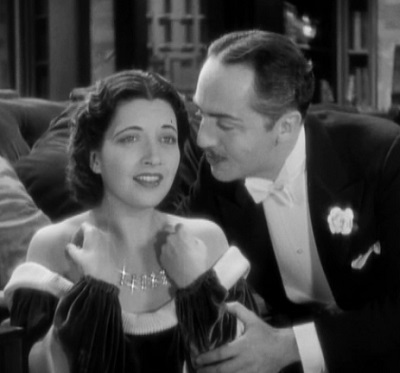
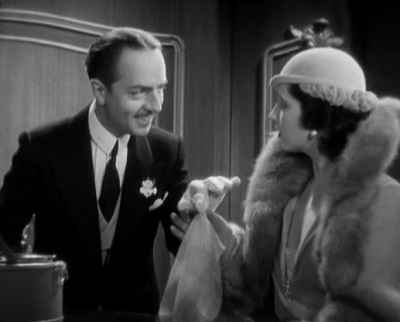
I think you’ll agree that the gun is not the threat here. This is not any thief. This is a robber played by William Powell with the grace, sophistication, and wit that would immortalize him two years later in The Thin Man. Describing his stealing method as a “drawing room style,” the robber plays music and converses with Teri as he and his henchmen snatch every trinket in the store she’s visiting after hours with her husband. He even explains his methods in great detail, including positioning a “very alluring blonde on each corner” to distract policemen.

flirtationPowellandFrancis
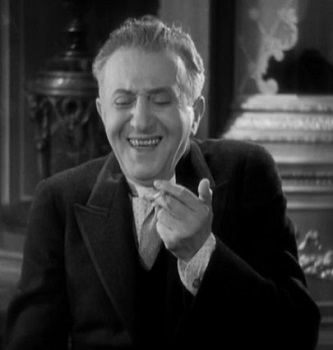
To keep the atmosphere light (and prevent retaliation), the thief compliments the shop owner’s taste and hands him a marijuana cigarette, which keeps him laughing through the trauma.

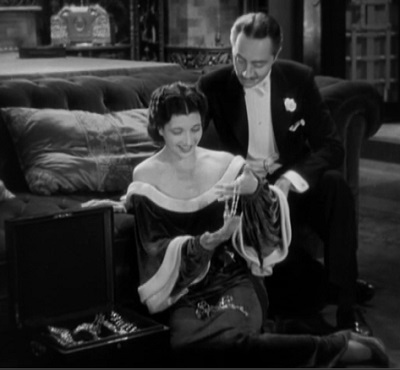
marijuanaprecode-JewelRobbery
After such a thrilling experience, the fickle wife is quickly in love, refusing to be locked up in the safe with either her husband or Paul, as she’d rather continue to be charmed by the thief. With such a man in her sights, what hope does a bureaucrat have to keep her interested?

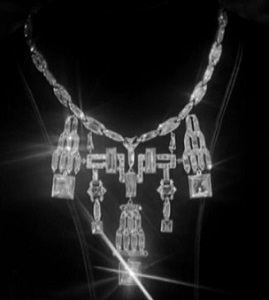
The one weapon Franz has in his arsenal is Teri’s love for sparkling beauties like this one:

Diamondnecklace
The couple is in the shop to purchase a 28-carat whopper, the Excelsior diamond, a ring Teri literally worships.

KayFrancis-Ring
“What wouldn’t a woman do for such a treasure?” she says when she sees it.

“Anything. I’d deceive my husband, with pleasure,” her sidekick Marianne (Helen Vinson) answers.

“A woman would do much more than that,” Terry explains. “She would tolerate her husband.”

But all such motivation is gone when the handsome distraction in question steals jewels for a living, can give her far more than even her multimillionaire spouse can. Franz tries to convince his “incurably romantic” wife out of her lust, but her expression really says it all:

dreamingKayFrancis
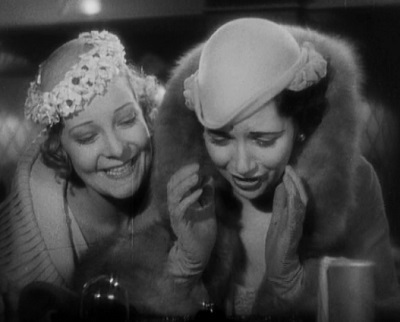
The thief’s attraction dims a bit once he catches sight of—and steals—her new treasure. But he returns it to her house while her husband is out. Teri’s friend Marianne is initially thrilled by the prospect of the robber on the premises.

VinsonandFrancis
But when Teri declares her intention to keep the ring in spite of its risks to her (given that she reported it stolen), Marianne is so spooked she announces her intention to leave to avoid being implicated in a scandal, declaring, “This is one night I shall be very glad to be with my husband.”

**Spoilers ahead**

Of course, this departure gives the besotted thief a chance to ask Teri to flee with him to Nice. He begins his seduction by taking her to his place. When she claims he should be more forceful (to match her romantic images of this moment), he carries her to the bed. She doesn’t deny him, only asking that they not hurry, with “so many pleasant intervening steps” before they get there.

BedKayFrancis
The thief reveals just how well he’s gotten to know her next. Could any foreplay work better on a woman who claims a diamond’s purity made her rethink her frivolous life than this display of riches?

foreplayPowellandFrancis
In spite of her feelings for him, Teri waffles on whether to leave the comforts of her position for a dangerous future. Unfortunately, she has no time for indecision, as the police have arrived. The robber ties her up to save her reputation, employing his usual panache in his daring exit across the roofs and into a waiting cop car his buddy has stolen.

WilliamPowellgbye
Teri tells her husband she needs to take a long rest in Nice to recover from the trauma of the kidnapping. She approaches the camera with one final gesture to ensure we are in no doubt about her intent:

KayFrancisforcamera
If this plot doesn’t convince you to watch the film, there are other gems: Helen Vinson is hilarious throughout the film, there’s a subplot about a guard who is both comically gullible and quickly becoming a fan of marijuana, and some nice rooftop action. Give it a try! And while you’re at it, read about many other funny, scandalous, fascinating pre-Code films.

Share
Posted in: 1930s films, Blogathons, Romantic Comedies (film), Uncategorized Tagged: Kay Francis, Pre-Code, robber, Romance, William Powell

Recent Posts

  • 100 Years Later, Still Scary: Dr. Caligari
  • Escaping Out of the Past (1947)
  • A Weeper for Those Who Love Jerks
  • Thank You, Academy, for Not Infuriating Me
  • Challengers (2024) Is a Bad Movie

Subscribe to Blog via Email

Enter your email address to subscribe to this blog and receive notifications of new posts by email.

Categories

  • 1920s films
  • 1930s films
  • 1940s films
  • 1950s films
  • 1960s films
  • 1970s films
  • 1980s films
  • 1990-current films
  • 2020s films
  • Action & Sports Films
  • Anti-Romance films
  • Blogathons
  • Childfree
  • Comedies (film)
  • Drama (film)
  • Feminism
  • Femme fatales
  • Film Noir/Crime/Thriller & Mystery
  • Gloriously Silly Scenes
  • Horror
  • Humor
  • Mae West Moments
  • Musicals and dancing films
  • Oscars
  • Random
  • Romance (films)
  • Romantic Comedies (film)
  • The Moment I Fell for
  • Turn My Sister into Classic Movie Fan
  • TV & Pop Culture
  • Uncategorized
Share
Classic Movie Blog Hub Member

Recent Comments

  • leah@carygrantwonteatyou.com on Meg Ryan’s Fate Foretold in Joe Versus the Volcano
  • Ryan on Meg Ryan’s Fate Foretold in Joe Versus the Volcano
  • leah@carygrantwonteatyou.com on 100 Years Later, Still Scary: Dr. Caligari
  • The Classic Movie Muse on 100 Years Later, Still Scary: Dr. Caligari
  • leah@carygrantwonteatyou.com on 100 Years Later, Still Scary: Dr. Caligari

Archives

  • November 2025
  • September 2025
  • May 2025
  • March 2025
  • January 2025
  • November 2024
  • August 2024
  • July 2024
  • May 2024
  • March 2024
  • February 2024
  • December 2023
  • November 2023
  • October 2023
  • September 2023
  • August 2023
  • July 2023
  • May 2023
  • April 2023
  • March 2023
  • January 2023
  • December 2022
  • November 2022
  • September 2022
  • July 2022
  • May 2022
  • April 2022
  • March 2022
  • February 2022
  • October 2021
  • September 2021
  • April 2021
  • March 2021
  • February 2021
  • December 2020
  • October 2020
  • September 2020
  • July 2020
  • May 2020
  • April 2020
  • March 2020
  • February 2020
  • December 2019
  • October 2019
  • September 2019
  • June 2019
  • May 2019
  • April 2019
  • February 2019
  • January 2019
  • November 2018
  • September 2018
  • July 2018
  • June 2018
  • May 2018
  • April 2018
  • March 2018
  • February 2018
  • January 2018
  • November 2017
  • September 2017
  • August 2017
  • July 2017
  • June 2017
  • May 2017
  • April 2017
  • March 2017
  • February 2017
  • January 2017
  • December 2016
  • November 2016
  • October 2016
  • August 2016
  • July 2016
  • June 2016
  • May 2016
  • April 2016
  • March 2016
  • February 2016
  • January 2016
  • December 2015
  • November 2015
  • October 2015
  • September 2015
  • August 2015
  • July 2015
  • June 2015
  • May 2015
  • April 2015
  • March 2015
  • February 2015
  • January 2015
  • December 2014
  • November 2014
  • October 2014
  • September 2014
  • August 2014
  • July 2014
  • June 2014
  • May 2014
  • April 2014
  • March 2014
  • February 2014
  • January 2014

Meta

  • Log in
  • Entries feed
  • Comments feed
  • WordPress.org

Copyright © 2025 Cary Grant Won't Eat You.

Church WordPress Theme by themehall.com