Cary Grant Won't Eat You

Classic movies for phobics

  • About
  • eBooks
  • Previous Blogathons
Classic movies for phobics

Month: September 2014

The Moment I Fell for Van Heflin

09/23/2014 by leah@carygrantwonteatyou.com 13 Comments

Heflincurious
I didn’t know a thing about Van Heflin when I saw The Strange Love of Martha Ivers (1946). I picked the movie because of my love for Barbara Stanwyck, whom I assumed from the title would be the star of the film; I didn’t realize she wouldn’t appear until half an hour into it.

Stanwyck, the versatile actress

Stanwyck in The Strange Love of Martha Ivers

The story begins in 1928. Young Sam Masterson (Darryl Hickman) is trying to convince his crush, Martha Ivers (Janis Wilson), to run off to the circus with him. Sam is always evading the police thanks to Martha’s aunt (Judith Anderson), Mrs. Ivers, the wealthy woman who owns the town. Only if they run away can they be together. Unfortunately, their initial efforts are foiled by tattletale Walter, who likes Martha too.
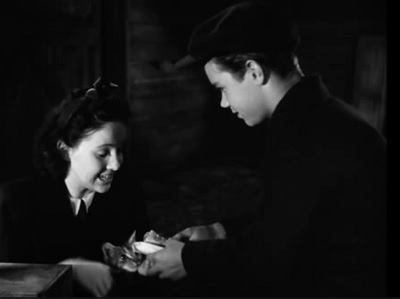
YoungSamandMartha
Sam does run away, but just before Martha flees to join him, Mrs. Ivers beats her beloved cat to death, and Martha retaliates by striking her aunt with the same cane. We see Sam riding a train just as his crush is concealing the murder with the aid of her greedy tutor and Walter, his son.

The film jumps to 1946. Sam has grown up to become an easygoing professional gambler (Van Heflin). In his car with a hitchhiking sailor, Sam catches sight of a “Welcome to Iverstown” sign.

“Well, whaddya know?” he says. “….Leave a place when you’re a kid, maybe seventeen, eighteen years ago, and you forget all about it, and all of a sudden you’re driving along and smacko, your own hometown up and hits you right in the face.”

He’s so surprised that he turns around to see the sign again and crashes his car.

Heflin-driving
Laughing at himself, he explains to his befuddled companion, “The road curved, but I didn’t.”

“Welcome to Iverstown,” he says to himself as he heads there for repairs. “Well, maybe this time, they mean it.”

I had expected to be disappointed by Stanwyck’s costar, as I usually am. Even actors good in other films come across as flat or artificial next to an actress this natural, and as downright stilted if unskilled to begin with (i.e., Herbert Marshall).

Captivated by the self-deprecation of Heflin’s character and his unexpectedly casual responses to conflicts, I soon forgot Stanwyck was even in the movie. I think I’d fallen for Van Heflin before he got out of the car.
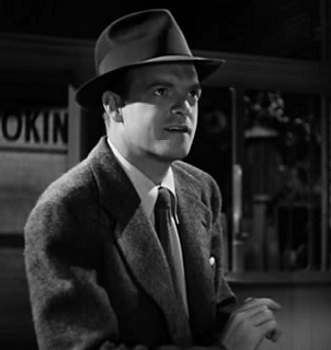
Discovering that “scared little boy” Walter is now a DA

Discovering that “scared little boy,” Walter, is now a DA

Heflin is an excellent foil for the scheming adult Martha (Stanwyck) and her alcoholic, tortured husband, Walter (Kirk Douglas). Sam’s relaxed, freewheeling persona acts as a kind of tonic to his tightly wound former love and a poison to her jealous and fearful husband, who assumes this childhood friend is back to blackmail them. Like Mrs. Ivers before him, Walter tries to drive Sam away. But Sam is no longer as powerless as he once was.

Heflin is every bit as comfortable in his role as Stanwyck is in hers, and the naturalness I would soon discover to be a hallmark of his acting works perfectly here, contrasting with the duplicitous couple’s double dealing. What makes Heflin so attractive as an actor is that same ease of movement Stanwyck possesses; it wasn’t surprising to discover this man spent much of his life as a sailor. Clearly, he finds his sea legs in every part quickly, and that comfort in his skin and in his environment is seductive to watch. By the time he meets Martha again, even the usually compelling Kirk Douglas is hopeless against him (Douglas plays an atypical part here, and is wonderful in it).
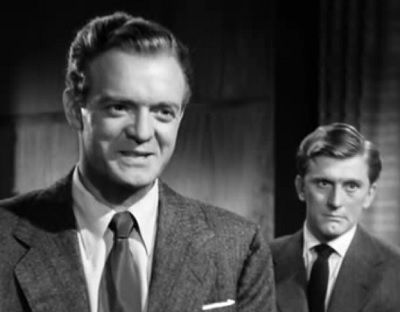
Seeing Martha again

Seeing Martha again

Heflin was not a traditionally attractive man, and famously remarked that “Louis B. Mayer once looked at me and said, ‘You will never get the girl at the end.’ So I worked on my acting.” Whatever he did worked: He’s so riveting to watch that I never questioned any woman Heflin won, even one as jaw-droppingly sexy as parolee Tony (Lizabeth Scott), who falls for Sam as he’s wandering around Iverstown.

Gorgeous Scott as Tony

Gorgeous Scott as Tony

Flirting with Walter's secretary to get an appointment

Flirting with Walter’s secretary

In fact, I’m more likely to question when Heflin doesn’t get the girl, as when Jean Arthur starts to fall for pretty-boy Alan Ladd in Shane over her tough husband (Heflin), or when Lana Turner prefers boring Richard Hart in Green Dolphin Street (to be fair, the character’s choices were just as baffling in the book). Even when Heflin plays a less courageous part than he usually does, as in 3:10 to Yuma, he’s always got some kind of hard, immovable core of strength to him. In The Strange Love of Martha Ivers, where I saw it first, this mental and physical strength appears when Walter starts to mess with him—and worse, with Tony.
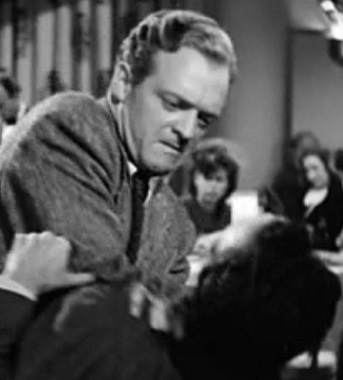
Fighting the detectives who stooge for Walter

Fighting Walter’s detectives

Yet Heflin is just as adept at playing kindness as brawn, as when Tony (Scott) betrays Sam out of weakness and then asks him to hit her because of it. Of course, he refuses to hurt her, but he does more than that: he shows compassion for her behavior. “The only thing you got coming, kid, is a break,” Sam says, the simplicity of his delivery conveying his conviction.

And it is a joy to see Heflin in scenes with Stanwyck. Sam suspects he’s in love with Martha, and even though the audience knows he should steer clear, it’s hard not to root for them, since it means more scenes with these two brilliant actors, and fewer with the less talented Scott.
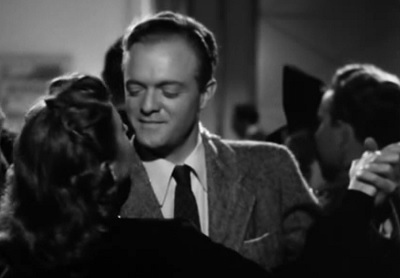
HeflinandStanwyckdance
The chemistry between the two is strong. It’s wonderful to witness Stanwyck unable to dominate an actor, to see in him an equal.
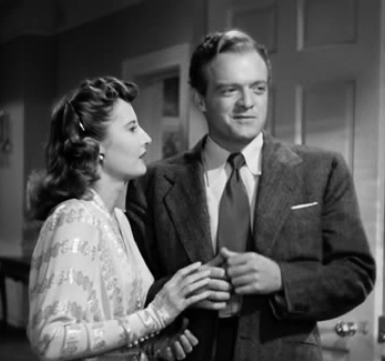
HeflinandStanwycktogether
Aware that she can’t manipulate Sam, Martha panics after she reveals her secret to him. Of course, Stanwyck conveys that fear in one look, as only she can:

MarthascaredStanwyck
And Heflin’s understated response portrays his excitement about her honesty, his understanding of her distress, and his disgust at what’s happened:
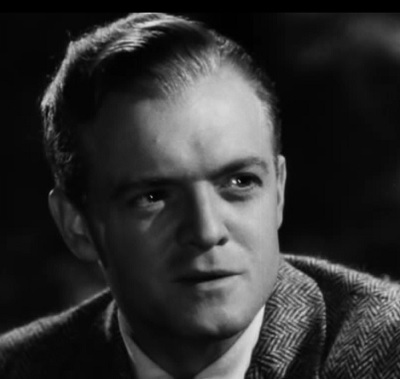
Heflin-discovery
Before long, of course, Sam must confront Walter about his feelings for Martha:
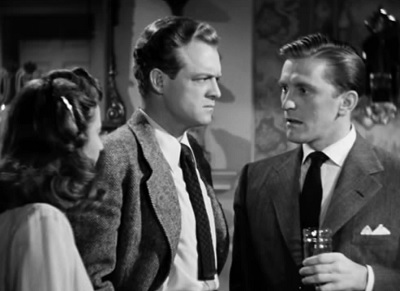
Three-HeflinDouglasStanwyck
And Martha must stop characterizing herself as a victim, instead seducing Sam with money, power, and lust:

HeflinandStanwyck
The role of Sam Masterson requires that Van Heflin have a great deal of range—that he express assurance, wonder, sympathy, violence, love, anger, fear, revulsion. Heflin’s performance carries the film, and he plays each emotion so perfectly that you feel like you know this man, and wish him far away from his destructive former playmates. I won’t spoil what happens, as the movie is well worth viewing, with excellent acting, an intriguing story, and a great script. But be warned: Heflin’ll get to you, just as he did to me.

This is the fourth in a monthly series of The Moment I Fell for posts…Hope you’ll share some of the moments that drew you to your favorite actors and actresses….

Share
Posted in: 1940s films, Drama (film), Femme fatales, Film Noir/Crime/Thriller & Mystery, The Moment I Fell for Tagged: Barbara Stanwyck, The Strange Love of Martha Ivers, Van Heflin

Being a Princess Would Suck: Roman Holiday

09/18/2014 by leah@carygrantwonteatyou.com 6 Comments

Like most girls, I was born wanting to be a princess, though I preferred Belinda from The Practical Princess to helpless Cinderella. Unlike for many of my peers, this desire ended quite early for me. The wedding of Princess Di lasted far too long for my attention span, and what was up with that poofy dress and that decidedly not Barbie-like haircut?

Even had Diana worn the kind of clothes I preferred at six, I knew her kind of life wasn’t for me. For a shy kid who dodged from view, that much limelight looked terrifying and—even worse—dull.

linesAudrey
It’s hard to ignore the tedium of official duties when you’re the daughter of a principal. “Are we going to be last AGAIN?” I used to whisper to my sisters at the high school concert’s or play’s conclusion as I shuttled between the mothers talking kids and fathers spinning funny stories and finally glared at that last soul who hadn’t noticed that my family and he had been the only ones there for the past hour.

Perhaps that’s why whenever Kate Middleton is shot in another gorgeous dress or chic hat, I always look past it to the caption, to see what tiresome event she wore it for. I like viewing the pretty dresses in princess films still today, but I’m far more interested in the conflicts the heroine has to endure.

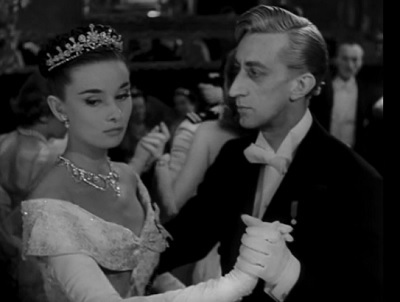
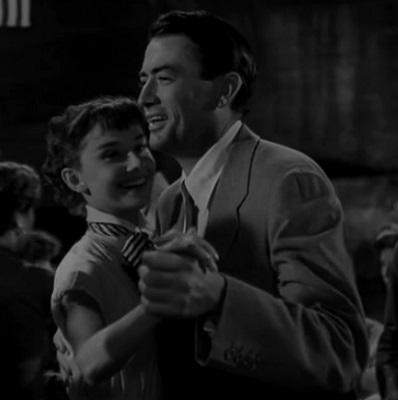
Audreydancing
In The Prince and Me, when Paige, Julia Stiles’s character, balks at the many rules of royalty, the queen claims jewels are compensations, and the camera rests on a feast of diamond and emerald. “Yeah,” I remember thinking when I saw it, “maybe for the first twenty minutes.” Because after enduring the 200th ribbon-cutting ceremony in honor of something I’d never heard of; choking through fussy, elaborate dinners while wearing Spanx; watching yet another stream of dull important people approaching me I’d have to pretend were interesting, like some sick replay of my worst date; I’d be handing that tiara to the gal next to me and high-tailing it to Vegas.

Perhaps that’s why Roman Holiday is my favorite of all princess films, a story about the glamour of everyday joys rather than balls, the excitement of the release from royalty. The film begins with Princess Ann (Audrey Hepburn) trying not to yawn through yet another official ceremony on her goodwill tour, and scandalously kicking off her tight heel, which her retinue quickly finds a way to conceal.

In response to her schedule for the next day, Ann rehearses her answers, her boredom coming through in every line: “Thank you, no thank you.” And which speech she’ll have to give, such as one of her regulars, “Youth and Progress.” Her frustration with all the routine soon leads to a nervous attack, a sedative, and her escape to play hooky in Rome, sans her identity or attendants. She meets handsome reporter Joe Bradley (Gregory Peck) as she wanders. He soon discovers her identity and plans for a scoop on the princess’s “holiday.” Oblivious to his discovery, she simply enjoys herself, and he, of course (this is Audrey Hepburn, after all) does too.

Everyday joys soon elevate the princess’s spirits from frustration to exuberance. Just look at that smile as she goes about the city…

Meeting a guy in nonofficial capacity...in PJs

Meeting a guy while in PJs

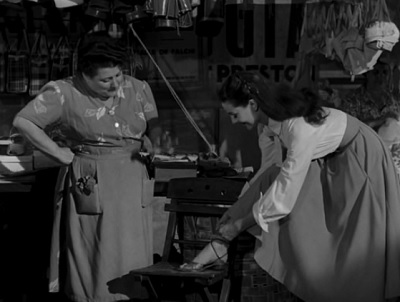
Shopping for sandals

Shopping for sandals

Getting a haircut

Getting a haircut

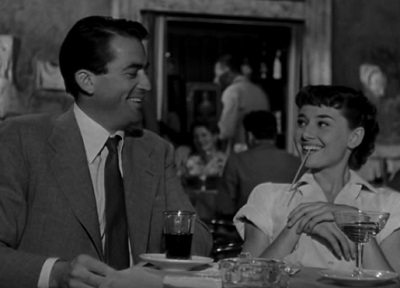
Drinking champaign for breakfast (Hepburn with Peck)

Drinking champaign for breakfast (Hepburn with Peck)

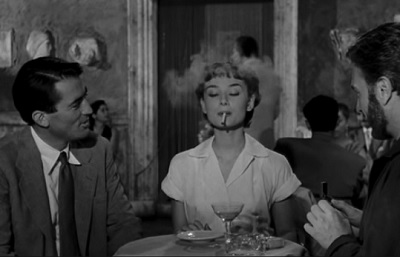
Trying what's forbidden... (with Peck and Eddie Albert as the adorable photographer)

Trying what’s forbidden (with Peck and Eddie Albert as the photographer)

Driving around....

Driving around….

Falling for a regular guy (if you can call Peck that)

Falling for a regular guy (if you can call Peck that)

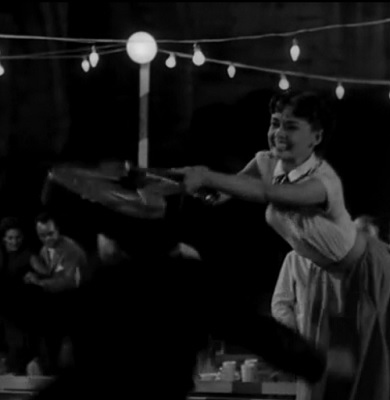
Causing a ruckus

Causing a ruckus

Compared to such pleasures, what are designer gowns and crown jewels?

Share
Posted in: 1950s films, 1990-current films, Humor, Romantic Comedies (film), TV & Pop Culture Tagged: Audrey Hepburn, Gregory Peck, Kate Middleton, princess films, Roman Holiday, The Prince and Me

From Poem to Boxing Ring: The Set-Up

09/13/2014 by leah@carygrantwonteatyou.com 8 Comments

An enthusiastic Rocky fan, I was curious how the classic films on boxing would measure up. The Set-Up sounded intriguing because it was about the underworld attached to the sport, and shockingly, was based on a poem.

TheSetup-intr
Let’s sit here and think about that for moment. A poem. Say it to yourself. Boxing. Poem. Can you put the two together? I sure couldn’t. But once I viewed the film, I did see a kind of poetry in it, and thought I’d say a few words about why this film is so moving and—yes, poetic. The Set-Up is about weighing choices, each of which shapes the film. The fact that the movie plays in the exact running time of the prep for and fight itself emphasizes the crucial timing of each decision…

Should a Manager Tell His Boxer He’s Fixed a Fight?
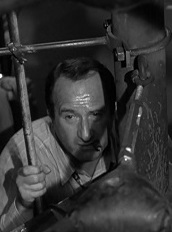
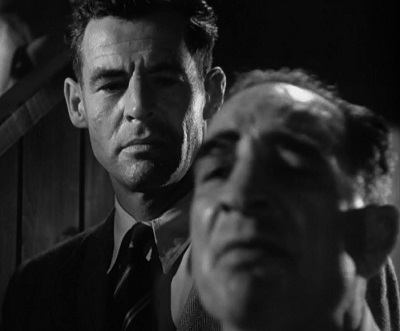
Manager Tiny (George Tobias) believes boxer Stoker Thompson will blow his match, satisfying mobster Little Boy (Alan Baxter), who has paid Tiny to fix the fight between Stoker and his favorite, Tiger Nelson (Hal Baylor). After all, Stoker is past his prime, and hasn’t been on a winning streak in quite some time.

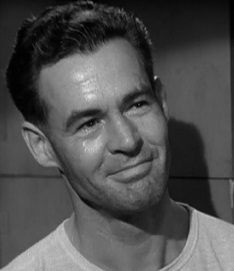
If Tiny informs Stoker (Robert Ryan) about the fix, he will lose some of his cut. On the other hand, if Stoker doesn’t perform as expected, Tiny is in trouble with a mobster. Certain of his boxer’s ineptitude, Tiny considers neither the justice of his action, nor the danger it poses to Stoker. Only when his boxer shows spirit during the fight does Tiny begin to sweat—for himself.

ManagerandfixerTheSetup
Should An Aging Boxer Give Up The Sport To Please His Wife?
Stoker’s wife, Julie (Audrey Totter), proclaims her resolution to stop attending her husband’s fights. She wants him to quit. Stoker tries to convince her he’s almost done with the sport, but urges her to wait longer, until he can make a greater success. At the start of the movie, he keeps looking to her window and the chair he’s reserved for her at the fight; she wanders around the city trying to decide whether to go.

Totter-TheSetUp
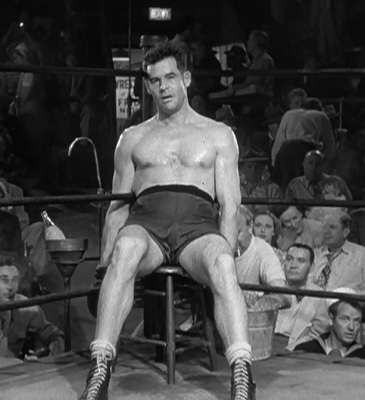
Clearly, Julie hates watching her husband get hurt, and worries about his survival. His love for her is painful to watch, as is hers for him. The problem is, all ambitions notwithstanding, Stoker also loves to fight. He enjoys the company of his fellow boxers, who thrive on hope, and rejuvenate his (comparatively) aging body and more resigned disposition with their energy and dreams.

Ryan-TheSetUp
Julie has put up with a lot to support him in this profession. How long should he ask it of her? Will she leave him if he doesn’t let it go?

How Long Should a Fighter Wait Before Abandoning that One Chance to Make It Big?
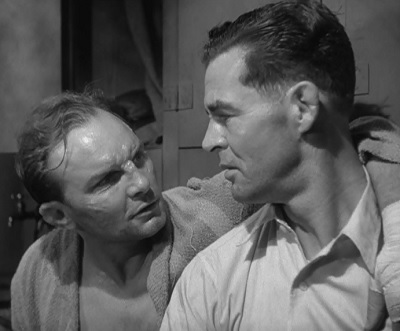
In the locker room, Stoker acts as a kind of patriarch to his peers, easing their nerves and encouraging their bravado. When a first-time boxer vomits before his first round, a trainer asks Stoker to admit it happens to everyone.

Yes, Stoker agrees aloud, recalling his own first bout, when he did the same: Trenton, NJ, 20 years before. Stoker’s face is poignant at the memory, back when he was as jubilant as the young men around him.

Among the many wonderful moments in the locker room, the best is perhaps the encounter between Gunboat and Stoker. Both aging fighters, both still trying to maintain ambition. Gunboat is inspired by a former middleweight champion who was beat 21 times before winning, a statistic he repeats to all who will listen, hoping his own record will soon resemble it.

“Can’t you see me, Stoke,” says Gunboat. “First I win the title, and then the exhibition tour, that’s where the easy dough is. I’ll be in the movie, Stokes, with a line of dames waiting for me a block long…”

boxers-The Setup
When Gunboat returns from his fight unconscious, the camera pans over each fighter and trainer in turn, the fear and pain in all of their faces perfectly capturing the guts it takes to move from this moment, as several must do, to their own matches. And, of course, it presents Stoker with the inevitable question: Has he waited too long to quit?

What Spells the Difference Between Enjoying a Dangerous Sport, and Craving the Carnage?
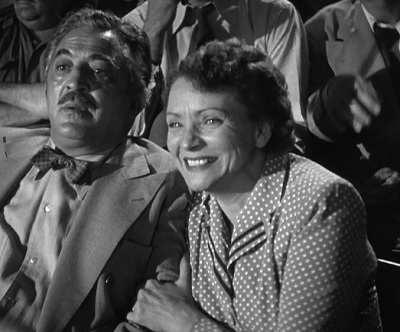
The movie focuses in on just a few spectators the whole film, letting us see the fight between Stoker and Nelson through their often disturbing reactions. There’s the woman in the crowd who claims to hate matches, but reacts with glee when the fighting is most brutal, and grumbles when it’s not….

Spectator-BloodthirstyTheSetup
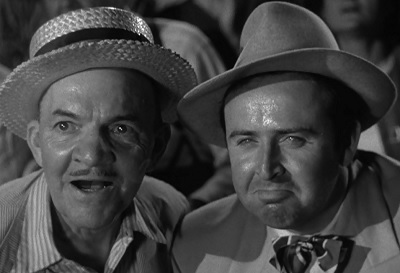
There’s the blind man relying on his friend for the play-by-play. “Nelson (Hal Baylor) opened up his left eye. He’s bleeding!” says the friend.

“Good,” his companion answers, and later yells at Nelson for not going for the eye again.

Spectator-happyTheSetUp
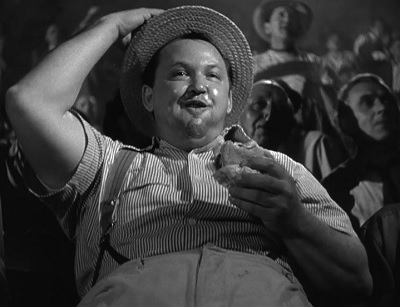
Then there’s the man who eats everything in the place, his appetite undisturbed by the blood, pain, or cries around him.

spectator-TheSetUp
No wonder Julie doesn’t want to come. No wonder Stoker flinches before his fight at a spectator’s cries: “Kill ’im!”

Reaction toCrowd-theSetup
What Should a Man Do When He Discovers Betrayal, But Payback Could Be Fatal?

boxeralone-TheSetUp
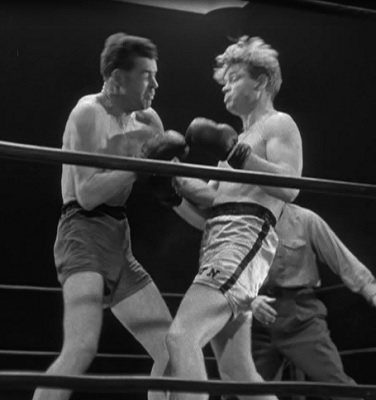
Stoker begins to suspect foul play when his manager keeps trying to convince him to ease up once he begins to win. The bout itself is riveting, moving from the match to those few members of the crowd we’re tracking.

Boxing-TheSetUp
Ryan boxed in college, which explains why his moves are so convincing onscreen, unlike those of many actors in boxing films since. The confusion, anger, betrayal, and uncertainty of how to handle this fix play on this talented actor’s face. Given his pride, his conflict over Julie, and his disillusionment, we aren’t sure just what Stoker will do….

How Faithful Should Filmmakers Be to the Source Material?
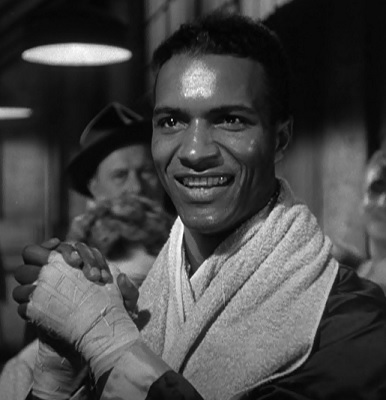
The Set-Up has been criticized for changing the race of the poem’s hero from black to white, and among the harshest detractors were the poem’s author, Joseph Moncure March. It’s easy to dismiss the director’s claim that this change was because RKO didn’t have an African-American star then. The date alone (1949) suggests less elevated motives, and the black fighter in the movie, Luther, is played by James Edwards, who starred in the award-winning Home of the Brave that very same year.

Luther-TheSetUp
Luther is portrayed sympathetically, which suggests the same could have happened with a black leading man, and the kind of treatment Tiny doles out to his boxer would have darkened and deepened the meaning of the movie had they not shared the same race (not to mention more faithfully reflecting the boxing world at the time).

However, the poem’s author, Joseph Moncure March, according to scholar Jefferson Hunter, “attacks an injustice without fully understanding his own involvement in it” and “is more a denizen of his time and place than he knows.” That is, March referred to his hero as a “jungle jinx” and saddled him with bigamy and a prison record. Therefore, some changes needed to be made to the story, and given its audience’s likely prejudices, perhaps some might even have been a good idea. But what a film it would have been with a morally questionable fighter, and an exploration of race politics in the ring….

Share
Posted in: 1940s films, Action & Sports Films, Drama (film), Film Noir/Crime/Thriller & Mystery Tagged: Audrey Totter, boxing, Robert Ryan, Rocky, The Set-Up

Say Anything Fan? Holiday (1938) Is the Classic Film for You

09/06/2014 by leah@carygrantwonteatyou.com 2 Comments

A hero who reveals his vulnerability, yet retains his pride; the kind of man devoted enough to lift a jukebox above his head blaring Peter Gabriel’s “In Your Eyes” to woo the girl who dumped him, yet still grounded enough to enjoy relaxing with his friends; a boy with few prospects who is seeking a “dare-to-be-great” situation.

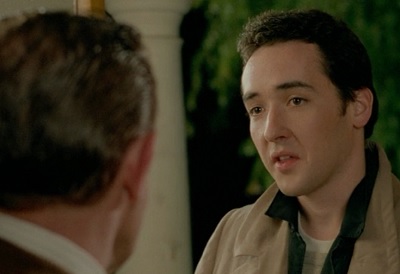
Lloyd-Cusack
There’s a reason Say Anything (1989) and its hero, Lloyd Dobler (John Cusack), were nearly universally worshipped by every middle and high school girl I knew. Cusack quickly became the heartthrob of my generation, just as Cary Grant was to his. In Holiday, Grant played a role much like Cusack’s in Say Anything. That’s why if you’re a diehard lover of Lloyd Dobler, I think you should check out this 1938 film and see for yourself the many similarities:

Lightheartedness
Those accustomed to seeing Grant’s suave persona on display in clips and photos might not realize how fun it is to witness him being the opposite—silly, playful, with that same uneasily expressed, coltish confidence in himself that makes Lloyd Dobler so appealing. In Holiday, Johnny (Grant) likes to do flips to cheer himself out of tough times or worries, just as Lloyd chides his sister for not being able to pull out of hers.

SolutiontoWorry-CaryGrant
Romancing the Daddy’s Girl—and Daddy Ain’t So Great
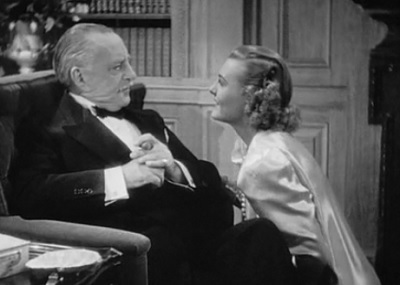
Both films feature heroines who are too close to fathers who don’t deserve such adulation. In Say Anything, Diane’s dad (John Mahoney) winds up being a crook; in Holiday, Julia’s (Henry Kolker) is so obsessed with money and status that he verges on caricature.

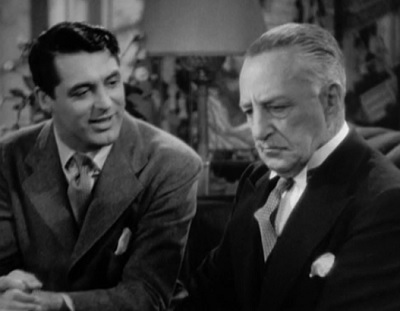
Johnny's fiancée and her father

Johnny’s fiancée and her father

Much of Holiday focuses on Johnny’s discovery that Julia (Doris Nolan) is much closer to her father’s character than he realized, just as Say Anything shows Diane (Ione Skye) slowly recognizing that her father is not the moral center of her universe. Luckily, we have both of Julia’s siblings, Linda (Katharine Hepburn) and Ned (Lew Ayres), mocking their dad the whole time in Holiday, which is way funnier than the whole Diane-Dad snooze fest.

Unconventional Ambitions
Both heroes have unpopular dreams. Lloyd’s is beautifully expressed when Diane’s dad opens the door and he tries to sell himself as a trustworthy date: “I’m an athlete, so I rarely drink. You heard of kickboxing, sport of the future?”*

DoblerSportoftheFuture
Lloyd responds to a question about his career plans with “Spend as much time as possible with Diane before she leaves” and proceeds to give an amusing description of his hopes: “Considering what’s waiting out there for me, I don’t want to sell anything, buy anything, or process anything as a career….So what I’ve been doing lately is kickboxing….”

Grant’s plan, captured in the film’s title, is to take a vacation from employment. He’s worked since the age of ten, and isn’t sure what he’s doing it for: “I want to know how I stand, where I fit in the picture, what it’s all gonna mean to me. I can’t find that out sitting behind some desk in an office, so as soon as I get enough money together, I’m going to knock off for a while….I want to save part of my life for myself….You know, retire young, work old, come back and work when I know what I’m working for, does that make sense to you?”

Johnny, like Lloyd, makes fun of the idea of needing familial or professional connections: “When I find myself in a position like this, I ask myself what would General Motors do? And then I do the opposite.”

And like Lloyd, Johnny thinks his love should be enough for Julia’s father: After offering a character reference, he adds, “I’m quite decent and fairly civilized. I love your daughter very much, which isn’t a bit hard. She seems to like me a lot too. And uh, well, that’s about all that can be said for me, except that I think we have a grand chance of being awfully happy.”

A Marvelous Support Network
Both men are backed by funny friends who provide much of the comic relief of their films. Edward Everett Horton plays a professor and Jean Dixon his wife, Susan; they are friends of Johnny’s who gravitate toward Linda rather than Johnny’s fiancée. When they arrive at the fussy engagement party for the couple, Susan says, “Don’t tell anyone, but I’ve got a run in my stocking.” “Good heavens, we’re ruined,” answers her husband. “Not a word of this to a soul,” he warns the butler.

GrantandHorton
Among Lloyd’s many entertaining friends, Corey (Lili Taylor) is the obvious standout, with her 63 songs about her ex and classic line in response to Lloyd’s “…I’m a guy. I have pride”: “You’re not a guy…The world is full of guys. Be a man.”

LiliTaylor
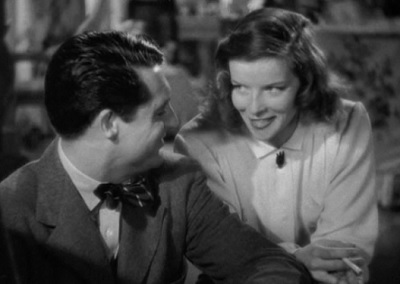
In Johnny’s case, Julia proves to be remarkably dull, and soon is outshone by her supportive sister, Linda (Hepburn). Linda can be quite amusing, though at times she’s a bit melodramatic about the family woes.

GrantandHepburn-Holiday
In Say Anything, we’re stuck with Ione Skye as the romantic interest the whole film, with that terrible acting doing nothing for any of us. When Diane dumps Cusack, all the viewers may protest, but it was a relief not to hear Skye talk for a bit and listen to Lloyd’s friends instead.

Rising Above…
Both Johnny and Lloyd display a remarkable level of emotional maturity—Lloyd, in his continued efforts to unite Diane and her father once they become estranged in spite of the latter’s hostility toward him.

CusackandMahoney
And Johnny, in his attention to his fiancée’s needs and sensitivity to her family despite her father’s rudeness toward him.

GrantandKolker
After asking many not-so-subtle questions about Johnny’s connections, Julia’s father expresses zero interest in her suitor’s obvious resourcefulness, the loss of his mother, and his pride in who he is. Johnny freely discusses his background: his dad’s grocery ownership and debts, an alcoholic uncle, and his own work as a steel mill worker, garbage truck driver, and laundry worker while earning his degree at Harvard. While he isn’t exactly trying to provoke the father’s snobbery, he clearly is amused by it.

“Admirable,” the father says after hearing Johnny’s answers about his life, with no sincerity whatsoever.

“Anything else, sir?” Johnny finally asks.

“I beg your pardon?” the father replies.

“I should think you would,” snaps Linda.

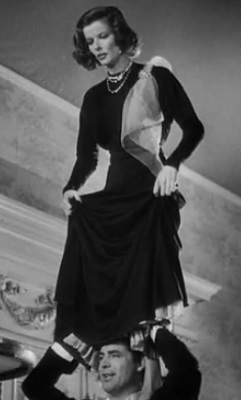
Luckily, fun-loving Linda is the one Johnny will eventually be falling for. If my description doesn’t win you, hopefully this image of the former acrobat (Grant) in action will.

acrobatCaryGrantKatharineHepburn
*When I mentioned this quote on kickboxing, my husband pointed out that Lloyd was one prescient guy given the success of UFC….

Share
Posted in: 1930s films, 1980s films, Comedies (film), Romantic Comedies (film), TV & Pop Culture Tagged: Cary Grant, Holiday, John Cusack, Lloyd Dobler, Say Anything

Recent Posts

  • 100 Years Later, Still Scary: Dr. Caligari
  • Escaping Out of the Past (1947)
  • A Weeper for Those Who Love Jerks
  • Thank You, Academy, for Not Infuriating Me
  • Challengers (2024) Is a Bad Movie

Subscribe to Blog via Email

Enter your email address to subscribe to this blog and receive notifications of new posts by email.

Categories

  • 1920s films
  • 1930s films
  • 1940s films
  • 1950s films
  • 1960s films
  • 1970s films
  • 1980s films
  • 1990-current films
  • 2020s films
  • Action & Sports Films
  • Anti-Romance films
  • Blogathons
  • Childfree
  • Comedies (film)
  • Drama (film)
  • Feminism
  • Femme fatales
  • Film Noir/Crime/Thriller & Mystery
  • Gloriously Silly Scenes
  • Horror
  • Humor
  • Mae West Moments
  • Musicals and dancing films
  • Oscars
  • Random
  • Romance (films)
  • Romantic Comedies (film)
  • The Moment I Fell for
  • Turn My Sister into Classic Movie Fan
  • TV & Pop Culture
  • Uncategorized
Share
Classic Movie Blog Hub Member

Recent Comments

  • leah@carygrantwonteatyou.com on Meg Ryan’s Fate Foretold in Joe Versus the Volcano
  • Ryan on Meg Ryan’s Fate Foretold in Joe Versus the Volcano
  • leah@carygrantwonteatyou.com on 100 Years Later, Still Scary: Dr. Caligari
  • The Classic Movie Muse on 100 Years Later, Still Scary: Dr. Caligari
  • leah@carygrantwonteatyou.com on 100 Years Later, Still Scary: Dr. Caligari

Archives

  • November 2025
  • September 2025
  • May 2025
  • March 2025
  • January 2025
  • November 2024
  • August 2024
  • July 2024
  • May 2024
  • March 2024
  • February 2024
  • December 2023
  • November 2023
  • October 2023
  • September 2023
  • August 2023
  • July 2023
  • May 2023
  • April 2023
  • March 2023
  • January 2023
  • December 2022
  • November 2022
  • September 2022
  • July 2022
  • May 2022
  • April 2022
  • March 2022
  • February 2022
  • October 2021
  • September 2021
  • April 2021
  • March 2021
  • February 2021
  • December 2020
  • October 2020
  • September 2020
  • July 2020
  • May 2020
  • April 2020
  • March 2020
  • February 2020
  • December 2019
  • October 2019
  • September 2019
  • June 2019
  • May 2019
  • April 2019
  • February 2019
  • January 2019
  • November 2018
  • September 2018
  • July 2018
  • June 2018
  • May 2018
  • April 2018
  • March 2018
  • February 2018
  • January 2018
  • November 2017
  • September 2017
  • August 2017
  • July 2017
  • June 2017
  • May 2017
  • April 2017
  • March 2017
  • February 2017
  • January 2017
  • December 2016
  • November 2016
  • October 2016
  • August 2016
  • July 2016
  • June 2016
  • May 2016
  • April 2016
  • March 2016
  • February 2016
  • January 2016
  • December 2015
  • November 2015
  • October 2015
  • September 2015
  • August 2015
  • July 2015
  • June 2015
  • May 2015
  • April 2015
  • March 2015
  • February 2015
  • January 2015
  • December 2014
  • November 2014
  • October 2014
  • September 2014
  • August 2014
  • July 2014
  • June 2014
  • May 2014
  • April 2014
  • March 2014
  • February 2014
  • January 2014

Meta

  • Log in
  • Entries feed
  • Comments feed
  • WordPress.org

Copyright © 2025 Cary Grant Won't Eat You.

Church WordPress Theme by themehall.com