Cary Grant Won't Eat You

Classic movies for phobics

  • About
  • eBooks
  • Previous Blogathons
Classic movies for phobics

Month: July 2014

The Public Enemy*: the Crime Flick with No Glamour?

07/31/2014 by leah@carygrantwonteatyou.com 4 Comments

Having attacked James Cagney in a previous post, but seen few of his films, I thought I owed it to him to watch one of his hits. I found The Public Enemy on a streaming site and rec list (thanks, John!) and was instantly sucked into this understated gem.
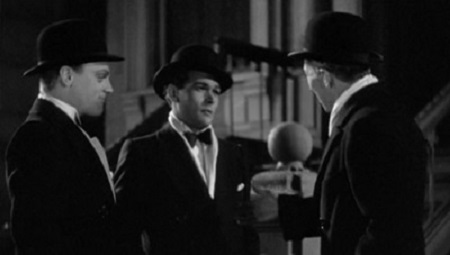
PublicEnemy-full
The hyperbolic title of the film suggests it will glamorize crime, much like films of my generation. (It’s disturbing when I scan through the films produced not long before my birth–Bonnie and Clyde, the Godfather series—and those popular during my childhood and early adulthood— Pulp Fiction, Goodfellas, Natural Born Killers—and find it hard to remember many that didn’t glamorize crime.) The Public Enemy does not glorify crime, despite some contemporary detractors’ claims. Neither, in spite of the PSA-style opening and closing of the film, does it truly condemn it. Instead, in The Wire-like fashion, the film simply shows you the life the main character leads, and lets you decide for yourself whether that life is worth emulating.

James Cagney as Tom

James Cagney as Tom

Tom Powers (James Cagney), the film’s antihero, is a small-time thug, not the leader of the underworld. Even in the glamorous gangster films of today, the small-timers don’t fare well. Tom may be a public enemy, but he’s hardly deserving of a “the.” It’s rare and satisfying to see a film highlight such a character, to show his humble beginnings without a big rise. The plot gives us enough of Depression-era Chicago to explain why crime might have attracted Tom and his buddy Matt (Edward Woods), who move from watch thefts to beer heists. The naturalistic tone of the film is likely due to its Oscar-nominated screenwriters, Kubec Glasmon and John Bright, whose story was supposedly based on real criminals’ accounts.
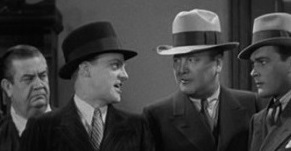
Unsavory alies

Tom’s unsavory allies

Of course, I must admit that the laughter the movie’s famous misogynistic scene produced (spoiler here) and Cagney’s star status as a result of it might have undercut the serious tone of the film, and explain some audience’s admiration for a character as pathetic as Tom. This is, after all, a guy who takes pride in intimidating others as a small-time mobster, and extends that bullying to his romantic relationships with Kitty (Mae Clark) and Gwen (Jean Harlow in an uncharacteristically tone-deaf performance).
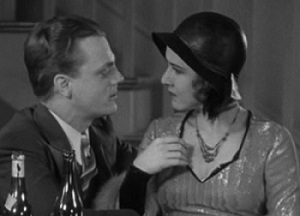
A disturbing fling (with Clark)

An unromantic fling (with Clark)

But Cagney is such a compelling presence that you can’t help but admire Tom just a little. His fiercely controlled energy and easygoing, natural style in spite of (or because of) his outsized personality make Cagney riveting to watch, much like Goodfellas standout Joe Pesci. Tom’s a terrible person, but thanks to Cagney, he’s an entertaining terrible person.
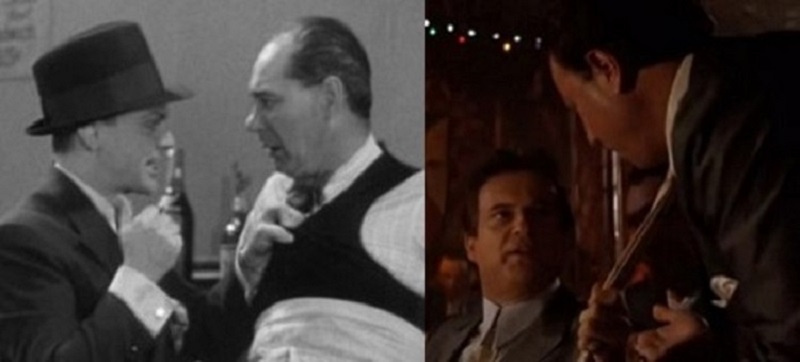
Cagney and Pesci: unkind to necks

Cagney and Pesci: unkind to necks

Even before Cagney shows up on the screen, the kids playing the young versions of him (Frank Coghlan Jr.) and his friend Matt (Frankie Darro) hooked me with their toughness and swagger, bravado that is hopelessly poignant in clothes like these:
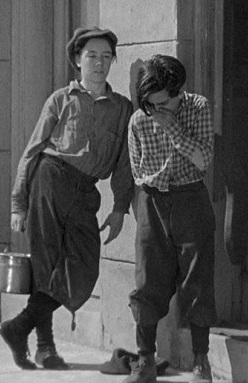
Tom and Matt
Tom and Matt

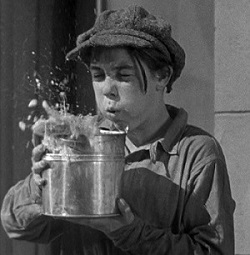
Tom sneaking from the family beer bucket

Tom sneaking from the family beer bucket

Young Matt has a rather exaggerated way of swiping his arm across his nose, which Woods (as adult Matt) adopts to show viewers that the men we’re seeing in 1915, six years after the film’s start, are the same people we’ve been watching.
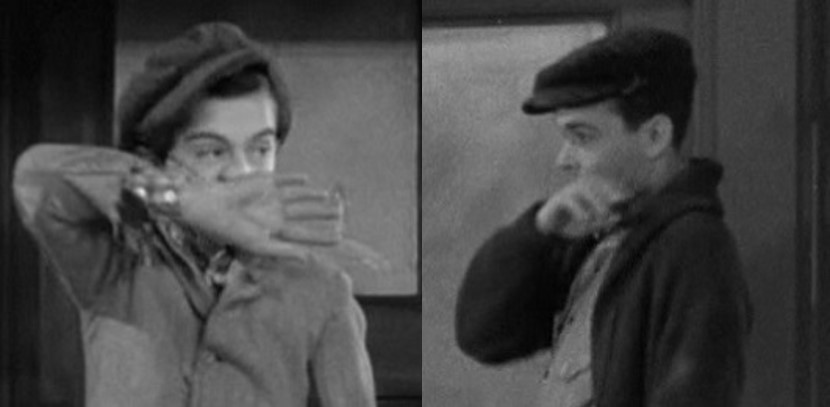
Arm-PublicEnemy
This simple transition is followed by a silent scene in which the adult hoodlums affirm with a guy at the bar that the boss is available through small movements.
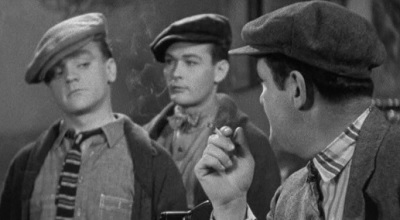
It's all about the gestures: Pacino & Deniro anyone?

It’s all about the gestures: Pacino & De Niro anyone?

The plot is fairly simple too—about friendship and betrayal, allies and enemies, as most mob stories are. But because the narrative is so minimalistic, the revenge is more difficult to watch, and more personal when it comes. We know the characters who end well—and those who don’t. Tom’s coldness is difficult to witness, especially when Matt, who is comparatively softhearted, can’t bring himself to stop his friend’s violence. I won’t spoil what happens, instead hoping you’ll give the film a try. If my review hasn’t convinced you, perhaps the framing of this shot will:
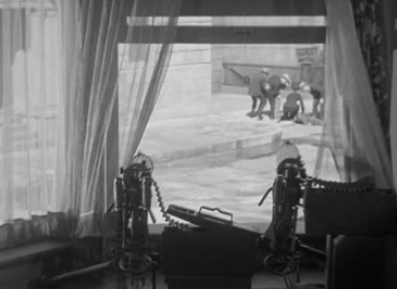
PublicEnemy-framing
*Not to be confused with the Johnny Depp vehicle, which was generous with glamour but frugal with character development.

Share
Posted in: 1930s films, Drama (film), Film Noir/Crime/Thriller & Mystery Tagged: glamour, James Cagney, Joe Pesci, Robert De Niro, The Public Enemy, violence

Help Me Turn My Sister into a Classic Film Fan

07/23/2014 by leah@carygrantwonteatyou.com 12 Comments

I’ve been trying to get my sisters into classic movies for a couple decades now. I have failed utterly. Their objections are:

  • The acting is stagey.
  • Who can get over the black and white?
  • Just as technology has improved, so have the films using it.

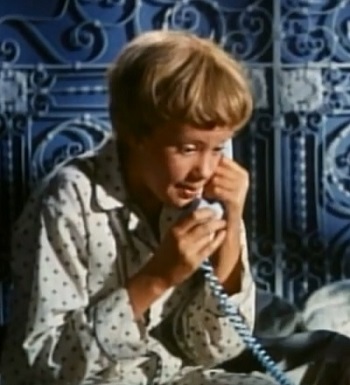
I have to give some share of the blame to my mother, who has a weakness for Hayley Mills Disney flicks and insisted the three of us view them as kids; Pollyanna, That Darn Cat! and The Parent Trap may have done irreparable damage. Mom tried to make up for these deplorable choices with some Shirley Temple movies and The Song of Bernadette, but though these films represented a qualitative improvement, they still didn’t demonstrate any perceptiveness about her children’s likely preferences.*

Hayley is calling for help, as am I.

Hayley is calling for help, as am I.

Some of the blame for my sisters’ hostility toward classic film must go to my father too, as he shares his daughters’ innate sarcasm and should have known to discourage the viewing of such sugary slosh, which would shade their opinion of all classic movies thereafter. (Had I not caught a five-minute clip of Ball of Fire as a teen and been lured into AMC addiction, I might possess my sisters’ baffling convictions myself.)

Luckily, my sister Rachel wants me to watch Breaking Bad so much that she has accepted a trade: I watch the show; she watches 10 classic films.

In terms of time, of course, this is not a fair exchange, as Rachel knows me well enough to predict I’ll be sucked into all five seasons. However, I am desperate enough to go along.

I’m sure you can see what’s at stake here: this is my best chance, possibly my only one in the (hopefully) decades left until I croak. Would anyone who either knows my sister or these films weigh in with advice on or alternatives to my tentative list?

My choices are based on my sister’s love for sports films; interest in the media, crime, and politics; sense of humor; and previous film favorites. Since she hates stagey acting, I’m a little hesitant about melodramas not of the dark variety—Sweet Smell of Success, perhaps; Grand Hotel, not so much. I’m thinking of James Garfield, Barbara Stanwyck, and their ilk for acting style—the more natural, the better. Rachel lists the following as among her favorite movies: The Big Lebowski, Absence of Malice, …And Justice for All, Good Will Hunting, Shawshank Redemption, Office Space, Ordinary People, Il Postino, Some Kind of Wonderful, and The Legend of Billy Jean.

One note: I’m better at predicting her taste in dramas than comedies, as she tends to be annoyed by my love for broad humor. She’s appreciated my Coen brothers and Arrested Development recs, but is disturbed by my appreciation for Judd Apatow.

Here’s my first try, with options (in no particular order):

  1. Scarface (1932) (since a remake, she might be interested)
  2. Ace in the Hole (since she liked The Paper)
  3. Notorious/Shadow of a Doubt (both reminded me of My Cousin Rachel, a Daphne du Maurier book she liked—I don’t think she’d appreciate the du Maurier adaptations)
  4. 3:10 to Yuma (for the Glenn Ford-Van Heflin interchange)
  5. Mr. Smith Goes to Washington (since she’s into politics)
  6. His Girl Friday (she’s seen Switching Channels and likes good dialogue)
  7. It Happened One Night/The Awful Truth/Libeled Lady/The Lady Eve (Which one???)
  8. On the Waterfront (as she likes some of Brando’s admirers)
  9. Hud/Out of the Past (since she likes Paul Newman, and might appreciate the style & looks of Robert Mitchum)
  10. The Third Man (perhaps iffy–I can’t come up with plot objections, but she really hated Citizen Kane and might therefore dislike Orson Welles.)

Films I haven’t seen yet she might like: Body and Soul, M, or possibly a noir such as Kiss Me Deadly or They Live by Night. I worry about any films with bad acting, as that will confirm her prejudice against old films. She couldn’t get past the mysteries’ quality in Psych, so I have no hopes for her with The Thin Man.

Any help you can give me?

*I should admit that Mom may have some odd favorites, but she is willing to read about all of mine; she has been my most loyal blog reader.

Share
Posted in: Humor, Turn My Sister into Classic Movie Fan Tagged: List advice, Reluctant classic film viewers, Sisters

The Moment I Fell for Jean Harlow

07/16/2014 by leah@carygrantwonteatyou.com 8 Comments

Jean Harlow
I’ll admit that I didn’t get the appeal of Jean Harlow initially. I originally saw her in a portion of the film Bombshell, and thought it dull and her annoying. I couldn’t understand why she was a sex symbol, the Marilyn Monroe of the 30s.  It took a lackluster movie in which she was riveting to change my mind.

Red-Headed Woman (1932) is one of those pre-code films in which a loose woman doesn’t pay the penalty for her behavior. Harlow is Lil (also known as Red), a secretary who seduces her married boss, Bill Legendre Jr. (Chester Morris), to make her way up in the world. His wife, Irene (Leila Hyams), is given the tired you-should-have-forgiven-him-instead-of-leaving-him-the-prey-of-that-hussy argument when she divorces him. Usually, this argument infuriates me, but in this case, I had some sympathy for it: Bill is such a sucker that it’s hard not to pity him. How could he succeed in business when he falls so easily for a woman’s wiles? (In today’s corporate world, he’d be bankrupt in a week.)

After the divorce, Lil (Harlow) marries Bill and then trades him in for a richer model, just as she dropped her bootlegger boyfriend at the start of the film to pursue Bill. It’s this single-minded self-interest that makes Lil such a wonderful anti-heroine, and Harlow so good at playing her. The actress is just so hilarious when conveying a conniving mind in action.

The story begins with Lil’s bold plan to go over to Bill’s house in a revealing outfit while his wife is away. She’s pretending to help with his dictation, but obviously planning on sex.

First, she gussies herself up in readiness for her scheme.

Harlowgettingready
Her pal, Sally (Una Merkel), is so convinced the plot will fail that she says she’ll wait outside Bill’s door for Lil; the first sign that Lil’s plans have succeeded is when we see Sally still outside in the dark, uncomfortably rising from her seat.

Lil has many seduction methods at her disposal, all of which she needs, since her boss is in love with his wife. Something about the transparency of her attempts, and lack of any hesitation, cracked me up so much that Harlow had won me just a minute into this routine, long before her Lil got to Bill.

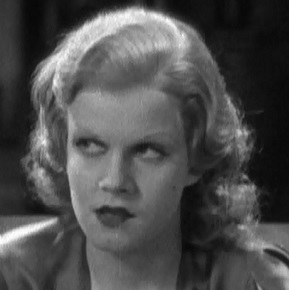
Lil tries some pouting…

Harlowpouting
Shows a little leg….

harlowshowingleg
Sobs a bit…

Harlowfakesobs
Pretends she will take his initial rebuffs in stride…

Harlowandhersap
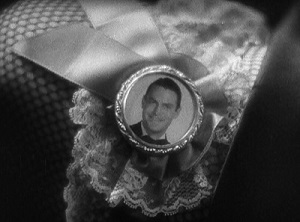
Feigns a longstanding affection for him, even going so far as to pin a photo of him to her garter (Her words when she was planning this ruse: “Well, it’ll get me more there than it will hanging on the wall”).

Harlowleg
Reveals her scheming ways when he’s not looking…

Harlowscheming
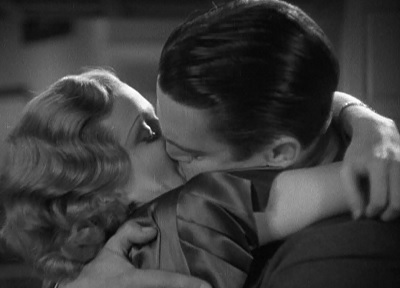
And finally, in just going for the direct approach, gets what she wants:

Harlowsuccess
Throughout the film, Harlow repeats a cycle of the techniques in Lil’s repertoire: baby talk, tears, denials, lies, threats, kisses. The character’s faux sweet veneer is so easily discarded for her brassy, true self; as in other Harlow roles; and it’s so much fun to watch the transition. Who wouldn’t want to see this shift again, and again, and again, especially in much finer films, with better-written parts? (My favorite may be the put-upon fiancée in Libeled Lady—I could watch Harlow marching toward jilter Spencer Tracy in that wedding dress all day long.)

As for the sex symbol status I didn’t understand? Ummm, I don’t know what to say for myself there. It’s about as hard to miss Harlow’s blazing sensuality as this predecessor’s. All you have to do is watch her posing, walking, or smiling for a few minutes, and you understand. There’s a reason Lil is confident she’ll win Bill and every other man she encounters. She just never seems to understand why her irresistibility doesn’t translate into success at the country club, a naiveté Harlow would repeat in other film roles as well–as if other wives would want her anywhere near their husbands.

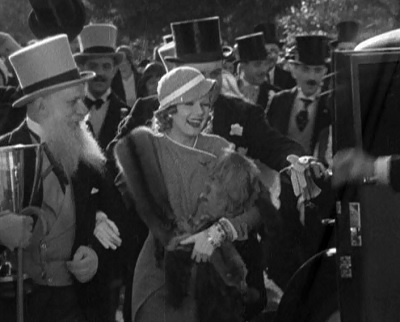
As for Lil, once she decides Bill, the country club, and the town are too small for her, she moves on to richer grounds, ultimately hooking an old French sugar daddy.

Harolwclosefilm
She’s won a trophy for her thoroughbred, is flooded by admirers, and is still holding onto her young lover in full view of her meal ticket at the movie’s close. Of course. How else could this film possibly end?

This is the third in a monthly series of The Moment I Fell for posts…Hope you’ll share some of your favorites!

Share
Posted in: 1930s films, Feminism, Femme fatales, Romantic Comedies (film), The Moment I Fell for Tagged: Jean Harlow

A Strange Mess: Mister Roberts

07/10/2014 by leah@carygrantwonteatyou.com 15 Comments

This is a contribution to the John Ford blogathon sponsored by Christianne Benedict at Krell Laboratories and Bemused and Nonplussed. Check out all the marvelous entries!

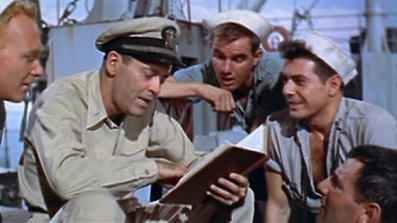
Punching his leading man. Drinking on the set. Quitting the production after being hospitalized. The tales of John Ford’s behavior on Mister Roberts aren’t pretty, and neither is the film. While some of its flaws can be blamed on its having multiple directors, the failures of Mister Roberts are largely a result of Ford’s decisions. The film is a bizarre mishmash of styles, moods, and genres, full of pointless shots and ludicrous acting. The fact that it was a success rather than a flop is likely due to the stellar performances of three of its stars, Henry Fonda, William Powell, and Jack Lemmon; if you love these three actors, as I do, watch the movie. The scenes between the three of them are compelling. If you don’t, avoid it, for the film is not quite bad enough to be camp, but comes awfully close.

Robertsandcrew
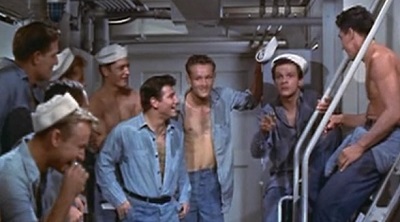
The film is about Roberts’ (Henry Fonda’s) efforts to get into combat in WWII, efforts that are squashed by his cargo ship captain, played by James Cagney. The crew love Roberts for his rebelliousness and his sympathy for their needs. The story is meant to be both moving and comic, but succeeds at neither thanks to Ford’s odd direction. Had I not known that this legend was at the helm, I would have guessed a newbie was having trouble distinguishing between stage and screen. Yes, Mister Roberts was a play, but that doesn’t explain why the crew in the film are practically shouting, or why their hamming reaches such preposterous levels that you have the feeling they’re always gathering to sing a song.

crew2
When they don’t, you feel vaguely uncomfortable, like when a stand-up comedian’s punchline falls flat. What’s even more puzzling is that you can almost see “exit left” printed on the screen because when figures leave the group, the others act as if they’re no longer in earshot. The transitions throughout the film feel forced, with odd shots of ocean and ship that neither advance the narrative, nor contribute to the mood, and the score seems slightly off the entire time.

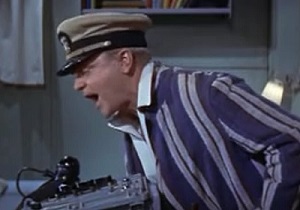
The choice to have James Cagney, who plays the villain of the film, act as if he’s starring in a camp masterpiece was also ill advised. Look, I love my camp. Brainsmasher: A Love Story is one of my favorite movies. But a film doesn’t work when half your cast is taking themselves seriously, and the other acting as if they’re auditioning for a Mystery Science Theater special. Cagney has talent, but you wouldn’t know it from this film. I kept wishing he’d disappear from the screen so that I could stop being embarrassed for him. A character can be ludicrous but still menacing, but Cagney’s bluster in Mister Roberts is merely a caricature of his earlier, meatier roles.

James Cagney as the cruel captain

James Cagney as the cruel captain

And try to forget the depiction of the islanders as soon as you see it. For a moment when I watched them approach the cargo ship in canoes, I thought, Battle!!!

Fordsislanders
I have the feeling that’s what Ford thought too, as it’s one of the few shots that worked in spite of its genre confusion and absurdity. Unfortunately, he moves from there to regular stereotypes:

islanderscloseupFord
Unfortunately, these scenes didn’t have the charms of camp portrayals, such as one of my favorites, the underappreciated parody Joe vs. the Volcano, in which the islanders are all obsessed with orange soda.

Joevsvolcano
But when Fonda is on the screen, you forget how bad Mister Roberts is. Ford made many mistakes, but his stubbornness in demanding Fonda over the studio’s preferences, Marlon Brando and William Holden, almost outweighs all of his poor choices. In a better movie, this performance could have won Fonda the Oscar, just as he won the Tony for it on the stage.

Fonda
He plays Roberts with such understated dignity, humor, and pathos. Watch his easy leadership of the crew, his posture demonstrating how naturally he takes charge. Witness his subtle deflation once he sacrifices his own ambitions for the sake of that crew. I have never seen Fonda so good in anything. How hard it must have been for him, to have the role that meant so much to him undermined by his own director.

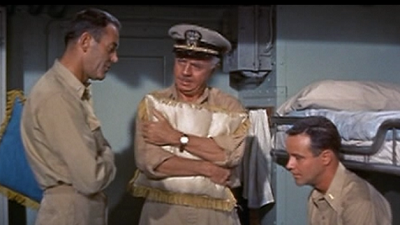
Luckily, there are multiple scenes with Fonda, Lemmon, and Powell.

Henry Fonda, William Powell, and Jack Lemmon

A perfect combination: Henry Fonda, William Powell, and Jack Lemmon

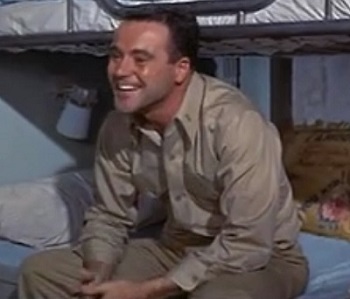
With the crew absent and only a room as background, the three show you what a film this could have been. Lemmon’s performance won him the Oscar. He’s riveting as a cowardly, lazy, sex-crazed ensign who has the potential to be so much more.

Lemmon
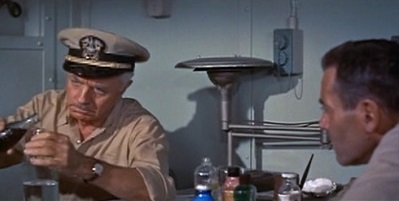
And how do you beat the joy of watching Powell create fake whiskey with utter seriousness, or recount the fake injuries of his crew when they’re avoiding work?

powellandfondawhiskey
As Doc, Powell plays the wise older man with utter perfection. While the film might not have deserved him, it’s truly a wonderful last Hollywood role, and the three have amazing chemistry.

To what extent Ford is to blame for the film’s flaws and not his co-director, Mervyn LeRoy (who was also assisted by Joshua Logan, the play’s cowriter and director), is impossible to exactly determine. But unless he ONLY directed the scenes with Powell, Lemmon, and Fonda, Ford was right to be embarrassed by it.

It’s a good thing he followed it up with one of his masterpieces.

Don’t forget to check out the other John Ford entries in the blogathon!  

Share
Posted in: 1950s films, Action & Sports Films, Blogathons, Comedies (film), Drama (film) Tagged: Henry Fonda, Jack Lemmon, Joe vs. the Volcano, John Ford, Mister Roberts, William Powell

The Film I Re-Watched Despite Missing a Quarter of It: The Major and the Minor (1942)

07/03/2014 by leah@carygrantwonteatyou.com Leave a Comment

MillandRogers
Those born in the age of streaming will never know the excitement of catching a favorite film on TV, running to get a tape on time to record it, and succeeding. With adept timing skills, one could even cut out the commercials. There were a few films I loved so much that I was willing to record them even if I had missed a significant portion of the start; What about Bob? was one of them. (40 minutes of a Bill Murray flick is still 40 minutes of Bill Murray.) But my favorite of those I only partially caught was Billy Wilder’s Hollywood directorial debut, The Major and the Minor. After a decade of watching the film from 25 minutes in due to a tardy discovery of it on TCM, and even tardier taping effort, I finally viewed the whole movie, and discovered it was even more charming than I’d thought.

The film begins when Susan Applegate (Ginger Rogers), fed up with New York, tries to head home to Iowa, only to find the train fare back has increased and she can’t afford it. Faced with the prospect of more skirt chasing and job changing, Susan pretends she’s a kid to get the half-price fare instead.

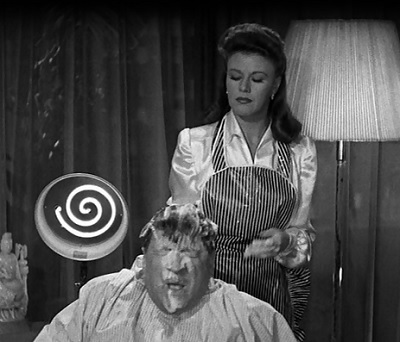
Susan's reaction to client harassment (a part I missed!)

Susan’s reaction to client harassment (a part I missed!)

Since this is a Wilder film, you know her ruse will lead to trouble. The train conductors, suspicious of her maturity, keep trying to catch Susan—asking her birthdate, spying on her reading material, looking her up and down. Finally, they spot her during an inadvisable smoking break. She escapes being thrown off by running into the berth of Major Kirby (Ray Milland), an instructor for a military academy. Kirby believes her kid routine and lets her stay in his other bed, but when the train stops due to bridge trouble, his fiancé, Pamela (Rita Johnson), drives up to see him and catches Susan. More clear-sighted than her husband-to-be, Pamela assumes Susan an adult and heads back to the school to get him fired.

Of course, Kirby beseeches Susan to visit his academy (as Sue Sue, her alter ego) while the train is delayed to prove his innocence, and Susan, moved by his sweetness and guilty at what she’s caused, agrees. So now there’s a woman pretending to be a child at a military school full of boys who might question her age, but have no doubts whatsoever about her attractiveness. You can imagine the kind of scenarios that ensue.

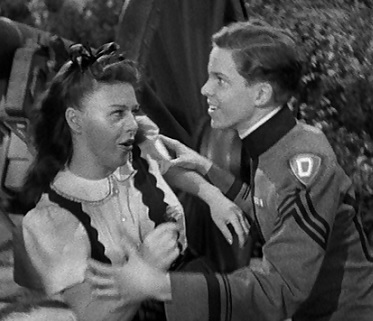
Gingerandtheboys
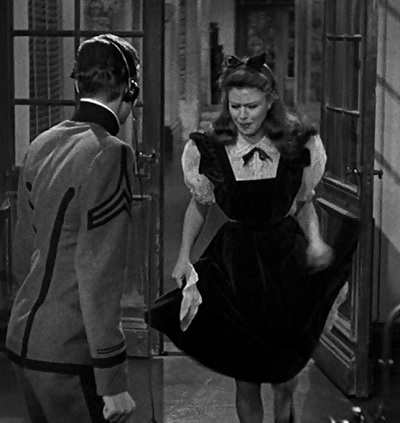
In my favorite moment, Rogers uses her dancing skill to lure a cadet off the phone long enough to assist Kirby’s efforts to get back into active military service, plans Pamela has secretly been trying to derail.

Rogersflirting
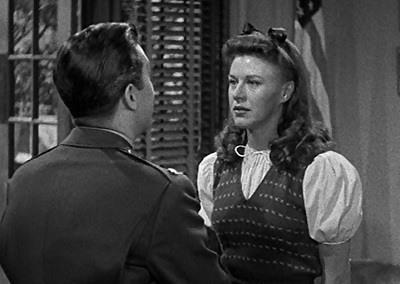
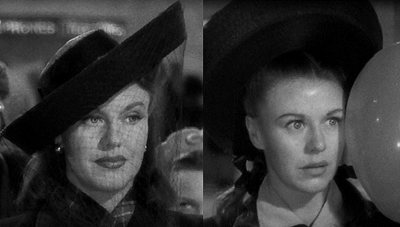
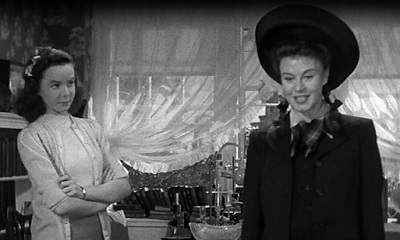
Of course, there are some questions here. Already in her thirties, Rogers looks about as likely to pass for 12 as I would for a toddler. Her childish voice does indeed sound like “Baby Snookums,” as she later admits, making you wonder whether Susan has ever encountered an actual twelve-year-old; that voice has to be a good seven years off. At first, I just considered the choice of Rogers bad casting; a frailer woman with a delicate voice might have pulled off a more convincing pre-adolescent than an actress with such a deep timbre and womanly shape.

Susan (Rogers) at the left; Sue Sue, her 12-year-old attempt, at right

Susan (Rogers) at the left; Sue Sue, her 12-year-old attempt, at right

But like Barbara Stanwyck’s appalling British accent in The Lady Eve, you begin to view Rogers’ very implausibility as part of the humor.

Despite the audience’s likely doubts about this community being so taken in by a woman who does not look or talk like a twelve-year-old, the depiction of their wholesomeness is so consistent throughout the movie that you soon forget your skepticism. This is a community, after all, in which the school administration and Kirby’s fiancée plot to fire him for sleeping in the same berth with a full-grown woman, but react this way to finding out Susan is a child:

Pamelajoyous
Throughout the movie, writers Charles Brackett and Wilder sidestep the scarier possibilities suggested by an older man-kid relationship by making those possibilities beyond the imaginations of people at this school. Therefore, in spite of Milland’s attention to Sue Sue, he never comes across as threatening or creepy, as heroes in other films with similar stories have, such as 1999’s Never Been Kissed. In fact, Milland plays the part of an avuncular type so well that it took about four films more of his work for me to actually recognize that he was attractive at all (this in spite of the great range of his roles, including his Oscar-winning performance as an alcoholic on a binge, Wilder’s The Lost Weekend.)

Predictably, the only one to discover the truth about the imposter’s age is the same age herself: Pamela’s sister, Lucy (Diana Lynn). Lucy is a great character, a budding scientist whose knowledge of human maturation would have made her perceive Sue Sue’s act even if her clothing hadn’t given it away. The two quickly become allies in separating Kirby from the unlikable Pamela.

SueSueandLucy
Once over the shock of Rogers playing a child, you start to realize just how marvelous she is in the role. She’s so convincingly jaded by her New York disappointments, a cynicism that comes out in an impeccable delivery of the screenwriters’ marvelous lines. Her dawning love for Kirby is equally convincing. Just as Rogers is said to have persuaded all of America that Fred Astaire was a sexy catch, so here she persuades us all that there is nothing more lovable than a guy who is trying to help a kid adjust to the pangs of early adolescence.

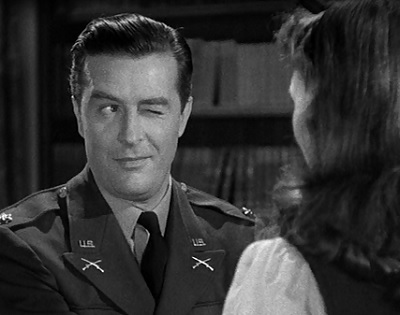
Kirby and his "bum eye" beginning to see something of Susan, not Sue Sue

Kirby and his “bum eye” beginning to see something of Susan, not Sue Sue

I definitely missed a little of the plot by re-watching my taped version of this movie for so many years, but I wasn’t wrong about the film’s quality. Whether watching five minutes or a 100, you’ll enjoy it too.

Share
Posted in: 1940s films, Romantic Comedies (film) Tagged: Ginger Rogers, Never Been Kissed, Ray Milland, The Major and the Minor

Recent Posts

  • 100 Years Later, Still Scary: Dr. Caligari
  • Escaping Out of the Past (1947)
  • A Weeper for Those Who Love Jerks
  • Thank You, Academy, for Not Infuriating Me
  • Challengers (2024) Is a Bad Movie

Subscribe to Blog via Email

Enter your email address to subscribe to this blog and receive notifications of new posts by email.

Categories

  • 1920s films
  • 1930s films
  • 1940s films
  • 1950s films
  • 1960s films
  • 1970s films
  • 1980s films
  • 1990-current films
  • 2020s films
  • Action & Sports Films
  • Anti-Romance films
  • Blogathons
  • Childfree
  • Comedies (film)
  • Drama (film)
  • Feminism
  • Femme fatales
  • Film Noir/Crime/Thriller & Mystery
  • Gloriously Silly Scenes
  • Horror
  • Humor
  • Mae West Moments
  • Musicals and dancing films
  • Oscars
  • Random
  • Romance (films)
  • Romantic Comedies (film)
  • The Moment I Fell for
  • Turn My Sister into Classic Movie Fan
  • TV & Pop Culture
  • Uncategorized
Share
Classic Movie Blog Hub Member

Recent Comments

  • leah@carygrantwonteatyou.com on Meg Ryan’s Fate Foretold in Joe Versus the Volcano
  • Ryan on Meg Ryan’s Fate Foretold in Joe Versus the Volcano
  • leah@carygrantwonteatyou.com on 100 Years Later, Still Scary: Dr. Caligari
  • The Classic Movie Muse on 100 Years Later, Still Scary: Dr. Caligari
  • leah@carygrantwonteatyou.com on 100 Years Later, Still Scary: Dr. Caligari

Archives

  • November 2025
  • September 2025
  • May 2025
  • March 2025
  • January 2025
  • November 2024
  • August 2024
  • July 2024
  • May 2024
  • March 2024
  • February 2024
  • December 2023
  • November 2023
  • October 2023
  • September 2023
  • August 2023
  • July 2023
  • May 2023
  • April 2023
  • March 2023
  • January 2023
  • December 2022
  • November 2022
  • September 2022
  • July 2022
  • May 2022
  • April 2022
  • March 2022
  • February 2022
  • October 2021
  • September 2021
  • April 2021
  • March 2021
  • February 2021
  • December 2020
  • October 2020
  • September 2020
  • July 2020
  • May 2020
  • April 2020
  • March 2020
  • February 2020
  • December 2019
  • October 2019
  • September 2019
  • June 2019
  • May 2019
  • April 2019
  • February 2019
  • January 2019
  • November 2018
  • September 2018
  • July 2018
  • June 2018
  • May 2018
  • April 2018
  • March 2018
  • February 2018
  • January 2018
  • November 2017
  • September 2017
  • August 2017
  • July 2017
  • June 2017
  • May 2017
  • April 2017
  • March 2017
  • February 2017
  • January 2017
  • December 2016
  • November 2016
  • October 2016
  • August 2016
  • July 2016
  • June 2016
  • May 2016
  • April 2016
  • March 2016
  • February 2016
  • January 2016
  • December 2015
  • November 2015
  • October 2015
  • September 2015
  • August 2015
  • July 2015
  • June 2015
  • May 2015
  • April 2015
  • March 2015
  • February 2015
  • January 2015
  • December 2014
  • November 2014
  • October 2014
  • September 2014
  • August 2014
  • July 2014
  • June 2014
  • May 2014
  • April 2014
  • March 2014
  • February 2014
  • January 2014

Meta

  • Log in
  • Entries feed
  • Comments feed
  • WordPress.org

Copyright © 2025 Cary Grant Won't Eat You.

Church WordPress Theme by themehall.com